Generalized Star Height Problem: How OpenAI’s Two-Split Proof Sets a Three-Level Ceiling

Generalized Star Height Problem illustrated by a ribbon sculpture beneath a three-level ceiling.

A regular language can require arbitrarily deep repetition in an ordinary regular expression. Add complement, and OpenAI’s September 25, 2026 manuscript gives every regular language a three-level ceiling. Its answer to the Generalized Star Height Problem is a uniform upper bound over the original alphabet, not a proof that three levels are necessary. Whether one … Read more
Exact Quantum Factoring: How OpenAI’s Fixed-Gate Proof Turns 25% Into Certainty

Sculptural mosaic illustrating exact quantum factoring and engineered certainty.

A factoring algorithm that almost always works is not the same as one that cannot fail. That distinction drives exact quantum factoring, the subject of OpenAI’s September 25, 2026 preprint. Its claimed advance is a polynomial-time-uniform family of quantum circuits that returns the complete prime factorization of every integer at least two with probability exactly … Read more

Permanent vs Determinant Problem: How OpenAI’s Proof Broke the Quadratic Barrier

Permanent vs determinant problem: a coral cubic sculpture breaks a plum square lattice.

Remove the alternating signs from a determinant, and a familiar matrix formula becomes a central challenge in algebraic complexity. OpenAI’s September 24, 2026 paper advances the permanent vs determinant problem by proving a cubic lower bound on the size of determinant representations, even when coefficientwise limits are allowed. The previous unrestricted complex border bound was … Read more

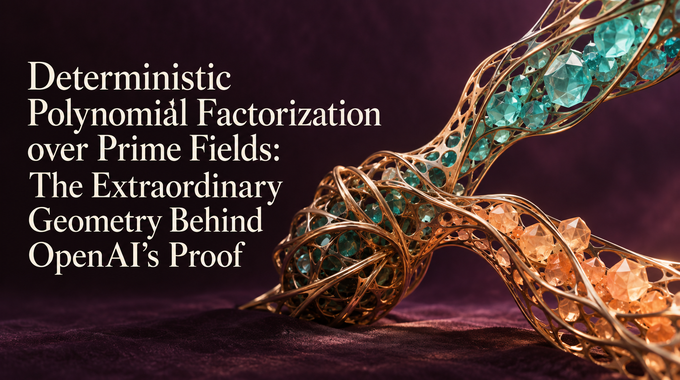
Deterministic Polynomial Factorization over Prime Fields: The Extraordinary Geometry Behind OpenAI’s Proof

Deterministic polynomial factorization over prime fields shown as copper geometry separating crystal strands.

A computer can quickly factor a polynomial by making random choices. Requiring it to make every choice predictably has resisted a comparable guarantee for arbitrary prime fields. OpenAI’s October 4, 2026 manuscript presents a way through that barrier, using geometry to force unknown roots to behave differently. Deterministic polynomial factorization over prime fields means finding … Read more

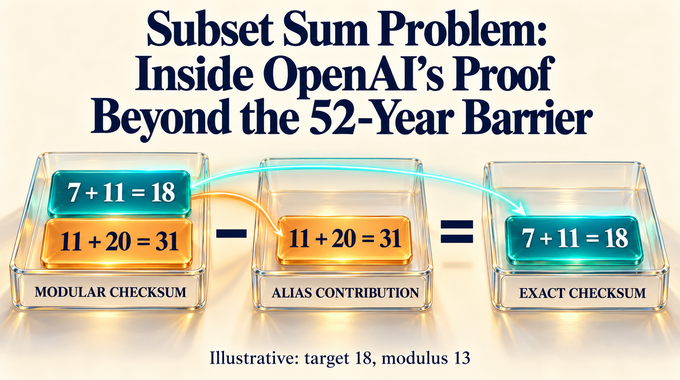
Subset Sum Problem: Inside OpenAI’s Proof Beyond the 52-Year Barrier

Subset sum problem artwork shows a lime path crossing a coral barrier beneath the article title.

For 52 years, the Subset sum problem had a stubborn exponential benchmark: split the inputs in half and search at the 2n/22^{n/2} scale. OpenAI’s October 4, 2026 preprint presents a randomized classical algorithm running in O(20.49n)O(2^{0.49n}) for polynomial-bit inputs in a specified word-RAM model. It promises at least 2/32/3 correctness probability for every fixed input, … Read more

Discrete Fourier Transform Complexity: How OpenAI Cracked the n log n Barrier

Discrete Fourier transform complexity shown as a mint wave passing through a narrow amber barrier.

The Fast Fourier Transform has spent decades turning quadratic calculations into manageable work. OpenAI now presents a proof that discrete Fourier transform complexity can fall below the familiar O(nlog⁡n)O(n\log n) scale, at every input length. The improvement is asymptotic, deterministic, and exact, but it belongs to a computational model with unrestricted complex coefficients and supplied … Read more

Edit Distance Approximation: OpenAI’s Almost-Linear Proof Meets the DNA Reality Check

Edit distance approximation concept: glowing DNA strands crossing a grid with a narrow light path

Comparing two strings sounds like a small job. Then the strings become long, insertions shift everything sideways, and a simple comparison becomes a search through millions of possible alignments. OpenAI’s September 24, 2026 manuscript tackles that cost with an edit distance approximation that combines almost-linear expected runtime with accuracy arbitrarily close to exact, provided the … Read more