Edit Distance Approximation: OpenAI’s Almost-Linear Proof Meets the DNA Reality Check
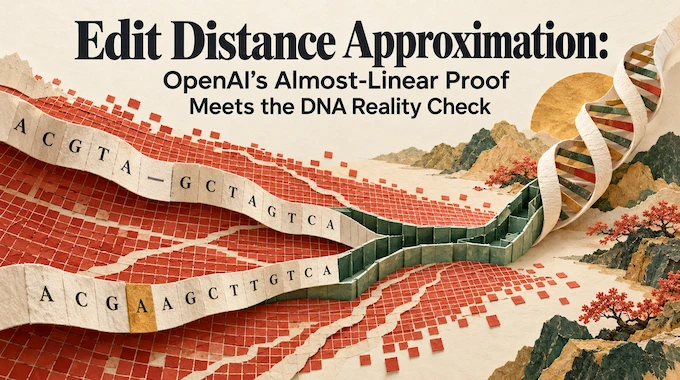
Edit distance approximation concept: glowing DNA strands crossing a grid with a narrow light path

Comparing two strings sounds like a small job. Then the strings become long, insertions shift everything sideways, and a simple comparison becomes a search through millions of possible alignments. OpenAI’s September 24, 2026 manuscript tackles that cost with an edit distance approximation that combines almost-linear expected runtime with accuracy arbitrarily close to exact, provided the … Read more
SynthID Bio: The Invisible Signature Inside AI-Generated Proteins

SynthID Bio watermark glowing inside a 3D AI-designed protein structure

An AI-designed protein can look completely novel. That is the point. But novelty creates a provenance problem: once a model-generated sequence leaves the design tool, how can a synthesis company, database curator, or researcher tell where it came from? Google DeepMind’s answer is SynthID Bio, a family of methods for watermarking AI-generated proteins. Instead of … Read more

Claude Enzyme Discovery: What ART Is, How Claude Found It, and What Isn’t Proven Yet

Cover image illustrating the Claude enzyme discovery of a phage-based reverse transcriptase system

The headline is irresistible: Claude discovers enzyme. The biology is more precise, and more interesting. Anthropic’s Claude enzyme discovery centers on a previously uncharacterized biological system called array-associated reverse transcriptases, or ART. Claude did not pull a brand-new enzyme out of nowhere. The reverse transcriptase itself had relatives that researchers had already encountered. What Claude … Read more

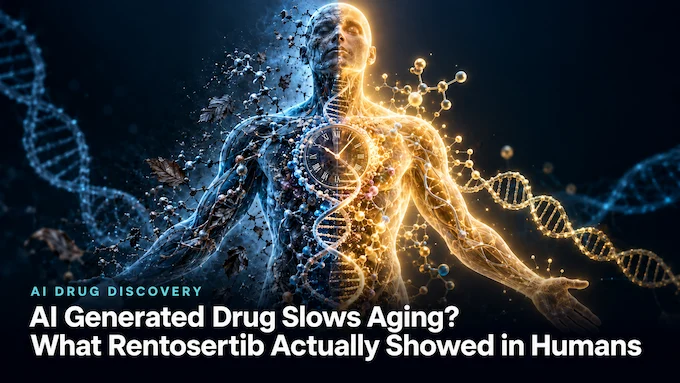
AI Generated Drug Slows Aging? What Rentosertib Actually Showed in Humans

Feature image illustrating how an AI generated drug slows aging in the Rentosertib human trial

The claim that an AI generated drug slows aging sounds like a science-fiction milestone. Rentosertib did not prove that people became younger. In a 12-week Phase 2a trial in idiopathic pulmonary fibrosis (IPF), researchers analyzed serum from a subset of participants using six proteomic aging clocks. Across the treated groups, those models shifted toward younger … Read more

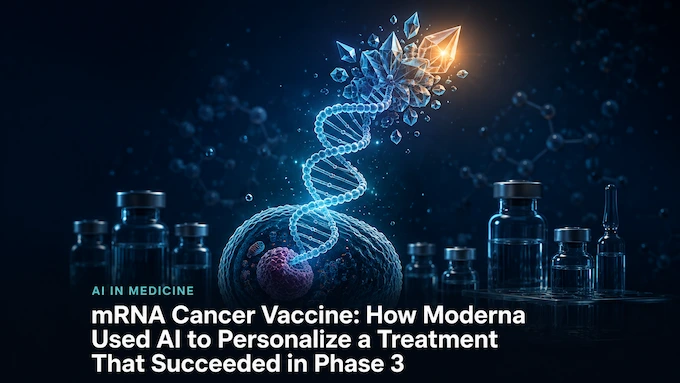
mRNA Cancer Vaccine: How Moderna Used AI to Personalize a Treatment That Succeeded in Phase 3

mRNA cancer vaccine concept showing AI-personalized neoantigen targets emerging from a glowing DNA strand

A personalized mRNA cancer vaccine has just crossed a line cancer researchers have been trying to reach for years. On August 19, 2026, Moderna and Merck announced that intismeran autogene, a made-to-order mRNA treatment combined with Keytruda, met key efficacy endpoints in a large Phase 3 melanoma trial. It reduced the risk of cancer returning … Read more

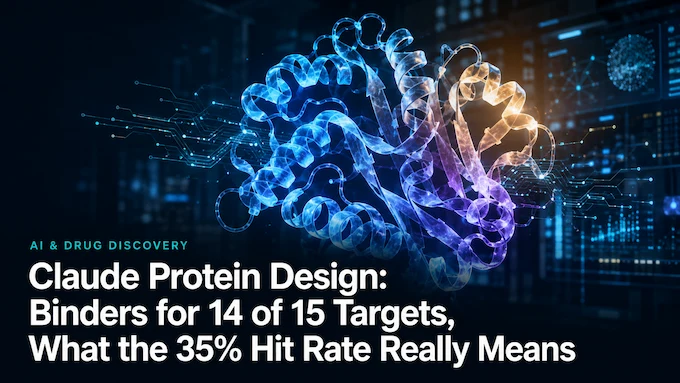
Claude Protein Design: Binders for 14 of 15 Targets, What the 35% Hit Rate Really Means

Claude Protein Design concept image showing an AI-generated protein ribbon structure representing binder discovery

Protein design has spent the last few years becoming dramatically better at generating plausible molecules. Anthropic’s new result asks a different question: can a general-purpose AI agent run the whole campaign, make the design decisions, operate specialist models, and hand scientists a ranked set of proteins that actually bind in the lab? The answer, at … Read more

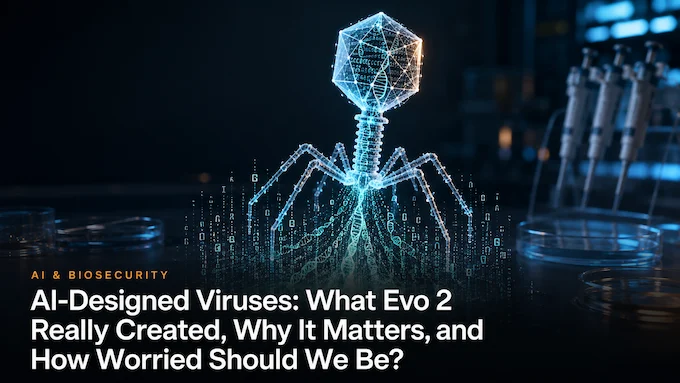
AI-Designed Viruses: What Evo 2 Really Created, Why It Matters, and How Worried Should We Be?

AI-designed viruses concept image showing a bacteriophage built from glowing genetic code

A headline saying that AI can now “create viruses” sounds like the opening scene of a techno-thriller. The real experiment is both less cinematic and more scientifically interesting. Researchers from Stanford University and the Arc Institute used the genome language models Evo 1 and Evo 2 to generate candidate genomes for bacteriophages, viruses that infect … Read more