The claim that an AI generated drug slows aging sounds like a science-fiction milestone.
Rentosertib did not prove that people became younger. In a 12-week Phase 2a trial in idiopathic pulmonary fibrosis (IPF), researchers analyzed serum from a subset of participants using six proteomic aging clocks. Across the treated groups, those models shifted toward younger predicted biological-age profiles. The signal was broad enough to be taken seriously, but the study was exploratory and cannot cleanly separate a true aging effect from changes caused by treating severe lung disease. The paper makes that limitation explicit.
So the useful question is not “did AI reverse aging?” It is: what exactly changed in humans, how strong was the signal, and what would have to happen before anyone could call this biological age reversal?
Table of Contents
1. What Is Rentosertib, And Why Is It Called An AI-Generated Drug?
Rentosertib, formerly INS018_055, is a small-molecule inhibitor of TRAF2- and NCK-interacting kinase (TNIK) being developed by Insilico Medicine. The phrase “AI-generated drug” is shorthand. AI did not replace pharmacologists, chemists, animal studies, manufacturing, or clinical trials.
The development path was closer to this: Insilico used AI-driven target-discovery methods, including PandaOmics, to investigate disease-gene relationships and identify TNIK as a promising target. Generative AI then contributed to molecular design. The resulting candidate still had to pass conventional experimental validation and clinical development. The Nature Biotechnology paper describes rentosertib as an AI-designed TNIK inhibitor and says the program was structured around both aging biology and IPF from the outset.
That matters because the aging analysis was not simply a post-hoc attempt to turn a lung drug into a longevity story. The researchers had already linked TNIK, IPF, and hallmarks of aging in the development strategy.
AI Generated Drug Slows Aging: Rentosertib Study at a Glance
| Study at a Glance | What the Evidence Says |
|---|---|
| Drug | Rentosertib, formerly INS018_055 |
| Developer | Insilico Medicine |
| Target | TNIK |
| Main clinical indication | Idiopathic pulmonary fibrosis |
| Original Phase 2a enrollment | 71 randomized participants |
| Proteomic aging analysis | 42 participants with complete longitudinal samples |
| Duration | 12 weeks |
| Aging measurement | Six protein-based aging clocks |
| Main signal | Treated groups shifted toward younger predicted biological-age profiles |
| Biggest limitation | IPF treatment effects and aging effects cannot be cleanly separated |
This is central to the Insilico Medicine rentosertib story. Specialized AI worked upstream in a conventional drug-development process that later produced measurable human biological signals.
2. What Did The Rentosertib Phase 2a Human Trial Actually Test?
The aging paper reanalyzed samples from a randomized, double-blind, placebo-controlled Phase 2a IPF trial conducted across 21 sites in China. The original trial selected 71 participants, not 42. Of those, 43 consented to serum proteomic screening, and one was excluded because a final measurement was missing. That left 42 people in the longitudinal aging analysis, with a mean age of 67.1 years.
The four randomized regimens were 30 mg once daily, 30 mg twice daily, 60 mg once daily, and placebo. Blood was collected at baseline and at weeks 2, 4, and 12. The aging analysis therefore compared repeated molecular measurements within a small but controlled human dataset.
AI Generated Drug Slows Aging: Rentosertib Phase 2a Trial Groups and Dosing
| Group | Original Randomized N | Proteomic Analysis N | Dosing | Sampling Used for Aging Analysis |
|---|---|---|---|---|
| Placebo | 17 | 11 | Placebo | Baseline, weeks 2, 4, 12 |
| Rentosertib 30 mg QD | 18 | 11 | Once daily | Baseline, weeks 2, 4, 12 |
| Rentosertib 30 mg BID | 18 | 11 | Twice daily | Baseline, weeks 2, 4, 12 |
| Rentosertib 60 mg QD | 18 | 9 | Once daily | Baseline, weeks 2, 4, 12 |
This is why calling it a “42-person trial” is misleading. The clinical trial was larger. Forty-two was the subset with the consent and complete biospecimens needed for this specific proteomic analysis. The paper’s Figure 1 shows the analyzed arms as 11, 11, 9, and 11 participants.
3. What Are Proteomic Aging Clocks, And What Did The Six Clocks Measure?
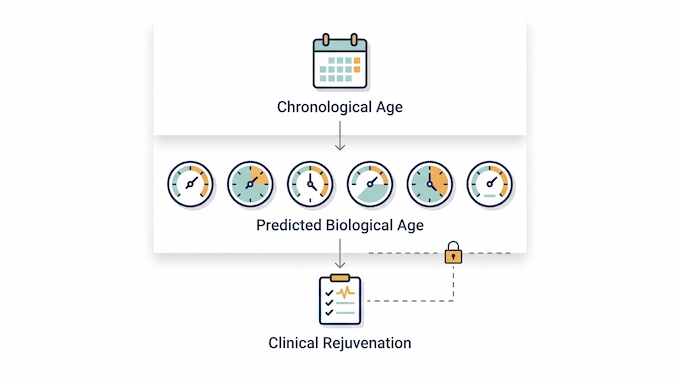
A proteomic aging clock is a machine-learning model that reads patterns in blood proteins and estimates an age-related state. Some clocks are trained to predict chronological age. Others are trained around mortality risk or related outcomes.
This study used six models: ProtAge, OrganAgechrono, OrganAgemortality, PAC, ipfP3GPT, and PAOPAC. Four were chronological-age models, while two were mortality-trained. They also used different machine-learning approaches, which gives cross-clock agreement more value than relying on a single model.
But there is an important correction to the viral framing: six clocks do not mean six independent human trials. They are six computational models applied to essentially the same patient samples.
That leads to three different concepts that should not be collapsed into one:
- Chronological age is how long someone has been alive.
- Predicted biological age is a model output based on molecular patterns associated with aging or risk.
- Clinical rejuvenation would require evidence that meaningful functions, disease risks, or outcomes improve in a way that reflects slower or reversed aging.
The study directly measured the second. It did not demonstrate the third.
4. Did Rentosertib Really Reverse Biological Age?
So where does the phrase AI generated drug slows aging get its scientific basis? This is where the “AI reverse aging” headlines get both their fuel and their problems.
Across all six clocks, treated arms generally moved toward lower predicted biological age relative to baseline, while placebo changed little or drifted slightly older. Researchers made 54 treatment-versus-placebo comparisons across six clocks, three timepoints, and three dosing regimens. Of those, 21 reached Q < 0.10 after false-discovery-rate correction. The signal clustered at week 4, where 11 of 18 comparisons were significant.
The dosing pattern was also interesting. The 30 mg twice-daily regimen produced the broadest cross-clock consistency, with nine significant comparisons. The 60 mg once-daily group produced seven, and the 30 mg once-daily group produced five.
At week 4, the 60 mg once-daily arm showed a predicted change of about −2.71 to −3.46 years across all four chronological clocks, but neither mortality clock showed a significant change. By contrast, 30 mg twice daily registered across both chronological and mortality-trained models.
Those are real model outputs. They are also why search phrases like AI drug reverse aging overstate the result as a scientific summary.
5. Did Patients Really Become Three To Six Years Younger?
No, not in the everyday meaning of the phrase.
A clock estimating that someone’s protein profile looks three years “younger” does not mean three years vanished from that person’s cells, organs, or lifespan. No birthdays were refunded.
The more accurate interpretation is that treatment shifted measured serum proteins in directions that several aging models associate with a younger biological state. That is biological age reversal as a biomarker signal, not proof of whole-body rejuvenation.
The organ-specific results make the point even sharper. Some mortality-based organ clocks reported much larger numerical shifts, including artery estimates in the range of roughly −7 to −17 years. Yet the chronological organ clocks did not show significant shifts at the same threshold.
If one cherry-picked the biggest number, the headline could become spectacular. It would also become less informative. Clock-specific estimates are not interchangeable with years added to life, years removed from chronological age, or demonstrated rejuvenation of every organ.
For readers asking can AI reverse aging, this study gives a serious “maybe there is a measurable pathway here,” not a clinical “yes.” That is why AI generated drug slows aging works only as shorthand for a biomarker result, not as a description of proven rejuvenation.
6. Could Treating Lung Disease Alone Explain The Younger Aging Clocks?
This is the hardest scientific question in the paper.
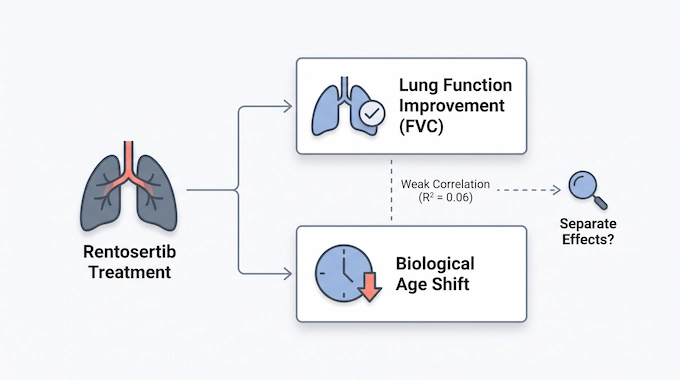
IPF is a severe fibrotic disease that changes inflammation, extracellular-matrix biology, tissue stress, and circulating proteins. If a drug improves the disease, some proteins may naturally move toward a healthier pattern. A proteomic clock could interpret that shift as “younger” even if the drug has no independent effect on aging.
The authors looked for evidence against that simple explanation. The strongest lung-function improvement in the original trial occurred with 60 mg once daily, while the strongest cross-clock aging pattern appeared with 30 mg twice daily. Change in forced vital capacity (FVC) also explained little of the variation in predicted biological-age change, with a median R² of 0.06 across the six clocks.
They also compared treatment-related protein changes with age-associated trajectories from more than 55,000 older adults in UK Biobank. The 30 mg twice-daily regimen showed a negative correlation with normal aging trajectories, meaning its protein shifts tended to run opposite to age-associated changes. Still, the authors call this indirect evidence and say definitive confirmation requires non-IPF populations.
The fair conclusion is narrow: disease improvement probably does not explain the entire signal, but disease confounding has not been eliminated.
7. What Changed In The Blood? TNIK, Senescence, And Aging-Related Proteins
The researchers measured 2,841 proteins and found 326 with treatment-associated expression trajectories at Q < 0.10. The 30 mg twice-daily group again showed the broadest response, including 142 proteins uniquely affected in that arm.
Several shifts fit the drug’s anti-fibrotic role. Proteins linked to fibrosis and extracellular-matrix remodeling, including COL1A1, MMP10, and FAP, decreased. Other affected proteins touched metabolism and stress resistance, including NAMPT, SOD2, and ALDH1A1.
The senescence analysis was also suggestive. Treated groups generally showed protein patterns moving opposite to established senescence signatures, while placebo moved in the other direction. That supports a possible senomorphic effect, meaning modulation of the harmful signals associated with senescent cells rather than proof that senescent cells were removed.
One protein is especially important for interpretation: LTBP2. It is strongly tied to fibrosis and was the only major feature shared across all six clocks in the researchers’ contributor analysis. The paper explicitly says this overlap makes anti-fibrotic and anti-aging effects difficult to separate.
That is the biochemical version of the whole story: intriguing overlap, not clean separation.
8. How Strong Is The Evidence?
The strengths are real. The analysis comes from a randomized placebo-controlled human trial, uses longitudinal samples, compares multiple aging clocks, and applies false-discovery-rate correction.
The limitations are just as important:
- only 9 to 11 analyzed participants per arm
- a 12-week observation period
- aging was an exploratory biomarker analysis, not the main clinical endpoint
- key comparisons used one-sided tests
- the relevant significance threshold was often Q < 0.10
- all six clocks were proteomic models, not independent clinical outcomes
- every analyzed participant had IPF
- the analysis depended heavily on computational interpretation
The authors summarize the problem directly: modest sample size, short duration, computational dependence, and the lack of complementary omics prevented clean separation of anti-fibrotic and anti-aging effects.
That does not make the result meaningless. It tells us what category it belongs in: interesting human biomarker evidence that deserves replication.
9. Is Rentosertib Safe, Approved, Or Available As An Anti-Aging Drug?
Rentosertib remains an investigational drug. It is not an approved anti-aging treatment, and there is no legitimate consumer anti-aging dose or price.
The Phase 2a program can provide short-term safety information in people with IPF at the studied regimens. It cannot tell us whether taking TNIK inhibition for months or years to modify aging would be safe in healthy people. Those are different risk-benefit questions.
The aging analysis itself notes that its findings persisted after excluding six participants with higher-grade adverse events, but that is a robustness check on the biomarker result, not a declaration of long-term safety.
Regulatory framing matters too. The paper argues that near-term aging research would more realistically be embedded in trials for recognized age-related diseases or tested in carefully selected older populations, with aging clocks treated as exploratory biomarkers until validated clinical endpoints exist.
10. Rentosertib Phase 3: What Happens Next?
Rentosertib Phase 3 development is primarily about IPF efficacy and safety. Even a successful Phase III IPF trial would not automatically prove that the drug slows human aging.
For a credible geroprotective claim, the evidence chain needs to become much harder to dismiss:
- replicate the proteomic signal in larger cohorts
- test non-IPF or risk-enriched older populations
- prespecify aging and senescence endpoints
- use complementary biomarkers rather than one molecular layer
- connect biomarker changes to meaningful clinical outcomes
That sequence closely matches the framework proposed by the researchers themselves. They describe the current work as a first stage, followed by replication outside IPF and eventually biomarker qualification or composite clinical endpoints that can establish geroprotection.
Until that chain is complete, AI generated drug slows aging remains a provocative summary rather than an established clinical claim. This is where the story becomes bigger than rentosertib. If aging biomarkers can be built into ordinary disease trials from the beginning, researchers may spot geroprotective effects years earlier than they would under the traditional “develop first, repurpose later” model.
11. So, Did An AI Generated Drug Slow Aging? The Evidence-Based Verdict
The cleanest answer to “AI generated drug slows aging” is: possibly at the biomarker level, not yet in the clinical sense most readers mean by slowing or reversing aging.
What is established is that rentosertib changed serum protein patterns in a younger direction across multiple proteomic aging clocks. The strongest consistency appeared around week 4, particularly with 30 mg twice daily, and the molecular analysis found changes involving fibrosis, metabolism, stress resistance, and senescence-associated pathways.
What is plausible is that TNIK inhibition may influence biology beyond pulmonary fibrosis. The mismatch between the best lung-function dose and the broadest aging-clock dose makes that possibility more interesting.
What is not established is just as important. Rentosertib has not been shown to extend lifespan, rejuvenate healthy people, reverse chronological age, or make every organ biologically younger. The paper’s central caveat remains intact: proteomic clocks alone cannot fully separate aging-specific effects from disease-specific effects.
That makes this a better story than “AI found the fountain of youth.” It is an early example of AI-assisted drug discovery colliding with human aging measurement in a real randomized trial, with enough signal to justify the next experiment and nowhere near enough evidence to skip it.
Follow Binary Verse AI for evidence-first breakdowns of AI drug discovery, biomedical AI, and the research claims that deserve more than a headline.
1. Can AI reverse aging?
No AI system or AI-designed drug has been proven to reverse human aging. Rentosertib is interesting because AI-assisted drug discovery produced a molecule whose treatment was associated with younger predictions from six proteomic aging clocks in human trial samples. Those biomarker changes are not equivalent to demonstrating that aging itself was reversed.
This directly targets Google’s PAA “Can we reverse aging with AI?” and your live data’s “can AI reverse aging”, which has low SD 5.
2. Is there a drug that can reverse aging?
No drug is currently approved or clinically proven to reverse human aging itself. Several drugs are being studied for effects on aging biology, but rentosertib remains an investigational IPF drug. Its recent study found changes in biological-age biomarkers rather than demonstrated reversal of whole-body aging.
3. Did rentosertib actually make patients three to six years younger?
No. The “years younger” figures are predictions from biological-aging models, not literal reductions in chronological age. For example, four chronological proteomic clocks estimated roughly 2.7–3.5 years lower biological age for one regimen at week four. Different clocks, doses and timepoints produced different estimates, so there is no single proven “years younger” effect.
4. Could rentosertib’s apparent anti-aging effect simply come from treating pulmonary fibrosis?
Possibly, and this is the study’s biggest unresolved question. Improving IPF can make disease-related proteins look healthier and potentially younger to a proteomic clock. However, lung-function improvement explained relatively little of the observed biological-age variation, and the dose with the strongest aging-clock signal differed from the dose with the strongest lung-function result. The study therefore suggests—but does not prove—that some effects may extend beyond fibrosis.
5. Is rentosertib FDA-approved for anti-aging use?
No. Rentosertib is an investigational drug being developed for idiopathic pulmonary fibrosis, not an approved anti-aging therapy. Its aging findings are exploratory biomarker results. Demonstrating a geroprotective treatment would require additional studies, including populations without IPF and clinically meaningful aging-related endpoints.