Protein design has spent the last few years becoming dramatically better at generating plausible molecules. Anthropic’s new result asks a different question: can a general-purpose AI agent run the whole campaign, make the design decisions, operate specialist models, and hand scientists a ranked set of proteins that actually bind in the lab?
The answer, at least for this experiment, is surprisingly strong. In the Claude Protein Design study released on August 18, 2026, Claude Opus 4.8 and Mythos Preview ran autonomous de novo protein-binder campaigns. After one target was excluded because its assay was uninterpretable, Claude produced at least one confirmed binder for 14 of 15 targets. Across 1,320 designs with reliable measurements, 354 bound, about a 27% overall hit rate. Mythos Preview reached 35.1% when it focused on one target per campaign.
That is meaningful, but easy to oversell. Claude did not discover 354 drugs, replace the wet lab, or prove that an LLM is better than expert protein engineers. The more interesting result is that an AI agent coordinated a difficult, multi-stage scientific workflow with unusually little human intervention.
Table of Contents
1. Claude Protein Design In 60 Seconds
The headline numbers describe different things, and mixing their denominators creates most of the confusion around this result.
Claude Protein Design: Key Results and Hit Rates
| Metric | Result | What It Actually Means |
|---|---|---|
| Targets with interpretable assays | 15 | One of 16 targets was excluded because mature GDF-8 aggregated under assay conditions. |
| Targets with at least one binder | 14/15 | Claude achieved target-level success on 14 evaluable targets. |
| Confirmed binders | 354/1,320 | 354 individual protein designs met the integrated binding criteria. |
| Overall design-level hit rate | ~27% | Roughly one in four tested designs bound. |
| Mythos Preview, single-target mode | 35.1% | 158 of 450 designs bound in dedicated 24-hour campaigns. |
| Mythos Preview, multi-target mode | 26.7% | 104 of 390 designs bound. |
| Opus 4.8, multi-target mode | 22.6% | 88 of 390 designs bound. |
| Rank-1 designs | 49% bound | Nearly half of the designs Claude ranked first for a target and campaign worked. |
The technical report is careful about this distinction. Fourteen out of fifteen is target coverage, while 354 out of 1,320 is design-level success. The report also says performance varied much more by target than by campaign, ranging from 72 binders out of 90 designs on TREM2 to zero out of 90 on maltose-binding protein (MBP).
So the useful summary is not “Claude has a 35% chance of designing a protein.” It is that a dedicated Mythos Preview workflow reached a 35.1% aggregate hit rate across its single-target campaigns, while individual targets remained much easier or harder than that average suggests.
2. What Is A Protein Binder, And What Does De Novo Mean?
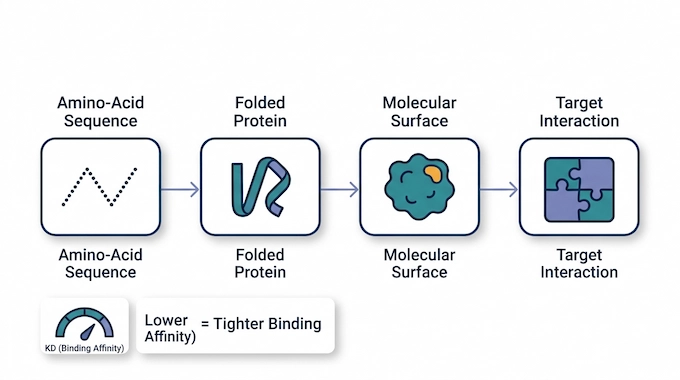
A protein binder is a protein designed or evolved to attach to another molecule, usually at a particular surface on a target protein. The strength of that interaction is described by affinity, commonly reported using the equilibrium dissociation constant, or KD. Lower KD values generally mean tighter binding.
For a non-biologist, the workflow can be reduced to:
amino-acid sequence → folded protein → molecular surface → target interaction
In de novo protein binder design, researchers are not simply looking up a natural protein that already performs the job. They are trying to create a new sequence that should fold into a useful structure and present the right shape and chemistry to bind the chosen target.
Claude protein binder design therefore goes beyond ordinary structure prediction. The campaign had to decide where to bind, generate structures and sequences, predict complexes, filter and optimize candidates, then select designs for synthesis.
A hit rate is the fraction of tested designs that experimentally bind. It does not tell us whether those binders are useful medicines.
3. How Claude Science Ran The Protein Design Campaign
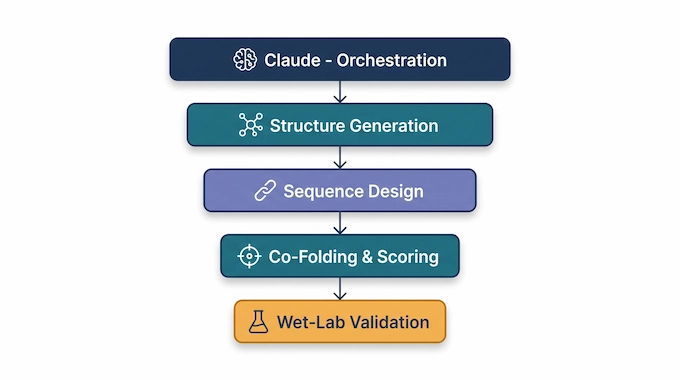
Claude acted as the orchestrator, not as a magical all-in-one molecular simulator. The campaigns ran inside Claude Science and used specialist open-source protein-design and structure-prediction tools. The protocol left target-specific epitope, scaffold, sequence, optimization, and final ranking decisions to Claude.
Claude Protein Design Workflow: Tools and Roles in the Study
| Workflow Layer | Main Job | Examples Used in the Study |
|---|---|---|
| Claude | Research the target, choose strategy, coordinate tools, filter, optimize, and rank. | Opus 4.8, Mythos Preview |
| Structure generation | Propose candidate protein backbones or complexes. | PXDesign, RFdiffusion3, Genie 3, FreeBindCraft, BindCraft-derived workflows |
| Sequence design | Choose amino acids for candidate structures. | SolubleMPNN, ProteinMPNN, SolubleCaliby |
| Co-folding and scoring | Predict target-binder complexes and rank confidence. | ESMFold2, ESMFold2-Fast, Protenix v2 |
| Wet-lab validation | Produce proteins and measure binding. | Adaptyv Bio, Twist Bioscience |
The resulting AI protein design workflow looked roughly like this: Claude researched target biology and available structures, selected target regions and epitopes, chose design methods, generated structures, designed sequences, screened for novelty and problematic composition, scored predicted complexes, ran additional in silico optimization, and returned 30 ranked designs per target. The ordered designs were synthesized without being rewritten by a human designer.
The contribution is orchestration. Specialist generators and sequence designers already existed. Anthropic protein design tests whether a reasoning agent can connect them into a working campaign.
Open source also does not mean lightweight. The report describes a $10,000 cloud-GPU budget for a 24-hour single-target campaign and $50,000 for a 48-hour multi-target campaign. This is not a laptop demo.
4. How Autonomous Was Claude Really?
This is where both the hype and the skeptical dismissal miss something.
Humans did substantial setup work. They selected targets, wrote the protocol, supplied a reference corpus, provided cloud compute and tool access, placed synthesis orders, and interpreted the final binding data. The central protocol was about 16,000 words, effectively packaging a large amount of expert campaign knowledge into Claude’s context.
But the protocol did not specify a target-specific epitope, scaffold, or sequence. Once a campaign started, Claude researched the target, chose the target region, picked methods, generated and optimized candidates, filtered them, and ranked the final designs. The operator mostly watched infrastructure and approved access requests that carried no scientific content.
So this was not “Claude inventing proteins from a blank prompt,” but it was not a protein engineer making the scientific choices while Claude clicked buttons either.
A better description is protocol-bounded scientific autonomy. Experts defined the playbook and resources. Claude made the campaign-level decisions inside it. The reusable asset may be the combination of agent, protocol, tools, and verification, not the language model alone.
5. What Does The 35.1% Protein Binder Hit Rate Actually Mean?
The 35.1% figure came from Mythos Preview in single-target mode: 158 binders from 450 tested designs. In the multi-target setting, Mythos Preview reached 26.7% and Opus 4.8 reached 22.6%.
It is tempting to read that as evidence that “focused Claude” is simply much better. The paper is more cautious. Single-target campaigns had a dedicated 24-hour run and about 2.8 times the per-target compute budget, so the experiment cannot cleanly separate the effect of focus from the effect of extra compute.
The protein binder hit rate also hides large differences in quality. Of the 354 binders, 194 had reported KD values below 100 nM, 90 below 10 nM, and 42 below 1 nM. Those are substantial results, but the study also includes much weaker binders and apparent affinities for oligomeric targets where avidity can contribute to the measurement.
Most importantly, binding is not function. A 35.1% hit rate does not mean a 35.1% chance of making a therapy. It means that under this assay and campaign setup, just over a third of the tested designs in those dedicated Mythos campaigns showed binding.
6. Did Claude Really Beat Human Protein Designers?
The clean answer is: Claude produced highly competitive campaign results, but this study does not establish that Claude is twice as good as human protein designers.
Anthropic compares its roughly 22% to 35% campaign hit rates with 10% to 15% described as typical in current de novo protein-design campaigns. That is not the same as running matched human experts and Claude on identical targets, tools, compute, and time budgets. The technical report explicitly says no matched human-expert campaign was run and does not claim Claude would outperform an expert using the same resources.
The strongest concrete comparison is RBX1. In a prior open competition, 9 of 245 de novo entries bound. Across Claude’s campaigns, 28 of 90 RBX1 designs bound. Anthropic also re-synthesized the competition winner and tested it on the same plate. Claude’s top-ranked Mythos Preview single-target design measured 3.9 nM on that plate, compared with 45 nM for the competition winner.
That is impressive, but still not a clean “AI versus humans” contest. Competition formats and budgets differed, and results from several prior competitions were in Claude’s reading material. The narrower claim is stronger: an autonomous agent achieved competitive performance in a modern de novo protein binder design workflow.
7. The Wet-Lab Validation Is The Part That Makes This Matter
Plenty of AI-for-science results stop at another model’s score. This one did not.
Adaptyv Bio and Twist Bioscience independently produced and tested the delivered sequences. The organizations used different experimental formats, and the report describes blinded handling of model, campaign, and rank information. The mature GDF-8 target was excluded because both CROs found its assay behavior uninterpretable, which is exactly the kind of messy experimental reality a purely computational benchmark would miss.
That validation supports a strong claim: the study demonstrated physical binding for hundreds of designed proteins.
It does not support several stronger claims. No designed complex was solved experimentally, so every structural pose shown in the report remains a prediction. No design was tested for biological activity in this study. The authors call this the chief limitation: the evidence is for binding, not structure or function.
The designs also appear novel at the sequence level. A Protein Data Bank search found that 1,285 of 1,315 tested designs, about 98%, had no chain aligning at 30% sequence identity or higher. That argues against simple copying, but cannot prove Claude had never encountered related strategies or literature during training.
8. Where Claude Protein Design Failed
The failures are arguably more useful than another victory lap.
Against BBF-14, only three of 90 designs bound, with modest affinities. Against MBP, none of Claude’s 90 designs met the integrated binder criteria, even though a known control binder worked in the assay.
The deeper problem is that Claude’s computational confidence did not clearly warn it that those campaigns had failed. Designs for MBP, BBF-14, and 15-PGDH received co-folding scores only slightly below those of much more productive targets. Among confirmed binders, higher computational scores were also only weakly related to tighter affinity.
That gives the experiment a useful boundary: Claude could make valuable rankings, but it could not reliably know whether a target campaign had succeeded before testing.
AI protein binder design has not escaped the wet lab. Better agents may reduce screening, but the final reality check still comes from experiments.
9. What Is Actually New About Anthropic Protein Design?
AI protein design itself is not new. Models already existed for structure generation, sequence design, co-folding, and candidate ranking. The report openly builds on that ecosystem.
The novelty is the level of end-to-end agency. Claude chose and operated tools, managed compute and sub-agents, adapted its strategy, checked intermediate results, optimized candidates, and made the final selection across long-running campaigns. The paper’s own framing is not that Claude replaces specialized protein models, but that it can supply a meaningful share of the expertise and labor needed to coordinate them.
That lesson travels beyond biology. Many technical workflows are blocked less by the absence of one brilliant model than by orchestration: choosing methods, setting up software, allocating compute, checking outputs, and deciding what to try next. Claude Science behaved less like a chatbot here and more like a computational research operator.
10. From Protein Binder To Drug: What Claude Has Not Solved
A successful binder is an early scientific result, not a finished medicine.
For drug discovery, a promising binder still has to clear harder gates: biological function, target modulation, selectivity, expression, stability, manufacturability, pharmacokinetics, tissue exposure, immunogenicity, toxicity, and efficacy in cells, animals, and eventually humans.
The current Claude Protein Design study does not answer those questions. Its strongest evidence is experimental binding, and the report explicitly says no design was tested for activity.
That does not make the work irrelevant to pharma. Quite the opposite. Early discovery contains expensive search and triage problems. If an autonomous agent can turn a target into a higher-quality shortlist of experimentally testable candidates in one or two days, researchers may be able to explore more targets, compare more design strategies, and spend wet-lab capacity on better-ranked molecules.
Designed binders can also become research reagents, assay components, sensors, or starting points for diagnostics. But the paper validates binding, not a finished product.
The pharmaceutical interpretation is modest but consequential: Claude may help compress one early bottleneck in molecular discovery, not the whole path from target to approved drug.
11. Claude Protein Design Is A Workflow Breakthrough, Not A Miracle-Drug Story
The most important result is not the 35.1% number in isolation. It is that a general-purpose AI agent, operating from a detailed expert protocol, could coordinate open-source design tools, make target-specific decisions, rank candidates, and deliver sequences that survived independent physical testing across 14 of 15 evaluable targets.
The caveats matter just as much. Performance varied wildly by target. Extra compute is entangled with the best hit rate. There was no matched human-expert control. Predicted confidence could not reliably identify failed target campaigns. And a binder is still many steps away from a drug.
That balance is what makes Claude Protein Design worth watching. The experiment points toward a future where AI agents do more than explain science or write code around scientific tools. They may increasingly run substantial parts of the computational research loop, while humans define the protocol, inspect the evidence, and decide what deserves real-world testing.
For more research-grounded breakdowns of frontier AI papers, benchmarks, and what the headline numbers actually mean, follow Binary Verse AI.
1. What is Claude Science for?
Explain that Claude Science is Anthropic’s scientific workbench for combining reasoning, scientific tools, compute and workflows; the protein-design campaigns were conducted through this environment. Anthropic describes it as a customizable scientific workbench rather than a protein-design model itself.
2. Can Claude actually design proteins
Yes, with an important qualification. In Anthropic’s experiment, Claude autonomously made target-specific design decisions and orchestrated specialized protein-design models; experimentally tested binders were obtained against 14 of 15 targets.
3. What does a 35.1% protein-design hit rate mean?
It means that in Mythos Preview’s single-target setup, 35.1% of the tested candidate designs were experimentally classified as binders. It does not mean 35.1% became drugs or worked therapeutically.
4. Did Claude design proteins better than human scientists?
The study shows results that were competitive with or better than several published/competition benchmarks, but calling Claude universally “better than human protein designers” is not supported. The often-cited 10–15% comparison is a typical campaign hit rate, not a controlled measure of average human ability.
5. Can Claude-designed protein binders become drugs?
Potentially some designed binders or derivatives could contribute to future therapeutic programs, but binding is only an early step. The study did not demonstrate clinical efficacy, safety or a finished drug.