
For decades, mathematicians have studied a deceptively simple question about nonlinear waves: when a wave keeps focusing, must it collapse in finite time, or can it keep concentrating forever without quite reaching a singularity?
A new paper by mathematician Leonard Dinh, developed with Meta’s Muse Spark, settles one version of that question for a specific Nonlinear Schrödinger Equation. The result concerns the focusing, homogeneous, mass-critical biharmonic nonlinear Schrödinger equation, where every radial negative-energy solution in the stated (H^2) setting must blow up in finite time, both forward and backward. The paper says this removes an unresolved “infinite-time grow-up” possibility left open by earlier work.
That is a real mathematical result, but it needs careful framing. Meta did not “solve the Schrödinger equation,” and Muse Spark did not independently replace a mathematician. The interesting story is narrower and more useful: AI participated in exploring, developing, and drafting a proof strategy for an open research problem, while researchers guided the work, checked the mathematics, and took responsibility for the final manuscript.
Table of Contents
1. What Is the Nonlinear Schrödinger Equation?
The ordinary Schrödinger equation familiar from quantum mechanics is linear. A Nonlinear Schrödinger Equation, usually shortened to NLS, adds a nonlinear term whose strength depends on the wave itself. In broad terms, the equation describes a contest between two effects.
Dispersion wants to spread a wave out. Nonlinearity can push the other way, causing the wave to focus or change shape as its amplitude grows. Depending on the model and initial conditions, that competition can produce stable structures, scattering, self-focusing, or blow-up.
A common schematic form is:
[ i\partial_t u + \Delta u + F(u)=0 ]
Here, (u) is the evolving wave field, (\Delta) represents spatial dispersion, and (F(u)) is the nonlinear interaction. The exact signs and powers matter enormously, which is why “the NLS” is really a family of equations rather than one universal formula.
Nonlinear Schrödinger Equation: Key Facts Behind the Finite-Time Blow-Up Result
This distinction matters for searchers looking for “nonlinear Schrödinger equation blow up.” Blow-up is not a generic fate of every NLS solution. It depends on the exact equation, dimension, sign of the nonlinearity, initial data, conserved quantities, and symmetry assumptions.
2. Why This Is Not the Textbook Quantum Schrödinger Equation
One of the easiest ways to misunderstand this result is to hear “Schrödinger equation” and assume Meta has rewritten quantum mechanics.
It has not.
The standard quantum Schrödinger equation is linear, which means superpositions of solutions remain solutions. A nonlinear Schrödinger model introduces amplitude-dependent interactions. Depending on the application, (u) may represent an optical field, a condensate wave, or another effective wave envelope rather than the probability amplitude of a single quantum particle.
The new paper goes one step further. It studies a biharmonic nonlinear Schrödinger equation, where the usual second-order spatial dispersion is replaced by a fourth-order operator, (\Delta^2). The authors describe this as a higher-order dispersive correction that has roots in models of intense laser beams propagating through Kerr media.
Nonlinear Schrödinger Equation Models: Linear, Standard NLS, and Biharmonic NLS Compared
So when people ask, “How can the Schrödinger equation be nonlinear if quantum mechanics is linear?”, the answer is that these are related mathematical structures used in different physical and mathematical settings. “Nonlinear Schrödinger equation” is a name for a broader class of nonlinear wave equations, not a claim that basic quantum mechanics has suddenly become nonlinear.
3. Where Is the Nonlinear Schrödinger Equation Used?
Nonlinear Schrödinger equation applications span several areas of wave physics. Variants appear in nonlinear optics, laser propagation, optical fibers, Bose-Einstein condensates through the Gross-Pitaevskii framework, water-wave models, plasma physics, and other dispersive systems.
The common theme is an evolving wave whose spreading interacts with a nonlinear response.
That also explains why mathematicians care about the edge cases. If dispersion dominates, a localized wave can spread. If focusing becomes strong enough, energy or amplitude can concentrate. The biharmonic model sharpens that competition by changing the dispersive operator from second order to fourth order.
The paper’s physical motivation should not be overstated. Its theorem is a rigorous statement about a mathematical PDE under specific assumptions. It is not a prediction that a real laser beam must literally reach infinite intensity.
4. Solitons, Self-Focusing, and Blow-Up Are Different Behaviors
A nonlinear Schrödinger equation soliton is a localized wave structure that maintains its form because dispersive spreading and nonlinear focusing balance each other. Solitons are one of the reasons NLS models are so famous.
Self-focusing is different. Here, nonlinear effects cause the wave to concentrate more strongly. That concentration can remain controlled, or it can head toward a singular regime.
Then there is blow-up. In PDE language, blow-up means that some mathematical quantity used to measure the solution becomes unbounded in finite time. In the Dinh and Muse Spark paper, the relevant (H^2) norm diverges as the maximal existence time is approached. The theorem states that this happens in both time directions for the specified class of radial negative-energy solutions.
This is not the same thing as quantum “wavefunction collapse.” The shared word “collapse” can be misleading. Here, the issue is singularity formation in a nonlinear evolution equation.
5. What “Finite-Time Blow-Up” Actually Means
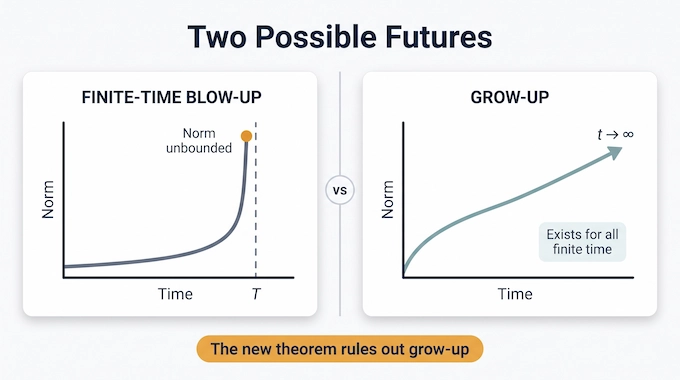
Suppose a model predicts that a measure of curvature, concentration, or derivative size keeps increasing. Two logically different futures are possible.
The first is finite-time blow-up. There is some finite time (T) beyond which the regular solution cannot be continued because its mathematical norm becomes unbounded.
The second is sometimes called grow-up. The solution exists for every finite time, but a norm becomes larger and larger as (t) tends to infinity.
That distinction was the heart of this problem. Earlier work by Boulenger and Lenzmann showed that radial negative-energy solutions in the homogeneous mass-critical setting must either blow up in finite time or remain global while growing without bound. Their method did not eliminate the second branch. The new theorem does.
For a physical reader, “infinite” should be treated as a warning sign about the model, not necessarily a literal claim about nature. Real systems can introduce losses, saturation, higher-order effects, finite resolution, or other physics before a formal mathematical singularity is reached.
6. What “Focusing,” “Mass-Critical,” “Radial,” and “Negative Energy” Mean
The theorem sounds sweeping until its conditions are unpacked. Each word narrows the claim.
Focusing means the nonlinear term encourages concentration rather than spreading. It is the regime where collapse questions become especially important.
Mass-critical refers to a scaling symmetry. For this biharmonic model, the exponent (8/N) is chosen so that the equation’s natural scaling preserves the (L^2) norm, commonly called mass. The paper states this directly when defining the model.
Radial means the initial data and solution depend only on distance from the origin, not direction. Think of a perfectly symmetric disturbance centered at one point.
Negative energy means the conserved mathematical energy defined for the PDE starts below zero. This is not “negative energy” in the science-fiction sense. It is a specific sign condition in the equation’s energy functional.
Together, those assumptions identify the class of solutions covered by the theorem. Remove them, and the result does not automatically follow.
7. The Open Problem: The Loophole That Would Not Go Away
The history is what makes the result interesting.
Earlier numerical work on the biharmonic NLS had already produced evidence that sufficiently large solutions could blow up in finite time. Later analytical work developed increasingly strong blow-up criteria. Boulenger and Lenzmann then proved a sharp alternative for radial negative-energy solutions in the mass-critical regime.
But one possibility survived: perhaps the solution could keep existing forever while its (H^2)-scale quantities grew without bound.
In simplified terms, the old result said:
- finite-time collapse happens, or
- the solution survives every finite time but grows indefinitely.
The second option was mathematically awkward. It looked like a loophole between “global existence” and “finite-time singularity.”
Dinh’s theorem closes that loophole for the homogeneous mass-critical biharmonic NLS in every dimension (N\ge2): under the radial and negative-energy assumptions, the global grow-up branch cannot occur. The collapse must happen after a finite amount of time.
That is much more precise than saying Muse Spark “solved the Nonlinear Schrödinger Equation.” It resolved one concrete open blow-up question inside a highly specific NLS regime.
8. How the New Blow-Up Proof Works
The proof is technical, but its architecture can be understood without reproducing twenty pages of PDE estimates.
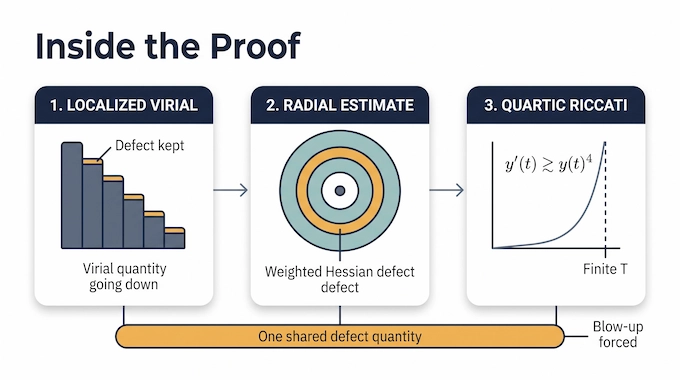
The starting point is a localized virial argument. Virial identities are a standard tool for studying whether a dispersive wave can remain regular or must concentrate. Earlier methods could show that a certain virial quantity kept decreasing, but they discarded a useful positive defect term along the way. That loss is what allowed the grow-up branch to remain possible.
The new strategy keeps that defect and makes it work twice.
First, the proof uses an exponentially localized quartic multiplier suited to the fourth-order operator (\Delta^2). The corresponding defect vanishes at quartic order near the origin, matching the biharmonic scaling.
Second, the authors derive a new radial weighted interpolation estimate that controls the nonlinear localization error using a weighted Hessian defect.
Third, they connect that same defect back to the localized virial quantity. Once the virial becomes sufficiently negative, the estimates lead schematically to a differential inequality of the form
[ y'(t)\gtrsim y(t)^4. ]
A function satisfying that kind of lower bound cannot stay finite for all future time. The contradiction rules out global grow-up and forces finite-time blow-up. The paper emphasizes that the quartic structure, rather than a quadratic one, is a consequence of adapting the mechanism to fourth-order dispersion.
The clever part is not “AI found a magic formula.” It is the way several estimates are made to share one carefully designed defect quantity.
9. What Meta Muse Spark Actually Did
This is where the AI story becomes more interesting than the headline.
The paper’s Statement of AI Use says it was developed through collaboration between researchers and Muse Spark through the meta.ai chat interface. Muse Spark helped explore ideas, develop candidate arguments, and draft material. Researchers guided the project, checked and corrected the mathematics, and took ownership of the final manuscript. The PDF also marks human-drafted and AI-assisted material in the margins.
That description rules out two simplistic interpretations.
The first is “the AI independently discovered and proved a theorem while humans watched.” The paper does not claim that.
The second is “the AI merely polished prose after the mathematics was finished.” The paper also does not say that. It credits Muse Spark with participation in idea exploration and candidate reasoning.
Meta framed the broader research effort as an attempt to move beyond benchmark problems with known answers and test whether its models could help scientists attack open research questions. Its October 2 announcement described mathematicians and Muse Spark collaborating on six research papers.
For people searching “Meta Muse Spark” or “Muse Spark AI,” that workflow is the real takeaway. The strongest evidence here is not that an AI system became an autonomous mathematician. It is that an AI-assisted research loop contributed to work that researchers were willing to verify, review, and present as new mathematics.
10. What the Result Does Not Solve
The easiest way to preserve the significance of the work is to be exact about its boundaries.
It does not solve every Nonlinear Schrödinger Equation. It does not prove that all NLS solutions blow up. It does not cover arbitrary initial data. It does not remove the radial-symmetry assumption. It also does not automatically transfer to every physical system modeled by an NLS-like equation.
The nonradial case is especially important. The paper says radial symmetry is used in the weighted interpolation step, where the problem can be reduced to a one-dimensional estimate on radial annuli. Without radial symmetry, that simplification disappears. There is also a geometric issue: concentration could occur away from the origin while a fixed localization remains centered there. The authors suggest possibilities such as a moving localization center or an interaction-type virial method, but they leave the problem open.
That gives researchers a clear next target. Find a suitable nonradial weighted interpolation estimate, or redesign the localization mechanism so it can follow concentration in space.
11. Why This Nonlinear Schrödinger Equation Result Matters
There are really two stories here.
The mathematical story is clean. A long-standing finite-time blow-up gap for a mass-critical nonlinear Schrödinger equation of biharmonic type has been closed under radial, negative-energy assumptions. The proof does so by preserving and reusing a weighted defect term until it drives a quartic Riccati contradiction.
The AI story is more tentative, but potentially broader. Meta’s Muse Spark was not presented as a substitute for mathematical ownership. It was used inside a research process where humans chose the problem, steered the work, checked the proof, corrected errors, and signed off on the result.
That is a more useful benchmark for scientific AI than another contest score. Open problems do not come with answer keys. Progress depends on choosing productive directions, discarding bad arguments, stitching together techniques, and surviving expert scrutiny.
The next question is not whether one model can generate impressive-looking mathematics. It is whether AI-assisted workflows can repeatedly produce ideas that expert researchers can verify and build on.
For more clear, source-driven explainers on AI research, frontier models, and the mathematics behind the headlines, follow Binary Verse AI.
1. What is the nonlinear Schrödinger equation in simple terms?
The nonlinear Schrödinger equation is a mathematical model for waves whose behavior depends partly on their own intensity. Dispersion tends to spread the wave out, while nonlinear effects can focus or reshape it. This competition produces phenomena including solitons, self-focusing and wave collapse, and appears in fields such as nonlinear optics and Bose–Einstein condensates.
2. How is the nonlinear Schrödinger equation different from the ordinary Schrödinger equation?
The ordinary Schrödinger equation of basic quantum mechanics is linear: adding two solutions gives another solution. The nonlinear Schrödinger equation adds an amplitude-dependent term, so the wave effectively interacts with itself. Depending on the application, its solution may represent an optical field or collective matter wave rather than the probability wavefunction of a single quantum particle.
3. What does finite-time blow-up mean in the nonlinear Schrödinger equation?
Finite-time blow-up means a mathematical quantity measuring the solution becomes unbounded after a finite amount of evolution rather than only becoming arbitrarily large as time approaches infinity. In the new biharmonic NLS result, the theorem eliminates the previously possible “infinite-time grow-up” scenario for radial negative-energy solutions.
4. Did Meta Muse Spark solve the nonlinear Schrödinger equation?
No. Leonard Dinh working with Muse Spark resolved a specific open finite-time blow-up problem for the focusing mass-critical biharmonic nonlinear Schrödinger equation under radial and negative-energy assumptions. The nonlinear Schrödinger equation is an enormous field with many other equations, regimes and open questions.
5. What did Muse Spark contribute to the proof?
According to the paper, Muse Spark helped researchers explore ideas, develop candidate arguments and draft material. Human researchers guided the research, checked and corrected the mathematics and take responsibility for the final manuscript. The paper even marks passages according to whether they were primarily human-written or AI-assisted.