Switch Chain Mixing Conjecture: How the OpenAI Proof Breaks the Every-Degree Barrier
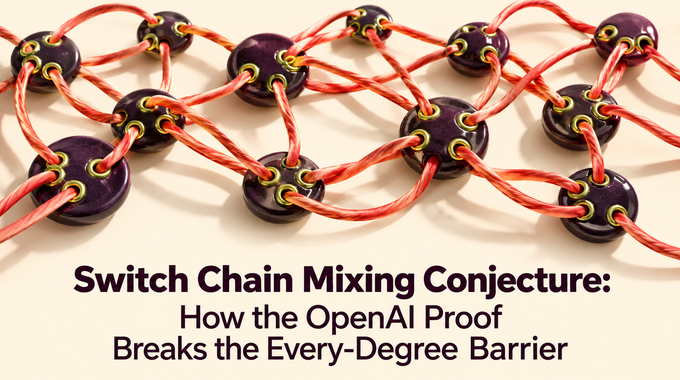
Artwork for the switch chain mixing conjecture showing coral cords threaded through fixed connection points.

Shuffle a network while keeping every person’s number of connections fixed. The operation is easy. Knowing when the shuffled network has forgotten its starting point was the hard part. The switch chain mixing conjecture asks whether this forgetting always takes polynomially many steps. OpenAI’s September 25, 2026 preprint proves the simple-undirected formulation for every graphical … Read more
Ionization Conjecture: How Many Extra Electrons Can an Atom Hold? The OpenAI Proof

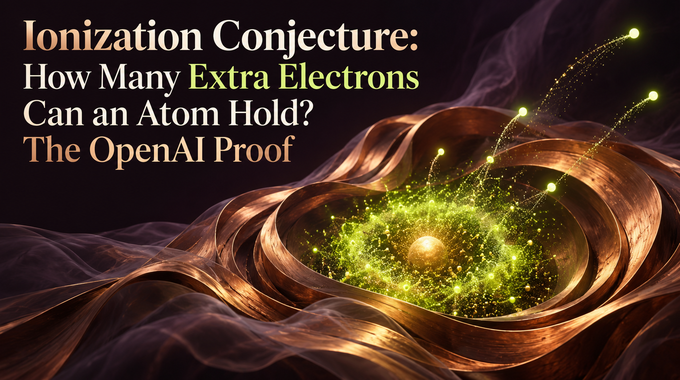
Ionization Conjecture artwork showing excess electrons escaping a copper potential well.

An atom can attract an extra electron. Explaining why it cannot keep collecting them indefinitely is much harder. The Ionization Conjecture asks whether every atom has a universal ceiling on its excess electrons, however large its nuclear charge becomes. OpenAI’s September 24, 2026 manuscript presents a proof that a nucleus of charge ZZ strictly binds … Read more

Hilbert Smith Conjecture: OpenAI Proof Breaks the Dimension Barrier by Ruling Out Faithful p-Adic Actions

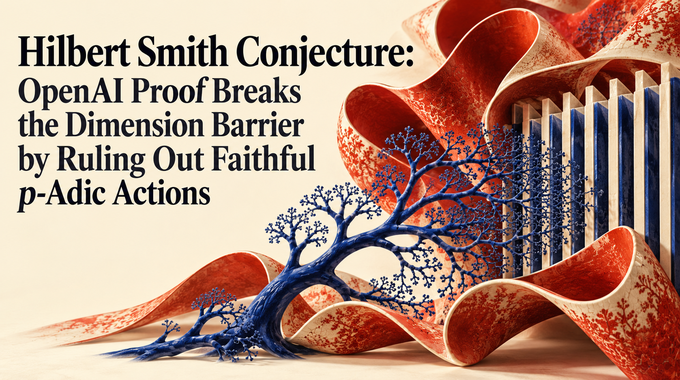
Hilbert Smith conjecture artwork: p-adic branches meet a fixed lattice beside a folded manifold.

A symmetry can be continuous without being smooth. The Hilbert Smith conjecture asks whether faithful symmetries of a finite-dimensional manifold must nevertheless form a Lie group, the familiar mathematical setting for rotations and other continuously parameterized transformations. OpenAI’s September 23, 2026 manuscript presents a proof in every finite dimension, including the unrestricted continuous cases beyond … Read more

Naimark Problem ZFC: How the OpenAI Proof Breaks the 1951 Barrier Without Extra Axioms

Recursive silver sculpture and one shadow illustrate the naimark problem zfc counterexample.

An infinite-dimensional algebra can have just one kind of irreducible representation and still fail to be an algebra of compact operators. OpenAI’s September 24, 2026 manuscript constructs precisely that object using standard set theory, without Jensen’s diamond principle. For readers searching for the Naimark problem ZFC result, that is the central answer. There is an … Read more

Random 3 SAT Threshold: How OpenAI Proved the Critical Ratio Is Computable

Random 3 SAT threshold enclosed by sculptural lower and upper bounds beneath the article title.

A computer can count every satisfying assignment of a finite Boolean formula and still lack a guaranteed way to calculate the transition point of infinitely growing random formulas. OpenAI’s September 27, 2026 preprint closes that gap for the random 3 sat threshold: one deterministic program can approximate the limiting critical ratio to any requested accuracy. … Read more

Triangular Lattice Universal Optimality: OpenAI Proof Breaks the Nonperiodic Barrier with an Atomic Certificate

Triangular lattice universal optimality shown as a red lattice facing irregular points beneath a certificate.

A perfect triangular grid has a formidable opponent: every disordered arrangement of points in the plane. The opponent can abandon repetition, squeeze distinct points arbitrarily close together, and concentrate enormous crowds in scattered regions. OpenAI’s September 26, 2026 preprint presents a proof that none can beat the grid’s lower energy per particle for an entire … Read more

Mean Payoff Games: OpenAI Proof Breaks the Binary-Weight Bottleneck in Quasipolynomial Time

Mean payoff games artwork shows compact binary code opening a vast game landscape.

A weight with a hundred binary digits can derail an algorithm that looks efficient on small numbers. Mean payoff games have carried that trap for decades: compact inputs can encode enormous numerical work. OpenAI’s September 25, 2026 manuscript presents a deterministic algorithm that computes every zero-threshold winner in quasipolynomial time measured against the complete binary … Read more