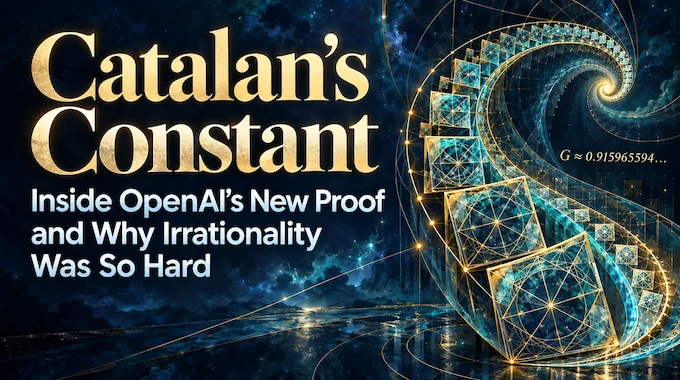
Catalan’s Constant: Inside OpenAI’s New Proof and Why Irrationality Was So Hard
Catalan’s constant proof shown as two steel plates closing on a glowing matrix grid

A number can be easy to calculate and maddeningly difficult to understand. Catalan’s constant fits that description perfectly. Its defining series is simple enough to write on a napkin, yet deciding whether the result is a fraction resisted generations of mathematical work. OpenAI’s manuscript dated September 24, 2026, claims a proof of its irrationality. The … Read more
Gemini 4 Argon: Inside Google’s 1M-Token Output Model, Benchmarks, Pricing and Release Date

Gemini 4 Argon infographic comparing a short context-window input with a one-million-token output budget

Google’s newest frontier model arrives with an unusual headline: Gemini 4 Argon can produce up to one million output tokens in a single trajectory. That is not just a bigger chatbot reply. Google is positioning the model for jobs that may involve hours of reasoning, tool use, code changes, document analysis and repeated decisions before … Read more

GPT-6.1 Sol: Near-Astra at One-Fifth the Cost, How Close?

GPT-6.1 Sol as a small amber orb on one coin stack nearly matching Astra's blue orb on five stacks

An AI agent that costs less to run can still be expensive to finish with. A cheap refactor becomes a costly afternoon when someone has to untangle its mistakes. GPT-6.1 Sol makes that tradeoff more interesting. OpenAI’s September 29 release targets complex coding, computer use and sustained work across apps. The company reports performance approaching … Read more

Claude Sonnet 5.5 vs Opus 5.5: When Cheaper Costs More

Claude Sonnet 5.5 and Opus 5.5 shown as two receipt printers, one printing a much longer cost receipt

The cheaper model just complicated the buying decision. Claude Sonnet 5.5 beats Opus 5.5 on Anthropic’s Terminal-Bench evaluation, nearly matches it on professional knowledge work, and charges half as much for standard input and output tokens. Yet running Sonnet at maximum effort can cost more per benchmark task than running Opus. That’s the central question … Read more

MiMo-V2.6: Xiaomi Scales Agentic RL Toward Self-Improving AI

MiMo-V2.6 self-improving AI concept image with a glowing reinforcement learning feedback loop

Most frontier model launches make the model itself the headline. MiMo-V2.6 is more interesting because Xiaomi wants the training loop to be the headline. The new family combines a large mixture of experts architecture with multimodal pre-training, agent-focused mid-training, and an unusually large reinforcement learning run. Xiaomi says MiMo-V2.6-Pro used 1,568 prompts and 16 rollouts … Read more