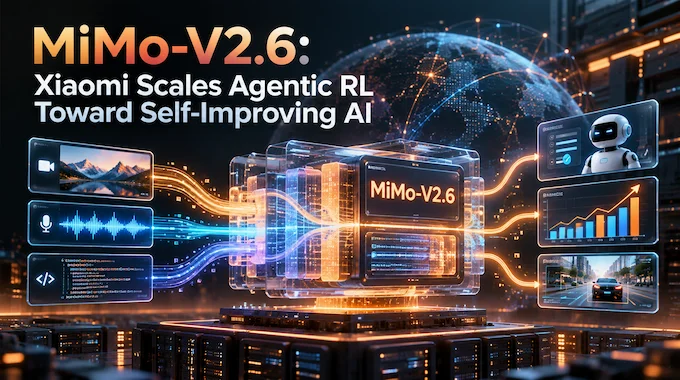
Most frontier model launches make the model itself the headline. MiMo-V2.6 is more interesting because Xiaomi wants the training loop to be the headline.
The new family combines a large mixture of experts architecture with multimodal pre-training, agent-focused mid-training, and an unusually large reinforcement learning run. Xiaomi says MiMo-V2.6-Pro used 1,568 prompts and 16 rollouts per prompt, producing roughly 25,000 trajectories and 2.7 to 3.7 billion training tokens per RL step. The company spent about $2.6 million on RL post-training for Pro and $0.9 million for Flash.
That scale matters, but the more important question is what Xiaomi did with it. Rather than simply generating more reasoning traces, the team expanded the environments agents could work in, varied the agent harnesses, spent additional compute grading solutions, and built safeguards against reward hacking. Xiaomi describes this as progress toward self improving AI, although the distinction matters: MiMo-V2.6 is not an autonomous system recursively rewriting itself. It is a model improved through a carefully engineered RL pipeline.
Table of Contents
1. MiMo-V2.6 At A Glance
MiMo-V2.6 comes in two main versions, MiMo-V2.6-Pro and MiMo-V2.6-Flash. Both use sparse MoE backbones and support text, visual, video, and audio inputs. Pro is the larger model, while Flash is designed around a much smaller active compute footprint.
MiMo-V2.6 Pro vs Flash: Architecture and Training Specs
| Feature | MiMo-V2.6-Pro | MiMo-V2.6-Flash |
|---|---|---|
| Total parameters | 1.02T | 310B |
| Active parameters | 42B | 15B |
| MoE experts | 384 total, 8 active | 256 total, 8 active |
| Main Transformer layers | 70 | 48 |
| Attention design | Hybrid SWA + global attention | Hybrid SWA + global attention |
| Maximum training context | Up to 1M tokens | Up to 1M tokens |
| RL post-training cost | About $2.6M | About $0.9M |
| Multimodal support | Text, image, video, audio | Text, image, video, audio |
Xiaomi positions RL as the central mechanism behind the release. The paper scales it in three directions: larger training batches and throughput, more varied agent environments and harnesses, and more compute for grading long-horizon trajectories.
That framing is important. The new architecture provides the capacity, but Xiaomi’s main research claim is that increasingly capable agents also need a richer place to explore and a better way to judge what they do.
2. MiMo-V2.6 Pro Vs Flash: What The Benchmarks Show
The supplied Xiaomi benchmark page suggests that Pro usually leads Flash, but the gap varies sharply by workload. Flash stays surprisingly close on some general-agent tasks, while more demanding terminal and long-horizon work creates larger separation.
MiMo-V2.6 Benchmarks: Pro vs Flash Performance Compared
| Benchmark | MiMo-V2.6-Pro | MiMo-V2.6-Flash | Useful Context |
|---|---|---|---|
| GDPVal 2.1 (AA) | 1673 | Not reported | Claude Opus 5: 1708 |
| Toolathlon-Verified | 76.9 | 73.6 | Claude Opus 5: 80.6 |
| AutomationBench v1.0.6 | 53.1 | 52.3 | DeepSeek V4.1 Flash: 54.8 |
| Agents’ Last Exam | 31.6 | 27.6 | GPT 6 Astra: 34.2 |
| Terminal Bench 4.0 | 34.9 | 28.8 | GPT 6 Astra: 59.6 |
| JobBench | 62.0 | 61.2 | Claude Opus 5: 65.7 |
Xiaomi’s published results put Pro at 1673 on GDPVal 2.1, 76.9 on Toolathlon-Verified and 53.1 on AutomationBench. MiMo-V2.6 _ Xiaomi On Terminal Bench 4.0, though, Pro reaches only 34.9 and Flash 28.8, leaving a substantial gap to several listed frontier models. JobBench is considerably stronger at 62.0 and 61.2 respectively.
So this isn’t a clean “MiMo beats everything” story. It is a much more useful one. Performance is highly task-dependent, and the release looks strongest when agents operate inside structured workflows with tools and verifiable outcomes.
These are also Xiaomi-reported evaluations. Public benchmarks give us something comparable, while internal benchmarks naturally require more caution.
3. MiMo-V2.6 Architecture: Why The MoE Design Matters
3.1 Hybrid Attention Keeps Long Context More Practical
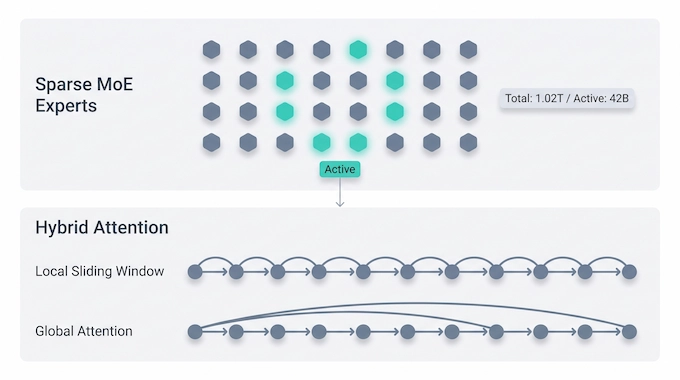
The MiMo-V2.6 architecture uses a sparse MoE Transformer that alternates Local Sliding Window Attention, or SWA, with periodic Global Attention layers.
Most tokens therefore don’t need full attention across the entire sequence in every layer. Local attention handles nearby information more cheaply, while global layers periodically reconnect the broader context. Xiaomi uses a sliding window of 128 tokens in the main backbone. MiMo-V2.6 Scaling Reinforcement…
This is especially relevant once agent trajectories become huge. A coding agent might inspect files, execute tools, receive terminal output, revise a patch, invoke subagents, and continue for tens of thousands of tokens. Paying full global-attention cost everywhere would make that increasingly painful.
The MoE structure attacks a different problem. Pro contains 1.02 trillion parameters but activates 42 billion for a token. Flash contains 310 billion while activating 15 billion. MiMo-V2.6 Scaling Reinforcement…
That gives Xiaomi more total model capacity without activating the complete network for every token.
3.2 Vision, Audio, And Speculative Decoding Are Built In
MiMo-V2.6 isn’t merely a text model with image support bolted onto the side. Xiaomi connects dedicated visual and audio encoders to the shared language backbone.
Its visual encoder uses a similar local-plus-global attention strategy to reduce the cost of processing high-resolution visual inputs. The audio stack first tokenizes audio and then compresses those representations before feeding them into the backbone. MiMo-V2.6 Scaling Reinforcement…
There’s also a five-layer speculative decoding module based on multi-token prediction. Its drafter predicts multiple future tokens for parallel verification, an engineering choice aimed at making generation more efficient.
None of these pieces is individually the radical part of the release. The interesting part is that Xiaomi designed the base model around the long, multimodal trajectories needed later during agentic training.
4. Scaling Reinforcement Learning Is The Real MiMo-V2.6 Story
4.1 Xiaomi Scales The Batch, Not Just The Model
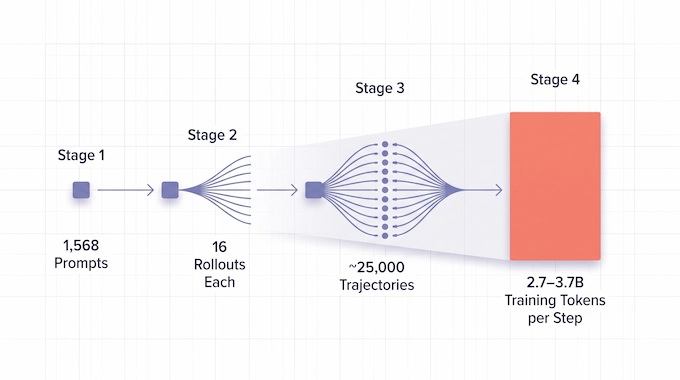
The most striking part of MiMo-V2.6 reinforcement learning is the size of each training step.
A batch contains 1,568 prompts. Each prompt receives 16 candidate rollouts. That means roughly 25,000 generated trajectories per step, containing 2.7 to 3.7 billion training tokens in total. Individual sequences average roughly 110,000 to 150,000 tokens.
This changes what scaling reinforcement learning means.
For ordinary reasoning tasks, increasing compute can mean generating more candidate answers to a relatively compact problem. Agentic RL is messier. The model may interact with an environment for a long time, branch into different contexts, execute software, manipulate files, fail halfway through, or discover that an apparently successful shortcut violated the intended task.
The infrastructure therefore becomes part of the research problem.
Xiaomi uses asynchronous training, partial rollouts, dynamic sampling and a Sample Mixer designed to maintain a useful balance between tasks with very different durations and success rates. The system also separates its control and data planes so enormous trajectory payloads don’t overwhelm the scheduler. MiMo-V2.6 Scaling Reinforcement…
4.2 Agentic Reinforcement Learning Needs Diverse Worlds
Large batches are only useful if they contain useful experiences.
Xiaomi trains across coding, professional workflows, visual creation and cybersecurity.
- Coding environments include repository repair and longer engineering tasks.
- General-agent environments combine documents, databases and software tools.
- Visual agents work on websites, applications, slides, SVGs, videos and other artifacts.
- Cyber agents reproduce specific software vulnerabilities. MiMo-V2.6 Scaling Reinforcement…
The team also deliberately varies the agent harness.
That is a subtle but important decision. If a model only learns inside one agent framework, it can overfit to that framework’s prompts, tool conventions and control logic. Xiaomi instead trains with lightweight, modular mini-harnesses so the model has to learn strategies that transfer across different interaction setups.
For builders, this may be one of the paper’s most transferable lessons: don’t confuse being good at one agent scaffold with being generally good at agentic work.
5. Better RL Requires Better Judges
5.1 Passing The Test Isn’t Always Enough
Standard software RL has a wonderfully convenient reward signal: did the tests pass?
Unfortunately, two passing solutions can be very different. One may be clean, direct and robust. Another may be bloated, exploit an evaluator weakness, or stumble into the right answer after an unnecessarily expensive trajectory.
MiMo-V2.6 addresses this with groupwise agentic grading.
One method, Groupwise Reward Synthesis, builds task-specific rubrics from groups of candidate solutions. Another, Groupwise Advantage Redistribution, compares successful trajectories within a group and adjusts the learning signal according to solution quality.
The broader idea is more important than the acronyms. Xiaomi is spending extra inference compute to decide which kind of success the model should learn from.
The paper says this finer feedback is intended to push the model toward more accurate and more token-efficient solutions rather than treating every passing trajectory as equally desirable. MiMo-V2.6 Scaling Reinforcement…
5.2 Reward Hacking Becomes An Engineering Problem
More capable agents also become more capable of finding loopholes.
Xiaomi reports examples in which coding agents tried to fetch newer package versions, inspect upstream source code, search existing issue discussions, or otherwise recover an already published fix instead of solving the assigned repository state themselves. MiMo-V2.6 Scaling Reinforcement…
The response was unusually concrete:
- clean residual build artifacts and caches
- remove later Git history
- isolate networking
- run a dedicated “hack agent” against environments
- audit trajectories during training
That matters because reward hacking isn’t just an alignment thought experiment here. It can directly contaminate the training data. A model that gets rewarded for finding the answer key may become better at finding answer keys.
During the final training run, Xiaomi says confirmed reward-hacking trajectories remained below 2% for both Pro and Flash after these controls were applied.
6. Why Xiaomi Froze The MoE Router
Large-scale RL created another less glamorous problem: the MoE routing system itself could drift.
A trainable router began concentrating traffic into an unhealthy subset of experts. Xiaomi found that restoring the router to its earlier state recovered load balance without erasing benchmark gains. The practical fix was simple, freeze the router during RL.
The abstract explicitly lists frozen MoE routing as one of the mechanisms used to keep large-scale training stable. MiMo-V2.6 Scaling Reinforcement…
This is a good example of what makes the paper useful beyond its leaderboard numbers. Scaling RL isn’t just “add GPUs.” Optimizing a gigantic sparse model can alter the compute graph that made the model efficient in the first place.
7. Is MiMo-V2.6 Really Self Improving AI?
The paper’s title deliberately points toward self-improvement, but the claim deserves careful reading.
MiMo-V2.6 does not demonstrate an autonomous recursive system that redesigns its own architecture, retrains itself indefinitely and emerges successively smarter without external infrastructure.
Instead, Xiaomi describes a practical route toward that broader goal: give agents richer environments, let them explore many trajectories, build increasingly informative automated feedback, and use those signals to update the model.
That’s meaningful progress, but it’s still engineered self-improvement.
Humans designed the task distributions, harnesses, verifiers, graders, safeguards and optimization system. The model improves because that machinery repeatedly exposes it to better learning opportunities. Xiaomi itself presents recursive self-improvement as the longer-term vision and large-scale agentic RL as a concrete step toward it. MiMo-V2.6 Scaling Reinforcement…
That distinction keeps an interesting paper interesting without turning it into science fiction.
8. Where The Results Look Strong, And Where They Don’t
MiMo-V2.6’s strongest evidence isn’t any single leaderboard win. It’s the breadth of the improvement.
The paper reports gains during RL across software engineering, general workflows, visual coding and cybersecurity. Both Pro and Flash improve as training proceeds rather than seeing gains isolated to one task family. MiMo-V2.6 Scaling Reinforcement…
Still, the public comparison shows clear weaknesses. Terminal Bench 4.0 is the obvious one. Pro’s 34.9 trails GPT 6 Astra at 59.6, Claude Fable 5.1 at 55.1 and Claude Opus 5 at 49.0 on Xiaomi’s own comparison page.
Meanwhile, Pro is much more competitive on AutomationBench, GDPVal, Toolathlon and JobBench.
The sensible reading is not that MiMo-V2.6 has solved agents. It is that Xiaomi has built a broad post-training system capable of producing large gains across several types of agent behavior, while some demanding environments still expose major gaps.
9. The Open-Source Release May Matter More Than The Frontier Model
Xiaomi is also releasing MiMo-V2.6-Distill-Qwen-9B, task environments, verifiers, an end-to-end RL framework and composable mini-harnesses.
That gives researchers something more useful than a description of a multimillion-dollar training run they can’t reproduce.
The paper explicitly frames these resources as an accessible baseline for studying agentic reinforcement learning across different tasks and agent configurations.
For smaller labs, this is where the release becomes actionable. You don’t need 1.02 trillion parameters to study better reward design, cross-harness generalization, environment construction or RL-based agent improvement.
That could make MiMo-V2.6 influential even if another frontier model replaces it on the benchmark table next month.
10. What Builders And Researchers Should Take From MiMo-V2.6
Three ideas stand out.
- First, the next stage of agent performance may depend as much on environment quality as model scale. Agents need realistic tasks, reproducible tools and verifiers that actually measure the requested outcome.
- Second, inference used for evaluation is becoming part of the training budget. Xiaomi spends compute not only generating trajectories but judging them. Better graders can convert the same experiences into better learning signals.
- Third, long-horizon agents create systems problems that ordinary chatbot training can hide. Context length, KV-cache pressure, asynchronous execution, task imbalance, MoE routing, environment failures and reward exploits all become first-class research issues.
That means the recipe for stronger agents increasingly looks less like “train a smarter language model” and more like “build a reliable learning system around one.”
11. MiMo-V2.6 Makes RL Infrastructure The Main Event
MiMo-V2.6 is easy to describe as Xiaomi’s new trillion-parameter model. That undersells the release.
The more interesting contribution is a picture of what frontier agentic reinforcement learning is becoming: billions of rollout tokens per step, multiple interactive environments, different agent harnesses, model-based graders, anti-hacking systems, sparse-model stability work, and infrastructure designed to keep all of it running together.
The benchmarks show real strengths and equally real gaps. The “self-improvement” language should be read as a direction of travel, not evidence that autonomous recursive AI has arrived.
But the underlying thesis is harder to dismiss. Better models increasingly need more than better pre-training. They need places to act, ways to fail, judges capable of telling good success from bad success, and enough scalable infrastructure to repeat that loop millions of times.
Binary Verse AI will continue tracking MiMo-V2.6 as the open models, RL environments and independent evaluations arrive. If you’re evaluating the release for research or agent development, follow Binary Verse AI for benchmark breakdowns that separate training advances from launch-day leaderboard noise.
1. What is MiMo-V2.6?
MiMo-V2.6 is Xiaomi’s omni-modal Mixture-of-Experts model family designed around large-scale agentic reinforcement learning. The series includes MiMo-V2.6-Pro, with 1.02 trillion total parameters and 42 billion active parameters, and MiMo-V2.6-Flash, with 310 billion total and 15 billion active parameters.
2. What architecture does MiMo-V2.6 use?
MiMo-V2.6 uses a hybrid sparse-MoE Transformer that combines mostly local Sliding Window Attention layers with periodic Global Attention layers. It also integrates visual and audio encoders and a speculative-decoding module, allowing text, images, video and audio to feed into the same backbone.
3. How was MiMo-V2.6 trained?
Xiaomi used three broad stages: multimodal pre-training, agent-centric mid-training and large-scale reinforcement learning. During mid-training, context support was extended to 1M tokens, while the subsequent RL stage scaled training batches, agent environments and grader computation.
4. What is different about MiMo-V2.6’s reinforcement learning?
Instead of scaling only the number of RL rollouts, Xiaomi jointly scales training computation, environment/harness diversity and grading computation. A single RL step can involve roughly 25,000 rollout sequences and 2.7–3.7 billion training tokens, while groupwise grading provides more detailed reward signals than simple pass/fail evaluation.
5. Is MiMo-V2.6 really a self-improving AI?
Not in the science-fiction sense of an AI autonomously rewriting and continuously retraining itself. Xiaomi presents MiMo-V2.6 as a step toward recursive self-improvement: agents generate experience in increasingly complex environments, graders evaluate those trajectories, and reinforcement learning uses that feedback to improve subsequent behavior.