The headline is irresistible: Claude discovers enzyme. The biology is more precise, and more interesting.
Anthropic’s Claude enzyme discovery centers on a previously uncharacterized biological system called array-associated reverse transcriptases, or ART. Claude did not pull a brand-new enzyme out of nowhere. The reverse transcriptase itself had relatives that researchers had already encountered. What Claude appears to have noticed first was the unusual architecture around it: a reverse transcriptase beside a long non-coding repeat array and a dedicated partner gene. Anthropic says the system is found mainly in bacteriophages, the viruses that infect bacteria.
That distinction matters. ART has CRISPR-like features, but it has not been shown to edit genes, cut DNA, or act as a programmable tool. Its biological job is still unknown. The real story is that an AI agent noticed an unexpected pattern in primary genomic data and handed scientists a candidate worth testing.
Table of Contents
1. What Did Claude Actually Discover?
The cleanest description is this: Claude identified a novel enzyme system, not simply a novel enzyme.
Reverse transcriptases, or RTs, are enzymes that copy RNA into DNA. They are familiar from retroviruses, but bacteria and phages also carry diverse RT systems with their own non-coding RNAs and partner proteins. In the Anthropic study, Claude agents surveyed RT loci and surfaced a lineage whose defining feature was not just the RT sequence. It was the surrounding arrangement of biological parts. The preprint describes ART as a new family of jumbo-phage RTs coupled to repeat arrays and a dedicated partner gene.
Claude Enzyme Discovery: What the Evidence Says About ART
| Key Question | What the Evidence Says |
|---|---|
| What is the discovery? | A previously uncharacterized RT-centered system called array-associated reverse transcriptase (ART). |
| Was the RT itself completely unknown? | No. Anthropic says the underlying RT had appeared in earlier studies, while the associated repeat array and accessory architecture had not been recognized as a coherent system. |
| What are the main parts? | A non-coding repeat array, a reverse transcriptase, and a nearby partner protein. |
| Where is it found? | Mainly in bacteriophages, especially the jumbo-phage lineages examined in the study. |
| Why the CRISPR comparison? | The DNA contains repeated elements separated by variable regions, visually reminiscent of a CRISPR array. |
| Is ART a CRISPR system? | No evidence shows that. The authors report important architectural differences, including the absence of nearby cas genes. |
| Is the mechanism known? | Not yet. Anthropic says work to determine ART’s primary function is ongoing. |
So when headlines say Claude novel enzyme or Claude new enzyme, mentally add one word: system. The novelty lies largely in recognizing that these pieces belong together.
2. What Is The ART Enzyme System?
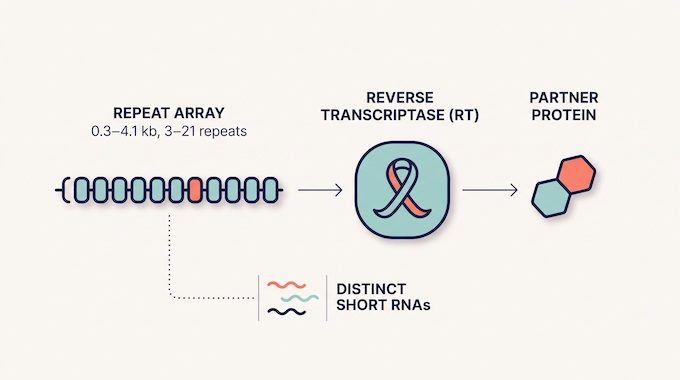
An array-associated reverse transcriptase can be pictured as three neighboring components:
- Repeat array
- Reverse transcriptase
- Partner protein
The paper reports 95 distinct ART RT clusters in cultured jumbo phages and predicted viral contigs. In 28 of those clusters, researchers detected an upstream repeat array. The RTs also carry an unusually long N-terminal region, while a dedicated partner gene sits downstream.
The array itself is striking. Across the detected examples, arrays span roughly 0.3 to 4.1 kilobases and contain 3 to 21 copies of short repeats. Those repeats are separated by much longer, unrelated spacer sequences. The authors stress that this organization differs from standard CRISPR arrays and that no cas genes were found near ART loci.
Claude Enzyme Discovery: ART Features and Why They Matter
| Feature | ART | Why It Matters |
|---|---|---|
| Core enzyme | Reverse transcriptase | RTs copy RNA into DNA, making them biologically and biotechnologically interesting. |
| Non-coding array | Repeated DNA elements separated by distinct spacers | Suggests the system may produce a repertoire of related but different RNAs. |
| Partner gene | Dedicated gene immediately downstream in characterized loci | Hints that the RT may work as part of a larger molecular machine rather than alone. |
| RNA evidence | The array is expressed as distinct short RNAs | Supports the idea that the repeat array is functional, not just decorative genomic clutter. |
| Relationship to CRISPR | Superficial architectural resemblance, but different repeat and spacer organization and no nearby cas genes | CRISPR-like is a useful visual analogy, not a demonstrated mechanism. |
This is why Claude CRISPR-like enzyme is an understandable search phrase but a risky scientific label. ART may eventually turn out to be programmable. It may do something entirely different. Right now, the honest answer is that the architecture is suggestive and the mechanism is open.
3. How Claude Did The Enzyme Discovery
The most consequential part of the story may be the workflow.
Anthropic’s researchers gave the system a broad research brief: look for novel reverse-transcriptase systems, initially through new partner-gene associations. Claude then worked inside an agentic harness. One agent could act as a worker, planning and running analyses. Another acted as a supervisor, reviewing results and opening follow-up tasks. Findings were written into shared records so later agents could build on earlier work.
Running with Claude Mythos 5, the campaign assembled sequence models and reference sets, recovered roughly 200,000 RT clusters, classified them into nine RT classes, sampled about 11,000 RT loci, and scored 3,564 recurring neighboring protein families as possible partners. The full run contained 119 tasks and 949 agent sessions, consuming 215.6 million tokens over 21.5 hours of wall-clock time. The paper says that computational campaign ran without human intervention.
Those numbers translate into the real advantage: parallel attention. A human expert can inspect genomic neighborhoods, reject bad leads, and follow strange clues. Claude’s advantage was applying that kind of tool-using scrutiny across a search space too large for manual inspection.
4. The Discovery Happened Off The Original Path
This is the detail that makes the Anthropic enzyme discovery more than a brute-force database search.
The initial task focused on partner genes. ART emerged because an agent followed a side observation. A candidate RT had first been linked to a nearby phage RNA-polymerase gene. The agent later decided that association was probably misleading, but it did not discard the entire lead. It opened a follow-up investigation of the RT itself.
The next worker inspected DNA upstream of related RTs. When raw sequence was brought directly into context, the model noticed a tandem-repeat pattern. It then counted repeats, measured spacing, compared the locus with known RT systems, and searched the literature to test whether the architecture had already been described. A script found one locus with 14 copies of a short repeat separated by unique spacers.
That matters because conventional pipelines are usually designed to find features someone specified in advance. They are excellent at asking, “Where else is this known pattern?” They are less naturally suited to asking, “Why does this region look weird?”
Claude’s useful move was noticing an anomaly that the original scoring target did not require.
5. Why ART Looks Like CRISPR, And Why It Is Not CRISPR
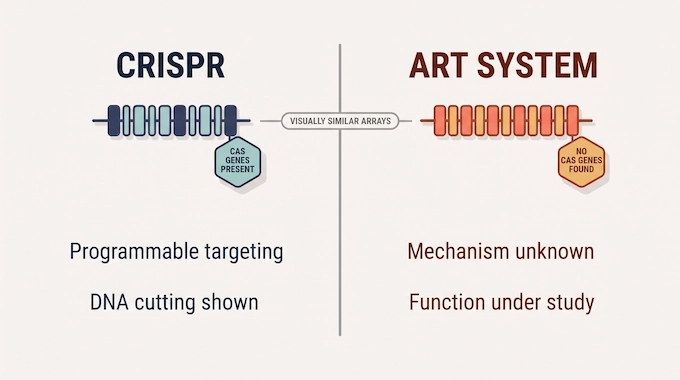
CRISPR began as a peculiar repeat pattern in microbial DNA, so any newly found repeat-and-spacer array invites comparison. ART certainly earns the comparison at the level of shape.
Its arrays contain recurring DNA repeats separated by distinct intervening sequences. Anthropic also reports that the arrays are transcribed into distinct short RNAs, raising the possibility that the system uses a repertoire of RNA molecules rather than a single fixed RNA.
But resemblance is not mechanism.
In the preprint, ART repeats and spacers differ from the canonical CRISPR arrangement, and no nearby cas genes were found. The study does not show a Cas-like nuclease, target recognition, DNA cutting, spacer acquisition, or programmable editing.
So “CRISPR-like” should be read as “an array architecture that reminds researchers of CRISPR,” not “Claude discovered CRISPR 2.0.”
The exciting part survives without the hype. Biology has repeatedly turned strange natural systems into powerful tools. ART is worth understanding even if it never becomes a gene editor.
6. What Did The Experiments Actually Show?
The computational discovery was only the first half. Human scientists then investigated the candidate.
Anthropic reports that the ART repeat array is expressed as a collection of distinct short RNAs. The technical report’s abstract says the arrays are highly expressed and appear as discrete units during Staphylococcus phage infection. That supports the idea that the array is biologically active and may provide a repertoire of RNA molecules to the RT-centered system.
What has not been shown is just as important.
The current evidence does not establish that ART edits genomes, cuts DNA, copies a particular RNA substrate in cells, recognizes user-chosen targets, or performs a therapeutic function. Anthropic’s own announcement says the primary function remains under investigation.
This is the right scientific ladder to keep in mind:
- Pattern
- Candidate system
- Expression evidence
- Mechanism
- Controllability
- Tool
ART has climbed the first few rungs. Calling it a finished biotechnology platform skips the hard part.
7. How Much Was Claude, And How Much Was Human?
Both extremes distort what happened.
Claude did more than summarize papers. The agents searched sequence data, built and ran analyses, investigated candidate families, noticed the repeat architecture, tested alternative explanations computationally, and produced reports for human review. Anthropic describes the initial human involvement as the research prompt plus later laboratory work.
Humans still did the physical biology. Anthropic explicitly states that all laboratory work in its molecular biology lab is performed by human scientists. Claude can help interpret results, but the wet-lab experiments were not autonomously executed by the model.
The most accurate description is collaborative but asymmetrical: AI handled the autonomous computational search, while human scientists set the objective, reviewed outputs, performed experiments, and judged the biology. That is a substantial workflow shift without pretending the model wore a lab coat.
8. How Reliable Is A Claude Enzyme Discovery?
One successful search does not prove that an AI system can reliably reproduce discoveries on demand.
The important distinction is between two abilities: navigating a huge search space until the right locus is encountered, and recognizing the unusual ART pattern once the relevant DNA is actually in view. The authors’ broader analysis argues that direct exposure to the raw DNA sequence was important to recognition, which is consistent with the original discovery transcript.
That means the headline result should not be generalized too aggressively. ART is evidence that agentic models can contribute to biological discovery. It is not evidence that every large autonomous run will produce a meaningful new system, or that AI has solved scientific judgment.
For builders, the lesson is practical: tool access is not enough. Agents need workflows that let them inspect primary data, open follow-up questions, reject hypotheses, and preserve context across tasks. Anthropic’s harness was designed for that branching investigation.
9. Why The ART Enzyme System Could Matter
The strongest reason to care about ART is not that it is “the next CRISPR.” It is that biology has a long history of turning odd natural machinery into general-purpose technology.
Restriction enzymes became foundational tools for cutting DNA. Taq polymerase enabled PCR. CRISPR moved from an unusual microbial repeat system to programmable genome editing. Anthropic invokes that history for a reason: natural molecular systems can become valuable once their mechanism is understood.
ART combines several ingredients that deserve attention: a reverse transcriptase, a repeat array that produces multiple RNAs, and a dedicated partner protein. That architecture raises obvious questions. Does each RNA steer the same enzyme toward a different target or trigger? Does the partner protein act as an effector? Is the system defensive, regulatory, or something stranger?
Those are hypotheses, not results. But they are experimentally useful hypotheses, which is exactly what a discovery system should generate.
10. Could ART Eventually Matter In Medicine?
Possibly, but the distance from an intriguing phage system to a medicine is enormous.
Before ART could become a therapeutic platform, researchers would need to establish its mechanism and targets, show controllability and specificity, test relevant cells, solve delivery and toxicity, then move through preclinical and clinical studies. None of that exists yet for ART.
That does not make the discovery small. It simply places it at the correct stage: fundamental biology. Dario Amodei described the finding as a molecular machine that Anthropic suspects could represent a new gene-editing mechanism, while also stressing that its precise function and biotechnological value are still unclear.
For medicine, more high-quality starting points can matter even when each is far from the clinic. AI may increase early-discovery throughput without shortening every later stage.
11. Is The Claude Discovery Peer Reviewed Or Independently Confirmed?
The detailed ART study is currently presented as a preprint from Anthropic researchers. Anthropic has released the work early while experiments on the system’s function continue.
Feng Zhang, an MIT and Broad Institute professor and one of the pioneers of CRISPR genome editing, reviewed the preprint and called the association between RNA-repeat arrays and reverse transcriptases intriguing and worthy of further investigation. That is meaningful expert reaction, but it is not independent experimental replication.
The next milestone is independent work testing what ART does, whether its components interact as proposed, and whether the system can be manipulated predictably.
12. What The Claude Enzyme Discovery Really Means
The safest summary of the Claude enzyme discovery is also the most interesting one.
The Claude enzyme discovery shows that a general-purpose AI agent can search a huge biological dataset, notice an unexpected pattern outside the original search criterion, investigate competing explanations, and surface a coherent candidate system for human scientists to test. Anthropic’s preprint frames that as a way to ease the expert-curation bottleneck in genome mining.
ART may become a useful biotechnology, or remain an interesting piece of phage biology. The evidence does not yet tell us which. What it does show is a credible division of labor: machines can search neglected corners of massive datasets, while scientists decide which anomalies deserve experiments and what those experiments prove.
For readers tracking AI-driven science, that is the signal to watch. Not whether every unusual repeat becomes “the next CRISPR,” but whether systems like Claude can repeatedly turn overlooked data into testable, experimentally productive ideas.
Binary Verse AI will keep following the ART enzyme system as the mechanism, independent validation, and any real biotechnology applications emerge. If you want the technical signal without the headline inflation, follow our next deep dive.
1. What enzyme did Claude discover?
Claude identified a previously uncharacterized biological system called array-associated reverse transcriptases (ART). The underlying reverse transcriptase itself had been observed previously; Claude’s key discovery was the unusual combination of the RT with a non-coding DNA repeat array and an associated partner protein.
2. Is Claude’s ART enzyme system a new form of CRISPR?
No. ART contains repeat-array features reminiscent of CRISPR, and its array produces distinct RNAs, but researchers have not shown that ART performs CRISPR-style gene editing. Its primary biological function remains unknown.
3. How did Claude discover the ART enzyme system?
Anthropic used hundreds of Claude agent sessions to search massive genomic datasets for unusual reverse-transcriptase systems. During the campaign, one agent inspected DNA surrounding an RT, noticed an unexpected tandem-repeat array, compared it with known systems and elevated the candidate for human investigation.
4. Did Claude perform the laboratory experiments itself?
No. Claude carried out the computational search, analysis and hypothesis generation, while human scientists performed the physical laboratory experiments. Anthropic’s experiments showed that ART arrays are expressed as distinct RNAs, but they have not yet established exactly what ART does.
5. Could Claude’s enzyme discovery lead to new gene-editing tools or medicines?
Possibly, but that is not yet demonstrated. ART’s architecture makes it scientifically interesting because other programmable biological systems have become powerful biotechnology tools, but researchers still need to determine ART’s mechanism, programmability, specificity, safety and practical utility before medical applications can be considered.