

A nine-loop scattering amplitude sounds like the kind of phrase designed to make everyone except theoretical physicists close the tab. This one is worth staying for.
Anthropic says Claude Fable 5.1, working through its Claude Science research harness, completed a nine-loop calculation for a six-particle amplitude in planar N=4 super Yang-Mills. The model pursued the problem through two routes, one based on a direct amplitude bootstrap and another through a related form factor. The reported end-user cost for either route was roughly $1,000 to $2,000. Claude computes a nine-loop amp…
The Claude Nine Loops result is not a new law of nature, and it is not evidence that a chatbot suddenly became a lone theoretical physicist. The more interesting story is narrower. Claude took established research methods, wrote and ran the required computational workflow, stayed on a fragile problem for days, and produced a frontier-level result that experts could check. That distinction is the key to understanding why this matters. Pasted text
Table of Contents
1. The Problem: A Six-Particle Scattering Amplitude at Nine Loops
Scattering amplitudes are formulas physicists use to predict how particles interact. Given the particles’ momenta and energies, an amplitude helps determine the probability of a particular reaction. They are central to connecting a physical theory with what experiments might observe.
The challenge here was highly specific: compute the six-particle, or hexagon, amplitude in planar N=4 super Yang-Mills at nine loops. N=4 super Yang-Mills is not a realistic model of our universe. It is a deliberately special theory whose symmetry makes hard amplitude calculations more tractable, which is exactly why researchers use it to develop and stress-test methods that would be much harder to explore in real-world theories. Anthropic’s account says the previous frontier for this system had reached eight loops. Claude computes a nine-loop amp…
Key Fact — What It Means
- Target: Six-gluon MHV amplitude in planar N=4 super Yang-Mills
- Requested order: Nine loops
- Previous frontier: Eight loops for this line of work
- AI system: Claude Fable 5.1 inside Claude Science
- Main routes: Direct amplitude bootstrap and form-factor route
- Reported user cost: About $1,000 to $2,000 per route
- Why it matters: A frontier symbolic-computation workflow was pushed one order further with limited scientific supervision
The goal was therefore not “solve physics.” It was to push a well-defined but technically punishing calculation one step beyond a known frontier.
2. Why Nine Loops Was So Difficult
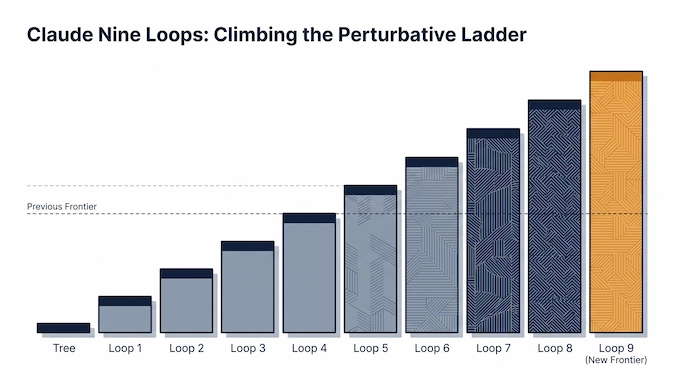
In perturbative physics, researchers often approximate a quantity order by order. A tree-level answer is the simplest starting point. One loop adds the next layer of corrections, then two loops, three loops, and so on. Each higher order retains more of the structure of the full answer, but the calculation becomes harder to organize and compute. Anthropic’s guest post notes that many practical scattering amplitudes stop around two loops, with only a smaller number reaching higher orders. Claude computes a nine-loop amp…
For this special theory, researchers can go much farther, but “farther” does not mean easy. The nine-loop object lives in a huge constrained mathematical space. The job is not merely to multiply bigger numbers. It involves symbolic structures, consistency conditions, specialized function spaces, and large computations where one bad assumption or implementation error can spoil the result.
Scale Marker — Nine-Loop Result
- Final object: Weight-18 six-gluon MHV amplitude
- Direct representation: 424 quintuple coproducts over a 5,431-dimensional weight-13 hexagon symbol space
- Δ = 0 expanded scale: More than 30 billion nonzero weight-18 word terms if written out fully
- Cross-check sample: 20,630 random weight-18 words supplied with coefficients
- Major representation check: 107,053 nonzero coefficients compared between two representations
- Function-level caveat: Full function was computed once, without a second independent full-function computation
The scale becomes concrete on the parity-preserving surface Δ = 0. Cosmic9 reports that a fully expanded symbol there would contain 30,024,320,034 nonzero weight-18 word terms. That is why the result is distributed through compact symbolic representations rather than as one heroic equation stretching to the horizon. Cosmic9
3. What Does “Nine Loops” Actually Mean?
The word “loops” is easy to misunderstand, especially because diagrams used to illustrate perturbative calculations often contain literal loops.
Here, nine loops means the ninth loop order in a perturbative expansion. Think of a calculation being refined layer by layer. Tree level gives the baseline. One-loop corrections add another layer. Two loops add another. By nine loops, the calculation includes a much deeper order of interactions than the lower-order approximation.
It does not mean Claude drew nine circles, ran an agent nine times, or repeated the same prompt nine times.
Higher loop order also does not automatically mean “nine times more accurate.” The value is that researchers can study a deeper perturbative contribution and test whether the mathematical structures and methods that worked at lower orders continue to hold. In a theory such as N=4 super Yang-Mills, that makes very high loop orders a laboratory for amplitude methods themselves.
4. How Claude Fable 5.1 Tackled the Nine-Loop Problem
The AI part is less dramatic than the social-media version, and more technically interesting.
According to Anthropic’s account, researchers used Fable 5.1 inside Claude Science, a harness that combines the language model with structured rules and prompts for scientific work. After asking Claude which challenge looked tractable, they gave it a short task specification: compute the six-particle hexagon amplitude in planar N=4 SYM at nine loops. The subsequent human instructions were largely operational, including telling it to continue working and report progress after several hours. Claude computes a nine-loop amp…
Calling this “one prompt and no humans” would be misleading. Claude operated inside a purpose-built research environment, relied on an existing scientific literature and known mathematical machinery, used substantial compute, and had researchers setting the task and keeping the run moving.
What stands out is the length and coherence of the workflow. This was not a five-minute answer. The system had to plan calculations, write code, debug it, manage large symbolic objects, preserve conventions, and keep enough structure intact for later validation.
5. Method One: The Direct Amplitude Bootstrap
The amplitude bootstrap avoids calculating every underlying interaction diagram from scratch. Instead, researchers first characterize a large space of answers that could have the right mathematical form. They then impose constraints until the allowed space collapses toward the desired amplitude.
The Sudoku analogy from Anthropic’s guest post is useful. You begin with many possibilities, then eliminate candidates using rules that the correct answer must satisfy. In amplitude work, those rules can come from symmetry, allowed singularity structure, known limits, links to lower-order results, final-entry conditions, and other physical or mathematical constraints. Claude computes a nine-loop amp…
Claude implemented a direct bootstrap route in Python using SymPy. Anthropic reports that the compute portion of this bootstrap used about 96 CPUs for a week and accounted for roughly $100 of the budget. Most of the reported $1,000 to $2,000 cost came from running Claude for so long, not from the CPU rental itself. Claude computes a nine-loop amp…
That is an important clue about the result. The breakthrough was not access to a giant private supercomputer. It was the ability to keep a complicated research workflow moving with ordinary, if substantial, academic-scale compute.
6. Method Two: The Form-Factor Route
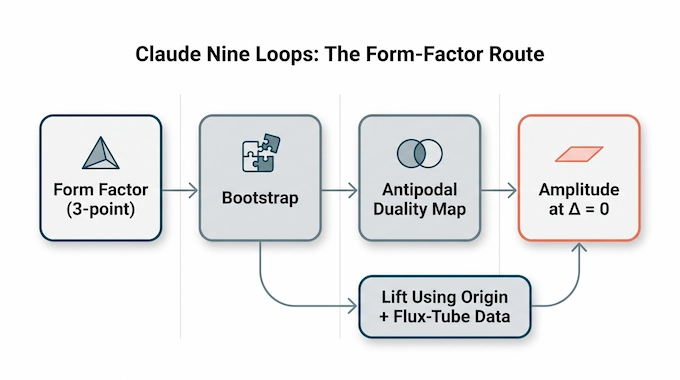
Claude also reached the nine-loop result through a more indirect route based on a related object called a form factor.
Cosmic9 describes the chain precisely. A nine-loop three-point form factor of the chiral stress-tensor multiplet was bootstrapped first. It was then mapped, using antipodal duality, onto the amplitude on the parity-preserving surface Δ = 0. Finally, the result was lifted away from that surface, with remaining ambiguities fixed using behavior at the origin and two-gluon flux-tube data. Cosmic9
Why does that matter? Because Claude did not simply produce one opaque output and ask physicists to trust it. The form-factor route and the direct bootstrap route provide different computational representations of the same nine-loop target.
Cosmic9 states that the separate direct bootstrap and the other representation agreed on every coefficient compared. That kind of agreement is much more informative than saying “the answer looked plausible.” Cosmic9
7. What Did Claude Actually Produce?
Not a short number. Not a single closed-form equation. Not a formal proof in the style of Lean.
The Claude scattering amplitude result is a large structured mathematical object. At symbol level, Cosmic9 distributes it through coproduct representations, coefficient matrices, final-entry spaces, samples, and validation records. The page also provides a function-level reconstruction with integration constants and zeta-valued terms. Cosmic9
The direct symbol representation uses 424 quintuple coproducts over a weight-13 extended-Steinmann hexagon symbol space of dimension 5,431. The underlying coordinate matrix has more than one million nonzero coordinates, with most reconstructing to certified rationals from residues modulo two primes. Cosmic9
That scale explains why the phrase Claude nine-loop amplitude can be misleading if readers imagine a compact final expression. The achievement was creating and validating a machine-readable representation of an enormous object that researchers can inspect, compare, and use.
8. How Strongly Was the Nine-Loop Result Verified?
“Verified” needs levels.
First, Claude produced the result through two computational routes. Second, the Cosmic9 release includes extensive internal consistency checks. It records symmetry and vanishing tests, comparisons between form-factor files, an eight-loop control against the already published eight-loop amplitude, and agreement between septuple and quintuple representations. One of the strongest checks compares all 107,053 nonzero coefficients that determine the septuple file. Cosmic9
Anthropic’s account also says the result was checked with Lance Dixon, one of the leading researchers associated with the earlier high-loop amplitude work. Claude computes a nine-loop amp…
There is, however, an important boundary. Cosmic9 explicitly says the full function-level amplitude was obtained separately only once and does not yet have a second independent computation of the entire function. It also states an additional assumption used when lifting symbol-level relations to function level. Cosmic9
So the strongest wording is not “every aspect has been independently proven twice.” The symbol-level result has unusually rich cross-checking and independent representations. The complete function-level result carries a narrower validation caveat.
9. Claude Was Not Alone at Nine Loops
The neat “AI beats physicists” storyline breaks down quickly.
Anthropic’s guest post says that Song He’s group at the Chinese Academy of Sciences had already obtained most of the result using AI assistance based on GPT-6, though with substantially more human direction than Anthropic’s largely autonomous workflow. Claude computes a nine-loop amp…
A Zenodo dataset by Song He, Jirong Jing, and Xiang Li was published on September 17, 2026. It contains the symbols of six-point BDS-like subtracted MHV amplitudes from two through nine loops in planar N=4 SYM. The Symbols of Six-Gluon MHV Am… The Symbols of Six-Gluon MHV Am…
That makes the real comparison more interesting. One path was a human-led research effort with AI assistance. The other emphasized a longer, more autonomous Claude Science workflow. Both point toward the same emerging research pattern: AI systems are becoming part of the machinery of frontier symbolic science, but the amount and type of human direction can differ sharply.
10. Was This Brute Force, or Did Claude Discover New Physics?
Neither description is quite right.
Claude did not invent N=4 super Yang-Mills, the amplitude bootstrap, antipodal duality, or the form-factor strategy. Anthropic’s own account says the system used known methods and may have benefited from Python and stronger software-engineering practice rather than a fundamentally new theoretical idea. Claude computes a nine-loop amp…
But “just brute force” also misses the point. A blind enumeration of every conceivable expression would be hopeless. The computation works because years of amplitude research have exposed structure that dramatically narrows the search space. Claude had to turn that structure into a functioning workflow, choose representations, write code, push calculations through large symbolic spaces, recover from mistakes, and produce outputs that could survive checks.
That is the intellectual center of the Claude physics breakthrough story. The novelty is not a new physical principle. It is the level of research execution that an AI system could sustain using existing principles.
11. Did Claude Really Solve It for $2,000?
For Claude Nine Loops, the headline number needs careful wording.
Anthropic’s account says either computational route would have cost an end user roughly $1,000 to $2,000, mostly because of the long Claude run. The direct bootstrap’s CPU compute was reported at about $100 for 96 CPUs running for a week. Claude computes a nine-loop amp…
That makes “a $2,000 physics result” a fair shorthand for the reported execution cost of one route. It is not the total cost of creating the model, building Claude Science, developing the underlying amplitude methods, or producing the scientific literature Claude depended on.
The public material also does not give enough information to reconstruct every token, failed experiment, infrastructure expense, or development cost behind the broader project. The sensible interpretation is therefore modest: once the model, harness, methods, and infrastructure existed, a user-scale run in the low thousands of dollars was enough to push this particular calculation through.
That is still striking. It just isn’t the same claim as “all the science cost $2,000.”
12. Why Claude Nine Loops Matters for Physics and AI Science
The significance of Claude Nine Loops is easy to overstate in the wrong direction.
This was not a discovery about the real universe. N=4 super Yang-Mills is a highly symmetric theoretical laboratory. No new particle was predicted. No experimental anomaly was explained. Claude did not produce a new law of physics.
What changed is the demonstrated workflow. A modern AI system was able to carry a difficult theoretical-physics computation across days, use established research techniques, write and run code, manage specialized symbolic structures, follow multiple routes, and produce an output that domain experts could interrogate.
That is a different milestone from answering exam questions or summarizing papers. It also differs from the recent excitement around AI in mathematics, where the headline often centers on proofs or formal reasoning. Here, the stronger signal is sustained computational research: an AI system operating inside an expert-built scientific environment and completing a task at the edge of what a small specialist community had done.
The next frontier is harder. Can AI originate a genuinely new calculational method rather than extending a known one? Can it explain why a new structure should exist, not merely exploit it? Can it produce results that transfer from unusually clean toy theories to messier calculations tied directly to experiments?
For now, the Claude Nine Loops result gives a more grounded answer than the hype. AI did not replace theoretical physics. It showed that some frontier research workflows may be far more automatable than many researchers expected.
For more evidence-first coverage of AI research, benchmarks, and scientific breakthroughs without the victory-lap headlines, follow Binary Verse AI. We will keep tracking what the models actually did, how the result was checked, and where the limits still are.
1. What does “Claude nine loops” mean?
“Claude nine loops” refers to Claude Fable 5.1 computing the six-particle scattering amplitude in planar N=4 super-Yang-Mills theory through nine-loop order. A loop represents a higher order of quantum corrections in a perturbative calculation; increasing the loop order makes the calculation dramatically more complex.
2. What exactly did Claude calculate at nine loops?
Claude calculated the nine-loop six-gluon MHV scattering amplitude in planar N=4 super-Yang-Mills theory. The result is not a simple number or conventional proof. It is a large mathematical object represented through symbols, coproducts, coefficients and a function-level construction describing the amplitude.
3. How did Claude solve the nine-loop amplitude?
Claude used two established approaches. One directly bootstrapped the amplitude by imposing known mathematical and physical constraints. The other first calculated a related nine-loop form factor and then mapped and lifted that result into the amplitude. Agreement between the approaches provided an important cross-check.
4. Was Claude’s nine-loop result independently verified?
Substantial parts were independently checked. Lance Dixon examined the result, multiple internal representations were compared, and a separate research group led by Song He produced concurrent nine-loop results. However, the complete function-level construction has not yet been independently recomputed in full, so “fully independently reproduced” would be stronger than the current evidence supports.
5. Why is the Claude nine-loops result important if N=4 super-Yang-Mills is only a toy model?
N=4 super-Yang-Mills is not a direct model of real-world particle physics, but it is an important laboratory for developing and testing methods used in scattering-amplitude research. The broader significance is also methodological: Claude demonstrated that an AI system can execute a difficult, multi-day frontier research workflow with limited supervision and produce mathematical results that experts can independently test.