Europe has plenty of AI policy. What it has had less of is a competitive large language model that organizations can actually download, run on their own infrastructure, and adapt without routing sensitive data through a foreign API.
Aleph Alpha Kolibri is an attempt to change that equation.
Released on October 3, 2026, Kolibri 1 is an English-German Mixture-of-Experts model with 78.1 billion total parameters but only 3.46 billion active for each token. It supports reasoning controls, tool calling, long-context workloads, and downloadable weights under Apache 2.0. Aleph Alpha has validated contexts up to one million tokens, although the model is trained natively to 256K.
That combination is what makes Kolibri interesting. It isn’t trying to win by being the largest model. Its pitch is narrower and arguably more practical: deliver strong reasoning, German performance, and enterprise capabilities while keeping the amount of computation required for each token relatively small.
The important question is whether the numbers support that pitch.
Table of Contents
1. What Is Aleph Alpha Kolibri? Key Specs at a Glance
Kolibri AI is the successor to Kolibri Origin, but the jump is much larger than the family name suggests. Origin had 30.6B total parameters and a 64K trained context. Kolibri moves to 78.1B parameters, substantially greater sparsity, a redesigned attention system, more training data, and a 256K trained context.
Aleph Alpha Kolibri Specifications: Key Model Details at a Glance
| Specification | Aleph Alpha Kolibri |
|---|---|
| Release date | October 3, 2026 |
| Developer | Aleph Alpha Research GmbH |
| Architecture | Mixture-of-Experts Transformer |
| Total parameters | 78.1B |
| Active parameters per token | 3.46B |
| Languages | German and English |
| Routed experts | 384 per MoE layer |
| Experts used per token | 6 routed + 1 shared |
| Transformer blocks | 50 |
| Native/trained context | 262,144 tokens |
| Validated maximum context | 1,048,576 tokens |
| Reasoning modes | None, low, medium, high |
| Tool calling | Yes |
| Weight precision | FP8, with selected components in BF16 |
| Approx. FP8 weight footprint | 78 GB |
| Knowledge cutoff | June 18, 2026 |
| License | Apache 2.0 open weights |
The model card positions the Kolibri LLM for multi-step reasoning, RAG, coding, agentic tool use, long-document processing, and German-English assistant workloads
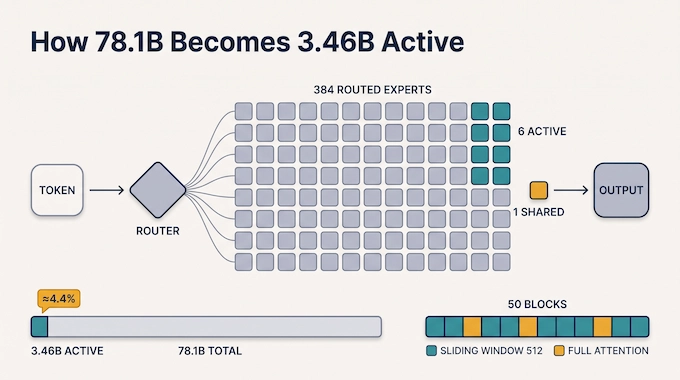
The standout number is not really 78B. It is 3.46B active parameters per token, about 4.4 percent of the full model. Aleph Alpha is betting that a large pool of specialized experts can provide broad capability without paying dense-model compute costs on every generated token.
2. Aleph Alpha Kolibri Benchmarks: Competitive, but Not the Overall Winner
Aleph Alpha’s published Kolibri benchmarks compare the model with Qwen3.5, Qwen3.6, Qwen3.8, Nemotron, Gemma, GPT-OSS, Mistral and several other open models.
The headline results need some context.
Aleph Alpha Kolibri Benchmarks vs Qwen3.5 and Qwen3.8
| Published Metric | Kolibri | Qwen3.5 35B-A3B | Qwen3.8 27B |
|---|---|---|---|
| Active parameters | 3.46B | ~3B | 27B |
| Overall English | 75.5 | 74.7 | 80.2 |
| Overall German | 70.8 | 69.8 | 79.9 |
| GPQA Diamond, English | 84.3 | 83.8 | 89.2 |
| Knowledge average, English | 50.1 | 52.7 | 56.8 |
| Math average, English | 96.5 | 90.1 | 97.8 |
These results come from Aleph Alpha’s own evaluation harness, with models generally using their highest available reasoning settings, so they should be treated as vendor-published evidence rather than independent verification.
The important result is not that Kolibri beats Qwen3.8. It doesn’t.
Qwen3.8 27B produces the higher overall score in Aleph Alpha’s own evaluation. The more interesting comparison is efficiency. Qwen3.8 is dense, meaning roughly 27B parameters participate in each token, while Kolibri activates only 3.46B. Aleph Alpha’s technical report therefore places Kolibri, Qwen3.5 and Qwen3.8 along the capability-versus-active-compute frontier rather than pretending they occupy the same cost point.
Aleph Alpha’s page 3 chart makes the same argument visually. It plots average benchmark performance against decoded text per GPU, with Kolibri landing on the reported Pareto frontier in both English and German.
That’s a more credible claim than “Kolibri is the best open model.” It isn’t. The claim is that it offers unusually strong capability for the amount of model activated during inference.
3. Why Kolibri Matters: Europe’s Sovereign Open-Weight AI Bet
“Sovereign AI” can quickly become marketing wallpaper, so it helps to translate it into practical terms.
For Aleph Alpha, sovereignty means an organization can download the model, keep inference inside infrastructure it controls, and avoid depending on an external proprietary inference service for every request. The company specifically targets public administration, industrial applications and aerospace, where data location, compliance and deployment control can matter as much as a benchmark point.
That distinction matters.
A German government agency processing confidential documents may rationally prefer a somewhat weaker locally controlled model over a stronger cloud-only system. The same applies to manufacturers working with proprietary engineering data or companies that need predictable infrastructure boundaries.
Kolibri therefore isn’t simply “a European ChatGPT competitor.” Its more defensible niche is high-control enterprise AI, particularly where German language quality and on-premises deployment overlap.
4. Kolibri Architecture Explained: How 78B Becomes 3.46B Active
The Kolibri architecture is where the model gets technically interesting.
There are 50 transformer blocks. Each MoE layer contains 384 routed experts, yet an individual token is sent to only six of them, plus one shared expert. The result is 78.1B parameters in total but 3.46B active per token.
Attention is sparse too. Forty of the 50 blocks use sliding-window attention over the preceding 512 tokens. Every fifth block uses full attention across the wider context. Kolibri uses 48 query heads, four key-value heads, and a 128,000-token vocabulary.
4.1 Why Sparse MoE Changes the Cost Equation
Think of the model as a large office full of specialists.
A dense 27B model effectively calls the entire office for every token. Kolibri keeps many more specialists available but consults only a small subset for each step.
That cuts the arithmetic required during inference. It also explains how a 78B-parameter model can compete with much more computationally expensive systems without behaving like a conventional 78B dense model.
The hybrid attention pattern serves the same goal. Most layers only examine a nearby window, while occasional full-attention layers carry information across the complete sequence.
4.2 The Catch: 3.46B Active Does Not Mean 3.46B of Memory
This is the easiest Kolibri specification to misunderstand.
Only 3.46B parameters are active for a token, but the whole model still needs to be stored somewhere so the router can select different experts as inference proceeds.
Aleph Alpha says the FP8 weights occupy roughly 78 GB. Sparse activation reduces compute. It does not magically turn Kolibri into a 3B model you can casually load onto ordinary consumer hardware.
That memory-versus-compute distinction matters when comparing Kolibri vs Qwen3.8 or smaller local models.
5. How Kolibri Was Trained: Nearly 24T Tokens With German Built In
Aleph Alpha trained Kolibri from scratch rather than fine-tuning somebody else’s foundation model.
Pre-training used 20 trillion tokens, followed by 3.44T tokens of mid-training and roughly 200B tokens for long-context adaptation. Pre-training ran for 21 days across 768 NVIDIA B200 GPUs, followed by separate mid-training and long-context stages.
The language mix is particularly important.
About 62.5 percent of pre-training data was English, 23.9 percent German, and 13.6 percent code. That is an unusually substantial German allocation for a frontier-style model.
Aleph Alpha also created a German-oriented UniBPE tokenizer. In its technical evaluation, that tokenizer required 11.2 percent fewer tokens on German web text than the GPT-5 tokenizer while keeping English efficiency competitive.
Post-training added supervised fine-tuning and reinforcement learning across reasoning, instruction following, coding and agentic environments. Users can select none, low, medium or high reasoning effort, effectively choosing how much inference work the model should spend on a problem. Tool calling can run alongside reasoning through the supplied vLLM integration.
This German-first engineering is more meaningful than simply adding “German” to a model card.
6. Does Kolibri Really Have a 1 Million Token Context Window?
Yes, but the wording needs care.
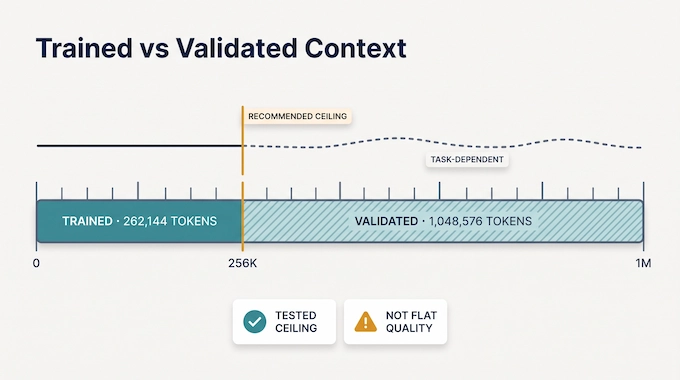
Kolibri was trained to 262,144 tokens during its final long-context stage. Aleph Alpha has separately validated operation up to 1,048,576 tokens.
Those are not the same thing.
The hybrid attention design helps extrapolation because positional encoding is confined to the fixed-window layers, while the full-attention layers do not use positional encoding. This lets the model stretch beyond its trained length without conventional position scaling.
But there is degradation. Aleph Alpha’s technical report explicitly describes performance beyond 256K as task dependent rather than flat all the way to one million tokens.
The company’s own recommendation is therefore sensible: stay at or below roughly 256K for complex tasks or latency-sensitive deployments.
So “1M context” is valid as a tested ceiling. It shouldn’t be interpreted as “one million tokens with identical quality to 128K.”
7. Kolibri Pricing and Hardware Requirements
Kolibri pricing is slightly unusual because the most concrete price is currently the cost of running it yourself.
The weights are downloadable under Apache 2.0, so there is no per-token license fee attached to simply obtaining and self-hosting the model. At the time reflected in the model card, Hugging Face also listed no inference provider serving Kolibri, so there was no standard public hosted token price to compare with commercial APIs.
Official Kolibri hardware requirements are substantial:
- Minimum configurations include 2× A100 80GB, 2× H100 SXM5, one H200, one B200 or one B300.
- Aleph Alpha recommends 2× H100 SXM5, 2× H200, one B200 or one B300.
- The FP8 model itself occupies about 78 GB before additional runtime and KV-cache requirements.
That means “3.46B active” should not be read as “runs like a 3B laptop model.”
A 64GB machine is below the official FP8 weight footprint even before runtime overhead. A 128GB unified-memory system may have enough raw capacity to hold the weights in principle, but that isn’t the same as being an officially supported or fast deployment target.
Long contexts also increase KV-cache requirements, so a deployment built around 256K or 1M-token prompts needs a very different capacity plan from one serving 4K chats.
8. Is Kolibri Really Open Source?
The precise phrase is open weight.
Aleph Alpha makes the full Kolibri weights available through Hugging Face under Apache 2.0. That gives developers much more control than a closed API model, including local deployment, modification and commercial use subject to the license terms.
Calling the whole system “fully open source” without qualification would be less precise because releasing model weights is not the same as publishing every training dataset, intermediate artifact and component needed to reproduce the model from scratch.
Still, Apache 2.0 is significant.
For enterprise teams, downloadable weights mean the model can survive independently of a hosted API’s pricing changes, rate limits or future product decisions. It can also remain inside a controlled network.
For a model marketed around sovereignty, that is not a minor licensing detail. It is part of the product.
9. Where Kolibri Is Strong, and Where It Falls Short
The strongest case for Kolibri is not raw leaderboard dominance.
Its math performance is particularly strong among sparse models. It also targets coding, tool use, RAG, long documents and agentic workflows while retaining unusually deep German support. Aleph Alpha’s published evaluation describes it as competitive across math, coding, grounding, long-context tasks and agentic capabilities.
The compromises are equally clear.
Kolibri is German-English rather than broadly multilingual. It is text-focused rather than a general multimodal system. The 78GB FP8 footprint makes local consumer deployment less convenient than the active-parameter count implies. One-million-token operation comes with quality degradation. And Qwen3.8 remains substantially stronger on Aleph Alpha’s own overall benchmark aggregates.
There is another practical caveat: Kolibri has just launched. Vendor evaluations are useful, but independent testing on real codebases, German enterprise documents, retrieval systems and production agent loops will matter more than another radar chart.
10. Who Should Actually Use Aleph Alpha Kolibri?
Kolibri makes the most sense when several requirements overlap rather than when someone simply wants “the smartest local model.”
The strongest candidates are German enterprises building RAG systems, organizations processing large internal document collections, government and regulated-sector deployments, agentic workflows that require tool calling, and teams that place a premium on on-premises inference and European infrastructure control.
It is less compelling for users who primarily want the highest raw benchmark score, broad multilingual coverage, multimodal input, or effortless consumer-hardware deployment.
That focus is a strength rather than a flaw. Models don’t need to win every category to be strategically useful.
11. Final Verdict: A Strong European Model With a Specific Advantage
Aleph Alpha Kolibri is competitive, but its significance is easy to misunderstand if you look only at 78B parameters or only at leaderboard position.
It isn’t a 3B model disguised as a 78B model. The full weight set is still large. It doesn’t beat Qwen3.8 overall. And its advertised one-million-token context shouldn’t be mistaken for one million tokens of perfectly flat performance.
What Kolibri does offer is more interesting: 78.1B parameters of model capacity with only 3.46B active per token, unusually serious German optimization, explicit reasoning controls, tool calling, a 256K native context, validated million-token operation, and downloadable Apache 2.0 weights.
For developers chasing the absolute highest score, other models may still win. For organizations balancing capability, serving efficiency, German performance, deployment control and data sovereignty, Kolibri has a much stronger argument.
And that may be the real story here. Europe doesn’t need another model whose main achievement is appearing on a leaderboard. It needs models that organizations can actually own, deploy and build around.
For more evidence-first breakdowns of new AI models, benchmarks, architectures and the claims behind them, follow Binary Verse AI at BinaryVerseAI.com.
1. What is Aleph Alpha Kolibri?
Aleph Alpha Kolibri is an English-German Mixture-of-Experts language model with 78.1 billion total parameters and about 3.46 billion active parameters per token. It supports reasoning, coding, RAG, tool calling and long-document processing, and its weights are available under the Apache 2.0 license.
2. Is Aleph Alpha Kolibri open source and free to use?
Kolibri is more accurately described as an open-weight model. Aleph Alpha has released its full model weights under Apache 2.0, allowing users to download and deploy the model themselves. That does not make inference free: users still pay for the GPUs, hosting and electricity required to run it.
3. What hardware do you need to run Kolibri locally?
The FP8 weights require roughly 78 GB of model memory. Aleph Alpha lists configurations such as 2×A100 80GB, 2×H100 SXM5, or a single H200, B200 or B300 as minimum supported hardware configurations. Quantized community versions may reduce memory requirements, but they should be treated separately from Aleph Alpha’s official FP8 configuration.
4. Does Kolibri really support a 1 million token context window?
Yes, but with an important qualification. Kolibri was actually trained to 262,144 tokens, while Aleph Alpha tested it out to 1,048,576 tokens. The technical report says useful capability remains at 1M tokens but also reports task-dependent degradation, so 1M should not be interpreted as identical quality to 256K.
5. Is Kolibri better than Qwen3.8?
Not across the board. Aleph Alpha’s own evaluation shows Qwen3.8 27B scoring higher on the overall English and German aggregates, while Kolibri activates far fewer parameters per token and competes strongly among sparse MoE models. The more useful comparison is therefore quality versus compute, memory, German capability and serving cost, rather than simply asking which model has the highest benchmark score.