Hyperinvariant Subspace Problem: The Backward Intertwiner Behind OpenAI’s Proof
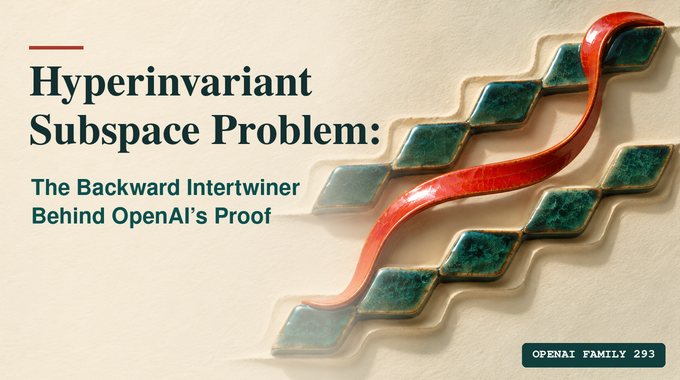
Hyperinvariant subspace problem cover with a red ribbon curling backward between two teal ceramic tracks.

Apply OpenAI’s operator to a vector supported at coordinates 0, 1, 2, and onward, and its support stays in that same tail. Now apply a second operator that commutes with the first. Even a vector concentrated at coordinate 0 can land at coordinate −1, in a different fiber. That backward move is the mechanism behind … Read more
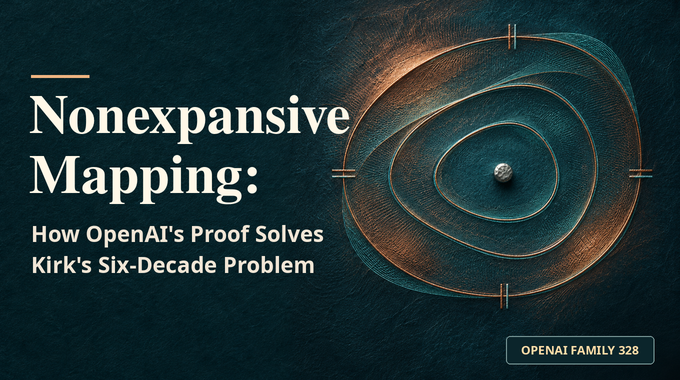
Nonexpansive Mapping: How OpenAI’s Proof Solves Kirk’s Six-Decade Problem

Etched copper contours surround a stationary silver pin, illustrating a fixed point of a nonexpansive mapping.

When must a distance-nonincreasing transformation leave some point unchanged? OpenAI’s September 2026 preprint proves that a nonexpansive mapping from a nonempty, norm-closed, bounded, convex subset of a real reflexive Banach space into itself always has a fixed point. That answers the question left by Kirk’s 1965 theorem for the space’s given norm. The proof begins … Read more

Dimension Reduction in Lp: How OpenAI’s Proof Escapes the Quadratic Trap

A copper lattice passes through a glass lens and emerges as a sparse network, illustrating dimension reduction in Lp.

An exact copy of the distances among a set of points can need quadratically many coordinates, even when the points themselves number only in the dozens. Allow a fixed amount of distortion, however small, and OpenAI’s preprint proves that the worst-case dimension drops below every positive power of the point count. This is dimension reduction … Read more

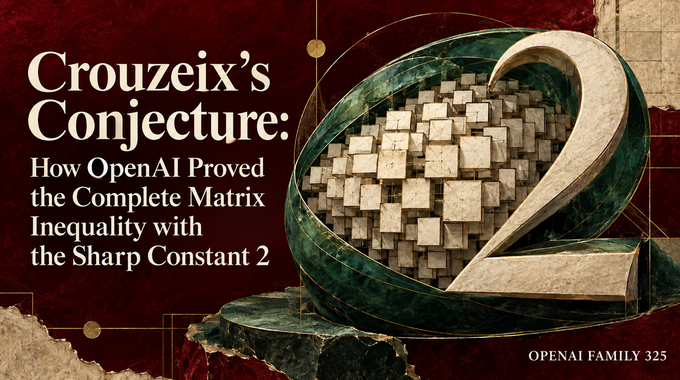
Crouzeix’s Conjecture: How OpenAI Proved the Complete Matrix Inequality with the Sharp Constant 2

Artwork for Crouzeix's conjecture, with matrix tiles enclosed by jade and the sharp constant 2.

A matrix can have only zero eigenvalues and still amplify a vector by a factor of two. That small surprise explains why Crouzeix’s conjecture matters: eigenvalues do not tell the whole story of nonnormal matrices. The right geometric object is their numerical range. OpenAI’s September 26, 2026 direct proof establishes the sharp constant 2 for … Read more