Birkhoff Conjecture: OpenAI’s Proof of the Remarkable Rigidity of Elliptical Billiards
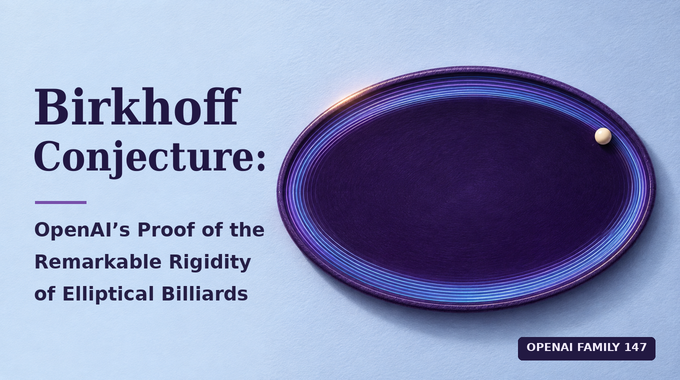
Birkhoff conjecture feature art showing a violet elliptical billiard with a band of nested caustics.

Why are ellipses special billiard tables? Send a ball around an elliptical table at a shallow angle and every leg of its path can stay tangent to the same invisible inner ellipse. The Birkhoff conjecture asks whether that kind of order forces the table itself to be elliptical. OpenAI’s September 24, 2026 manuscript proves the … Read more
Chemical Reaction Network Theory: OpenAI’s Proof That Species Cannot Fade to Zero

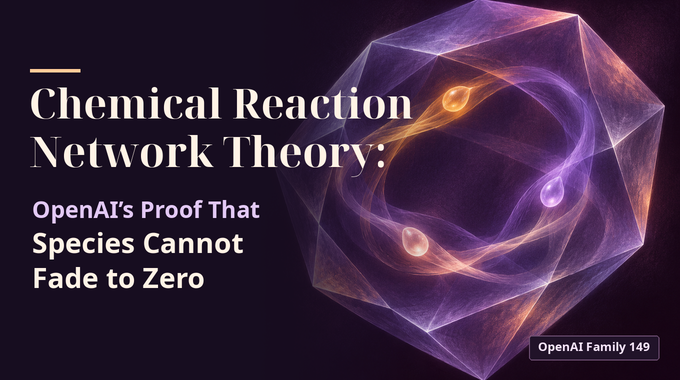
Chemical reaction network theory artwork showing three glowing droplets confined inside a glass polytope.

Can a chemical species fade to zero even if every reaction has a directed return path? For a finite weakly reversible network governed by mass action kinetics, OpenAI’s September 25, 2026 preprint proves that it cannot, provided the reaction rates are positive constants and every species starts at a strictly positive concentration. Theorem 1.1 gives … Read more

Self-Similar Measures: OpenAI’s Proof of the Exact Overlaps Dimension Conjecture

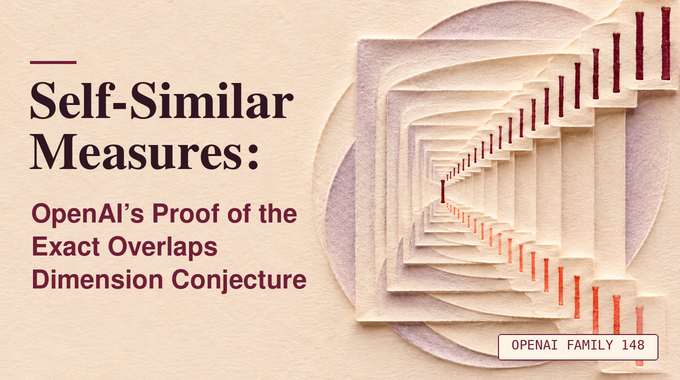
Embossed paths converge on one mark, illustrating exact overlaps in self-similar measures.

Two different instructions can draw precisely the same piece of a fractal. With the maps “divide by three,” “divide by three and add one,” and “divide by three and add four-thirds,” nine two-step paths produce only eight affine maps. Counting those paths as separate outcomes gives the construction more information than it actually carries. OpenAI’s … Read more

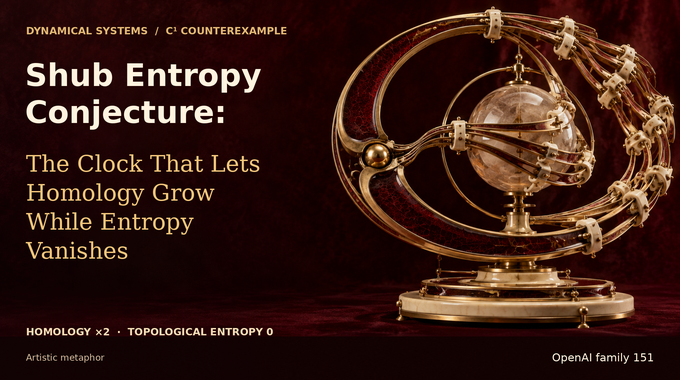
Shub Entropy Conjecture: The Clock That Lets Homology Grow While Entropy Vanishes

Shub entropy conjecture artwork showing a slowing clock and multiplying golden topology.

A sphere map can double aa topological feature every iteration while its observable orbit complexity grows slower than exponentially. OpenAI’s proof makes that mismatch explicit: the general C¹ self-map formulation of the Shub entropy conjecture is false. Its construction has zero topological entropy but an eigenvalue of 2 on second real homology. The mechanism combines … Read more

Standard Map Chaos: How OpenAI Proved Chaotic Motion Occupies Positive Area

Standard map chaos as a yellow woven field on blue fabric, with the complete article title.

A computer can draw a turbulent-looking standard map in seconds. Proving that its chaos occupies positive area, rather than an intricate set of area zero, is a different problem entirely. OpenAI’s September 23, 2026 paper proves that standard map chaos has this stronger, measurable form for every sufficiently large positive parameter. Its result concerns the … Read more

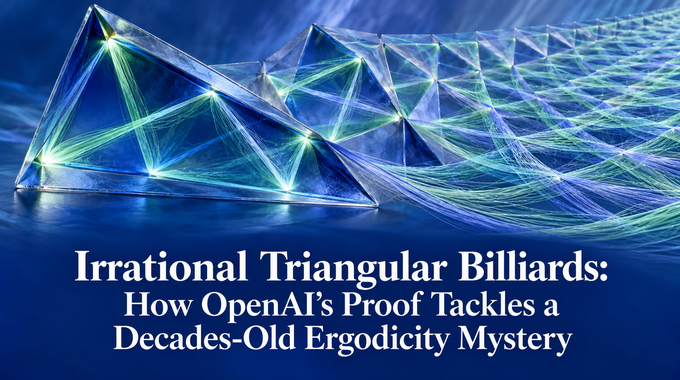
Irrational Triangular Billiards: How OpenAI’s Proof Tackles a Decades-Old Ergodicity Mystery

Irrational Triangular Billiards: OpenAI’s Ergodicity Proof illustrated through jade paths and mirrored triangles.

A particle can ricochet inside a triangle forever, obeying one elementary reflection rule, while hiding a difficult question: does its motion explore position and direction in the correct statistical proportions? OpenAI’s September 25, 2026 manuscript presents a proof that irrational triangular billiards are ergodic whenever at least one interior angle is an irrational multiple of … Read more

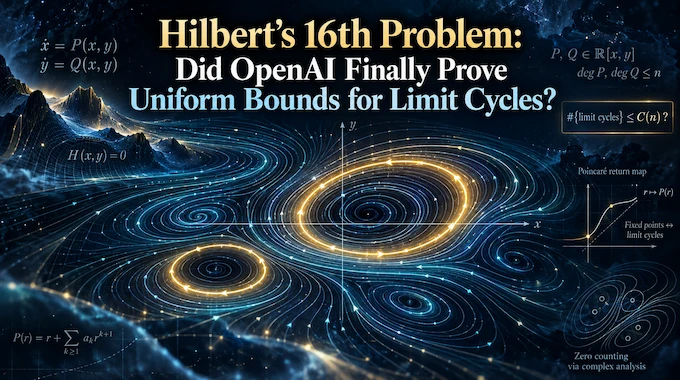
Hilbert’s 16th Problem: Did OpenAI Finally Prove Uniform Bounds for Limit Cycles?

Glowing limit cycle ring under a ceiling line, visualizing Hilbert’s 16th Problem and OpenAI’s uniform bound claim

A mathematical question can survive 126 years not because nobody knows how to count, but because nobody knows whether the counting can ever get out of control. That is the tension behind Hilbert’s 16th Problem, and it sits at the center of a striking new OpenAI manuscript. Released in OpenAI’s October 2026 mathematics collection and … Read more