Memory Sample Tradeoff: Why Perfect Gaussian Measurements Still Demand More Samples
Paper records curl into a narrow slot, illustrating the memory sample tradeoff in noiseless Gaussian regression.

A stack of exact Gaussian equations can pin down an unknown vector after just as many measurements as it has coordinates. Put those same equations through a learner that can read each pair only once and retain at most a fixed multiple of the dimension squared in bits, and the precision changes what it needs. … Read more

Polynomial Identity Testing with Division: How OpenAI’s Proof Constructs Universal Matrix Hitting Lists

Light passes through one set of matrix tiles, illustrating a hit in polynomial identity testing with division.

Imagine a sealed box that accepts a tuple of matrices and returns the value of a hidden formula. Some queries fail because an intermediate matrix has no inverse. Which queries can you choose in advance so that every nonzero formula of a given size gives you a decisive answer? OpenAI’s September 24, 2026 preprint gives … Read more

One-Way Liveness: OpenAI’s Proof That Rereading Cannot Save Exponential States

One-way liveness cover with looping punched tape and a fan of red ceramic tiles representing states.

Give a finite automaton permission to walk back and forth across its input, and it can revisit a choice point as often as it likes. Can that freedom make up for losing nondeterminism? OpenAI’s one-way liveness preprint gives a family for which the answer is no. A nondeterministic machine can recognize the language with h+3h+3 … Read more

Graph Coloring NP-Hard: The OpenAI Proof Behind the Three-Color Paradox

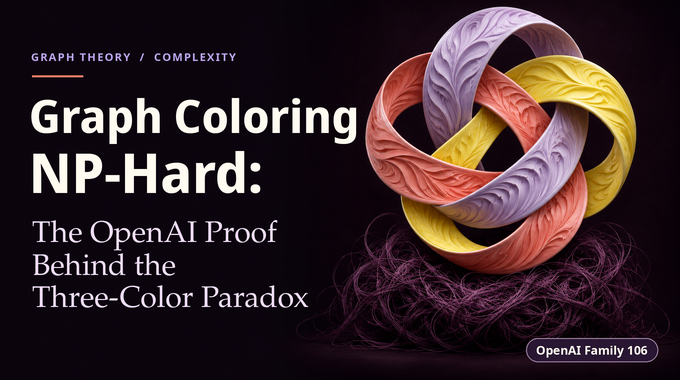
Three porcelain ribbons rise from tangled threads, illustrating why graph coloring is NP-hard.

A graph can come with a guarantee that three colors suffice and still hide a solution that no polynomial-time algorithm can always find, unless P equals NP. Is graph coloring NP hard even if the algorithm gets a larger palette? Yes, for any fixed palette of three or more colors. OpenAI’s September 24, 2026 preprint … Read more

Aaronson Ambainis Conjecture: How One Bit Revealed the Limits of Quantum Speedups

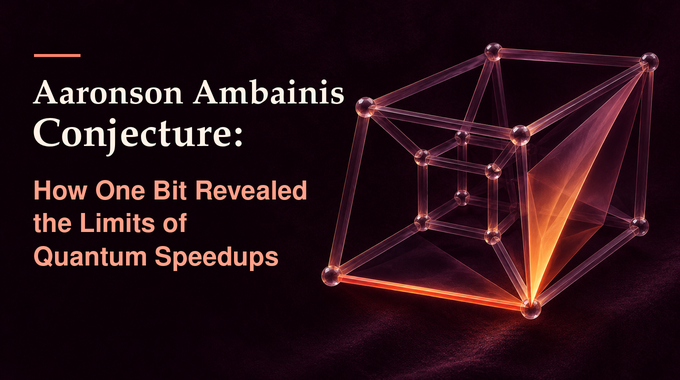
A glowing edge on a glass hypercube represents an influential bit in the Aaronson Ambainis Conjecture.

Suppose a quantum algorithm can query a vast string of bits in superposition, while a classical algorithm has to inspect one bit at a time. How can the classical algorithm know where to look? The November 2026 proof of the Aaronson Ambainis Conjecture gives an answer. Every nonconstant bounded polynomial of low degree on the … Read more

Contingency Table Sampling: The Paradox of Getting Perfect Uniformity from Imperfect Randomness

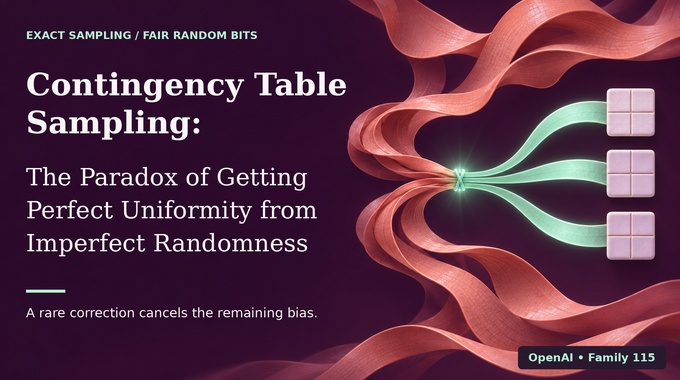
Contingency table sampling shown as coral ribbons corrected into equal mint streams and table tiles.

Three tables can have identical row and column totals yet receive very different probabilities from a careless random generator. Contingency table sampling asks for something stricter: every feasible integer table must have the same chance. OpenAI’s September 24, 2026 manuscript establishes exact uniform sampling for arbitrary nonnegative margins, with polynomial expected bit complexity. Its route … Read more

PCP for PPAD Conjecture: Why Broken Gates Cannot Hide an Answer

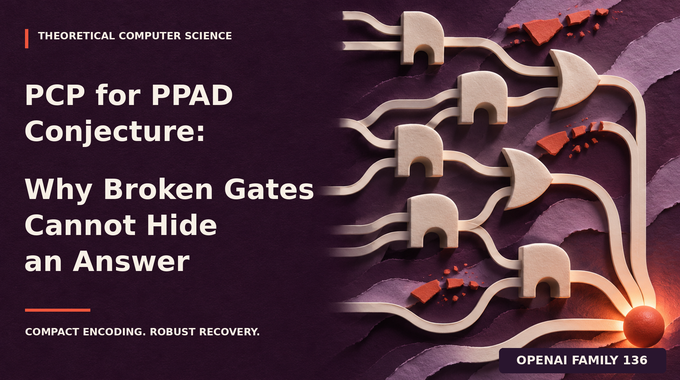
PCP for PPAD Conjecture illustrated by fractured ceramic gates and intact paths converging on an answer.

Imagine a circuit that can conceal its answer by breaking a few carefully chosen gates. The PCP for PPAD Conjecture asks whether that escape route can be closed with almost linear storage overhead. OpenAI’s September 25, 2026 manuscript presents a proof: even an adversarially placed constant fraction of failed constraints cannot prevent polynomial-time recovery of … Read more