Potts Model: OpenAI’s Proof Pinpoints Where Four-State Information Disappears
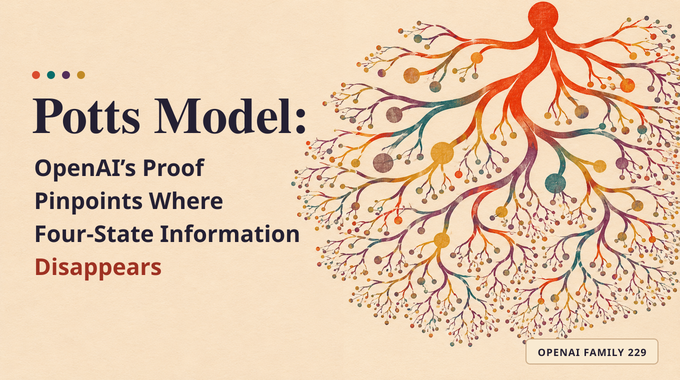
A woodcut Potts model broadcast tree with a vivid root and distant leaves in four mixed colors.

Imagine a telephone game where every player hears one of four colors and passes a noisy copy to several children. You see every color in the last row. As that row gets farther away, can you still tell what the first player heard? For the ferromagnetic four-state Potts model, OpenAI’s proof locates the exact cutoff … Read more
Random Matrix Singularity: OpenAI’s Proof Pins Down the Odds of a Missing Inverse

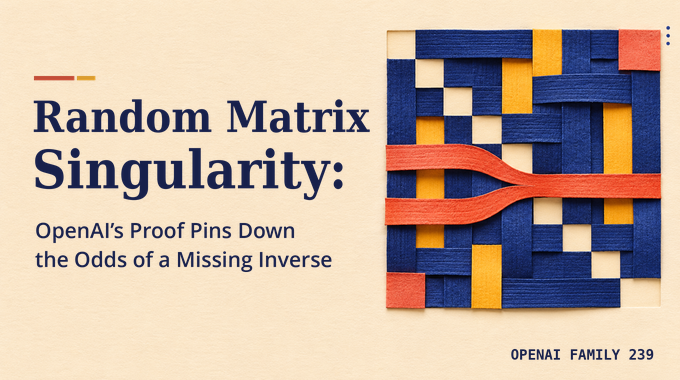
Two coral ribbons merge across a woven random matrix, illustrating how matching rows remove the inverse.

Two rows of a random matrix can match by accident. When they do, the matrix loses its inverse. But rows can also depend on one another in less obvious ways, and symmetry ties their entries together. Can all those other dependencies make singularity exponentially more likely than one matching pair? OpenAI’s October 3, 2026 preprint … Read more

Self-Avoiding Walk: OpenAI’s Proof of the Hidden 3/4 Law on the Honeycomb Lattice

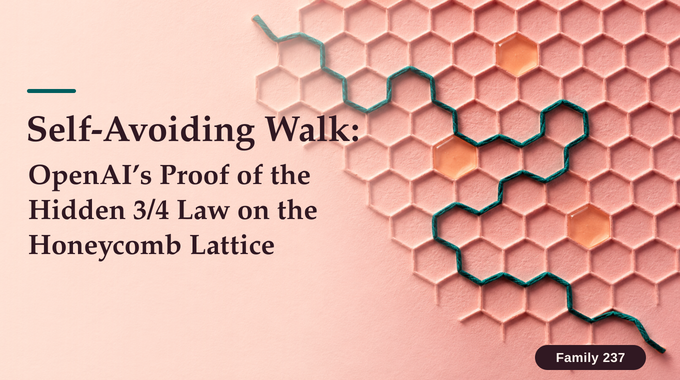
Teal self-avoiding walk stitched across a peach honeycomb lattice beside the article title.

Imagine two routes across a honeycomb grid, each exactly a thousand steps long and each forbidden to touch a vertex twice. One can curl back toward its start while the other reaches across the grid. How much space does a typical route occupy? OpenAI’s manuscript proves that a uniformly sampled nn-step self-avoiding walk on the … Read more

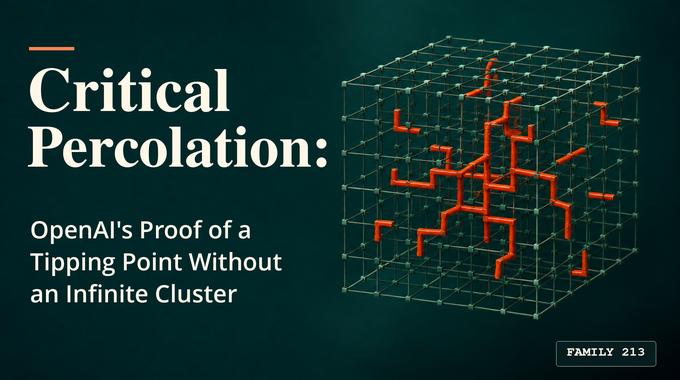
Critical Percolation: OpenAI’s Proof of a Tipping Point Without an Infinite Cluster

Orange finite clusters branch through a cubic lattice in this critical percolation illustration.

At the critical percolation threshold, a random network on the cubic lattice can still contain clusters that stretch across any prescribed finite distance. Yet an infinite open cluster has probability zero. That is Theorem 1.1 of OpenAI’s September 24, 2026 preprint, which proves the statement for nearest-neighbor Bernoulli bond and site percolation on ℤ3\mathbb{Z}^3, each … Read more

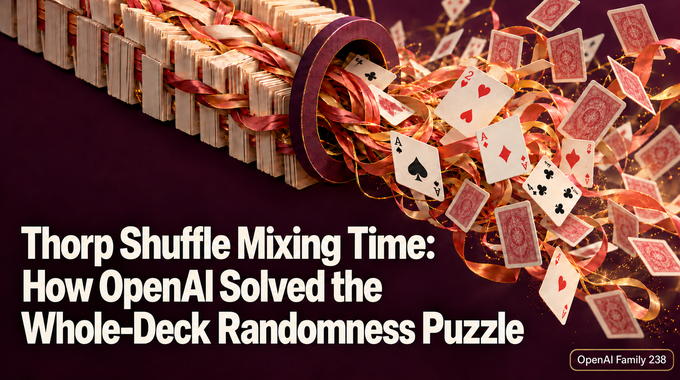
Thorp Shuffle Mixing Time: How OpenAI Solved the Whole-Deck Randomness Puzzle

Thorp shuffle mixing time shown as ranked playing cards escaping a loom of hidden correlations.

After three Thorp shuffles, every card in an eight-card deck has exactly the right chance of occupying every position. Yet almost nine-tenths of all deck orders remain impossible. Each card looks innocent. The correlations give the game away. The Thorp shuffle mixing time asks how quickly the entire deck becomes approximately uniform. OpenAI’s September 26, … Read more

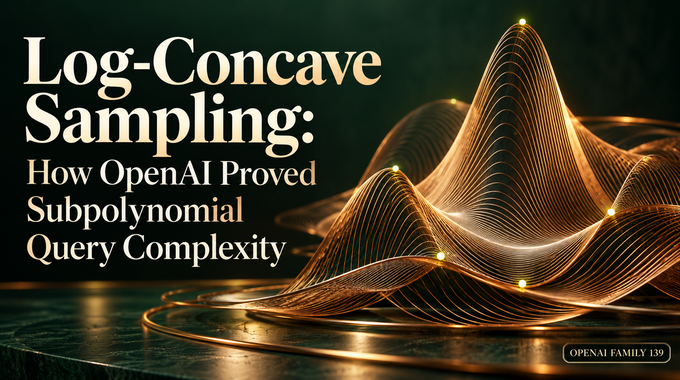
Log-Concave Sampling: How OpenAI Proved Subpolynomial Query Complexity

Log concave sampling artwork with copper probability contours and the OpenAI Family 139 label.

A sampler can know the exact slope of a probability landscape and still spend a dimension-dependent number of queries finding its way around. OpenAI’s manuscript changes that theoretical picture. For log concave sampling with a known minimizer and tightly bounded curvature, it proves that every fixed positive power of dimension can be avoided in the … Read more

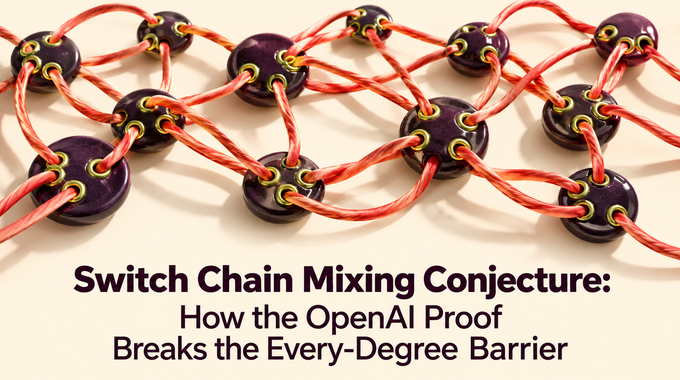
Switch Chain Mixing Conjecture: How the OpenAI Proof Breaks the Every-Degree Barrier

Artwork for the switch chain mixing conjecture showing coral cords threaded through fixed connection points.

Shuffle a network while keeping every person’s number of connections fixed. The operation is easy. Knowing when the shuffled network has forgotten its starting point was the hard part. The switch chain mixing conjecture asks whether this forgetting always takes polynomially many steps. OpenAI’s September 25, 2026 preprint proves the simple-undirected formulation for every graphical … Read more