
At the critical percolation threshold, a random network on the cubic lattice can still contain clusters that stretch across any prescribed finite distance. Yet an infinite open cluster has probability zero. That is Theorem 1.1 of OpenAI’s September 24, 2026 preprint, which proves the statement for nearest-neighbor Bernoulli bond and site percolation on , each at its own critical probability. The proof turns a hypothetical infinite cluster at criticality into reliable connections between finite boxes. Those connections persist when the opening probability drops, allowing the proof to build an infinite cluster below the threshold and reach a contradiction.
Table of Contents
01. Critical Percolation: Does an Infinite Cluster Exist at the Tipping Point?
Translation invariance makes the probability of belonging to an infinite open cluster the same at every vertex. When it vanishes at the origin, the countable union over all vertices shows that almost surely no infinite cluster exists anywhere on the lattice.
| Item | What the Paper Establishes |
|---|---|
| Lattice | Nearest-neighbor cubic lattice |
| Models | Independent Bernoulli bonds and sites |
| Critical result | Almost surely, every open cluster is finite. |
| Transition | The chance that the origin belongs to an infinite cluster tends to zero from above. |
| Proof ingredients | Finite hyperedge comparison, box relays, and adaptive exploration |
An open path can be arbitrarily long while its cluster remains finite. For any fixed length, the event that every required edge or site on a prescribed straight path is open has positive probability. The critical parameter is positive, as follows by counting simple paths and bounding their open probabilities for small opening parameters. An infinite origin cluster would have to reach every distance in the same realization.
02. Bond and Site Percolation on the Cubic Lattice
Each vertex has six nearest neighbors, one unit away in either direction along each coordinate axis. In bond percolation, every edge has an independent Bernoulli bit and opens with probability . All vertices are present, and a path is open when every edge it uses is open. In site percolation the independent bits instead belong to vertices. Every site on an open path must be open, including both endpoints. A path of zero edges therefore connects a bond vertex to itself automatically, while the corresponding site connection requires that vertex to be open.
A specified two-edge path is open with probability for bonds and for sites. The site threshold is strictly higher by a separate result of Grimmett and Stacey.
03. The Percolation Threshold: What Does Critical Nonpercolation Mean?
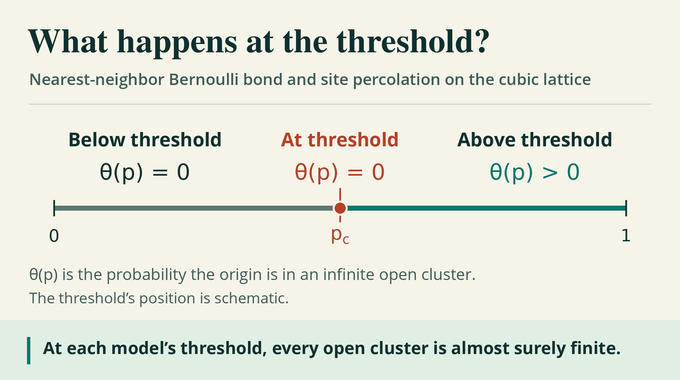
Write for the probability law at parameter and for the probability that the origin belongs to an infinite open cluster. The percolation threshold is defined separately for each model.
Because opening more bits can only add connections, is nondecreasing. Below the threshold it vanishes, and above it the probability is positive. Its value at the threshold is the question settled by the theorem.
Let mean that an open path inside the box of radius connects the origin to the box boundary. A path reaching a larger box must first hit the smaller boundary. These events decrease with , and their intersection is the event that the origin cluster is infinite. The lattice is locally finite, so an infinite connected cluster also contains an infinite simple path from the origin. The finite-box event probabilities are polynomials in .
04. Why Three-Dimensional Critical Percolation Resisted Earlier Proofs
On the square lattice, Harris proved critical bond nonpercolation at one half, and Kesten identified one half as the bond threshold. Russo proved the critical site result on the square lattice. Planar proofs exploit how paths and dual boundaries constrain one another. In 3D percolation, open paths can pass around each other. The lace expansion establishes mean-field behavior for nearest-neighbor bonds in dimensions 11 and higher, with a separate treatment for sites in sufficiently high dimensions.
Grimmett and Marstrand showed that the bond thresholds of widening slabs converge to the full-lattice threshold. Duminil-Copin, Sidoravicius, and Tassion proved critical bond nonpercolation in each fixed slab. Those facts give information at a sequence of slab thresholds. The full-lattice question asks for control of connections across arbitrarily large distances at the limiting parameter.
The preprint credits Justin Leder’s earlier public account of a Lean proof for bonds on for . It also cites work prompted by Ahmed Bou-Rabee that recorded related finite comparisons and reported site nonpercolation for . OpenAI’s contribution here is a self-contained cubic argument with explicit relay geometry for both models. Its mathematics release provides publication context, while the family 213 Lean scope note and comparator specify the formalized cubic claims. The note also describes a broader bond theorem associated with a separate paper.
05. The Finite Hyperedge Inequality That Makes the Proof Possible
Kozma and Nitzan’s reduction linked a finite connection comparison to critical nonpercolation. Proposition 2.1 proves a joint comparison on a finite hypergraph, where a single open hyperedge joins every node it contains. The opening bits are independent and can have different probabilities. Let be the source, a nonempty set of possible relays, and a target set. The notation means that the source connects to at least one member of . The comma denotes the intersection of two events.
If each relay misses the target with probability at most , subtracting the joint probability from the probability of reaching bounds the chance of reaching while missing by . Fixing a bit is equivalent to assigning its opening probability zero or one, so the comparison survives deterministic reveals when the remaining law is a product.
For sites, give each original vertex a private node and each original edge a connector node. The hyperedge controlled by a site joins its private node and all incident connectors. Connections between distinct private nodes encode open site paths. Hypergraph self-connection is automatic, whereas site self-connection requires an open site. On the failure event of interest the source has reached by an open site path and is therefore open. That observation preserves the failure bound even when the source itself belongs to one of the sets.
06. Inside the Inequality: Cluster Columns and Conditional Resampling
Lemma 2.2 orders a list of nodes. For the column associated with , it conditions on the cluster of avoiding every earlier listed node. The row for records the conditional probability that this cluster contains . Entries above the diagonal vanish, and each diagonal entry is one. This makes the columns of the resulting matrix a basis.
Weight each row’s membership indicator by a nonnegative increasing function of the cluster. The lemma says that subtracting the original column times the conditional mean of leaves a nonnegative combination of later columns. To see why the signs can be controlled, condition on the exact cluster union of the earlier nodes. The hyperedges disjoint from that union retain their original law. The proof alternates sampling that union and resampling the cluster of in its complement. The residual compares cluster weights before and after deleting an additional cluster. A coupling shows that this difference is nonnegative and grows with the deleted cluster. Induction then expresses each residual column using nonnegative coefficients. With hyperedge probabilities below one, there is a uniform positive chance of isolating at each resampling, so the iterated function converges to its conditional mean.
To obtain the proposition, list the relays first and the source last. The last row gives a lower bound by a weighted sum of relay-to-target probabilities. The weights are nonnegative and sum to the probability of reaching , so replacing each relay probability by their minimum gives the stated inequality. Continuity extends the result to bits fixed open.
07. Twenty-Four Quarter-Faces and the Move Below Criticality
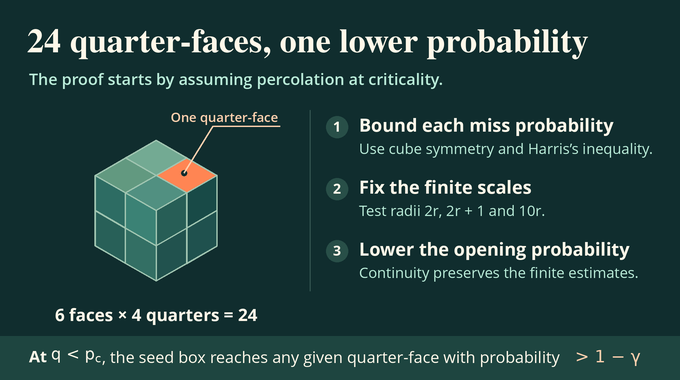
Assume an infinite cluster exists at with positive probability. Existence is a zero-or-one event because changing finitely many bits cannot destroy every infinite component of a locally finite graph. Existence suffices, regardless of the uniqueness of an infinite cluster. Thus large seed boxes meet an infinite cluster with probability approaching one. A cluster that meets the seed box must reach the boundary of any larger concentric cube.
Transverse coordinate signs split each of six faces into four. Symmetry makes the 24 miss probabilities equal. The miss events are decreasing, so Harris positive association bounds the probability of missing them all from below by the product of their probabilities. If the chance of missing the whole boundary is below , each individual miss probability is below . This is a bound for each specified face. A union bound would give for missing at least one face at the lower parameter.
The paper fixes the seed and relay scales before lowering . Only the radii , , and are needed. All the connection tests at those radii involve finitely many bits. At one with , the probability of reaching each specified quarter-face from the seed box still exceeds .
08. The Extension Lemma: How Independent Seeds Create Reliable Connections
Lemma 4.1 starts with a rectangle inside a region whose internal bits are fresh at parameter . The source lies outside the -expansion of . Every point of that expansion must admit a permitted cube lying inside with a quarter-face contained in the target . Under these conditions the probability of reaching but missing is below .
The proof first chooses a deterministic boundary layer. Closing every available entrance on a layer with few entrances prevents the source from reaching any deeper layer. The resulting closure events for different layers are disjoint, so averaging finds one layer where reaching with too few entrances is unlikely. The outside bits identify reachable entrances. Greedy spacing gives disjoint seed boxes, so the seed trials at those selected entrances are independent conditional on the outside bits.
For example, take a reachable exterior vertex with unique inward neighbor . Place a seed box inside the layer containing . If its internal bits are open, the seed center connects to . Bonds require the crossing edge to be open too, giving success probability . For sites, is already open and is part of the open seed, giving probability . Relay quality is computed from the interior alone, averaging over exterior and crossing bits. A relay is good if its conditional chance of reaching exceeds . The table uses for the seed radius, for the number of trials, for a lower bound on single-trial success, and for a lower bound on closing a sparse layer.
| Failure | Bound and Source |
|---|---|
| Sparse layer | Too few reachable entrances. |
| Too few successes | Chebyshev’s inequality for independent trials. |
| Too many weak relays | Markov’s inequality for the weak-relay count. |
| Missed target | The finite comparison after fixing the interior. |
09. The Thirteen-Move Argument Between Neighboring Cubes
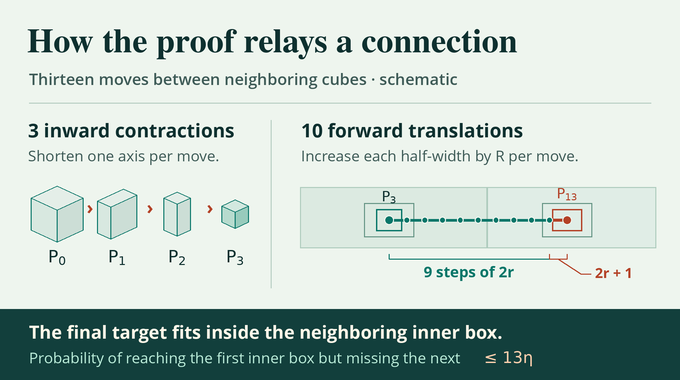
The proof places disjoint cubes of radius on a planar grid with center spacing . Adjacent cubes form a single rectangular prism with interface edges between them. Each contains an inner box of radius . With the source outside the prism, the relay estimate transfers a connection from one inner box to the next.
Three contractions shorten one coordinate direction at a time using inward-facing quarter-faces. The third yields a cube of radius centered at the starting point. Ten translations then move forward. The first nine advance by each, and the last advances by , putting the final center exactly at the neighboring center. At each translation the target half-width grows by to accommodate the extension lemma’s expanded starting region. The final half-width is less than , so the target fits inside the neighboring inner box.
Reaching the first box and missing the last means some move loses the connection. A union bound gives for this failure.
10. Adaptive Exploration: Why Dependence Does Not Break the Argument
Start by opening the root cube and, for bonds, its four interfaces. This has positive probability and leaves every other bit independent at parameter . Queue the four neighbors with the root as parent. Conditional on the revealed history, each pending cube’s inner box must connect to the origin through its parent chain with probability greater than . The root-facing quarter-face estimates give the initial promises.
To process a cube, expose its internal bits and, for bonds, its incoming interface. This decides its connection event. Using the new history, compute a connection probability for each unvisited neighbor without opening that neighbor’s bits. The processed cube is good only if its own connection holds and every tested neighbor meets the promise. A good cube queues those neighbors. Other processing steps leave each pending cube’s unknown bits untouched, so its promise persists.
The two-cube relay estimate is applied before the current reveal, while both cubes and their shared interface are fresh. Averaging the subsequent predictions bounds the probability that the current connection succeeds and a particular neighbor’s prediction falls short at . At most four tests and the possible failure of the current connection give a conditional probability of being declared bad of at most . The bound holds for every revealed history.
11. Planar Contours, the Final Contradiction, and Critical Continuity
If only finitely many cubes are good, the queue empties and every outside neighbor of the good set is bad. A dual boundary cycle in the coarse square grid then separates the root from infinity. For length , the paper counts at most candidate cycles and selects at least crossed edges with disjoint endpoints. Each selected edge must have a bad endpoint. For such edges there are endpoint choices. Each choice has probability at most of being processed and all bad, by applying the conditional bound in processing order. Summing the resulting cycle bounds gives
Thus infinitely many good cubes occur with positive probability after root initialization. Each gives an actual connection to a distinct inner box, producing an infinite cluster at and contradicting the threshold definition.
For critical percolation, this also settles continuity at the percolation phase transition. Choose a finite box whose boundary connection probability at is below a given tolerance. The same bound holds just above by finite-event continuity, and it bounds from above. Hence as . Exact threshold values, critical exponents, and a rate of convergence remain outside the theorem’s scope. Follow Binary Verse AI for more research explainers that trace the argument from the theorem to the steps that prove it.
Does an infinite cluster exist at the critical percolation threshold?
No. OpenAI’s cubic-lattice theorem establishes that nearest-neighbor Bernoulli bond and site percolation on ℤ³ almost surely have no infinite open cluster at their respective critical probabilities.
Can critical percolation have very large clusters without an infinite cluster?
Yes. A critical cluster can span any prescribed finite distance with positive probability. At the critical threshold, every open cluster on the cubic lattice is almost surely finite.
Are bond and site percolation thresholds the same on the cubic lattice?
No. The site threshold is strictly higher. Bond percolation randomly opens edges, while site percolation randomly opens vertices. The paper proves critical nonpercolation separately at each model’s own threshold.
Why did earlier two-dimensional and slab results not settle the cubic-lattice problem?
Planar proofs exploit geometric properties unavailable in three dimensions. Convergence of the slab thresholds gives their limiting value, but the full-lattice result requires controlling connections on arbitrarily large scales at that limit.
How can the proof lower the probability below p_c without losing its connection estimates?
The proof fixes the scales first and obtains strict bounds for finitely many connection events. Their probabilities are continuous in the opening parameter, so the bounds hold at a single nearby parameter below the threshold.
Does the proof assume neighboring successful cubes are independent?
No. The exploration preserves independence of unrevealed Bernoulli bits and controls the conditional failure probability at each step. Those bounds suffice for the contour argument even when the coarse cubes’ success events are dependent.
Does OpenAI’s proof determine the exact percolation threshold or critical exponents?
No. The theorem proves critical nonpercolation and continuity of the infinite-cluster probability at the transition. Exact critical probabilities, critical exponents, and convergence rates remain outside its scope.