Koebe Circle Domain Conjecture: How OpenAI’s Proof Tames Wild Boundaries
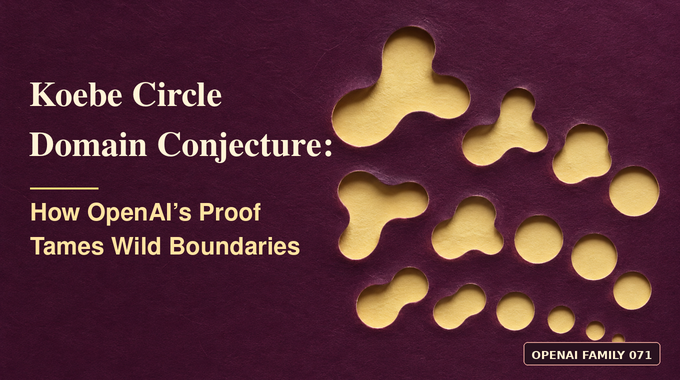
Irregular paper cutouts give way to circles and pinpoints in an illustration of the Koebe circle domain conjecture.

A round disk can survive every stage of a conformal approximation and still fail to fill its hole in the limit. That gap is the central difficulty of the Koebe circle domain conjecture. In a manuscript dated September 23, 2026, OpenAI proves that every domain on the Riemann sphere has a conformally equivalent model whose … Read more
Fourier Series Convergence: How Did OpenAI Solve the L log L Problem?

Engraved waves resolve into one jade trace, illustrating Fourier series convergence.

A Fourier sum can approximate a function in mean square while still behaving erratically at individual points. OpenAI’s September 23, 2026 preprint settles a sharper question about Fourier series convergence. For every complex-valued function in Llog⁡LL\log L on the circle, the ordinary symmetric partial sums converge to the function almost everywhere along the full sequence … Read more

Erdős Similarity Conjecture: OpenAI’s Proof of the Almost-Full Set Paradox

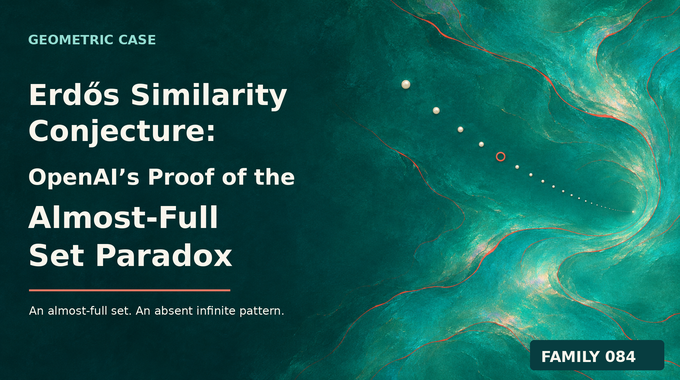
Erdős similarity conjecture artwork showing a nearly intact field and an interrupted geometric sequence.

Remove less than one percent of a unit interval. Can the remaining compact set exclude every translated, stretched, compressed, or reflected copy of an infinite geometric progression? OpenAI’s proof answers yes for every fixed ratio 0<q<10<q<1. Its October 5, 2026 paper establishes the geometric case of the Erdős similarity conjecture: however small the permitted loss … Read more

Trilinear Hilbert Transform: The Quadratic Symmetry OpenAI Had to Untangle

Trilinear Hilbert transform artwork with intertwined curved strips and the exact article title.

A quadratic wave can oscillate furiously while three shifted copies conceal its cancellation. That is the central difficulty behind the trilinear Hilbert transform. OpenAI’s October 5, 2026 manuscript proves the fixed-slope estimate L3×L3×L3→L1L^3\times L^3\times L^3\to L^1 for slopes 1, 2, 3. Its contribution is a method for controlling matched quadratic structure across arbitrarily many scales. … Read more

Brennan Conjecture Proof: How OpenAI Solved a 48-Year Mathematics Problem

Brennan conjecture artwork showing a slit ceramic surface, saddles, and higher peaks linked by lime arcs.

A conformal map can preserve every local angle while squeezing area savagely near a slit. The Brennan conjecture asks whether that distortion nevertheless obeys a universal integrability limit. OpenAI’s 31-page manuscript, dated September 24, 2026, proves the conjectured open interval: the derivative raised to any power strictly between four-thirds and four has finite area integral. … Read more

Kakeya Conjecture in All Dimensions: OpenAI’s Local Smoothing Proof

Local smoothing conjecture artwork showing blue wavefronts converging into a bright, fleeting focus.

A spherical wave can arrive quietly, concentrate into a violent peak, and disperse again. The local smoothing conjecture asks how expensive that peak remains when we measure the wave across time. OpenAI’s October 25, 2026 manuscript presents a proof for every Euclidean spatial dimension from two upward, with consequences for Kakeya sets, Fourier restriction, and … Read more

Littlewood Polynomials: OpenAI Proof Achieves Near-Perfect Two-Sided Flatness Using Only ±1

Littlewood polynomials illustrated by binary sign tiles forming a luminous ring of nearly constant magnitude.

A polynomial can have only two choices for each coefficient and still face an entire circle of tests. OpenAI’s October 5, 2026 manuscript presents a proof that littlewood polynomials with coefficients ±1 can have magnitude arbitrarily close to their natural square-root scale at every angle, for every sufficiently large integer length. The achievement asserted is … Read more