Milnor K-Theory: How OpenAI’s Five-Fiber Proof Reconstructs Function Fields
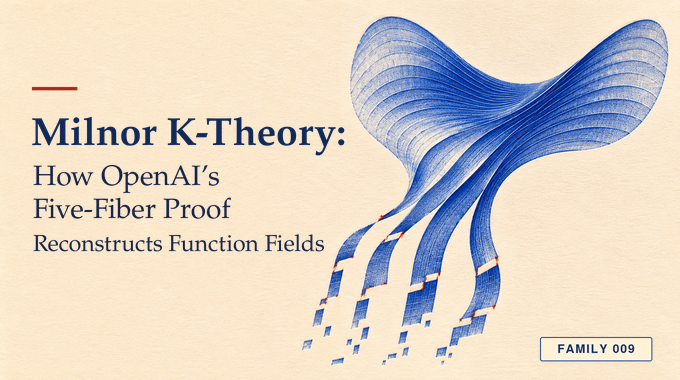
Engraved blue fragments form a surface, illustrating function field reconstruction in Milnor K-Theory.

A zero of order two vanishes from a divisor record taken modulo two. Lose enough zeros and poles this way, and it seems impossible to recover the field that produced them. OpenAI’s Milnor K-Theory manuscript shows why the loss can be overcome. For finitely generated function fields of transcendence degree at least two over algebraically … Read more
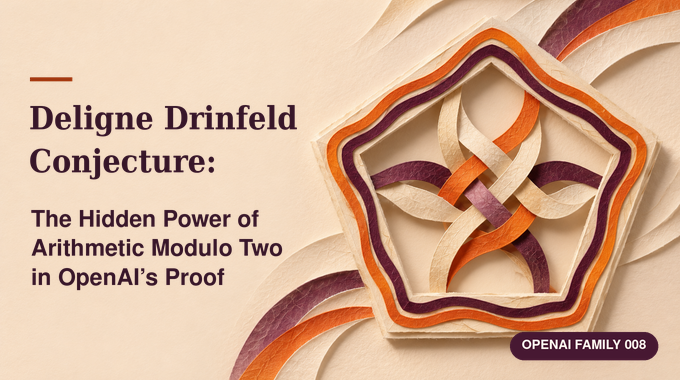
Deligne Drinfeld Conjecture: The Hidden Power of Arithmetic Modulo Two in OpenAI’s Proof

A paper braid inside a pentagon evokes the Deligne Drinfeld conjecture and its modulo-two proof.

Four braid strands can be regrouped along two routes around a pentagon. How many infinitesimal symmetries survive its compatibility equations? The Deligne Drinfeld conjecture predicted a precise answer in every weight, and OpenAI’s September 2026 manuscript proves it. The rational Grothendieck–Teichmüller Lie algebra is freely generated by one element in each odd weight starting at … Read more

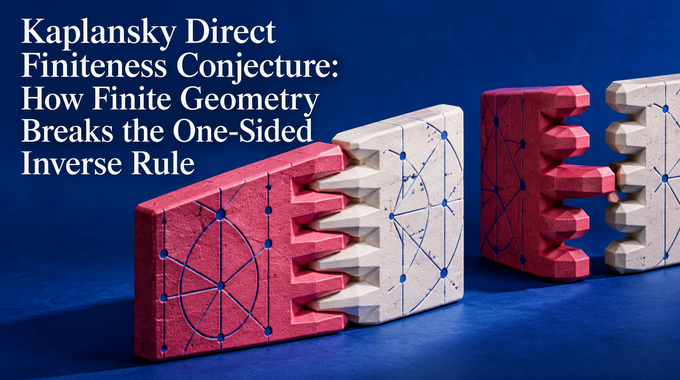
Kaplansky Direct Finiteness Conjecture: How Finite Geometry Breaks the One-Sided Inverse Rule

Kaplansky Direct Finiteness Conjecture illustrated by ceramic combs that fit in one order but clash in reverse.

An inverse is supposed to undo an operation. OpenAI’s September 23, 2026 preprint constructs two finite algebraic expressions that undo each other in one order and fail in the other. The Kaplansky Direct Finiteness Conjecture predicted that this could never happen in a group algebra. The paper presents a characteristic-two counterexample, with a finitely presented … Read more

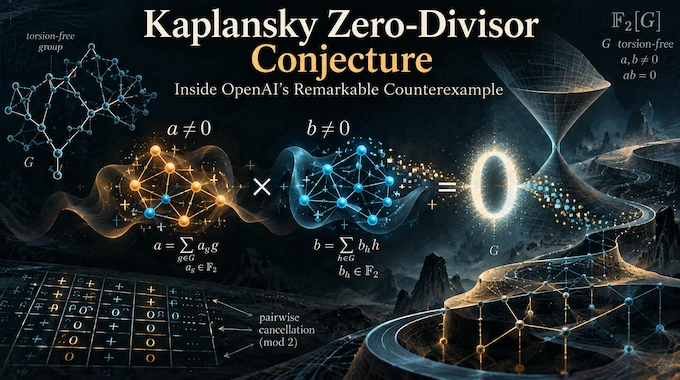
Kaplansky Zero-Divisor Conjecture: Inside OpenAI’s Remarkable Counterexample

Two glowing graphs multiplying to zero, illustrating the Kaplansky Zero-Divisor Conjecture counterexample

For decades, mathematicians had good reasons to believe that a certain kind of algebra could never contain zero divisors. The argument seemed plausible: remove finite-order elements from the underlying group, and the familiar route to producing those troublesome products disappears. But plausibility isn’t a proof. On September 23, 2026, OpenAI released A Torsion-Free Group Algebra … Read more