
Four braid strands can be regrouped along two routes around a pentagon. How many infinitesimal symmetries survive its compatibility equations? The Deligne Drinfeld conjecture predicted a precise answer in every weight, and OpenAI’s September 2026 manuscript proves it. The rational Grothendieck–Teichmüller Lie algebra is freely generated by one element in each odd weight starting at three. The decisive step counts rational solutions by reducing a carefully chosen lattice modulo two. In that setting the pentagon can be tested by deleting letters from words, giving an upper bound that matches the number of independent Lie words the proof constructs over the rationals.
Table of Contents
1. What Is the Deligne–Drinfeld Conjecture?
Think of four strands with parentheses specifying which strands to group first. You can reach the same final grouping by two sequences of elementary reassociations. A Drinfeld associator makes those routes agree and also interacts with braiding, which exchanges strands. The Grothendieck–Teichmüller group encodes symmetries of this structure. Its Lie algebra describes the corresponding infinitesimal changes.
Let be the space of rational homogeneous Lie polynomials of weight satisfying the three equations below, and let . Theorem 1.1 of the original manuscript asserts that there exist homogeneous for every such that the following map is a graded Lie algebra isomorphism.
The theorem includes closure under the Ihara bracket and a continuous graded isomorphism after weight completion. The generators are choices. Freeness means their brackets have only the universal Lie relations, and generation means those brackets and the generators span every solution.
2. The Grothendieck–Teichmüller Lie Algebra Explained
The free Lie algebra on consists of bracket polynomials in two letters, subject to bilinearity, alternation and Jacobi. It embeds in the associative word algebra, where . Weight counts both letters, so has weight three. In the braid Lie algebra on four strands, records a pair of strands. Disjoint pairs commute, and for distinct indices.
Antisymmetry reverses the arguments of . The three-term identity cycles , where . The pentagon equates the two reassociation routes inside the four-strand braid Lie algebra.
To describe their Lie bracket, define a derivation by and , then extend it by the bracket product rule. The resulting Ihara bracket adds the input weights.
3. Why the Conjecture Remained Unsolved
Drinfeld credited Ihara with odd-weight existence and gave an associator proof. Francis Brown’s work on mixed Tate motives over the integers supplied a free Lie subalgebra through the faithful action of the prounipotent motivic Galois group on the fundamental group of the projective line punctured at . Thomas Willwacher also proved freeness for homogeneous odd-weight families with a nonzero coefficient of at weight .
The remaining question was whether every solution came from that free subalgebra. Florian Naef and Willwacher’s computations for the linearized Kashiwara–Vergne algebra, combined with known inclusions, confirmed equality through weight 29. OpenAI’s main estimate rules out extra dimensions in every weight, so it addresses the gap that finite-weight checks leave open.
4. OpenAI’s Proof: A Roadmap from Rational Numbers to Characteristic Two
The manuscript builds an upper bound by compressing the equations and a lower bound by constructing independent solutions. The six stages below follow the logic of the proof. OpenAI attributes the release to an internal model, and its published reasoning summaries cover other results.
- Preserve the rational count. Choose representatives with odd denominators so reduction modulo two preserves the dimension.
- Keep the leading pentagon. Rewrite the reduced solutions in three letters and organize them by the number of occurrences of one letter. Transport the leading piece to an arrangement algebra that admits word tests.
- Prove the projection is faithful. Drop one letter, then use deletion tests and a further identity to show that a leading piece with zero image was already zero.
- Count the possible images. Polynomial shifts force the surviving building blocks to be commutators of odd weight. The free Lie algebra on those commutators supplies the ceiling.
- Construct the missing directions over the rationals. Compare two braid transports to find a solution with a nonzero coefficient on a word containing exactly one copy of the second letter in each odd weight.
- Match the counts. Combine these directions with independent brackets of lower-weight generators. Dimension equality forces those elements to account for the entire solution space.
5. Why Arithmetic Modulo Two Changes the Problem
Rational numbers can have even denominators, so arbitrary rational coefficients cannot be reduced modulo two. The paper localizes at two, using , the rationals with odd denominators. The ring of 2-adic integers comes from completing with respect to powers of two.
Intersect with the weight- free Lie lattice over to obtain . This intersection is saturated. If and is a solution, then is a rational solution and belongs to . Thus reduction embeds into . Clearing denominators shows the lattice spans over . Its rank becomes the dimension of its reduction . The argument bounds this embedded space of liftable solutions. The integral targets of the defining equations are torsion-free, so an equation that vanishes over the rationals still vanishes in the lattice before reduction.
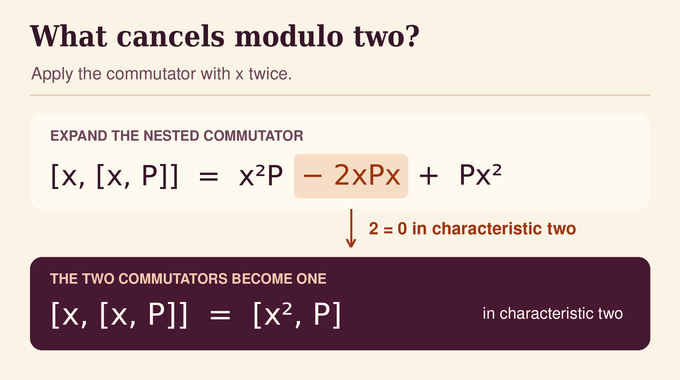
In the associative algebra over , let . Applying it twice gives . The middle term vanishes and addition equals subtraction, leaving the identity that pairs successive adjoint operations.
6. Transforming the Pentagon Equation
The paired adjoints let the proof encode homogeneous Lie polynomials of weight greater than one in a new alphabet inside the associative word algebra.
The leading words have unique concatenation decodings, so this substitution is injective. Here is an associative square, and the expressions under study are ordinary Lie polynomials in the new letters. Give weight two and weight one. The filtration consists of terms with at least letters . At count a leading component of weight has letters from , where .
In the pentagon, the symbols replacing are single braid generators of a specified type. Four terms contribute to the count- equation, while the substitution using only generators of that type has count . The paper transfers the four terms to the level-two cyclotomic hyperplane arrangement, defined over by and , with integral incidence relations reduced afterward. This keeps the plus and minus hyperplanes distinct.
The transfer uses a common word ordering. Source corrections can increase the count and target corrections can decrease it. The count-preserving calculations agree. Independence of ordered words on the braid side forces their count-preserving coefficients to vanish. The target therefore satisfies the leading relation modulo lower-count terms.
7. How Deletion Operators Recover Hidden Information
Deletion operators act on words with designated endpoints. Each deletes an internal letter with a coefficient determined by its neighbors and the orders of their differences along the arrangement hyperplanes. The operators satisfy the integral arrangement relations. A test that empties a word with zeros needs at least operators of the type replacing . This kills the lower-count remainder and turns the four-term relation into exact scalar constraints.
Suppose the projection vanishes. The deletion tests force the terms involving both and to vanish, so a candidate kernel element depends only on . Drinfeld’s special identity, derived over before reduction, then equates coefficients for words obtained by exchanging an and a . With at least two ’s, a coefficient with three ’s receives three copies of that common coefficient. Three equals one modulo two, so the coefficient must vanish. For a single , the symmetry interchanging and and the ordinary Lie bracket rule eliminate the remaining cases. Hence projection detects each associated graded piece of the reduced solution space.
8. Why Only Odd-Weight Generators Are Needed
Write . Antisymmetry and a restriction on the surviving iterated brackets imply for every polynomial , even with independent scalar parameters. The substitution cannot increase -count, and the bracket restriction rules out any count below . What remains is the original count- expression.
Encode a word by the monomial . Replacing the th by a power of identifies its two neighboring exponent variables. The coefficients linear in the shift parameter give a Vandermonde system on these identifications. Its determinant is nonzero over the rational function field in independent variables over . Thus each identification kills the encoded polynomial, which is divisible by the product of the adjacent differences.
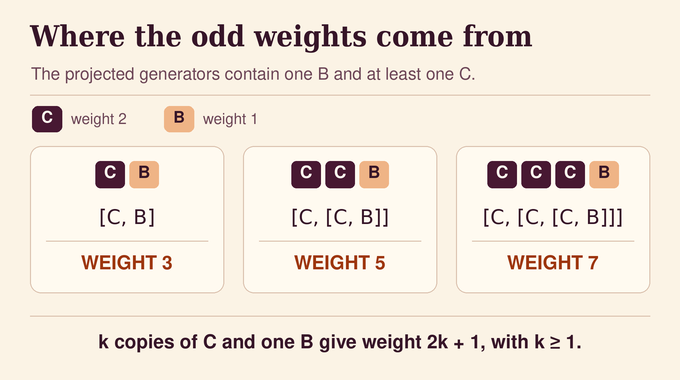
In the iterated-commutator basis this divisibility excludes any factor . For , the word encodes as , which vanishes when the two variables coincide. The word encodes as and fails the same test. The surviving ordinary free Lie alphabet consists of the iterated adjoints below.
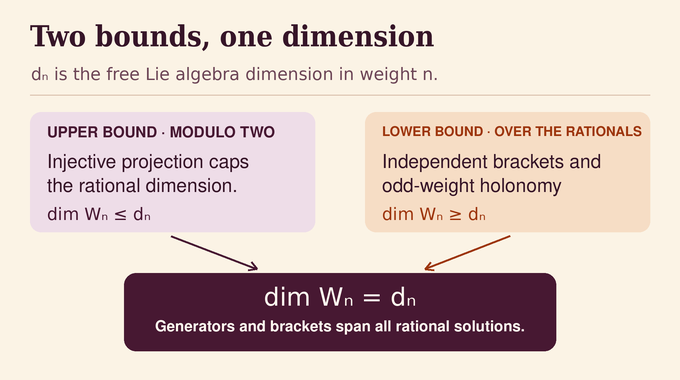
Each contains one and copies of , giving weight . Lie words of length in these generators have -count . If is the weight- dimension of this free Lie algebra, a Hall basis gives the same count over and . Summing the injective bounds over gives in every weight.
9. Constructing the Rational Generators Through Holonomy
The lower bound requires a rational solution at every odd weight with a nonzero coefficient on . Braid holonomy transports along paths in the space of distinct points. Regularization removes the endpoint singularities associated with clustering points. On a reassociation path the transport gives the associator series . The paper compares this transport with the rule that conjugates the paths and negates the chord generators.
The path is real, so conjugation fixes it. At ordinary depth one, the operator logarithm of the comparison is read from . Negating both letters changes the sign in odd weight. The relevant coefficient of is with , and the convergent series is positive. In the comparison logarithm the coefficient consequently doubles in odd weight. Evaluation on the reassociation arrow sends compatible categorical derivations to a Lie subalgebra of solutions. In each weight the compatibility conditions are finite and defined over the rationals. The complex calculation shows that the coefficient functional on this system is nonzero. It therefore has a nonzero value at some rational solution. The argument uses zeta nonvanishing and leaves independence questions about multiple zeta values untouched.
10. The Dimension Squeeze That Completes the Proof
Induct on weight. The brackets of previously selected integral generators have independent leading projections because the projected Ihara bracket is the ordinary commutator and the corresponding Hall words are independent. A relation among their images would already appear at its smallest -count, where the projected words of that count are independent.
The old Hall words supply all directions in even weight and in odd weight . Holonomy supplies the last direction in odd weight. Bracketing adds ordinary depths, so the old words have no term with exactly one . Ordinary depth counts ’s, whereas contributes a and has zero -count.
The upper bound is attained in each filtration piece because the individual deficits are nonnegative. At count one in weight , the image fills the line spanned by . Lift its nonzero class to choose the next integral generator. The holonomy witness gives the dimension and the lift advances the induction. The resulting Hall images span and are independent in each weight. Passing from the direct sum to the product of the finite-dimensional weight spaces gives the completed isomorphism.
11. What the New Free Lie Algebra Structure Reveals
The first even-weight bracket between distinct generators has weight eight, since . Weight six would require , which vanishes by alternation. At weight nine a bracket using three copies of also vanishes, leaving as the only basis element.
The motivic Lie subalgebra from Brown’s work now exhausts the rational solution algebra weight by weight. Willwacher’s earlier isomorphism also identifies the zeroth cohomology of Kontsevich’s graph complex with the completed free Lie algebra on these generators. The cohomological degree zero and the odd generator weights refer to different gradings.
12. Lean Verification, Mathematical Significance and Remaining Questions
OpenAI’s Lean scope note covers the rational equation space, its Ihara bracket and the continuous isomorphism after weight completion. The Comparator challenge states the target theorem, with its proof in a separate module. Regularized transport and the graph-complex consequence fall outside that formalization.
Thomas Willwacher subsequently streamlined the characteristic-two proof. Nikita Markarian interpreted the projection geometrically using a double cover and filling a puncture. Minoru Hirose gave an alternative proof using confluence relations and a Hoffman-basis result over the same localized ring. The full space of solutions defined directly in characteristic two and other graph-complex cohomology degrees lie beyond the original theorem. The reusable idea is to preserve a characteristic-zero dimension through a lattice, then exploit new identities in the reduced equations.
The Deligne Drinfeld conjecture is settled because the mod-two projection preserves enough information to count rational solutions, and the rational construction meets that count in every weight. Follow Binary Verse AI for more research explainers on AI-assisted mathematics, including the formalization of Fermat’s Last Theorem in Lean.
What is the Deligne–Drinfeld conjecture?
It states that the rational Grothendieck–Teichmüller Lie algebra, with the Ihara bracket, is freely generated by one element in each odd weight starting at three. The result also holds after completion by weight.
Has OpenAI proved the Deligne–Drinfeld conjecture?
Yes. OpenAI’s September 23, 2026 manuscript proves freeness and generation in every weight. Thomas Willwacher later posted a streamlined version of the proof, and Minoru Hirose gave an alternative proof.
Why does OpenAI’s proof use characteristic two?
Modulo two, applying a commutator with the same letter twice is equivalent to taking one commutator with its associative square. This reorganizes the pentagon, makes its leading terms amenable to an injective projection, and bounds the dimension of the rational solution space in every weight.
Is the Deligne–Drinfeld proof based on 2-adic numbers?
The main reduction uses , the localization consisting of rationals with odd denominators, and then reduces the solution lattice modulo two. The 2-adic integers form the completion with respect to powers of two.
Why does the Grothendieck–Teichmüller Lie algebra have odd-weight generators?
The projected free Lie alphabet consists of for . Each contains copies of the weight-two letter and one weight-one letter , giving weight . The rational proof attains the dimension bound supplied by this alphabet.
Has the Deligne–Drinfeld conjecture been formally verified in Lean?
Yes. The published formalization covers the main rational Lie algebra theorem and the continuous isomorphism after weight completion. Its stated scope excludes the regularized-transport proposition and the graph-complex consequence.
Why is the Deligne–Drinfeld conjecture important?
It describes all infinitesimal associator symmetries in the rational solution algebra and identifies that algebra with the motivic Lie algebra already embedded in it. Through Willwacher’s isomorphism it also determines the zeroth cohomology of Kontsevich’s graph complex as a completed Lie algebra.