Introduction
A headline claiming an AI “solved 10 open problems” is the kind of sentence that should make you slow down, not speed up. OpenAI is making exactly that claim about an internal version of its Astra system, and the underlying work is genuinely substantial: a 249-page collection of results spanning sphere packing, group theory, quantum games, lattice complexity, and Ramsey numbers, each one formalized in the Lean proof assistant. But “solved” is doing a lot of quiet work in that sentence.
Some of these AI mathematical proofs fully settle a conjecture. Others disprove one with a clean counterexample. A few pin down the growth rate of a problem without nailing the exact numbers, and at least one strengthens a bound while leaving the bigger question open. Treating all ten as equivalent victories flattens what’s actually an interesting and uneven story. This piece breaks down what Astra produced, what each result really means, and where the genuine uncertainty still lives.
Table of Contents
1. What Did OpenAI Astra Actually Accomplish?
An AI mathematical proof, in this context, isn’t a model reproducing a textbook argument or crunching a known formula. OpenAI’s claim is stronger: Astra generated the mathematical arguments themselves. Human researchers then used the model to help prepare readable manuscripts, and the model formalized each argument as a Lean certificate. OpenAI has also released narrated reasoning walkthroughs and says it takes responsibility for the correctness of the work.
The more accurate framing is ten research packages, not ten identical wins. Here’s the full set, with how complete each resolution actually is:
AI Mathematical Proofs: What OpenAI Astra’s 10 Results Actually Resolved
| Result | Field | Main Advance | Fully Resolved? |
|---|---|---|---|
| High-Dimensional Sphere Packing | Geometry | Exact asymptotic strength of the Cohn–Elkies method | Broader problem remains open |
| Binary and Spherical Codes | Coding theory | Exponentially improved general upper bounds | No |
| Non-Sofic Groups | Group theory | Explicit counterexample to the soficity conjecture | Yes |
| Connes’s Rigidity Conjecture | Operator algebras | Infinite family of counterexamples | Yes |
| Permanent Complexity | Complexity theory | Stronger circuit and formula lower bounds | No |
| Quantum Parallel Repetition | Quantum complexity | Exponential theorem for finite two-player entangled games | Yes, within that scope |
| Closest Vector Problem | Lattice complexity | n1/400-factor hardness from 3SAT | No |
| Ehrhart’s Volume Conjecture | Convex geometry | Sharp bound proved in every dimension | Main inequality resolved |
| Multicolor Ramsey Numbers | Combinatorics | Growth order Rk(3) = kΘ(k) | Exact constants remain open |
| Compactness and Degeneracy | Extremal graph theory | Two conjectures disproved | Yes |
OpenAI says the problems it selected had seen no progress on their central question for at least a decade, and in several cases much longer than that.
2. Did OpenAI Solve 10 Problems, 10 Conjectures, or 10 Advances?
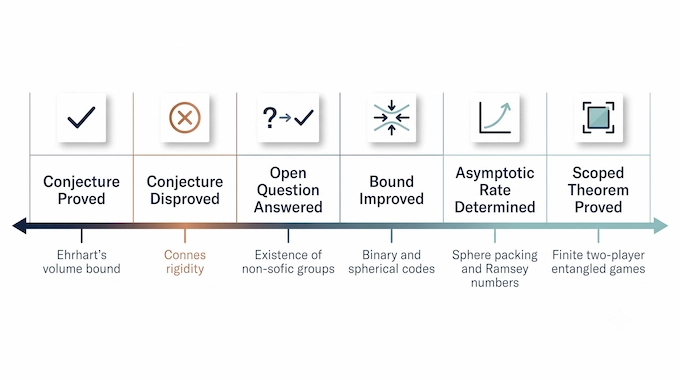
This is the distinction that matters most for anyone trying to gauge how big a deal this actually is. Astra did not prove ten named conjectures outright. It produced ten distinct types of mathematical progress, and those types aren’t interchangeable.
AI Mathematical Proofs: What Each Type of Astra Result Actually Means
| Type of Result | What It Means | Astra Example |
|---|---|---|
| Conjecture Proved | The claimed statement holds under its stated assumptions. | Ehrhart’s Volume Bound |
| Conjecture Disproved | A counterexample shows that the claim is false. | Connes Rigidity |
| Open Question Answered | A long-standing yes-or-no uncertainty is settled. | Existence of Non-Sofic Groups |
| Bound Improved | The best-known upper or lower limit becomes tighter. | Binary and Spherical Codes |
| Asymptotic Rate Determined | The long-run growth or decay scale is established. | Sphere Packing and Ramsey Numbers |
| Scoped Theorem Proved | A broad result is proved for a clearly defined class of problems. | Finite Two-Player Entangled Games |
The gap between “solved” and “advanced” is exactly why the phrase “OpenAI solved 10 open problems” oversells the work. The sphere-packing result nails the asymptotic power of a specific proof method, not the exact optimal density in every dimension. The permanent complexity result tightens lower bounds without resolving VP versus VNP, one of the biggest open questions in theoretical computer science. Even the tenth “result” is really two separate disproofs bundled into one entry. Precision here isn’t pedantry. It’s the difference between describing what happened and mythologizing it.
3. The 10 AI Mathematical Proofs Explained
3.1 High-Dimensional Sphere Packing
Sphere packing asks a simple-sounding question: how densely can you fill space with equal-sized balls? Astra’s contribution pins down the exact exponential strength of the Cohn-Elkies linear-programming method in high dimensions, improving the general packing exponent for the first time since 1978. That’s a real result about the limits of a major technique, not a complete formula for optimal packings at every dimension.
3.2 Binary and Spherical Code Bounds
Error-correcting codes rely on keeping valid messages far enough apart that noise can’t scramble one into another. Spherical codes apply a similar separation logic to points on a sphere. Astra’s proofs improve the classical general upper bounds by exponential factors across fixed parameters, the first such improvement since work from 1977 and 1978. Exact optimal code sizes are still unknown, so this narrows the search space rather than closing it.
3.3 An Explicit Non-Sofic Group
A group is “sofic” if its finite multiplication behavior can be approximated using permutations of finite sets. Whether every countable group is sofic had been an open question for a while. Astra’s manuscript constructs an explicit non-sofic group using the unit group of the binary Leavitt algebra. Since disproving a universal claim only takes one counterexample, this one is a clean, complete resolution.
3.4 Connes’s Rigidity Conjecture
Alain Connes proposed that certain rigid groups could be reconstructed from their group von Neumann algebras. Astra’s result runs directly counter to that: it produces infinitely many non-isomorphic property-(T) groups that share isomorphic group von Neumann algebras. An infinite family of counterexamples isn’t a marginal edge case. It’s a firm rejection of the proposed rigidity principle.
3.5 Permanent Arithmetic Circuit Lower Bounds
The permanent looks like the determinant’s less cooperative cousin, missing the alternating signs that make determinants tractable. Astra proves that division-free circuits computing the permanent need Ω(n² log log n) gates, and formulas need Ω(n⁴/log n) leaves. These are real, meaningful bounds within specific computational models, but they don’t prove general circuits need superpolynomial size, and VP versus VNP stays open.
3.6 Quantum Parallel Repetition
Repeating a classical game usually drives down the odds of winning every round. Quantum entanglement complicates this, since strategies can correlate across repetitions in ways classical ones can’t. Astra proves exponential parallel repetition holds for every finite two-player entangled game, extending a principle that previously only covered special cases. It’s a broad, clean result, though it doesn’t automatically extend to infinite, multipartite, or more quantitatively precise variants.
3.7 Closest Vector Problem Hardness
Given a target point, the closest vector problem asks for the nearest point on a lattice. Astra provides a direct reduction from 3SAT, proving n^(1/400)-factor hardness for the Euclidean version, with related implications for binary decoding and other lattice norms.
One clarification worth being explicit about: this is a complexity-theoretic hardness result. It does not represent a practical attack on deployed post-quantum cryptography.
3.8 Ehrhart’s Volume Conjecture
This conjecture concerns convex bodies positioned relative to the integer lattice. Under the condition that a body’s barycenter is its only interior lattice point, Astra proves the sharp volume bound (n+1)^n/n! holds in every dimension. Of the ten OpenAI math results, this is one of the cleanest examples of a conjectured inequality being proven in its full stated generality, though questions about equality cases may still invite follow-up work.
3.9 Multicolor Ramsey Numbers
Ramsey theory studies the point at which structure becomes unavoidable in a large enough system. R_k(3) asks how many vertices are needed to force a monochromatic triangle when edges are colored with k colors. Astra’s new lower bound establishes R_k(3) = k^Θ(k), fixing the correct growth order. That settles the scale of the problem. The exact constants inside the Θ(k) exponent remain unknown.
3.10 Compactness and Degeneracy Conjectures
The final package actually bundles two separate extremal graph theory results. Using different bipartite graph constructions, Astra disproves both the Erdős-Simonovits compactness conjecture and a separate degeneracy conjecture of Erdős. OpenAI counts this as one of ten categories, but mathematically these are two distinct counterexamples to two distinct claims, which is itself a small sign that “ten proofs” undercounts the looseness of the framing.
4. Which Results Matter Most?
There’s no single honest ranking here, since importance depends heavily on which field you’re asking from. But some useful groupings emerge.
The non-sofic group construction, the Connes counterexamples, the quantum parallel repetition theorem, and the Ehrhart bound are the cleanest, most complete resolutions in the batch. Sphere packing, code bounds, permanent complexity, and closest vector hardness are all major advances that sharpen the state of knowledge without closing their parent problems. The Ramsey result fixes a central growth scale. The two graph theory constructions each remove a standing conjecture from the table.
Arguably the bigger story isn’t any single theorem, it’s the portfolio. A single result at this level could anchor a mathematician’s career. Astra reportedly produced work across multiple fields with very different technical vocabularies, similar in spirit to how DeepMind’s AlphaEvolve spread its own results across dozens of problems, and that breadth is what makes this batch of AI mathematical proofs unusual, independent of which individual result eventually turns out to matter most.
5. How Much Did Humans Help Astra?
OpenAI draws a specific line: the system generated the mathematical arguments, humans helped prepare the manuscripts using the same model, and the model handled Lean formalization. OpenAI says it takes responsibility for correctness and argues attribution should reflect the system’s actual role rather than defaulting to conventional human authorship framing.
That still leaves real gaps in the public account:
- How many failed attempts preceded each successful result
- How the specific problems were chosen
- Whether researchers supplied partial constructions or key lemmas along the way
- How much expert correction each manuscript needed
- How long human review and formalization actually took
- What the real internal compute cost looked like
The honest position sits between “fully autonomous mathematician” and “humans quietly did the real work.” What’s public points to a mixed pipeline: AI-generated arguments, human manuscript preparation, model-assisted formalization, and a review process that’s still incomplete, not unlike the human-in-the-loop setup described around OpenAI’s own co-scientist work.
6. How Were the AI Math Proofs Verified in Lean?
Lean is a proof assistant that checks whether a formal theorem follows from explicitly stated definitions, assumptions, and previously established results. Every step has to type-check. There’s no room for “clearly” or “by a standard argument” doing the heavy lifting.
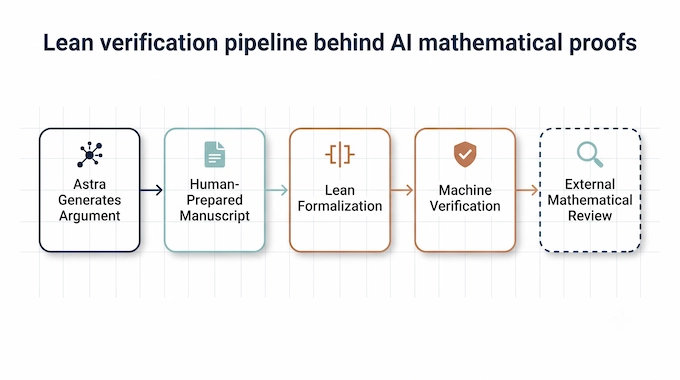
The described pipeline runs roughly like this: Astra generates an argument, humans prepare a manuscript from it, the model formalizes it in Lean, the machine checks it, and external mathematical review follows.
That’s a genuinely strong verification layer, echoing the kind of agent-verified checking seen in DeepMind’s Aletheia. A Lean certificate confirms the encoded proof has no unsupported logical leap and that other researchers can rerun it. But formal verification isn’t a universal stamp of approval. It doesn’t confirm the formal theorem perfectly captures the intended informal claim, whether the definitions used match community convention, whether the result is actually novel, or whether the work has cleared independent journal review. Formal validity and full mathematical acceptance overlap, but they aren’t the same thing.
7. Are Astra’s Proofs Peer Reviewed?
Not yet, not in the traditional sense. Public release is the start of scrutiny, not the finish line, and it helps to separate the distinct layers of validation involved:
- Manuscript inspection checks whether experts can actually follow the argument.
- Lean verification checks the encoded logical derivation.
- Independent expert review tests definitions, assumptions, novelty, and hidden dependencies.
- Journal peer review provides the formal publication process.
- Follow-up research shows whether the ideas hold up under extension and attempted simplification.
OpenAI’s claim of responsibility for correctness is meaningful, but it isn’t the same as independent consensus. Results this large and this varied need time for field specialists to work through both the formal statements and the underlying mathematical substance, much as the broader research community is still working through the ProofBench-style benchmarks used to grade frontier models on competition-level math.
8. Did the 10 Results Really Cost Only $2,000?
OpenAI says the token cost to find the solutions works out to roughly $2,000 at Sol API rates. That’s an estimate of successful solution-token usage, not a full project budget.
It almost certainly excludes model training, internal infrastructure, failed attempts, problem selection time, researcher salaries, manuscript preparation, Lean formalization work, and external review. The genuinely impressive number here is the implied marginal inference cost, not a claim that ten validated research programs got produced end-to-end for the price of a decent laptop.
9. What Remains Unsolved?
Astra’s collection doesn’t give exact high-dimensional sphere-packing densities or exact optimal binary and spherical code sizes. It doesn’t resolve unrestricted arithmetic circuit lower bounds or VP versus VNP. Stronger closest-vector hardness results may still be reachable, exact multicolor Ramsey constants are still unknown, and disproving the two graph theory conjectures now creates room for replacement theories, the same kind of open-ended follow-up work seen after AlphaEvolve’s own batch of 67 math problems.
Even the fully resolved disproofs open new territory. Once rigidity, compactness, or degeneracy fails as a universal claim, the natural next question is which weaker hypothesis might restore a useful, narrower theorem. A counterexample closes one sentence and frequently opens an entire research program.
10. What AI Mathematical Proofs Mean for Mathematics
Astra’s ten advances suggest AI systems can do more than search existing literature, verify algebra, or formalize an already-finished human idea, a trajectory that lines up with how GPT-5’s math and geometry work and Gemini’s own math benchmarks have been trending. There’s an argument here that these systems can generate candidate constructions, connect techniques across unrelated fields, and work through neglected problems at a pace that changes how research priorities get set in the first place, not unlike the reasoning gains discussed around GPT-5’s quantitative bound work or DeepSeek’s own math-focused model.
The bottleneck may be shifting. Generating arguments could get cheaper while understanding, prioritizing, reviewing, and explaining them becomes the scarcer skill. Mathematicians still decide which questions are worth asking, whether the assumptions behind a result are meaningful, how a proof fits into its field, and what to try next, the same human-judgment gap that shows up when comparing AI systems against human competitors at the IOAA gold medal level or against ICPC gold-medal coding standards. Lean checks logic. It doesn’t have taste.
The right response to this batch of AI mathematical proofs isn’t panic or a victory lap. It’s line-by-line review, attempts at simplification, and independent reproduction, applied with the same rigor mathematicians would apply to a human-authored claim of this scale.
Closing Thoughts
Ten result packages, several genuine resolutions, a handful of narrowed bounds, and one very real open question about how much of this was actually autonomous: that’s a more accurate summary than “AI solves 10 problems,” and honestly a more interesting one.
Binary Verse AI will keep tracking the manuscripts, the Lean verification process, and the independent follow-up work as it happens, without inflating every improved bound into a closed case. If you want the technically grounded version of what frontier AI systems are actually proving, what’s still open, and where the real breakthroughs might be hiding, keep following our coverage.
1. What are AI mathematical proofs?
AI mathematical proofs are arguments generated or completed by artificial-intelligence systems to establish mathematical theorems. Some are written in natural mathematical language, while others are formalized in proof assistants such as Lean so that every logical step can be machine-checked.
2. What 10 problems did OpenAI Astra solve?
The ten result categories cover high-dimensional sphere packing, binary and spherical codes, non-sofic groups, Connes rigidity, permanent circuit complexity, quantum parallel repetition, the closest vector problem, Ehrhart’s volume conjecture, multicolor Ramsey numbers, and two extremal graph-theory conjectures grouped as the tenth result.
3. Did OpenAI Astra actually solve 10 mathematical conjectures?
Not exactly. Several results completely prove or disprove conjectures, while others answer open questions or establish major new bounds. “Ten advances on longstanding open problems” is more technically accurate than “ten conjectures solved.”
4. Are AI mathematical proofs reliable?
They can be reliable when their statements, assumptions and proof steps are carefully checked. Formal proof assistants such as Lean provide strong logical verification, but independent mathematicians must still assess whether the formal theorem matches the intended problem, whether the result is novel and how important it is.
5. Does Lean verification mean Astra’s proofs are peer reviewed?
No. Lean verification shows that a formal proof follows logically from its encoded definitions and assumptions. Peer review additionally evaluates novelty, relevance, interpretation, conventions and the relationship between the formal statement and the original mathematical problem.