Introduction
A model that costs a fraction of a cent per request and still tops its predecessor on nine benchmarks is the kind of claim that deserves scrutiny, not a headline reflex. That’s exactly the position DeepSeek V4 Flash is in with its new 0731 release. Same architecture, same DSpark speculative decoding setup as the preview, but with post-training gains strong enough to push it past DeepSeek V4 Pro Preview across every published agentic benchmark.
This DeepSeek V4 Flash review looks past the pricing headline (roughly $0.28 per million output tokens) to answer the question developers actually care about: is this a genuine upgrade for coding agents and automation, or a narrow win dressed up as a broad one? Short answer: it’s a real upgrade, but a conditional one. The gains are concentrated in terminal work, repository navigation, and tool-heavy tasks, and the strongest evidence comes from DeepSeek’s own test harness. That distinction matters more than the price tag.
Table of Contents
1. DeepSeek V4 Flash Review At A Glance
Before the deep dive, here’s the practical summary. DeepSeek V4 Flash pairs a million-token context window, open weights, tool calling, and long outputs with benchmark scores that beat an older Pro checkpoint on agent-heavy tasks.
DeepSeek V4 Flash 0731 Verdict: Key Strengths, Limitations, and Use Cases
Best for: coding-agent developers, repository analysis, long-context automation, cost-sensitive products, teams that want open weights.
Not ideal for: vision-heavy apps, standard local hardware, workflows where small reliability differences outweigh throughput gains.
2. What Is DeepSeek V4 Flash 0731?
The “0731” tag marks the July 31 general-availability checkpoint that replaces the earlier preview build, though the hosted API still lists it under the plain deepseek-v4-flash name. That naming quirk is worth flagging: a provider can swap the underlying checkpoint while the display name stays identical, which means a benchmark run against the preview isn’t a fair comparison against 0731, even if both show up under the same label.
DeepSeek states the architecture and parameter count are unchanged from the preview. The improvement came from post-training alone, not from scaling the model up. That’s a meaningfully different story than most “new version” announcements, and it’s worth taking at face value rather than assuming a bigger model is hiding underneath.
DeepSeek V4 Flash Specifications, Parameters, and API Pricing
The DeepSeek V4 Flash parameters explain a lot of the economics here. A 284B-parameter model sounds like a heavyweight, but only 13B parameters activate per token thanks to the mixture-of-experts design. You still need to store and route the full weight set, so local deployment isn’t casual, but the active compute per token is much closer to a lean dense model.
3. DeepSeek V4 Flash Pricing Explained
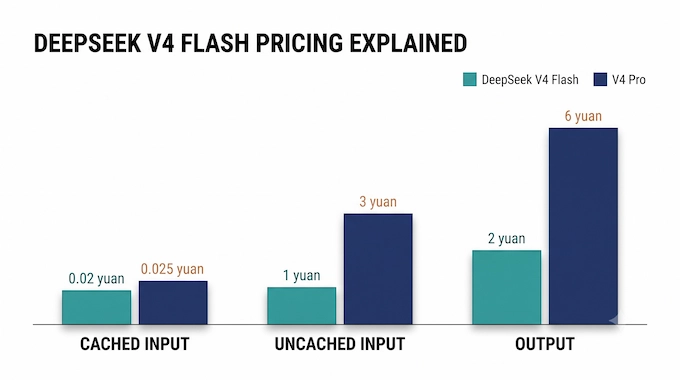
The “$0.28 per million tokens” figure people keep repeating refers specifically to output tokens, not the full cost of a request. DeepSeek V4 Flash pricing is split three ways: cached input, uncached input, and output, each billed at a different rate.
That split matters a lot for agents, which tend to resend tool outputs, file contents, and conversation history on every turn. Cached input is nearly free. Uncached input costs considerably more, and reasoning tokens are billed as output, not as some separate freebie category.
Official rates:
- Cached input: 0.02 yuan per million tokens
- Uncached input: 1 yuan per million tokens
- Output: 2 yuan per million tokens
For comparison, V4 Pro runs 0.025 yuan for cached input, 3 yuan for uncached input, and 6 yuan for output. Flash costs a third of Pro’s rate on both uncached input and output, which is the real basis for the price-performance argument.
DeepSeek has also floated a peak-valley pricing scheme where rates double during Beijing business hours (9:00 to 12:00 and 14:00 to 18:00). Anyone building this into a production budget should check the live pricing page rather than anchoring to launch-day numbers.
3.1 What Flash Actually Costs In Practice
Using the official rates and counting reasoning tokens as output:
- Normal chat request (2,000 uncached input, 1,000 output): about 0.004 yuan, roughly $0.00056. Doubles under peak pricing.
- 100K-token document analysis (100,000 uncached input, 4,000 output): about 0.108 yuan, around $0.015.
- Repository-level coding task (200,000 input, 70% cache hit rate, 20,000 output/reasoning): about 0.1028 yuan, around $0.014.
- Multi-step agent session (1M cumulative input, 80% cache hit rate, 100,000 output/reasoning): about 0.416 yuan, roughly $0.058.
That last number is the one that matters for agent builders. A full multi-step coding session costing under six cents means you can afford exploratory tool calls and retries without watching the meter. The tradeoff is that cheap tokens make it easy to ignore inefficient prompting, unnecessary max-reasoning calls, and agent loops that run longer than they should.
4. DeepSeek V4 Flash Benchmarks: How Big Is The Jump?
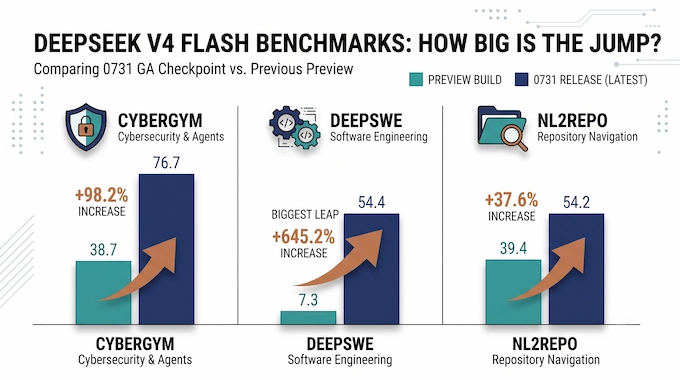
The DeepSeek V4 Flash benchmarks show 0731 ahead of both the Flash preview and V4 Pro Preview on all nine published tests. What stands out isn’t just the win column, it’s the size of some of these gaps.
Terminal Bench 2.1 climbs from 61.8 to 82.7, ahead of V4 Pro Preview’s 72.1 and GLM-5.2’s 81.0. NL2Repo moves from 39.4 to 54.2. Cybergym nearly doubles, from 38.7 to 76.7. DeepSWE shows the biggest leap of all, from 7.3 to 54.4.
Toolathlon-Verified rises from 49.7 to 70.3. Agents’ Last Exam goes from 15.8 to 25.2. AutomationBench Public climbs from 10.8 to 25.1. On DeepSeek’s internal DSBench-FullStack and DSBench-Hard sets, 0731 scores 68.7 and 59.6, against V4 Pro Preview’s 41.8 and 31.1.
Three things worth taking away from this:
First, this isn’t a minor patch. Post-training alone produced a substantial jump in how the model performs inside agent loops, which says something about how much headroom post-training can still unlock without touching architecture.
Second, the gains cluster tightly around terminal use, repo navigation, coding, tool calling, and full-stack automation. Nothing here demonstrates broad superiority in vision, factual accuracy, creative writing, or general reasoning outside these domains.
Third, test conditions shape the results. DeepSeek ran these at max reasoning effort, temperature 1.0, top-p 0.95, using a minimal version of its own DeepSeek Harness for code-agent tasks. Two of the benchmarks (DSBench-FullStack and DSBench-Hard) are internal. The honest framing is that Flash performs exceptionally well under DeepSeek’s own recommended setup, not that any provider or prompt will reproduce these exact numbers.
5. How Good Is Flash At Coding And Agentic Work?
The benchmark selection maps closely onto real developer workflows. Terminal Bench measures command-line operation. NL2Repo tests repository comprehension and editing. DeepSeek’s own DSBench sets and DeepSWE probe multi-file software engineering. Toolathlon and AutomationBench evaluate tool selection across longer task chains.
The pattern that emerges is that Flash’s strengths show up most clearly when it can act, observe results, and self-correct across multiple steps, not necessarily in a single chat response. If you’re evaluating it, a static prompt-and-answer test will likely undersell it. Put it in a loop with shell access, file reads, patch application, and test runs, and you’ll see a more accurate picture.
The open question is endurance. Short benchmark tasks don’t reliably surface the failure modes that show up in long tool chains: repeated actions, dropped constraints, false assumptions about tool state, or reasoning that spins on a dead end. The million-token context helps the model hold onto more information, but a large context window doesn’t guarantee reliable long-horizon planning. Those are different capabilities, and it’s easy to conflate them.
Early anecdotal reports describing the model as verbose or prone to overfitting on benchmarks are worth tracking, but they aren’t a substitute for controlled testing across your own workloads and providers.
6. DeepSeek V4 Flash Vs V4 Pro: Is Flash Actually Better?
On DeepSeek’s published benchmark set, yes, and it isn’t particularly close. DeepSeek V4 Flash vs V4 Pro comes down decisively in Flash’s favor across every listed test, at a third of the API cost for uncached input and output.
For agentic coding specifically, Flash is the more rational default right now. Stronger published scores, higher concurrency limits, Responses API support, open weights, and dramatically lower output pricing all point the same direction.
Three qualifications keep this from being a clean sweep, though. The comparison uses V4 Pro Preview, not a current, fully finalized Pro checkpoint. The benchmark set leans heavily toward coding and agent tasks rather than general capability. And DeepSeek ran the key evaluations on its own harness at maximum reasoning effort, which is a best-case setup rather than a default one.
V4 Pro may still hold an edge for work that rewards slower, more deliberate reasoning or where the cost of an occasional mistake outweighs token savings. The current evidence doesn’t support calling Flash better across writing quality, reliability under pressure, or reasoning tasks outside the tested domains.
Practical framing: pick Flash when cost, throughput, context length, and agentic performance are the priority. Pick Pro when a small quality edge might be worth the extra spend. Hold off on switching either way if a newer Pro checkpoint is likely to land soon and the decision isn’t urgent.
7. How Does Flash Compare With GLM-5.2 And Opus 4.8?
DeepSeek’s own results put Flash ahead of GLM-5.2 across every listed benchmark. Against Opus 4.8, Flash is competitive but generally trails, closing the gap most on Agents’ Last Exam (25.2 versus 25.7) and staying close on AutomationBench Public and DSBench-FullStack.
That’s a genuinely strong showing for a low-cost, open-weight model. It’s still a narrow claim, though. It applies to the specific agent benchmarks tested, not to vision tasks, polished long-form writing, safety-sensitive behavior, or high-stakes factual accuracy, none of which are covered by this benchmark set.
8. Is DeepSeek V4 Flash Actually Fast?
“Flash” in the name signals an efficiency target, not a guaranteed throughput number. Real-world speed depends on the hosting provider, hardware, runtime, context length, cache hit rate, and reasoning effort setting you choose.
DSpark, the speculative decoding system behind Flash, drafts candidate tokens and verifies them in batches rather than generating strictly one token at a time. DeepSeek supports enabling it in vLLM through a speculative decoding configuration flag. That can meaningfully improve throughput, but it doesn’t erase the cost of long prompts or high reasoning effort. Time to first token can still climb with a large repository loaded into context or with max reasoning enabled. On local deployments, speed also depends on expert routing efficiency, memory bandwidth, quantization choices, and how well the workload is distributed across hardware.
If you’re benchmarking this yourself, measure time to first token, generation speed, and total task completion time as three separate numbers. A model that streams tokens quickly but takes extra unnecessary tool steps to finish a task isn’t actually faster where it counts.
9. API Access, Open Weights, And Local Deployment
The official API serves the model as deepseek-v4-flash, with both OpenAI-compatible and Anthropic-compatible endpoints, plus support for JSON output, tool calls, thinking modes, and the Responses API, which makes Codex-style integrations more straightforward to build.
The Responses API implementation has real gaps, though. It’s stateless, so previous_response_id, conversations, and stored responses aren’t supported. Image and file blocks get replaced with placeholder text rather than being processed. Several fields are silently ignored, including verbosity settings, prompt-cache keys, metadata, background mode, and a number of built-in tools. That silent ignoring is the part worth flagging to any team migrating from an OpenAI-based integration, because it can produce an integration that appears to work while quietly behaving differently than expected.
Open weights ship under the MIT License, which is about as permissive as it gets. DeepSeek provides custom encoding scripts in place of a standard Jinja chat template, along with vLLM instructions and local inference guidance. Its reference deployment uses a four-GPU GB300 node, which gives a realistic sense of the hardware scale required to run this seriously rather than as a toy setup.
If you’re accessing the model through OpenRouter or a third-party provider, confirm they’re actually serving the 0731 checkpoint. The generic model name alone doesn’t guarantee it.
10. Limitations And What’s Still Unproven
A few limitations are worth keeping in view before deploying this in production.
Officially documented: image and file inputs aren’t meaningfully supported in the Responses API, the API is stateless, several fields are silently ignored, and local deployment requires serious hardware.
Evaluation-related: two of the nine benchmarks are internal DeepSeek tests, code-agent evaluations ran on DeepSeek’s own harness, and max reasoning effort was enabled for the headline numbers. These conditions likely represent a best-case performance ceiling rather than what most users will see by default.
Operational: higher reasoning effort settings increase both output-token usage and latency. Long contexts can slow responsiveness. Silently ignored API fields are a plausible source of subtle integration bugs that won’t show up until production traffic hits an edge case.
Still open: there isn’t yet enough independent, long-term testing across providers, sustained agent sessions, and non-coding workloads to fully judge reliability. Teams considering a switch should run their own regression suite against real tasks before replacing a model that’s already working.
11. Who Should Actually Use DeepSeek V4 Flash?
Flash is a strong match for coding-agent builders, repository analysis tools, long-document processing pipelines, tool-heavy automation, and any high-volume product where token cost directly affects margins. The million-token context and MIT-licensed open weights make it especially appealing for teams that want flexibility beyond a single API provider.
It’s a weaker fit for vision-dependent applications, workflows that lean on a fully stateful Responses API, teams without access to serious GPU infrastructure, and high-stakes use cases that need more independent reliability evidence than currently exists.
The most useful test isn’t a generic chatbot prompt. Give it a real repository, your actual tool schema, realistic context lengths, and the specific failure conditions your application needs to handle. Then compare completion rate, retry count, latency, reasoning-token consumption, and cost per successfully completed task, not just the benchmark table.
12. Final Verdict
DeepSeek V4 Flash 0731 is currently the stronger price-performance option for most coding-agent, automation, and high-volume API workloads. It beats the older V4 Pro Preview across DeepSeek’s published agent benchmarks, ships with a million-token context, offers open weights under the MIT License, and costs a fraction of Pro’s rate.
Calling it universally smarter than V4 Pro would be overstating the evidence. The comparison involves an older Pro checkpoint, a benchmark set weighted toward agent tasks, internal evaluations, and limited independent production testing so far. Flash has earned a legitimate spot on any serious model shortlist. It hasn’t earned a blank check.
Choose Flash when cost, scale, openness, and agentic performance matter most for your workload. Choose Pro when deeper reasoning or proven reliability is worth the extra spend. Wait for an updated Pro checkpoint if quality is the top priority and the decision isn’t time-sensitive.
For more technically grounded reviews, benchmark breakdowns, and practical implementation guides on the latest AI models, keep following Binary Verse AI. The next useful step isn’t another leaderboard screenshot, it’s testing which model completes your actual work at the lowest reliable cost.
1. Is DeepSeek V4 Flash fast?
DeepSeek V4 Flash is designed for fast, high-throughput inference and supports DSpark speculative decoding. However, actual speed depends on the API provider, hardware, context length and reasoning-effort setting. Low or high reasoning can respond faster than max reasoning, while very long prompts and agentic tool use can considerably increase total completion time.
2. How good is DeepSeek V4 Flash at coding?
DeepSeek V4 Flash 0731 performs particularly well on coding-agent and tool-use benchmarks, including Terminal Bench 2.1, NL2Repo and DeepSWE. Its strongest use cases are repository navigation, terminal tasks, multi-step coding and tool-based automation. The published results are impressive, but some tests used DeepSeek’s own harness and two reported benchmarks are internal.
3. How many parameters are in DeepSeek V4 Flash?
DeepSeek V4 Flash has approximately 284 billion total parameters, with around 13 billion parameters activated for each token through its Mixture-of-Experts architecture. This helps it deliver stronger performance than a conventional 13B model without using all 284B parameters during every inference step.
4. Why is DeepSeek V4 Flash so cheap?
DeepSeek V4 Flash uses a sparse Mixture-of-Experts architecture, activating only part of the model for each token. It also uses efficiency techniques such as cache discounts and speculative decoding. Its advertised $0.28 rate applies to one million output tokens; uncached input, cached input and third-party provider charges are calculated separately.
5. Is DeepSeek V4 Flash free or paid?
The model’s open weights can be downloaded and self-hosted, but running them requires suitable hardware and still carries infrastructure costs. DeepSeek’s official API is paid according to input, cache and output token usage. Some applications or providers may offer free credits or limited access, but these are separate from the official API pricing.