Moonshot AI just did something no Chinese lab had pulled off before. It shipped an open weight model that sits at the very top of the size leaderboard while beating a Western frontier lab on hard technical benchmarks, not just cheap chatbot rankings. Kimi K3 landed on July 16, 2026, a 2.8 trillion parameter model that Moonshot calls the world’s first open 3T class system, and the numbers behind that claim are hard to wave away.
If you’re trying to work out what Kimi K3 actually is, what it costs, how it compares to Claude Fable 5 and GPT-5.6 Sol, and whether the open weights are usable outside a data center, this guide walks through all of it using Moonshot’s own disclosures. We’ll also get into the distillation controversy that’s been trailing Moonshot since February, because skipping it would be dishonest.
Table of Contents
1. What Is Kimi K3? Release Date, Specs, And Why It Matters
Kimi K3 is Moonshot AI’s new flagship model: 2.8 trillion total parameters, native vision understanding, and a context window of 1,048,576 tokens (the full 1M mark, not a rounded marketing number). It’s built on two architectural changes Moonshot introduced this cycle, Kimi Delta Attention (KDA) and Attention Residuals (AttnRes), paired with a Stable LatentMoE routing framework.
The scale claim matters because it’s verifiable. Moonshot has held the record for the largest open model size for nine of the past twelve months, and K3 pushes that further than any lab, open or closed, has gone with public weights.
As for the Kimi K3 release date, Moonshot launched the model on July 16, 2026 across Kimi.com, Kimi Work, Kimi Code, and the Kimi API. The second part of the release followed on July 27, when Moonshot published the full Kimi K3 open weights, technical report, and key infrastructure components including MoonEP, FlashKDA, and AgentEnv. The official Kimi K3 checkpoint is now available for download and self-hosted deployment, alongside Moonshot’s API and consumer applications.
2. Kimi K3 Benchmarks: How It Stacks Up Against GPT-5.6 Sol And Fable 5
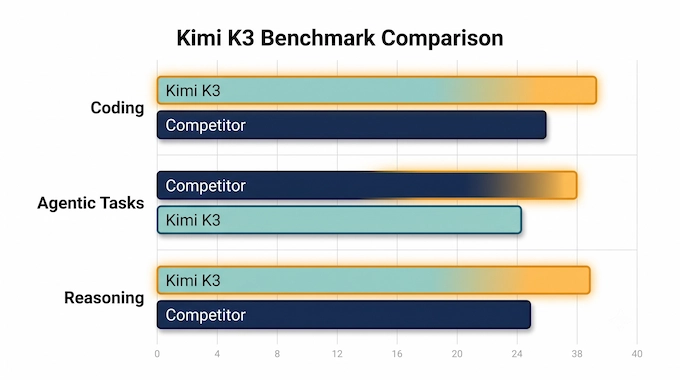
Here’s the full benchmark set Moonshot published at launch, run at max reasoning effort against Claude Fable 5, GPT-5.6 Sol, Claude Opus 4.8, GPT-5.5, and GLM-5.2.
Kimi K3 Benchmarks: Full Score Comparison Table
| Benchmark | Kimi K3 | Fable 5 | GPT-5.6 Sol | Opus 4.8 | GPT-5.5 | GLM-5.2 |
|---|---|---|---|---|---|---|
| DeepSWE | 67.5 | 70.0 | 73.0 | 59.0 | 67.0 | 46.2 |
| Terminal Bench 2.1 | 88.3 | 84.6 | 88.8 | 84.6 | 83.4 | 82.7 |
| FrontierSWE | 81.2 | 86.6 | 71.3 | 66.7 | 64.9 | 67.3 |
| SWE Marathon | 42.0 | 35.0 | 39.0 | 40.0 | 14.0 | 13.0 |
| Kimi Code Bench 2.0 | 72.9 | 76.9 | 64.8 | 71.7 | 69.0 | 64.2 |
| GDPval-AA v2 (Elo) | 1668 | 1760 | 1748 | 1600 | 1494 | 1514 |
| BrowseComp | 91.2 | 88.0 | 90.4 | 84.3 | 84.4 | — |
| GPQA-Diamond | 93.5 | 92.6 | 94.1 | 91.0 | 93.5 | 91.2 |
| HLE-Full | 43.5 | 53.3 | 44.5 | 49.8 | 41.4 | — |
| OmniDocBench | 91.1 | 89.8 | 85.8 | 87.9 | 89.4 | — |
| MMMU-Pro | 81.6 | 81.2 | 83.0 | 78.9 | 81.2 | — |
The pattern that jumps out: Kimi K3 doesn’t win everywhere, and Moonshot doesn’t pretend it does. Its own launch post states plainly that K3 trails Claude Fable 5 and GPT-5.6 Sol overall, which is a rare bit of candor for a model launch. What K3 does deliver is genuine frontier-tier performance in specific lanes, the kind of results worth tracking alongside broader SWE-Bench Pro comparisons. It edges Fable 5 on Terminal Bench 2.1 (88.3 vs 84.6), leads everyone on SWE Marathon by a wide margin, and posts the best score on OmniDocBench, a document understanding test where it beats every model in the comparison set.
Where it clearly loses ground is long-horizon reasoning depth (HLE-Full, 43.5 vs Fable 5’s 53.3) and FrontierSWE, a newer coding benchmark where Fable 5 pulls ahead by five points. One caveat worth flagging: these scores were collected under different agent harnesses (KimiCode for K3, Claude Code or Codex for the others), and Moonshot documents this openly in its footnotes. Harness choice can shift a score by several points on its own, so treat any single-benchmark bragging rights with a bit of skepticism.
2.1 Independent Kimi K3 Benchmarks: What Vals AI Found
Independent testing broadly supports the idea that Kimi K3 belongs near the frontier, although the results are more nuanced than Moonshot’s launch chart alone suggests. Vals AI’s July evaluation placed Kimi K3 near the top of its overall model rankings and found particularly strong coding performance, including competitive results on Terminal Bench 2.1, SWE Bench and Vibe Code Bench.
More recent repository-level evaluations show why no single ranking tells the whole story. On Vals AI’s JAX benchmark, Kimi K3 completed 42 of 54 tasks, matching Claude Fable 5 and finishing one task behind GPT-5.6 Sol. On the Bun repository benchmark, Kimi K3 completed 26 of 48 tasks versus 25 for Fable 5. Those independent results reinforce the broader conclusion of Moonshot’s own data: K3 can match or beat proprietary frontier models on some coding workloads, but it does not consistently dominate them across every task.
3. Kimi K3 Vs Fable 5: Where Moonshot Wins And Where It Doesn’t
Since “Kimi K3 vs Fable 5” is the comparison everyone’s actually searching for, here’s the short version. Fable 5 wins on raw reasoning and most vision benchmarks. It scores meaningfully higher on HLE-Full, CharXiv, and MathVision, and it holds a comfortable lead on FrontierSWE. If your workload is genuinely open-ended research reasoning or complex visual analysis, Fable 5 is the stronger model today.
Kimi K3 wins on cost-adjusted throughput and specific agentic tasks. It leads on SWE Marathon (sustained, long-running engineering sessions), Automation Bench, and Job Bench, three benchmarks that map closely to real agent workflows rather than single-shot coding puzzles. It also matches or beats Fable 5 on Terminal Bench 2.1 and DeepSearchQA.
The honest takeaway is that Kimi K3 isn’t a Fable 5 killer. It’s a model that gets within striking distance of a frontier proprietary system while being open weight and priced at a fraction of the cost, which is a genuinely different value proposition than “we beat the leader.”
4. Kimi K3 Pricing: API Cost Per Million Tokens
This is where Kimi K3 stops being just an interesting benchmark story and becomes a real infrastructure decision. Here’s the official rate card next to Claude Fable 5’s.
Kimi K3 Pricing: Input, Output, And Context Window Costs
| Model | Input (Cache Hit) | Input (Cache Miss) | Output | Context Window |
|---|---|---|---|---|
| Kimi K3 | $0.30 /MTok | $3.00 /MTok | $15.00 /MTok | 1,048,576 tokens |
| Claude Fable 5 | ~$1.00 /MTok (estimated) | $10.00 /MTok | $50.00 /MTok | 1,000,000 tokens |
On standard input, Kimi K3 is roughly a third of Fable 5’s price. On output, the gap is identical: $15 versus $50 per million tokens, meaning Fable 5 costs a bit over 3x more for every token it generates. The cache-hit column for Fable 5 is an estimate based on the roughly 90 percent caching discount Anthropic applies elsewhere in its lineup. It’s not an official number, but even at that estimate, Kimi’s $0.30 cache-hit rate still comes in more than three times cheaper.
That cache-hit rate matters more than it looks. Moonshot says its official API sustains a cache hit rate above 90 percent on coding workloads, powered by its Mooncake disaggregated inference setup. In practice, that means most of the repeated context in an agentic coding loop (system prompts, file trees, prior turns) gets billed at $0.30 instead of $3.00. For anyone running high-volume agent loops, that’s the number that actually decides the monthly bill, not the headline output price.
Run the math on a realistic agent session: 500,000 input tokens with a 90 percent cache hit rate, plus 50,000 output tokens. On Kimi K3, the cached input costs about $0.135, the remaining uncached input costs $0.15, and the output costs $0.75. That puts the full session at roughly $1.04. The equivalent workload on Claude Fable 5 is about $3.45 at current API rates and the same 90 percent cache-hit assumption, making K3 roughly 70 percent cheaper in this example.
5. The Anthropic Distillation Controversy: Did Kimi Copy Claude?
No honest Kimi K3 writeup skips this. In February 2026, Anthropic published findings accusing three Chinese labs, Moonshot AI, DeepSeek, and MiniMax, of running large-scale campaigns to extract Claude’s capabilities through fraudulent API accounts. Anthropic’s disclosure described millions of exchanges aimed at agentic reasoning, tool use, coding, and computer-use behavior, with a later phase specifically targeting Claude’s internal reasoning traces rather than just its final answers.
Moonshot has not publicly confirmed or denied that any of this data made its way into Kimi K3 specifically. The model’s July technical blog attributes its gains to architecture (KDA, AttnRes, Stable LatentMoE) and training efficiency, not to any external data source, and reads like standard scaling-story marketing rather than a response to the allegations.
What’s fair to say: the timing is awkward. K3 launched just days after Fable 5 and GPT-5.6 Sol went wide, and independent observers on forums like Hacker News have openly debated whether Moonshot closed the capability gap through distillation of frontier teacher models rather than purely independent scaling. Some earlier academic work has also found that older Kimi models show behavioral fingerprints (tool-use patterns, response style) closer to Claude than to GPT models, which fuels the suspicion without proving anything about K3 specifically.
The responsible reading here is that this is a real, documented controversy with real evidence behind Anthropic’s February accusation, but the specific claim that K3 was built on stolen Claude data remains unverified speculation rather than confirmed fact. Treat it as an open question, not a settled one.
6. Kimi Code And The Kimi Coding Plan: Agentic Coding At Scale
For developers evaluating the Kimi coding plan, the practical entry point is Kimi Code, Moonshot’s terminal and IDE agent. Switching to K3 inside it is a one-line /model command, and Moonshot’s launch case studies lean heavily on what long, unsupervised coding sessions can do.
The standout example is a GPU kernel optimization test, where K3 was given 24 hours to profile and rewrite four kernel tasks in an identical sandbox against other frontier models. It cut a forward-and-backward pass from 283.6ms to 114.4ms and performed competitively with Fable 5, while clearly outpacing Opus 4.8, GPT-5.6 Sol, and GPT-5.5 on the same task. In a separate test, K3 built MiniTriton, a compact GPU compiler with its own IR layer and PTX code generation pipeline, from scratch, and the resulting compiler held its own against Triton and torch.compile on several workloads.
Perhaps the most eyebrow-raising case study: in a single 48-hour autonomous run, K3 designed, optimized, and verified a functional chip on the open-source Nangate 45nm library, closing timing at 100MHz and simulating over 8,700 tokens per second of decode throughput. It’s a proof of concept rather than production silicon, but it’s a genuine demonstration of sustained, low-supervision engineering work, which is exactly the kind of task the Kimi coding plan is being positioned around.
7. Kimi K3 VRAM & Hardware Requirements: Can You Run It Locally?
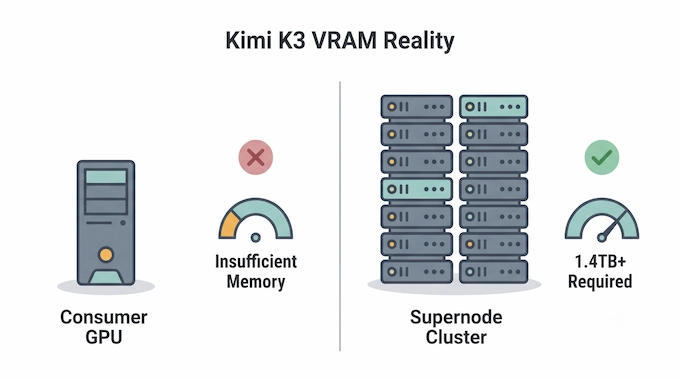
The Kimi K3 weights are now public, so the hardware requirements are no longer just theoretical. The official Hugging Face repository is roughly 1.56 TB, and production deployment requires additional memory for activations, KV cache, runtime overhead and usable context length. In other words, Kimi K3’s VRAM requirement is far beyond a normal workstation even before you try to serve its full 1,048,576-token context window.
For practical GPU requirements, current vLLM deployment guidance describes 8× NVIDIA B300 or 8× AMD MI355X accelerators as the easiest starting configuration, while Moonshot recommends supernode deployments with 64 or more accelerators when optimizing K3 for high-throughput production inference. Consumer cards such as an RTX 4090 cannot hold the model locally, and even multi-GPU enthusiast systems are nowhere close to the roughly 1.5–1.7 TB model-memory class involved.
Moonshot’s own infrastructure notes back this up indirectly: they recommend deploying K3 on supernode configurations with 64 or more accelerators, and the model uses quantization-aware training with MXFP4 weights from the fine-tuning stage onward specifically to make that kind of deployment feasible at all.
So no, this isn’t a model you’ll be running on an RTX 4090, or realistically any consumer GPU setup, even a stacked one. What the open weights do enable is cheap third-party hosting. Once cloud providers and inference platforms stand up K3 endpoints, expect pricing to undercut Moonshot’s own API within weeks, the same pattern that played out with Kimi K2 and DeepSeek’s open releases. For the r/LocalLLaMA crowd, the realistic move is watching for quantized community builds and cloud-hosted endpoints rather than planning a local deployment.
8. Inside The Architecture: Kimi Delta Attention And Stable LatentMoE
For the more technical readers, K3’s efficiency gains trace back to a handful of specific design choices. Kimi Delta Attention is a hybrid linear attention mechanism built to scale better across long sequences than standard quadratic attention. Attention Residuals selectively retrieve representations across model depth instead of accumulating them uniformly layer by layer, which Moonshot says helps information flow more cleanly through a very deep network.
On the Mixture of Experts side, K3 uses a Stable LatentMoE framework that activates just 16 of 896 total experts per token, an extreme level of sparsity that keeps inference cost manageable despite the model’s total size. Two smaller innovations support that sparsity at scale: Quantile Balancing, which derives expert allocation directly from router-score quantiles instead of relying on brittle heuristic updates, and Per-Head Muon, an extension of the Muon optimizer that tunes attention heads independently.
Put together, Moonshot claims these changes deliver roughly 2.5x the overall scaling efficiency of Kimi K2, meaning K3 converts a given amount of compute into more usable intelligence than its predecessor did. That’s a meaningful claim if it holds up under independent scrutiny once the technical report lands.
9. Vision And Multimodal Reasoning: From Games To Interactive Dashboards
K3’s native multimodal design shows up most clearly in Moonshot’s creative demos. One case study has the model building a fully procedural, browser-based 3D exploration game using Three.js and WebGPU, generating terrain, weather, and a village environment from a text brief, then iterating by looking at its own screenshots to refine the output. That “vision in the loop” pattern, where the model sees its own rendered output and self-corrects, is the actual technical story behind the demo, not just the game itself.
On the knowledge-work side, K3 produced a 42-year interactive research site on the ASIC industry, pulling from over 11,000 pages across 87 quarterly reports through more than 2,800 web searches and terminal data pulls. In a scientific computing example, it analyzed 391 gravitational-wave events from the GWTC-5 catalog using more than 20 concurrent subagents, producing seven visualizations and a literature synthesis in a single run. Separately, it reproduced a set of published astrophysics relations, cross-validating over 20 papers and generating 3,000-plus lines of code, in about two hours, a task Moonshot says would typically take an experienced researcher one to two weeks.
10. Conclusion: What Kimi K3 Means For The Global AI Race
Kimi K3 doesn’t dethrone Claude Fable 5 or GPT-5.6 Sol, and Moonshot isn’t claiming it does. What it proves is narrower and arguably more important: an open weight model can now sit within a few benchmark points of the best closed systems on real agentic and coding work, while costing roughly a third as much per token. Whether or not the distillation questions ever get resolved, that pricing and performance combination is going to pressure every lab building on the assumption that frontier intelligence stays expensive.
If you’re building on Kimi K3 or weighing it against Fable 5 and GPT-5.6 Sol for a real project, keep watching this space. Binary Verse AI will keep this guide updated as new independent Kimi K3 benchmarks, quantized deployments, inference engines, pricing changes and successor models appear.
Is Kimi K3 open source and what is the release date?
Yes. Kimi K3 is an open-weight model. Moonshot released the full 2.8 trillion parameter weights and technical report on July 27, 2026, following the API and application launch on July 16.
How much does the Kimi K3 API cost compared to Claude Fable 5?
Kimi K3 is significantly cheaper than its US competitors. Kimi K3 is priced at $0.30/MTok for cache-hit inputs, $3.00/MTok for cache-miss inputs, and $15.00/MTok for outputs. In contrast, Claude Fable 5 costs a massive $50.00/MTok for outputs.
Did Moonshot AI distill Kimi K3 from Anthropic’s Claude?
There is heavy speculation among AI researchers on Reddit and Twitter that Kimi K3’s training data was distilled from Anthropic models. Users noticed that K3 occasionally references Anthropic’s specific safety and content policies in its internal “thinking” traces, suggesting Claude outputs were used in K3’s reinforcement learning phase.
Can I run Kimi K3 locally on consumer hardware?
Not on normal consumer hardware. The released Kimi K3 repository is roughly 1.56 TB, and actual inference requires additional GPU memory for runtime overhead and context. Current deployment guidance starts around 8× high-memory B300 or MI355X-class GPUs, while Moonshot recommends 64+ accelerators for high-throughput production deployments. An RTX 4090, 5090, or typical multi-GPU workstation is therefore not sufficient for the full Kimi K3 model.
How does Kimi K3 compare to GPT-5.6 Sol and Claude Fable 5?
Fable 5 slightly in DeepSWE (67.5 vs 70.0), it actually beats Fable 5 on Terminal Bench 2.1 (88.3 vs 84.6) and is universally recognized as having superior cost-to-performance efficiency for agentic coding.