
SpaceXAI spent less than two weeks moving Grok 4.5 from private beta to a public launch, and it landed in one of the most crowded release weeks the AI industry has had all year. Claude Opus 4.8 already had the developer market’s attention, OpenAI pushed GPT-5.6 out the same week, and now Grok 4.5 has entered the race with a specific pitch: not the smartest model on the leaderboard, but one of the cheapest per finished task.
That distinction matters more than it used to. The frontier model race spent two years chasing benchmark leaderboards. Now that most flagship models can solve a similar class of software engineering problems, the real argument has shifted to inference speed, token efficiency, and what a completed task actually costs to run. Grok 4.5 is built almost entirely around that argument.
This piece breaks down what Grok 4.5 actually is, how its benchmarks compare against Claude Opus 4.8, GPT-5.5, and Fable 5, what it costs to run in production, and the controversies attached to launch day, including a data leak into its benchmark scores and a block that’s keeping it out of the EU for now.
Table of Contents
1. What Is Grok 4.5? SpaceXAI’s New Frontier Coding Model
If you’re catching up: Grok is the family of AI models built by SpaceXAI, the company that used to be xAI before SpaceX acquired it in a deal that closed earlier this year. Elon Musk said in May that xAI would stop existing as a separate brand and fold entirely into SpaceXAI, which is why the launch materials for Grok 4.5 read like they’re coming from a rocket company. Most coverage still calls it xAI out of habit, and this piece uses both names.
Grok 4.5 is the newest release in the Grok 4 series, following Grok 4 and Grok 4.1 earlier this year. It’s a mixture-of-experts model built on what SpaceXAI calls its 1.5 trillion parameter V9 foundation model, trained across tens of thousands of NVIDIA GB300 GPUs. The data mix leans heavily on coding, science, engineering, and math, plus, and this is the notable part, trillions of tokens of real developer session data from Cursor.
That Cursor connection isn’t incidental. SpaceX has a pending 60 billion dollar all-stock deal to acquire Cursor’s parent company, Anysphere, announced in mid-June and expected to close later this year. Grok 4.5 is effectively the first visible product of that relationship, trained jointly with Cursor’s team before the acquisition has even formally closed. Cursor’s own smaller coding model, Composer 2.5, stays a separate, leaner product built for low-latency work inside the editor. Grok 4.5 is the bigger, broader sibling, aimed at coding plus general knowledge work like finance, legal drafting, and data analysis.
2. Grok 4.5 Benchmarks: Trading Punches With GPT-5.5 and Fable 5
SpaceXAI published six benchmark comparisons at launch, each covering a different flavor of software engineering work. Here’s the full picture, with every model shown at its top reported setting (Opus 4.8 and Fable 5 at max effort, GPT-5.5 at xhigh reasoning):
Grok 4.5 Benchmark Comparison: Complete Results Table
| Benchmark | Grok 4.5 | Opus 4.8 | GPT-5.5 | Fable 5 | Composer 2.5 | Opus 4.7 | GLM 5.2 |
|---|---|---|---|---|---|---|---|
| Terminal-Bench 2.1 | 83.3% | 78.9% | 83.4% | 84.3% | 73.0% | 78.9% | N/A |
| SWE-Bench Multilingual | 78.0% | 84.4% | 77.8% | N/A | 71.6% | N/A | N/A |
| DeepSWE 1.0 | 62.0% | 55.75% | 64.31% | 66.1% | 18.0% | 40.12% | N/A |
| DeepSWE 1.1 | 53% | 59% | 67% | 70% | N/A | N/A | 44% |
| SWE Marathon (pass@1) | 29.0% | 26.0% | N/A | 24.0% | N/A | 16.0% | N/A |
| SWE-Bench Pro | 64.7% | 69.2% | 58.6% | 80.3% | 54.0% | 64.3% | 62.1% |
N/A means the provider hasn’t published a score for that model on that benchmark.
A few things stand out. Grok 4.5 comfortably beats Composer 2.5 everywhere, which makes sense since Composer is the smaller, cheaper coding specialist rather than a true rival. Against Opus 4.8, the result is genuinely mixed: Grok 4.5 wins on Terminal-Bench 2.1, DeepSWE 1.0, and SWE Marathon, but loses on SWE-Bench Multilingual, DeepSWE 1.1, and SWE-Bench Pro, the benchmark most engineers treat as the serious one. GPT-5.5 sits in almost the same band as Grok 4.5 across the board, close enough that neither model has a clean win.
The one name that tops almost every chart is Fable 5, Anthropic’s higher tier model that sits above Opus 4.8. If you need the single best score on a hard software engineering task, Fable 5 is still where you’d look first. Grok 4.5’s argument isn’t that it beats Fable 5 or even Opus 4.8 outright. It’s that it gets close enough on most tasks while working very differently underneath, which the next two sections get into.
3. The Opus 4.8 Question: Decoding the 4.2x Token Efficiency Gap
Benchmark scores only tell you whether a model reaches the right answer, not what it costs to get there. This is where Grok 4.5’s pitch gets more interesting than the raw numbers above suggest.
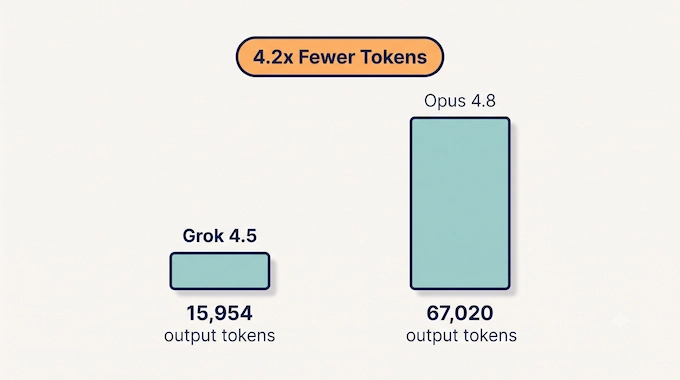
On SWE-Bench Pro tasks, SpaceXAI reports that Grok 4.5 resolves the average task using 15,954 output tokens. Opus 4.8 running at max effort uses 67,020 output tokens for the same class of task, about 4.2 times more. Grok 4.5 loses that specific benchmark on accuracy (64.7 percent versus 69.2 percent), but it gets there while writing roughly a quarter of the text.
For a one-off question in a chat window, that difference barely registers. For an agentic pipeline running thousands of tasks a day, it’s the whole budget. Output tokens are the expensive half of any API bill, and a model that reasons its way to an answer without padding every step in verbose explanation ends up cheaper per completed task even before you account for its lower sticker price. Stack Grok 4.5’s cheaper per-token rate on top of its lower token count per task, and the gap versus Opus 4.8 compounds fast across a large agent fleet.
The catch is that efficiency doesn’t erase the accuracy gap. If your pipeline can’t tolerate a lower success rate on the hardest tasks, writing four times fewer tokens doesn’t help much when the task fails and a person has to redo it anyway.
4. Grok 4.5 API Pricing vs Claude Opus 4.8 and GPT-5.5
Here’s where the Grok 4.5 vs Opus 4.8 argument gets concrete. Pricing, per million tokens:
Grok 4.5 API Pricing: Complete Cost Comparison Table
| Model | Input | Output | Cached Input | Context Window |
|---|---|---|---|---|
| Grok 4.5 (standard) | $2.00 | $6.00 | $0.50 | 500K |
| Grok 4.5 (fast variant) | $4.00 | $18.00 | N/A | 500K |
| Claude Opus 4.8 (standard) | $5.00 | $25.00 | $0.50 | 1M |
| Claude Opus 4.8 (fast mode) | $10.00 | $50.00 | N/A | 1M |
| Claude Fable 5 | $10.00 | $50.00 | N/A | 1M |
| GPT-5.5 (flagship tier) | ~$5.00 | ~$30.00 | N/A | N/A |
GPT-5.5 figures reflect its flagship reasoning tier and are less precisely documented than the Anthropic and SpaceXAI numbers above.
The base rate tells most of the story. Grok 4.5 costs a fraction of Claude Opus 4.8 pricing on both input and output tokens, and even its fast variant undercuts Opus 4.8’s standard output rate. GPT-5.5 lands closest to Opus 4.8 on sticker price. Fable 5, Anthropic’s higher tier, is priced above all of them, which tracks with it topping most of the benchmark charts above.
One detail deserves a place in any real cost model: cached input pricing. Grok 4.5 charges just $0.50 per million tokens for cached input, a quarter of its standard input rate. If you’re running retrieval over a large codebase or repeatedly feeding the same system prompt and context into an agent loop, caching is where the real savings show up, not the headline per-token number.
5. The CursorBench Question: Did Grok 4.5 Get a Boost From Leaked Data?
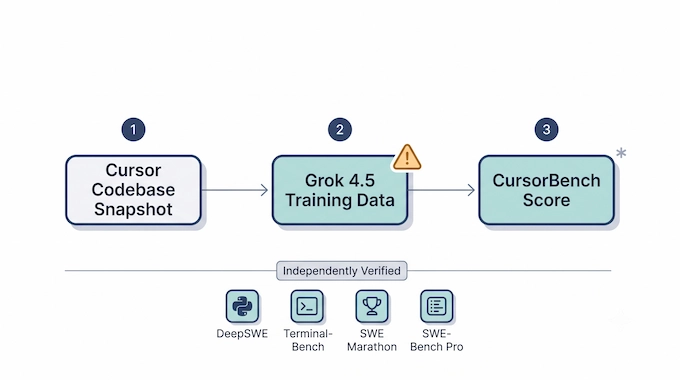
Tucked into the release notes is an admission that deserves its own callout. SpaceXAI states that an early snapshot of the Cursor codebase was accidentally included in Grok 4.5’s training data, giving it an advantage on CursorBench specifically. The company says the exact size of that advantage is unclear, that the data has been stripped out for future model versions, and that CursorBench itself is getting a larger rework partly because of this.
That’s a real asterisk, and it applies to any chart that includes a CursorBench column. But it’s also a narrow one. DeepSWE, Terminal-Bench 2.1, and SWE-Bench Pro are run independently, using each provider’s own harness, and none of them touch the Cursor codebase directly. The contamination issue affects one benchmark, not the whole scorecard. If you’re evaluating Grok 4.5 for your own workload, the sensible move is to discount any CursorBench-specific marketing claim and lean on the independently administered evals instead.
6. Blazing Fast Inference: 80 TPS on GB300 Clusters
Grok 4.5 is served at 80 tokens per second, which SpaceXAI positions as meaningfully faster than comparable flagship models. Paired with the token efficiency numbers from earlier, the practical effect compounds twice over: fewer tokens needed to finish a task, and each of those tokens arriving faster.
SpaceXAI has also suggested there’s headroom left in how well the current serving stack is tuned to the GB300 hardware it runs on, meaning throughput could climb further. Treat that as forward-looking, not a benchmarked result. For now, 80 TPS is the number to plan around, and it’s already fast enough to change how usable Grok 4.5 feels in an interactive coding session compared to a model that streams its answer slowly.
7. Grok Build and Agentic Coding: How to Actually Use It
Grok 4.5 is available today through several entry points. Grok Build, SpaceXAI’s terminal-based coding agent, uses Grok 4.5 as its default model and can run interactively or headlessly inside scripts and CI pipelines. It’s also live inside Cursor on every plan, not gated behind a higher tier, which puts it in front of Cursor’s existing developer base immediately.
For teams wiring it into their own tools, the API call is simple:
curl -s https://api.x.ai/v1/responses \
  -H "Authorization: Bearer $XAI_API_KEY" \
  -H "Content-Type: application/json" \
  -d '{
    "model": "grok-4.5",
    "input": "Find and fix the bug, then explain it: function median(a){a.sort();return a[a.length/2]}"
  }'
Grok 4.5 also runs through model gateways including OpenRouter, Vercel, Cloudflare, Snowflake, and Databricks Mosaic, so teams already standardized on one of those don’t need a separate SpaceXAI account just to try it. A prompt cache key is worth setting from day one too. Without one, conversations can land on a cold server and quietly lose the discount that makes long agent loops affordable.
8. Beyond Code: Office Work and Excel Modeling
SpaceXAI is positioning Grok 4.5 as more than a coding tool. It’s the default model behind the Word, PowerPoint, and Excel add-ins, where it can build multi-sheet spreadsheet models that pull in live web research, lay out PowerPoint slides using native shapes instead of static images, and draft structured prose in Word.
That’s a meaningful shift from Composer 2.5’s narrower coding focus, and it’s a direct pitch at knowledge workers who aren’t developers at all. Whether Grok 4.5 actually holds up against a dedicated spreadsheet workflow or a skilled human analyst is a separate question from whether it can write correct Rust or Python, and it’s worth testing independently before trusting it with a real financial model.
9. Political Bias and the Edgy Persona: Why It Doesn’t Touch Your Code
Grok’s conversational persona has been a recurring source of controversy, including past incidents where its looser content guardrails produced extremist and antisemitic outputs on X that drew widespread criticism. SpaceXAI has generally kept Grok’s chat personality deliberately less filtered than rivals like Claude or ChatGPT, which is a design choice, not a bug.
For developers evaluating Grok 4.5 specifically for coding and agentic work, the two are easy to keep separate. The persona settings that shape how Grok talks in a chat window don’t carry over to how it writes Rust, C++, or Python through an API call or inside Grok Build. Code generation runs on different training objectives and evaluation criteria than conversational tone does. That said, a vendor’s broader safety track record is still a fair thing to weigh separately in procurement.
10. Why Grok 4.5 Is Not Yet Available in the EU
Grok 4.5 launched everywhere except the European Union. SpaceXAI says EU access is expected in mid-July but hasn’t given a firm date or a stated reason for the delay, either in the announcement or the documentation.
The likeliest explanation is regulatory friction tied to the EU AI Act, which places compliance obligations on general-purpose AI models above certain capability thresholds, alongside the wider regulatory attention EU authorities have been paying to SpaceXAI’s products this year. That’s an inference, not a confirmed reason, since the company hasn’t said so directly. For European teams, the practical takeaway is to plan around a mid-July window and keep a fallback model ready in case that date slips, the way vendor-announced availability windows sometimes do.
11. Conclusion: Should You Switch to Grok 4.5?
The honest answer depends on what you’re running. If you’re paying Claude Opus 4.8 pricing for high-volume, automated coding tasks where a small accuracy gap is tolerable and cost per completed task is what actually matters, Grok 4.5 is worth piloting now. Lower per-token pricing combined with roughly a quarter of the output tokens per task adds up to a real budget difference at scale, not a marginal one.
If your workload leans on multilingual codebases, long-horizon SWE-Bench Pro style tasks, or you simply can’t tolerate the accuracy trade-off, Opus 4.8 still wins those specific benchmarks and remains the safer default. And for the genuinely hardest problems, the ones where being wrong is expensive no matter how cheap the attempt was, Fable 5 is still the model most benchmark charts point to first.
Grok 4.5 isn’t a clean win over Opus 4.8, and SpaceXAI’s own published numbers don’t claim it is. What it offers is a real, credible option in the mid tier of frontier coding models, with a pricing and efficiency argument strong enough to justify testing against your own tasks rather than taking any vendor’s chart at face value.
We’ll keep tracking how Grok 4.5 performs as more independent evals land, alongside the rest of this month’s model releases. Check back on Binary Verse AI for the next comparison as the picture gets clearer.
Is Grok 4.5 available and how can I access it?
Answer: Grok 4.5 is available today via the SpaceXAI API, Grok Build, and the Cursor IDE. However, it is currently geo-blocked in the European Union across all products and the API console. EU availability is expected in mid-July 2026.
How much does the Grok 4.5 API cost?
Answer: Grok 4.5 is aggressively priced at $2.00 per million input tokens and $6.00 per million output tokens. Furthermore, cached input tokens are discounted to just $0.50 per million, making it highly cost-effective for long-horizon agentic tasks.
How does Grok 4.5 compare to Claude Opus 4.8 and Fable 5?
Answer: Grok 4.5 trade punches with GPT-5.5 and outperforms Claude Opus 4.8 on benchmarks like DeepSWE 1.0 (62.0% vs. 55.75%). While Claude Fable 5 remains the strongest overall performer (scoring 80.3% on SWE-Bench Pro), Grok 4.5 offers comparable intelligence at a fraction of the API cost and with much faster inference speeds.
Why is Grok 4.5 considered more “token efficient” than Claude?
Answer: Benchmarks reveal that Claude Opus 4.8 suffers from extreme verbosity, using an average of 67,020 output tokens to resolve a SWE-Bench Pro task. Grok 4.5 resolves the same tasks using only 15,954 tokens on average. This 4.2x token efficiency multiplier drastically reduces real-world API billing costs.
Did Grok 4.5 cheat on the CursorBench coding evaluation?
Answer: SpaceXAI added an official asterisk to Grok 4.5’s CursorBench scores, admitting that an earlier snapshot of the Cursor codebase was accidentally included in its training data. While this data contamination gives it an unfair advantage on CursorBench, its high scores on independent benchmarks like Terminal-Bench 2.1 and DeepSWE remain valid.