
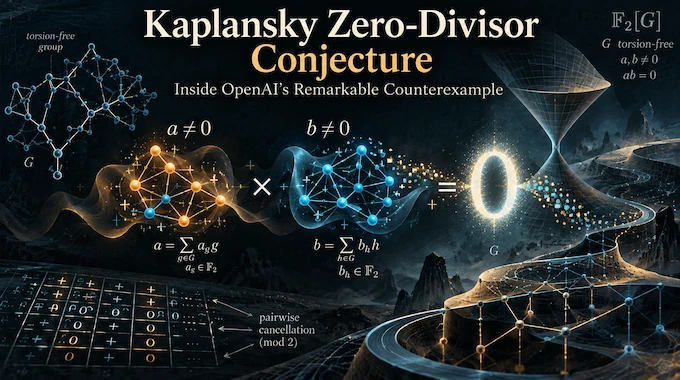
For decades, mathematicians had good reasons to believe that a certain kind of algebra could never contain zero divisors. The argument seemed plausible: remove finite-order elements from the underlying group, and the familiar route to producing those troublesome products disappears. But plausibility isn’t a proof.
On September 23, 2026, OpenAI released A Torsion-Free Group Algebra with Zero Divisors, a paper presenting a counterexample to the Kaplansky Zero-Divisor Conjecture. It constructs a torsion-free group whose algebra over the two-element field contains two nonzero elements with product zero. OpenAI has also published a Lean formalization of the main theorem.
The interesting part isn’t simply that a long-standing prediction fails. It’s how the paper makes many algebraic terms cancel while proving that neither factor vanishes and the group contains no torsion. Here’s what the result establishes, what made the problem difficult, and what remains unanswered.
Table of Contents
1. What Is the Kaplansky Zero-Divisor Conjecture?
The Kaplansky Zero-Divisor Conjecture proposed that whenever a group has no nonidentity element of finite order, its group algebra over any field has no nonzero zero divisors. In symbols, for a field K and torsion-free group G, the prediction was:
αβ = 0 implies α = 0 or β = 0, for α and β in K[G].
A group algebra combines group multiplication with coefficients from a field. Its elements are finite sums such as 3g + 2h − 1, and multiplication distributes across those sums using the group’s operation. The resulting ring may be noncommutative.
The question traces back to Graham Higman’s work in 1940 and to Irving Kaplansky’s problem list from a 1956 conference, published in 1957. It endured because the conjecture held for many important families of groups, yet nobody had established it for every torsion-free group.
| Key Fact | What Readers Should Know |
|---|---|
| Original prediction | A torsion-free group’s algebra over any field has no nonzero zero divisors |
| New paper | A Torsion-Free Group Algebra with Zero Divisors |
| Author and date | OpenAI, September 23, 2026 |
| Counterexample | A finitely presented torsion-free group G with αβ = 0 in F₂[G], although both factors are nonzero |
| Extra structural result | The group has a finite two-dimensional classifying space |
| Verification material | Public Lean formalization of the main theorem |
The conclusion is specific, but its logical impact is broad. One genuine counterexample is enough to refute a statement claiming to hold for every field and every torsion-free group.
2. What Are Zero Divisors in a Group Ring?
In ordinary arithmetic, two nonzero integers can’t multiply to zero. Other rings behave differently. In arithmetic modulo six, for example, 2 × 3 ≡ 0 (mod 6), even though neither two nor three is zero modulo six.
Group rings introduce another source of structure. Suppose a group contains an element g with finite order m > 1, meaning gᵐ = 1. Then
(1 − g)(1 + g + g² + ··· + gᵐ⁻¹) = 1 − gᵐ = 0.
Both factors are nonzero group-algebra elements. The equality telescopes, just as a geometric series does. This explains why mathematicians focused so intensely on torsion-free groups: the obvious construction cannot use a nonidentity finite-order element there.
| Setting | Can Nonzero Factors Multiply to Zero? | Why It Matters |
|---|---|---|
| Ordinary integers | No | The familiar intuition |
| Integers modulo six | Yes | Coefficient arithmetic can create zero divisors |
| Group algebra with finite-order g | Yes | The geometric-series construction works |
| OpenAI’s torsion-free F₂[G] | Yes | The old explanation involving torsion is unavailable |
The phrase group ring zero divisors therefore describes an algebraic property, not an attempt to divide by zero. A zero divisor is about a product becoming zero, not about computing 1/0.
3. Why Torsion-Free Groups Were the Hard Case
A group is torsion-free when no element other than the identity returns to the identity after a positive number of repetitions. The infinite cyclic group, familiar through the integers under addition, is a straightforward example.
The absence of finite-order elements blocks the geometric-series example above. It also lines up with positive results established across substantial classes of groups. For instance, the domain property was known for torsion-free elementary amenable groups and, through more recent work, for torsion-free three-manifold groups.
That history made the conjecture more than a tempting guess. Researchers could prove it in broad settings, often using geometric or algebraic properties specific to those groups. But a universal theorem needs to cover groups outside every convenient classification.
The OpenAI Kaplansky conjecture paper targets precisely that gap. Rather than showing the old mechanism works after all, it builds a new mechanism in which cancellation comes from a carefully engineered pattern of group-element products.
4. Why Earlier Approaches Did Not Settle the Problem
One influential idea is the unique-product property. Take two finite, nonempty subsets of a group. If at least one element of their product set has exactly one representation as a product of elements from the two subsets, then the corresponding coefficient in the product of two nonzero group-algebra elements cannot cancel.
Groups satisfying this property therefore have no nonzero zero divisors in their group algebras. The complication was that mathematicians had already discovered torsion-free groups without unique product. That defeated a promising route to proving the conjecture universally, but did not defeat the conjecture itself.
Why not? Because finding a group element with two different representations doesn’t automatically make its coefficient vanish. Over F₂, each group element must occur an even number of times for its total coefficient to be zero. Losing uniqueness is weaker than obtaining complete cancellation.
A separate milestone came in 2021, when mathematician Giles Gardam disproved Kaplansky’s related unit conjecture. That discovery established that certain torsion-free group algebras possess unexpected invertible elements. Yet a nontrivial unit is not the same thing as a zero divisor, so the zero-divisor question survived.
This distinction is central to the new Kaplansky conjecture counterexample: it must arrange cancellation, not merely demonstrate unusual multiplication.
5. What Did OpenAI Actually Prove?
Theorem 1.1 of OpenAI’s 26-page manuscript states that there is a finitely presented torsion-free group G and nonzero elements α, β of F₂[G] satisfying
α ≠ 0, β ≠ 0, and αβ = 0.
The field F₂ has just two elements, zero and one, with 1 + 1 = 0. This last identity is indispensable: whenever the same group element appears an even number of times, its coefficient disappears.
The paper adds that G admits a finite two-dimensional classifying space, written K(G,1). That is a strong geometric statement about the group, not a decorative footnote. It helps establish that the group genuinely has no torsion and that the construction uses only a finite presentation.
So the phrase Kaplansky conjecture disproved is justified at the level of the theorem stated and proved in the manuscript, while the public Lean artifacts provide an additional formal record. It does not mean that every neighboring Kaplansky conjecture has been settled by this one paper.
6. How OpenAI Built the Counterexample
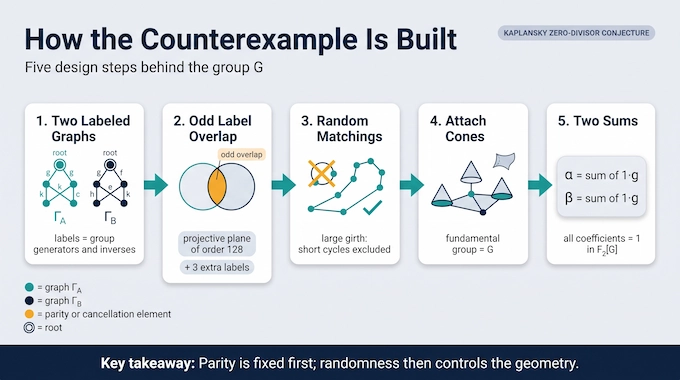
The construction begins with two finite, edge-labeled graphs, called ΓA and ΓB. Labels act like group generators and their inverses. Each graph has a chosen root, and paths from those roots determine elements of the group the authors construct.
A major design decision concerns the outgoing labels at each pair of vertices. The paper uses the geometry of a finite projective plane of order 128, together with three additional labels, to ensure that the two outgoing-label sets always overlap in an odd number of labels.
That sounds abstract, but the role is simple. The graph design fixes the parity needed for cancellation before the random choices of edges are made. The randomness is then available to control the more delicate geometric properties.
The authors select graph matchings subject to large-girth conditions, meaning short cycles are excluded. They then attach cones along graph components to a common labeled base graph. The fundamental group of this resulting two-dimensional space is the proposed group G.
From the vertices in the rooted components, the construction forms two finite group-algebra sums. Their coefficients are all one, so the problem becomes a question about how many times each group element appears when the sums are multiplied.
7. The Parity Trick That Makes the Product Zero
Here is the most approachable part of the Kaplansky conjecture proof.
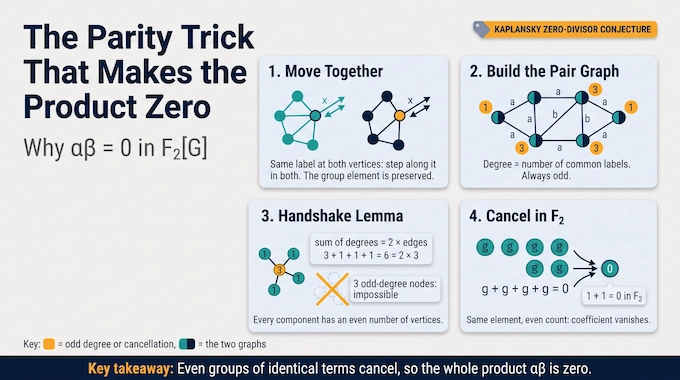
Consider a pair of vertices, one from each graph. If the same label is available at both vertices, move along that label in both graphs simultaneously. This movement preserves the group element associated with that vertex pair.
Now form a new finite graph whose vertices are precisely those pairs. Its degree at a pair equals the number of common outgoing labels. By design, every degree is odd.
A basic graph theorem supplies the punchline. In a finite graph, the sum of vertex degrees is twice the number of edges. Consequently, any connected component in which every vertex has odd degree must contain an even number of vertices.
All vertex pairs within one component contribute the same group element to the product αβ. Because there are an even number of them, their contributions add to zero over F₂. Repeat that for every component, and the entire product disappears.
This is much more satisfying than an unexplained cancellation miracle. The algebraic identity follows from a deliberately chosen incidence pattern and the familiar handshake lemma from graph theory. The genuinely difficult work is showing that the graphs can also satisfy the safeguards needed to make the example legitimate.
8. Why the Two Factors Don’t Vanish
There is a trap in any proposed zero-divisor construction: proving αβ = 0 means little if α = 0 or β = 0 already. Then the product would tell us nothing about the conjecture.
OpenAI addresses this with root separation. Each selected root contributes the identity element of the group to its corresponding sum. The proof establishes that a path from a root to a different vertex cannot represent the identity.
That makes the root the only contributor to the identity coefficient in each sum. Since that coefficient is one, both sums are nonzero. The authors don’t need to show every other vertex has a different group label, which would be unnecessarily strong.
This is a useful example of economical proof design: establish exactly the separation required to keep the factors alive, rather than trying to control every equality in a very large group.
9. How the Proof Establishes Torsion-Freeness
The last major obstacle is showing that the new group hasn’t secretly reintroduced finite-order elements. If it had, the result would no longer contradict Kaplansky’s original prediction.
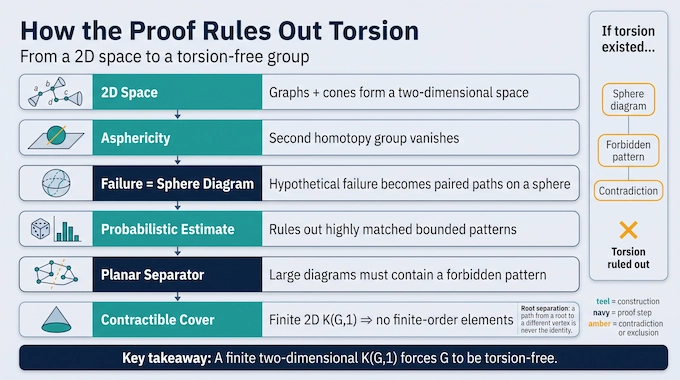
The paper studies the two-dimensional space built from the labeled graphs and their attached cones. Its central geometric claim is asphericity, meaning, in this setting, that the relevant second homotopy group vanishes.
The authors turn hypothetical failures into diagrams made of paths paired along a sphere. A probabilistic estimate rules out certain highly matched bounded patterns. A planar separator argument then shows that even a much larger troublesome diagram would contain one of those forbidden patterns.
With these arrangements excluded, the paper obtains both root separation and the required topological control. The universal cover is shown to be contractible, giving a finite two-dimensional K(G,1). Standard facts about finite-dimensional classifying spaces then rule out nontrivial finite-order elements in G.
There is no shortcut hiding in the phrase “torsion-free.” It’s one of the central achievements of the argument, proved alongside the cancellation construction rather than simply assumed.
10. Is the Kaplansky Conjecture Lean Proof Available?
Yes. OpenAI has published a Lean formalization of the main result in its mathematics repository. Its scope document for result #196 states that the formalized theorem gives a finitely presented torsion-free group with nonzero zero divisors in F₂[G], together with a finite two-dimensional classifying space.
Readers can inspect the Lean theorem file and its imported construction. Formalization gives the result a precise machine-readable statement and a proof artifact that researchers can examine and rebuild. As with any substantial formal project, independently checking the build and understanding the correspondence with the paper are useful next steps.
This is the appropriate way to describe the Kaplansky conjecture Lean proof: available publicly, with its scope explicitly documented, and open to examination rather than dependent on a press release.
11. What Has Changed, and What Remains Open?
The universal zero-divisor conjecture has a proposed negative resolution backed by a detailed manuscript and public formalization. The example shows that removing torsion doesn’t, by itself, force all group-algebra products of nonzero elements to stay nonzero.
Two limitations matter. First, the new counterexample is over F₂. It does not give a zero-divisor counterexample over the rational or complex numbers. Characteristic-zero cases therefore remain a separate research direction.
Second, the paper’s graph construction is probabilistic. It proves suitable finite matchings exist, but does not list one explicit set of matchings from which a reader can directly extract a concrete group presentation and the two factors. That is a distinction between an existence proof and an immediately reproducible worked example, not a defect in the logical form of an existence theorem.
The new result also shouldn’t be confused with the unit conjecture or direct-finiteness conjecture. These ask different questions about group rings. A counterexample to one does not automatically serve as a counterexample to another.
For researchers, natural next questions concern simpler witnesses, other coefficient fields, and which geometric properties let special classes of groups retain the zero-divisor-free behavior established in earlier work.
12. Why This Matters for Mathematics and AI Research
The Kaplansky Zero-Divisor Conjecture is a useful case study in what a serious AI-assisted mathematical advance looks like. The central idea is understandable: manufacture even multiplicities so terms cancel in characteristic two. The hard work lies in coordinating that idea with probabilistic graph construction and topology until every condition of the theorem is met.
Nothing here suggests that group theory has suddenly become easy, or that one counterexample translates into a ready-made software application. Its value is intellectual and methodological. A long-standing universal prediction meets an unfamiliar construction, and the proof is shared in forms that others can scrutinize.
Start with OpenAI’s original paper, then follow the Lean documentation if you want to inspect the formal statement. For more careful explainers of AI research and its mathematical foundations, explore Binary Verse AI, where the goal is to understand what the evidence really says, not merely repeat the headline.
1. Has Kaplansky’s Zero-Divisor Conjecture been disproved?
OpenAI’s September 2026 paper presents a counterexample: a finitely presented torsion-free group whose algebra over \(\mathbb F_2\) contains nonzero zero divisors. This contradicts the conjecture’s universal assertion, and OpenAI has also published a Lean formalization of the main result.
2. What is a zero divisor in a group ring?
A zero divisor is a nonzero element that multiplies with another nonzero element to produce zero. The surprising feature of OpenAI’s construction is that this happens in the group algebra of a torsion-free group.
3. How did OpenAI construct the counterexample?
OpenAI combined specially designed labeled graphs with probabilistic and topological arguments. The graph structure forces cancellation over \(\mathbb F_2\), while separate arguments establish that the factors are nonzero and the group is torsion-free.
4. Is OpenAI’s Kaplansky conjecture proof available in Lean?
Yes. OpenAI’s public mathematics repository contains a Lean formalization covering the main zero-divisor counterexample and its finite two-dimensional classifying space.
5. Does OpenAI’s counterexample work over the complex numbers?
The September 2026 construction works over \(\mathbb F_2\), a field of characteristic two. It disproves the original universal conjecture but does not establish a corresponding counterexample over the complex numbers or other characteristic-zero fields.