
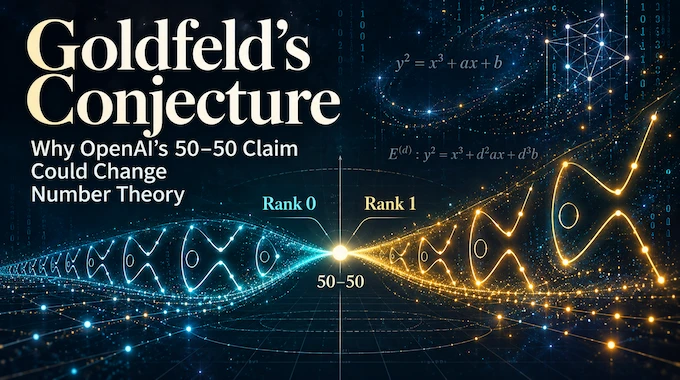
An infinite collection of equations, a coin-flip prediction, and a proof that has resisted mathematicians for decades. Goldfeld’s Conjecture sounds deceptively tidy: take one elliptic curve, build its quadratic twists, and analytic ranks zero and one should each appear half the time. The average should approach one-half.
OpenAI now claims arguments establishing both conclusions for every elliptic curve over the rational numbers, using a specified ordering of twists. Its October 7 density manuscript supplies a proposed bridge from earlier arithmetic statistics to analytic rank. A companion handles the average.
If correct, these arguments would resolve a central problem in number theory. But a published manuscript is not an independently verified theorem. The useful question is what the proof adds, which steps carry the mathematical weight, and how much confidence the available evidence supports.
Table of Contents
1. What Is Goldfeld’s Conjecture? The 50–50 Prediction Explained
Goldfeld’s Conjecture asks how rank behaves across the quadratic twists of a fixed elliptic curve. The widely used density prediction says half should have analytic rank zero, half rank one, and higher ranks should occupy a proportion tending to zero.
The average-rank prediction adds something: those rare higher ranks must contribute negligibly to the limiting mean. Counting exceptional curves and weighing their ranks are different jobs.
Goldfeld’s Conjecture: Key Questions, OpenAI’s Claims and Verification Status
| Key Question | What Readers Should Know |
|---|---|
| Which family? | Quadratic twists of each fixed elliptic curve over ℚ. |
| What does OpenAI claim? | Analytic ranks zero and one each have density ½, with mean analytic rank tending to ½. |
| How are twists counted? | Signed squarefree integers, ordered by absolute value. |
| What was already established? | Smith’s unrestricted 50–50 distribution of full 2-power Selmer coranks. |
| What is the verification position? | As of October 10, 2026, the sources examined do not establish completed independent verification of these claims. |
Goldfeld’s original 1979 formulation concerns an average over quadratic-field discriminants. The new manuscripts explicitly use signed squarefree parameters. An accurate explainer should preserve that convention rather than silently treat every ordering as interchangeable. math.columbia.edu
Also, Goldfeld is not Goldbach. Goldbach concerns sums of primes. Similar spelling has done enough damage to the search results already.
2. Quadratic Twists: One Curve, Infinitely Many Arithmetic Relatives
An elliptic curve can be written
[ E: y^2=x^3+Ax+B, ]
with coefficients chosen so the curve is nonsingular. We study rational points: solutions whose coordinates are fractions, together with a distinguished point at infinity.
One standard equation for its quadratic twist by a nonzero squarefree integer (d) is
[ E^{(d)}: y^2=x^3+d^2Ax+d^3B. ]
For the curve (y^2=x^3-x), twisting by five gives (y^2=x^3-25x). The point ((25/4,75/8)) satisfies the second equation. You can check it by substitution, although one point alone does not determine the curve’s rank.
These curves become isomorphic after adjoining (\sqrt d). Over the rationals, however, their rational-point groups can differ substantially. Quadratic twists of elliptic curves therefore create a controlled family: closely related equations with changing arithmetic.
“Squarefree” means no prime square divides (d). This avoids repeatedly counting parameters that represent the same squareclass. Both positive and negative parameters enter the manuscripts’ main statistics.
The starting curve stays fixed throughout the count. Averaging every elliptic curve by height is a different problem, despite its similar-looking rank predictions.
3. Analytic Rank vs Algebraic Rank: What Zero and One Mean
Rational points on an elliptic curve form a group. Its structure consists of a finite torsion part and a free part generated by independent points. Algebraic rank, also called Mordell–Weil rank, counts those independent infinite-order generators.
Rank zero means finitely many rational points, not none. Rank one means one independent infinite-order generator, whose multiples already produce infinitely many points. Rank two means two independent generators, not merely two visible solutions.
Goldfeld’s Conjecture: Key Questions, OpenAI’s Claims and Verification Status
| Key Question | What Readers Should Know |
|---|---|
| Which family? | Quadratic twists of each fixed elliptic curve over ℚ. |
| What does OpenAI claim? | Analytic ranks zero and one each have density ½, with mean analytic rank tending to ½. |
| How are twists counted? | Signed squarefree integers, ordered by absolute value. |
| What was already established? | Smith’s unrestricted 50–50 distribution of full 2-power Selmer coranks. |
| What is the verification position? | As of October 10, 2026, the sources examined do not establish completed independent verification of these claims. |
The last column expresses the rank equality predicted by BSD. Analytic rank is the order of vanishing of (L(E,s)) at (s=1). This L-function encodes arithmetic information, including counts of points modulo primes.
The distinction matters because OpenAI’s headline concerns analytic ranks. Moving from Selmer information to that analytic conclusion is precisely the proposed advance.
4. Why Mathematicians Expect a 50–50 Split
The completed L-function satisfies a functional equation with a sign called the root number. Sign (+1) forces even analytic rank. Sign (-1) forces odd analytic rank.
The smallest possibilities are therefore zero and one. In the full signed quadratic-twist family, the expected balance of signs motivates the 50–50 prediction. Proving parity is easier than proving that almost every curve achieves the smallest permitted rank: an even order could still be two or four.
Define
[ \mathcal D(X)={d\in\mathbb Z:0<|d|\le X,\ d\text{ squarefree}}. ]
The density claim is
[ \frac{#{d\in\mathcal D(X):r_{\mathrm{an}}(E^{(d)})=j}} {#\mathcal D(X)}\longrightarrow\frac12, \qquad j=0,1. ]
This is a limiting proportion as the parameter bound grows. It does not promise a perfect split among the first thousand twists, or separately inside every residue class. Selecting twists with one root number changes the question.
5. Before OpenAI: What Alexander Smith Had Established
Earlier work produced nonvanishing results, positive proportions in special families, and converse theorems under technical conditions. Kriz and Li, for example, established positive proportions of ranks zero and one for curves admitting a rational 3-isogeny. Positive proportions are progress toward the prediction, rather than the exact 50–50 conclusion. web.math.princeton.edu
Alexander Smith’s March 2025 paper, The Birch and Swinnerton-Dyer Conjecture Implies Goldfeld’s Conjecture, established that every rational elliptic curve has a quadratic-twist family with full (2^\infty)-Selmer coranks zero and one occurring 50% each.
Smith had previously obtained related distributions under restrictions on the curve. The 2025 statement removed those restrictions. Its analytic consequence remained conditional on BSD. arxiv.org
That distinction is the foundation of the OpenAI Goldfeld conjecture story. The statistical machinery was already there. What remained was an unrestricted way to turn its arithmetic output into analytic rank.
Giving Smith credit also makes the new claim easier to understand. OpenAI proposes to complete a specific bridge in an existing research program.
6. The Previous Barrier: From Selmer Corank to Analytic Rank
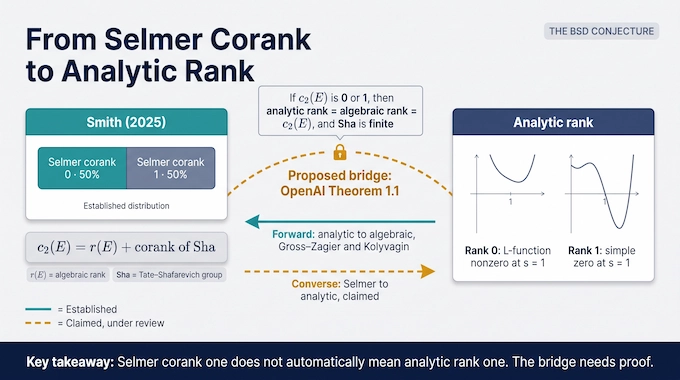
A Selmer group organizes information about rational points and related equations that satisfy local solvability conditions. Its full 2-power corank measures a size that includes algebraic rank and a possible contribution from the Tate–Shafarevich group, written (\Sha).
Schematically, the manuscript uses
[ c_2(E)=r(E)+\operatorname{corank}_{\mathbb Z_2}\Sha(E/\mathbb Q)[2^\infty]. ]
That extra term explains why “Selmer corank one” does not automatically mean “analytic rank one.” The numerical agreement needs an argument.
Classical results of Gross–Zagier and Kolyvagin establish the forward direction in low analytic rank: analytic information yields rank equality and finiteness of (\Sha). The converse must start with Selmer information and establish analytic nonvanishing.
OpenAI’s Theorem 1.1 claims that, for every elliptic curve over ℚ,
[ c_2(E)\in{0,1}\quad\Longrightarrow\quad r_{\mathrm{an}}(E)=r(E)=c_2(E),\qquad\Sha(E/\mathbb Q)\text{ finite}. ]
It imposes no restriction on reduction type, complex multiplication, rational torsion or rational isogenies. The low-corank hypothesis remains essential. This is not a claim that every curve has rank at most one.
Combine that proposed converse with Smith’s distribution, and the desired analytic densities follow.
7. Inside the Proposed Proof: Auxiliary Twists and Interpolation
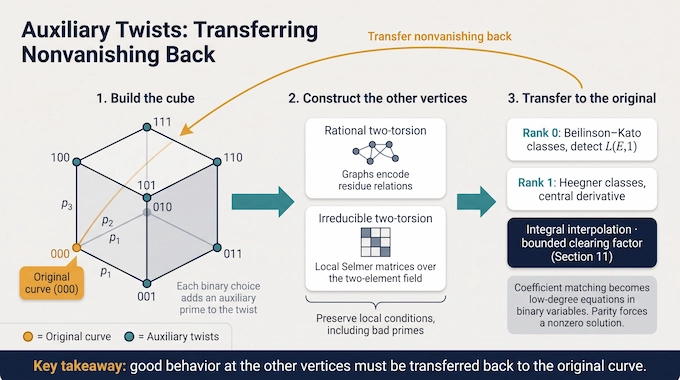
The 130-page density manuscript builds finite families of twists arranged like the vertices of a binary cube. Each binary choice controls which auxiliary prime factors enter a twisting parameter. The zero vertex represents the original curve.
The proposed strategy constructs the other vertices with controlled analytic behavior, then transfers nonvanishing back to that missing vertex. This requires arithmetic relationships between the vertices. Knowing unrelated neighboring curves behave well would prove nothing about the original one.
7.1. Constructing the Auxiliary Family
For curves with rational two-torsion, graphs encode prescribed quadratic-residue relationships between auxiliary primes. The construction aims to make multiple coefficient tests nonzero simultaneously.
When the two-torsion representation is irreducible, the argument instead uses local Selmer matrices over the two-element field. Relations among prime configurations and coefficient tests support another construction of suitable vertices.
These branches address different arithmetic cases. Their shared job is to supply an auxiliary family while preserving the local conditions needed later, including at bad primes.
7.2. Transferring Nonvanishing to the Original Curve
The rank-zero argument uses Beilinson–Kato classes whose central specialization detects (L(E,1)). The rank-one argument uses Heegner classes and height formulas connected to a central derivative, with an auxiliary quadratic field and companion twist.
Integral interpolation provides the transfer. Its denominator-clearing estimates must remain controlled as more auxiliary primes enter the family. Otherwise the required precision could grow faster than the construction can supply it.
Section 11’s bounded clearing factor and transfer lemmas are therefore central, alongside the arithmetic estimates developed in Sections 12 and 13. The manuscript claims uniform control sufficient to recover nonvanishing at the original vertex.
The transfer has a concrete combinatorial core. At fixed precision, coefficient matching becomes a system of low-degree equations in binary variables. With enough variables, a parity argument forces a nonzero solution alongside the zero solution. The valuation bounds then turn this match into control of the original curve’s analytic detector. Each part depends on the hypotheses established earlier.
This is the main burden of the Goldfeld conjecture proof. The final statistical deduction is short once these pointwise implications are available. The difficult question is whether the construction and its uniform estimates survive specialist scrutiny. Goldfeld’s Conjecture.pdf
8. Why Average Analytic Rank One-Half Needs Another Paper
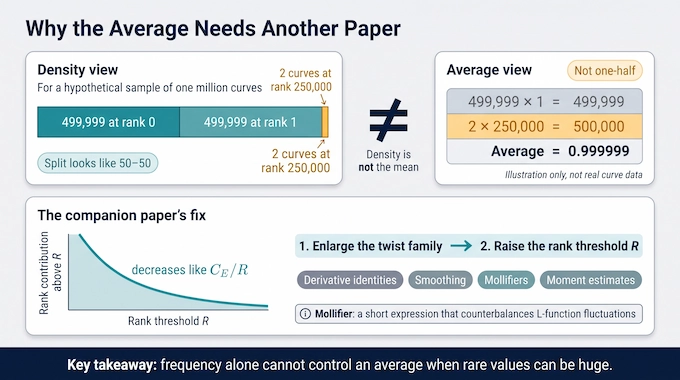
Imagine a hypothetical sample of a million curves. There are 499,999 of rank zero, 499,999 of rank one, and two of rank 250,000. Its average is 0.999999, despite the near-perfect 50–50 split among ordinary cases.
This is a numerical illustration, not a claim about actual elliptic curves. It shows why frequency alone cannot control an average when exceptional values can grow.
The companion, The Mean Analytic Rank of Quadratic Twists of Elliptic Curves, claims a bound making the normalized rank contribution above a threshold (R) decrease like (C_E/R).
Its argument uses derivative identities, smoothing, mollifiers and moment estimates to constrain how often large analytic ranks can occur. A mollifier is a short expression designed to counterbalance fluctuations in an L-function. The manuscript combines counting estimates with a pointwise rank bound to control the remaining rank mass.
The order of limits matters: first enlarge the twist family, then raise the rank threshold. Together with the density theorem, the tail estimate yields the claimed mean one-half. It does not impose a universal maximum on individual ranks. GitHub
9. Goldfeld’s Conjecture and BSD: What Follows, What Remains Open
BSD predicts equality between algebraic and analytic rank, finiteness of (\Sha), and a precise formula for the leading nonzero L-function coefficient. The formula involves arithmetic quantities such as periods, regulators and Tamagawa factors. Clay Mathematics Institute
These are distinct conclusions. Rank equality alone does not establish the leading-coefficient formula.
The density manuscript claims rank equality and finiteness of (\Sha) for a density-one set of twists. Its separate two-primary BSD companion adds a formula concerning the prime two. The catalogue’s broader low-Selmer-corank BSD claim would, if verified together with the needed inputs, supply the full formula for a density-one set.
“Density one” allows infinitely many exceptions. Exceptional higher-rank twists, individual curves outside the low-corank hypothesis, and the complete BSD conjecture remain beyond this conclusion. Clay continues to list BSD as unsolved.
A result covering almost every twist of every fixed curve would be substantial. It still cannot be rewritten as a theorem covering every individual elliptic curve.
10. What Has Been Verified? Manuscripts, Lean and Review
As of October 10, 2026, the available material establishes what OpenAI claims and provides arguments to inspect. The uploaded density manuscript is dated October 7. No completed independent verification of both headline claims was located in the sources examined.
The published Lean formalization catalogue checked contains no matching entry for Goldfeld or the mean analytic-rank manuscript. That is an observation about this catalogue, not proof that no related formal material exists anywhere. OpenAI’s repository explicitly describes varying verification stages and acknowledges that unformalized results may contain issues. GitHub
Lean can check a formal proof relative to its definitions and assumptions. Reviewers must still establish that the formal statement matches the mathematical claim and audit its dependencies. A successful build for another theorem cannot settle this one.
Independent checking should examine the auxiliary constructions, interpolation bounds and analytic tail estimates, then trace every imported result. Revisions should identify exactly which assertion changed. Expert excitement can signal significance, but it cannot substitute for that work.
11. What Would a Verified Proof Mean for AI and Mathematics?
For Goldfeld’s Conjecture, a correct unrestricted converse would turn a powerful statistical result into analytic information across every quadratic-twist family over ℚ. Its methods could then be studied for other problems, with their assumptions carefully retained.
Did the model invent new mathematics or combine existing tools? Both questions require examination of the actual lemmas. A new construction using established machinery can be an original contribution. Naming familiar ingredients does not establish that the assembly was routine.
Nor would this result alone demonstrate AGI. It would provide evidence of research capability in a discipline with precise statements and checkable proofs. Broader reliability, performance outside mathematics and reproducibility are separate questions.
The immediate application is foundational understanding. These rank statistics do not provide a general algorithm for finding rational points or a demonstrated attack on elliptic-curve cryptography. Researchers still need to verify, simplify and explain the argument before using it confidently.
12. What to Watch Next
Goldfeld’s Conjecture now has a proposed route connecting Selmer statistics, analytic nonvanishing and control of rare high ranks. Its importance rests on those connections surviving verification.
Watch for independent analyses of the 2-converse, an audit of the mean-rank companion, and formalizations that state the same hypotheses and counting convention. Those developments would change the evidence more than another announcement tally.
Follow Binary Verse AI for research-paper explainers that trace the original problem, unpack the new argument and track what experts have actually checked. Share this article with someone asking whether AI has “solved BSD.” The distinction between an impressive claim and an established theorem is where the useful conversation begins.