
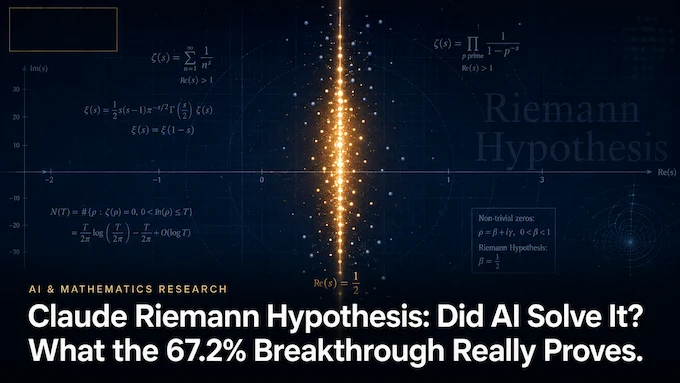
No, Claude did not solve the Riemann Hypothesis. That is the first fact to keep fixed while reading everything that follows.
What Claude appears to have done is still striking. During an attempt on one of mathematics’ most famous open problems, an unreleased Anthropic research model found a new route to a related theorem about the zeros of the Riemann zeta function. The result raises the unconditional lower bound for zeros known to lie on the critical line from just over 41.6% to about 67.2%. The paper’s optimized version gives 67.25%.
That is a major jump. It is also not “67.2% of the Riemann Hypothesis solved,” and the remaining 32.8% should not be read as zeros that violate the hypothesis. The Claude Riemann Hypothesis story is more interesting than that headline because it sits at the intersection of analytic number theory, formal proof, autonomous research workflows, and a very old mathematical barrier.
Table of Contents
1. Claude Riemann Hypothesis Result: The Claim Versus the Reality
The paper is unusually clear about what it does and does not establish. It proves lower bounds on how many zeros must lie on the critical line. It does not prove that every non-trivial zero lies there, which is what the Riemann Hypothesis requires. The paper also states that the result has no bearing on RH “in either direction.”
Claude Riemann Hypothesis: What the 67.2% Result Actually Proves
| Question | What the Result Actually Says |
|---|---|
| Did Claude solve the Riemann Hypothesis? | No. RH remains unproven. |
| What changed? | The unconditional lower bound for zeros on the critical line rises from over 41.6% to about 67.2%. |
| Is 67.2% the measured fraction of all zeros on the line? | No. It is a guaranteed lower bound. |
| Are the other 32.8% known to be off the line? | No. The method simply does not certify them. |
| Did Claude prove or disprove RH? | Neither. |
| Is there a formal proof artifact? | Yes. A Lean 4 formalization accompanies the paper. |
That distinction matters because has the Riemann Hypothesis been solved is a yes-or-no question. The answer is still no. Claude instead improved one of the strongest unconditional statements mathematicians can currently make about where many zeta zeros must lie.
2. What Did Claude Actually Prove?
The paper’s headline theorem says that at least two thirds of the relevant zeros are distinct zeros on the critical line. It also obtains the same two-thirds lower bound for zeros that are both simple and on the critical line, and at least five sixths for distinct zeros overall. With an optimized test family, those constants become 0.6725, 0.6725, and approximately 0.83625.
Claude Riemann Hypothesis: How the 67.2% Result Compares With Previous Bounds
| Quantity | Previous Unconditional Benchmark | Claude Paper |
|---|---|---|
| Zeros guaranteed on the critical line | >41.66% | 67.25% optimized |
| Simple zeros on the critical line | Lower prior unconditional guarantee | 67.25% optimized |
| Distinct zeros overall | 66.03% | 83.625% optimized |
| Full Riemann Hypothesis | Unsolved | Still unsolved |
The previous critical-line record cited in the paper was (5/12), or about 41.66%, reached through refinements of Levinson’s method. The paper describes its route as fundamentally different. It makes an older pair-correlation argument unconditional rather than squeezing another small gain from the Levinson-style approach.
That is why the 41.6% to 67.2% jump has attracted attention. In a field where percentage-point gains can represent years of highly specialized work, adding roughly 25 percentage points is not a cosmetic improvement.
3. What Is the Riemann Hypothesis in Simple Terms?
Prime numbers look irregular, but their distribution is tied deeply to a complex-valued object called the Riemann zeta function, usually written (\zeta(s)).
The zeta function has zeros, points where its value is zero. Some are “trivial” zeros that are well understood. The famous ones are the non-trivial zeros inside the critical strip, the region where the real part of (s) lies between 0 and 1.
The Riemann Hypothesis says something remarkably precise: every non-trivial zero has real part (1/2). In geometric language, every one of them lies on a vertical line through (1/2), known as the critical line. The paper restates the history plainly and notes that the hypothesis remains unproven.
So the logical structure is:
Critical strip → possible locations of non-trivial zeros → critical line at Re(s) = 1/2 → RH says all of them are there.
That word “all” is doing enormous work.
4. Why 67.2% Does Not Mean RH Is 67.2% Solved
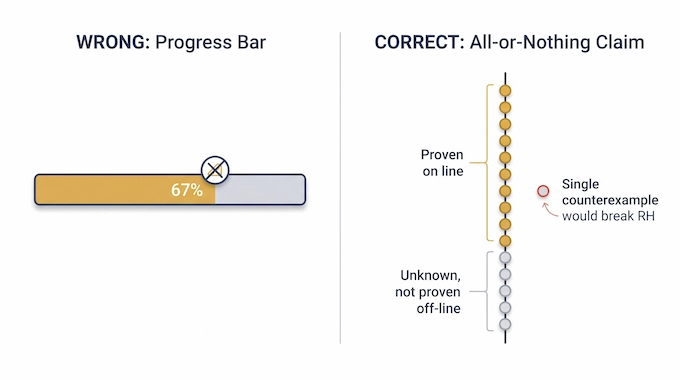
A universal statement is not a progress bar.
Suppose you prove that 67.2% of an infinite family obeys a rule. You have learned something substantial about the family, but you have not proved that every member obeys it. One counterexample is enough to kill a universal claim.
There is another subtlety. Claude’s 67.2% is a lower-density guarantee. The result does not identify the remaining 32.8% as off-line zeros. They could also lie on the critical line. The proof just cannot force that conclusion from the information it uses.
Even an asymptotic statement that “100% of zeros lie on the line” can be weaker than RH if it means density one rather than literally every zero. A sparse exceptional set can have density zero and still contain infinitely many objects. Perfect squares offer a simple analogy: they become vanishingly rare among positive integers, yet there are infinitely many of them.
That is why riemann hypothesis solved is the wrong interpretation of the Claude result. RH allows no exceptional non-trivial zeros at all.
5. How Did Claude Find the Riemann Zeta Result?
The discovery process is almost as notable as the theorem.
According to Anthropic’s account, Jarred Sumner gave an unreleased research version of Claude the broad challenge to take a serious shot at RH. Claude first generated about 650 ideas that failed. A second push expanded into a research workflow involving roughly 60 subagents, 31 million output tokens, about 2,400 shell commands, hundreds of Python scripts, and thousands of numerical checks against known zeta zeros.
The system also searched the literature, downloaded 54 arXiv papers to check novelty, had agents referee one another, looked for counterexamples, and independently re-derived the result. This was not a single eloquent chat response that happened to contain a theorem.
The much-shared “believe in yourself” angle is amusing, but it can obscure the real mechanism. The encouragement did not encode the mathematics. Its apparent role was to keep the system searching after an initial wave of failures. The meaningful ingredients were persistence, parallel exploration, computation, literature review, criticism, and re-checking.
For AI builders, that distinction matters. The Claude Riemann Hypothesis episode looks less like a prompt-engineering trick and more like an agentic research loop with a very large search budget.
6. The Mathematics Behind Claude’s Proof, Without Pretending It Is Simple
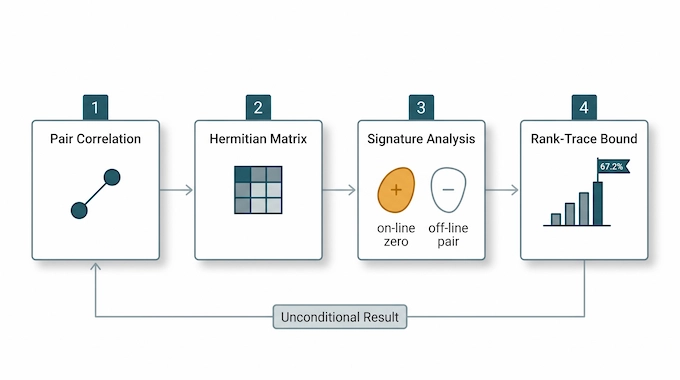
The core idea connects several pieces of earlier mathematics in a new way.
6.1 Montgomery’s Pair-Correlation Route
In the 1970s, Hugh Montgomery studied statistical relationships among zeta zeros. His pair-correlation machinery could produce strong statements about simple and distinct zeros, but the classical zero-side reading relied on assuming RH.
Later work by Baluyot, Goldston, Suriajaya, Turnage-Butterbaugh and others clarified that the prime-side second-moment calculation itself is unconditional. The hard part was interpreting the zero side when zeros might sit away from the critical line.
6.2 Replace Missing Positivity With Linear Algebra
Claude’s claimed new step is to stop asking the entire zero-side expression to behave as a positive sum.
Instead, the proof uses Weil’s Hermitian form and restricts it to a finite-dimensional family of test functions. This produces a Hermitian matrix, a finite compression of an object whose full positivity is tied to RH.
Zeros on the critical line and symmetric pairs of zeros off the line then leave different linear-algebraic fingerprints. On-line zeros contribute nonnegative rank-one pieces. An off-line pair contributes a block with one positive and one negative direction, a signature ((1,1)).
6.3 Rank, Trace, and Inertia Do the Counting
Once the problem is encoded this way, Claude uses Sylvester’s law of inertia and a rank-trace inequality for Hermitian matrices. First- and second-moment information from the prime side constrains the matrix strongly enough that too few on-line zeros would be impossible.
That turns Montgomery’s old two-thirds phenomenon into an unconditional bound. The paper summarizes the novelty as a “linear-algebraic reading” of the existing pair-correlation input.
The conceptual move is important. Claude did not invent the zeta function, pair correlation, Weil’s form, or Sylvester’s law. The claimed contribution is the connection that lets those tools remove a hypothesis that previously blocked this route.
7. Did Claude Discover New Mathematics or Just Combine Old Papers?
Those are not opposites.
Research mathematics routinely advances by connecting known tools in a way nobody had previously used to prove a given theorem. A proof can rely heavily on Riemann, Montgomery, Bombieri, Baluyot, Goldston, Suriajaya, Turnage-Butterbaugh and others while still contain a genuinely new argument.
The right question is whether the finite-compression, signature, and rank argument is new, correct, and sufficient to obtain the unconditional bounds claimed.
The paper presents it as new. Anthropic says its mathematicians studied the result in context, and the paper attributes the analytic inputs to prior human work while identifying the new ingredient as the linear-algebraic interpretation.
So “AI invented everything” is wrong. “It only retrieved an existing proof” is also unsupported by the available evidence.
8. Why the 67.2% Result Matters Even Though RH Is Unsolved
Three things make the Claude Riemann Hypothesis result significant.
First, the size of the improvement is unusually large. The paper moves the cited unconditional critical-line lower bound from (5/12) to (2/3), then to 0.6725 with optimization.
Second, it opens a different route. Rather than being another tweak to the long Levinson-method lineage, it revives Montgomery’s pair-correlation strategy and replaces the RH-dependent positivity step with matrix arguments.
Third, the research process is a stronger test of AI mathematics than solving problems with known answers. Claude had to search, fail, inspect literature, test conjectures, synthesize older results, propose a theorem, and help formalize it. That does not mean mathematicians are obsolete. It does mean the boundary between “AI that solves benchmark math” and “AI that participates in open-ended mathematical research” has become harder to draw cleanly.
9. Can Claude Keep Going From 67.2% to 100%?
Not by simply repeating the same trick.
The paper studies the limits of its own method and gives a ceiling of about 0.68185 for the kind of bandwidth-one certificate used in the argument. It estimates that forcing guarantees of 70%, 80%, and 90% through the same broad route would require pair-correlation information on wider Fourier supports of roughly 1.04, 1.26, and 1.70, beyond what is currently available in that framework.
So the internet joke that a few more 25-point jumps will get Claude past 100% misses the mathematics. The current technique runs into a structural wall.
More compute might help discover a new route. It does not make the present proof machinery scale automatically to RH.
10. Is Claude’s Proof Actually Verified?
There are several layers of checking, and they should not be collapsed into one word.
Claude’s own process included adversarial subagents, numerical checks, counterexample searches, literature review, and independent re-derivation. Anthropic says Levent Alpöge and Ralph Furman examined the work, while Brian Conrey and Dan Goldston also examined the paper on short notice.
More unusually, a Lean 4 formalization accompanies the work. The repository description says the formalization covers Theorems A through E, is “sorry-free,” and that the headline theorem types have no added hypotheses beyond Lean’s standard logical axioms.
That is strong evidence against many ordinary proof-step and algebraic errors. It is not the same thing as saying the mathematical community has already completed years of independent scrutiny, nor is it a proof of Riemann Hypothesis itself. The formal artifact verifies the theorem that was encoded, namely the lower-bound result.
For anyone searching for a proof of Riemann Hypothesis, this is the crucial distinction: Claude has a formalized proof of a new theorem about zeta zeros, not a formalized proof of RH.
11. What Would Solving the Riemann Hypothesis Actually Change?
A genuine proof of RH would be a different category of event. It would settle a conjecture dating to 1859, resolve one of the Clay Mathematics Institute’s Millennium Prize Problems, and remove a major conditional assumption from a large body of analytic number theory. The zeta zeros matter because they encode fine information about the distribution of prime numbers.
What it would not mean is that every cryptographic system suddenly fails the next morning. RH concerns the distribution of primes, not a ready-made fast algorithm for factoring the large integers used by systems such as RSA. The mathematical consequences would be profound, but “RH proved, therefore encryption broken” skips several hard steps.
That contrast helps put the Claude Riemann Hypothesis result in scale. Claude has not crossed the finish line. It has apparently moved an important unconditional boundary inside the surrounding theory.
12. What the Claude Riemann Hypothesis Story Really Tells Us
The cleanest summary is also the least sensational.
Claude failed at the task it was originally given. The Riemann Hypothesis remains unsolved. But in the process, it appears to have found a substantial new theorem that raises a decades-old unconditional lower bound from about 41.6% to 67.2%, with a claimed method that combines deep prior number theory with a new finite-dimensional linear-algebraic argument.
That is more interesting than pretending an AI completed 67.2% of a Millennium Prize problem.
The remaining gap is not 32.8 percentage points waiting to be filled. RH is an all-or-nothing statement, and the paper itself explains that its current certificate cannot simply be pushed to 100%. The real milestone is methodological: an AI system was used not just to answer a hard question, but to conduct a large, failure-heavy research search, synthesize literature, generate a candidate theorem, attack its own proof, and produce a machine-checkable formalization.
If you want technical AI stories without the headline distortion, follow Binary Verse AI. We break down the papers, benchmarks, proofs, and caveats behind the claims so you can see what actually changed, and what did not.
1. Who solved the Riemann Hypothesis?
No one has produced an accepted proof or disproof of the Riemann Hypothesis. Claude did not solve it either. Its 2026 result concerns a related lower-bound problem, showing that at least roughly 67.2% of Riemann zeta zeros can be guaranteed to lie on the critical line.
2. What is the Riemann Hypothesis in simple terms?
The Riemann Hypothesis says that every non-trivial zero of the Riemann zeta function lies on a specific vertical line in the complex-number plane called the critical line, where the real part equals 1/2. Those zeros are deeply connected to how prime numbers are distributed.
3. What does ζ mean in math?
The symbol ζ is the Greek letter zeta. In this context, denotes the Riemann zeta function, a mathematical function whose non-trivial zeros encode important information about the distribution of prime numbers. The Riemann Hypothesis makes a precise claim about where all those zeros are located.
4. Why is the Riemann Hypothesis important?
It gives extremely precise control over irregularities in the distribution of prime numbers and is connected to many results throughout number theory. A proof would settle one of mathematics’ most important open questions and resolve numerous results that are currently known only under the assumption that RH is true.
5. What would happen if the Riemann Hypothesis were solved?
A valid proof would resolve one of the Clay Mathematics Institute’s Millennium Prize Problems, potentially earn the $1 million prize after the required scrutiny, and turn many conditional mathematical results into unconditional ones. It would be historically transformative for mathematics, although claims that it would automatically break modern encryption are exaggerated.