An AI-designed protein can look completely novel. That is the point. But novelty creates a provenance problem: once a model-generated sequence leaves the design tool, how can a synthesis company, database curator, or researcher tell where it came from?
Google DeepMind’s answer is SynthID Bio, a family of methods for watermarking AI-generated proteins. Instead of attaching a removable label, the system hides a detectable signal inside the protein sequence itself, or inside the atomic coordinates of an AI-predicted 3D structure. The hard part is biological rather than cosmetic. A watermark is useless if it makes the protein fold badly, bind the wrong target, or stop working.
DeepMind’s Nature paper presents SynthID Bio as a proof of concept for function-preserving biological watermarking, not as a universal safety system. The work covers both protein sequences and predicted structures, with wet-lab tests showing that selected watermarked protein binders retained useful biological activity.
Table of Contents
1. What Is SynthID Bio?
SynthID Bio is Google DeepMind’s attempt to give AI-generated biological designs a built-in provenance signal. The goal is not to mark a protein with a visible tag. It is to make subtle choices during generation that a secret detector can later recognize.
SynthID Bio: Key Facts About AI Protein Watermarking
| Key Fact | What It Means |
|---|---|
| Developer | Google DeepMind |
| Main Purpose | Track the provenance of AI-generated biological designs |
| What Can Be Watermarked | Protein amino-acid sequences and predicted 3D biomolecular structures |
| Sequence Method | Modifies how ProteinMPNN samples amino acids |
| Structure Method | Fine-tunes part of AlphaFold 3 so predicted coordinates carry a detectable signal |
| Evidence So Far | Wet-lab protein-binder tests plus in-silico structure evaluations |
| Main Use Cases | Biosecurity screening and scientific-data integrity |
| Biggest Caveat | It is a proof of concept, and tested watermarks can be removed or weakened under some attacks |
The distinction between provenance and safety matters. SynthID Bio is designed to answer something closer to, “Did this object come from a watermark-enabled AI system?” It does not answer, “Is this protein biologically harmless?”
The Nature paper also makes clear that operational deployment would need more technical work, coordination, and standardization across model developers, synthesis providers, and other stakeholders.
2. How Does SynthID Bio Watermark AI-Generated Proteins?
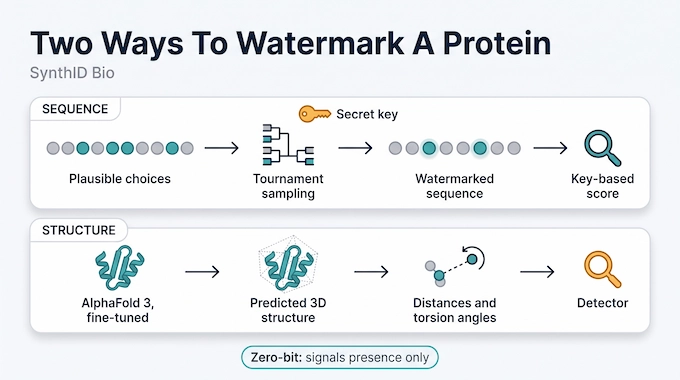
There are really two different systems under one name. The paper’s Figure 1 on page 2 makes that split easy to see: the sequence pipeline adds a watermark during ProteinMPNN sampling, while the structure pipeline trains the watermarking behavior into AlphaFold 3‘s prediction process.
SynthID Bio: How Sequence and Structure Watermarking Work
| Method | Where The Signal Lives | How It Is Added | How It Is Detected |
|---|---|---|---|
| SynthID Bio Sequence | Amino-acid choices across a protein sequence | Tournament sampling biases which plausible residues are selected | A secret key is used to recompute watermark scores across the sequence |
| SynthID Bio Structure | Subtle geometric patterns in predicted atomic coordinates | Part of AlphaFold 3 is fine-tuned with an added watermarking objective | A detector analyzes geometric features such as atom distances and torsion angles |
2.1 SynthID Bio Sequence: A Statistical Pattern In Amino Acids
A useful mental model is a weighted coin, not a barcode. When ProteinMPNN generates a sequence, it often has several plausible amino acids available at a given position. SynthID Bio does not insert one fixed “special” residue at a known location. Instead, it changes the sampling process so that certain acceptable choices are slightly favored according to a secret watermarking key.
The paper adapts SynthID-text’s “tournament sampling” approach. Candidate amino acids effectively compete under a secret scoring rule. Repeated across the sequence, those choices create a statistical pattern. A detector that knows the key can reconstruct the scoring process and ask whether the sequence scores unusually high compared with a non-watermarked sequence.
That is why protein watermarking can be subtle. No single amino acid has to scream “AI made this.” The evidence is distributed across many residue choices.
There is a trade-off, though. Stronger detectability can require stricter filtering of candidate designs. In the paper’s tested configuration, calibrated score thresholds could guarantee 100% true-positive detection, but lower pass rates mean more candidates may need to be generated before one survives the full design pipeline.
2.2 SynthID Bio Structure: Hiding A Signal In 3D Geometry
The structure method is fundamentally different. Here, the object being watermarked is not an amino-acid string but a predicted arrangement of atoms.
DeepMind fine-tunes part of AlphaFold 3’s diffusion network while training a detector alongside it. The extra objective nudges the model toward structures that remain accurate while carrying a detectable geometric signature. The detector looks at features such as atom-to-atom distances and torsion angles.
This matters for open or widely shared models. A watermark added after prediction can simply be skipped. A watermarking tendency encoded into the model weights is harder to bypass without changing the model or altering its output afterward.
3. Can The Watermark Survive Physical Protein Synthesis?
For the sequence watermark, yes in the basic sense that matters. The watermark is encoded in the amino-acid sequence, and that sequence defines the physical protein that is synthesized. DeepMind explicitly describes the signature as remaining verifiable beyond the digital model and into the synthesized protein. SynthID Bio_ Watermarking metho…
That does not mean someone can hold a vial up to the light and “see” the watermark. Detection still depends on recovering or knowing the relevant sequence information and applying the correct detector or secret key. The physical molecule carries the amino-acid choices that encode the statistical signal, but the signal remains computational.
This is one reason biological watermarking is conceptually different from adding metadata to a file. Metadata can be stripped away while the underlying object remains unchanged. Here, the SynthID Bio watermark is carried by the designed biological sequence itself.
4. Does Changing Amino Acids Change Protein Function?
This is the central scientific risk. Protein function depends on sequence, folding, stability, and molecular interactions. A watermark that damages those properties would defeat the purpose of the design.
DeepMind tested watermarked binders against three targets: VEGF-A, the SARS-CoV-2 receptor-binding domain, and PD-L1. The study started from known AlphaProteo binder backbones, then resequenced them with ProteinMPNN with or without watermarking. Across the reported experiments, the authors found no significant population-level differences in binding affinity between the watermarked and non-watermarked groups, with broadly comparable hit rates at the key affinity threshold.
The binding-affinity chart on page 3 of DeepMind’s announcement tells the same story visually. The distributions for watermarked and non-watermarked designs substantially overlap across the three targets.
That is meaningful evidence for the tested binder setting, but it is not a license to generalize to every protein. The experiments used specific AI-designed proteins, known backbones, and particular targets. Enzymes, membrane proteins, large complexes, intrinsically disordered proteins, and other biological systems can impose very different constraints. The paper repeatedly calls SynthID Bio a proof of concept for good reason.
5. How Accurate Is SynthID Bio Detection?
The structure results provide the cleanest headline number. SynthID Bio Structure exceeded 99.8% true-positive detection at a 0.1% false-positive rate across the reported AlphaFold 3 evaluation settings. The researchers also found that the most conservative watermarking configuration preserved the key structural-accuracy metrics they examined. Pasted text
Sequence detection is more conditional. Without filtering on watermark score, detection varies with sampling temperature and watermark strength. With a calibrated threshold, the tested pipeline could force 100% true-positive detection, but at the cost of rejecting more candidate designs before they reach later stages.
A useful term here is zero-bit watermark. In its current form, the system mainly signals that a watermark is present. It is not yet a rich embedded identity card carrying detailed information about a specific user, lab, or individual generation event.
6. Can Someone Remove A SynthID Bio Watermark?
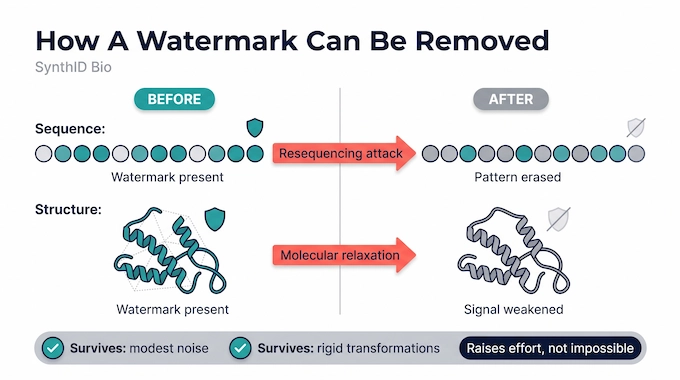
Yes, and that is one of the most important limitations of the work. For the sequence watermark, the paper tested a ProteinMPNN resequencing attack and found that it could effectively remove the watermark. In practical terms, an attacker can take the protein’s structural context and generate a new amino-acid sequence that aims to preserve function while erasing the statistical pattern. Pasted text
The structure watermark is tougher against simple edits. It survives modest coordinate noise and rigid transformations in the reported experiments. But the research also found that molecular relaxation could defeat the tested watermark, which means post-processing still matters. Pasted text
So the right interpretation is not that the watermark cannot be removed. It is that the watermark can make protein provenance detectable by default and may raise the effort needed to erase it.
That can still be useful. Security systems often earn their keep by changing incentives and adding friction, not by being mathematically impossible to bypass.
7. Does A SynthID Bio Watermark Mean A Protein Is Safe?
No. A watermark is a provenance signal, not a biological safety certificate. A detected SynthID Bio watermark could tell a synthesis provider that a design appears to have come through a watermark-enabled model or workflow. That information can inform screening, but it cannot prove that the molecule is non-toxic, non-pathogenic, therapeutically useful, or otherwise safe.
“Trusted origin” and “safe biological function” are separate questions. A model can have safeguards and still produce something that needs review. Likewise, an unwatermarked sequence is not automatically dangerous. SynthID Bio should therefore sit beside other checks rather than replace them.
8. Why DNA Synthesis Screening Is The Most Practical Use Case
The practical value becomes clearer when a digital design has to become a physical molecule.
DNA synthesis companies already screen orders against known biological threats. The problem is that AI-designed proteins can be highly novel and may have little obvious sequence similarity to entries in threat databases. DeepMind argues that this makes unfamiliar sequences harder to interpret and can force more manual review.
A SynthID Bio watermark adds another signal. If an unfamiliar design carries a valid provenance mark from a model with built-in safeguards, the synthesis provider has more context about how the sequence was produced. That could help prioritize which orders need deeper review.
This is best understood as a layered defense. DeepMind itself describes watermarking as one piece of a broader biosecurity system, alongside model-level safeguards, customer vetting, and DNA synthesis screening.
9. Protein Provenance Could Also Protect Scientific Databases
Biosecurity is only half the story. The other half is scientific integrity.
Public resources such as the Protein Data Bank, UniProt, and GenBank are increasingly important inputs for both human research and machine-learning systems. If AI-generated sequences or predicted structures are submitted without clear labeling, synthetic data can be mistaken for experimentally observed biology.
DeepMind proposes using SynthID Bio as a flag during submission or curation, helping databases identify synthetic entries for labeling or further review.
The risk is recursive. AI systems learn from scientific databases, then generate new biological artifacts. If synthetic outputs flow back into those databases without provenance, future models can end up training on increasingly ambiguous mixtures of observed and generated data. Protein provenance therefore becomes a data-quality problem as much as a security problem.
10. What About DNA, RNA, And Watermarked Bacteriophages?
The structure detector was evaluated on more than proteins. The Nature research reports watermark detection across different biomolecular structures, including protein, RNA, and DNA. Pasted text
DeepMind is also extending the idea beyond protein design. In ongoing work with the Hie lab at Stanford and Arc Institute, the team says it integrated SynthID Bio into Evo 2 to watermark the genome of an AI-designed bacteriophage. Early bacterial-culture tests found that the watermarked phages remained functional, but DeepMind says a fuller technical manuscript is still to come.
That makes the bacteriophage result interesting, but preliminary. The protein work has the detailed Nature paper behind it. The genome-watermarking extension does not yet have the same published technical depth.
11. The Biggest Limitations Of SynthID Bio
SynthID Bio solves a narrow problem well enough to be interesting, but several gaps stand between a research demonstration and dependable infrastructure.
The current sequence and structure systems are zero-bit watermarks, so they mainly indicate presence rather than encoding rich provenance. Sequence marks can be removed by resequencing. Structure marks can be vulnerable to relaxation. Stronger detection can reduce design pass rates. Secret detector keys require trusted distribution. The system also does not yet solve reliable differentiation across multiple users or providers.
There is also a deployment asymmetry. Sequence watermarking is relatively easy to bolt onto ProteinMPNN-style sampling, but users can potentially turn that mechanism off. Structure watermarking is embedded in model weights, which makes disabling it harder, but it requires model fine-tuning and still does not prevent post-processing attacks.
Most importantly, the evidence is not yet broad enough to say that every class of AI-generated protein can be watermarked without meaningful biological consequences. Long-term stability under mutation, evolution, partial sequence editing, and diverse wet-lab conditions remains an open research area.
The paper’s own framing is appropriately cautious. Practical use will require further innovation, coordination, and standardization before SynthID Bio can become routine infrastructure.
12. What SynthID Bio Changes For AI-Designed Biology
SynthID Bio is interesting because it moves provenance from the paperwork around a biological design into the design itself.
For sequences, that means statistically shaping amino-acid choices so the origin can later be detected. For structures, it means training a prediction model to leave a subtle geometric signature in its output. In both cases, DeepMind’s key result is that the watermark can coexist with useful biological or structural performance in the settings tested.
The technology should not be mistaken for an unbreakable lock, a universal detector for all AI-generated proteins, or proof that a molecule is safe. Its value is more practical: SynthID Bio adds a new verification layer where provenance is otherwise easy to lose.
That is a meaningful shift. As AI-designed proteins move from model outputs to synthesis orders, lab experiments, and public databases, knowing where a design came from will matter almost as much as knowing what it does.
For more grounded explainers on AI models, scientific breakthroughs, and the engineering details behind the headlines, follow Binary Verse AI.
What is SynthID Bio?
SynthID Bio is Google DeepMind’s system for embedding detectable watermarks into AI-generated protein sequences and predicted biomolecular structures. Its purpose is to help establish the provenance of biological designs for applications such as DNA synthesis screening and scientific-database integrity.
How does SynthID Bio watermark AI-generated proteins?
For protein sequences, SynthID Bio modifies the sampling process used by ProteinMPNN so that certain plausible amino-acid choices collectively form a statistical signal linked to a secret key. For 3D structures, DeepMind fine-tunes AlphaFold 3’s diffusion system so subtle geometric patterns in the predicted coordinates carry a detectable watermark.
Does SynthID Bio change how a protein works?
In DeepMind’s reported experiments, watermarked binders targeting VEGF-A, SARS-CoV-2 RBD and PD-L1 retained broadly comparable binding performance to non-watermarked designs. However, this is a limited experimental demonstration, not proof that watermarking will preserve the function of every possible protein.
Can a SynthID Bio watermark be removed?
Yes, under some conditions. The Nature paper reports that ProteinMPNN resequencing can effectively remove the sequence watermark. The structure watermark withstands some noise and geometric transformations, but tested molecular relaxation could destroy it. Improving resistance to deliberate removal remains an open research problem.
Does a SynthID Bio watermark prove an AI-designed protein is safe?
No. SynthID Bio is primarily a provenance signal. Detecting the watermark can indicate that a biological design came through a particular watermark-enabled workflow, but it does not independently establish that the resulting protein is harmless. It is intended to complement—not replace—existing biosecurity screening.