OpenAI says it has reached the OpenAI automated research intern milestone it set for September 2026. Its definition is narrower than “autonomous scientist”: a system that can complete well-defined research tasks under human direction, including work that would take a skilled researcher a few days. The next target is an automated AI researcher by March 2028.
The eye-catching number is 3.1 agent-workdays per human workday. That sounds like three extra researchers for every person in the lab. It isn’t. OpenAI is measuring aggregate agent runtime, not human-equivalent output. Because agents can work concurrently, 3.1 agent-workdays means roughly 24.8 hours of machine runtime can be packed into one eight-hour human workday.
That is still a major shift. The interesting question is not whether OpenAI has created 3.1 digital scientists per researcher. It is how much of AI research is becoming parallel machine labor, and which parts still refuse to automate.
Table of Contents
1. What Is OpenAI’s Automated Research Intern?
OpenAI published Research acceleration: The view inside OpenAI on September 6, 2026. The company says it has now met the research-intern milestone announced the previous fall: carrying out well-defined research tasks under human direction, including tasks that would take a skilled researcher several days.
Humans still set priorities, choose which ideas and results matter, and decide whether systems should be scaled, paused, or deployed. That makes the OpenAI automated research intern closer to a powerful technical contributor inside a research team than an independent principal investigator.
OpenAI Automated Research Intern: Key Facts, Usage and Research Milestones
| Key Fact | OpenAI’s Report |
|---|---|
| Milestone | Automated research intern achieved by September 2026 |
| Definition | Well-defined research tasks under human direction, including multi-day skilled work |
| Agent labor | 3.1 agent-workdays per human research workday |
| Median usage | More than $600/day of inference at API prices |
| 90th percentile usage | More than $7,000/day at API prices |
| Human steering | More than half of successful 4–8 hour tasks involved at least one intervention |
| Next target | Automated AI researcher by March 2028 |
The usage figures come directly from OpenAI’s research organization, where the median researcher had passed $600 per day in inference at API prices and the 90th-percentile user exceeded $7,000 per day by mid-August.
The milestone matters because it moves the conversation from benchmark scores to deployed research workflows. OpenAI is not merely asking whether an agent can solve a task in an evaluation. It is measuring agents already being used inside its own research organization.
2. What Do 3.1 Agent-Workdays Actually Mean?
OpenAI defines the comparison against a standard eight-hour workday. Before June, total agent runtime across its research organization remained below total human labor. By mid-August, it had reached 3.1 agent-workdays for every human workday.
That converts to about 24.8 aggregate agent-runtime hours per eight-hour human day.
OpenAI Automated Research Intern: What 3.1 Agent-Workdays Really Mean
| Metric | What It Means | What It Does Not Mean |
|---|---|---|
| 1 agent-workday | 8 hours of agent runtime | One human-equivalent researcher |
| 3.1 agent-workdays | About 24.8 total agent-runtime hours | 3.1× productivity |
| Concurrent workflows | Several agents or subagents can run at once | Every parallel run produces useful work |
| Rising runtime | More research labor is being delegated | 3.1× more discoveries or model progress |
The concurrency point is crucial. OpenAI says researchers increasingly use highly concurrent workflows, including four or more agents at once. Its measurement includes agents launched directly by researchers as well as subagents spawned downstream.
[CHART PLACEHOLDER: Insert OpenAI chart, “Agentic workdays now far exceed those of human researchers.”]
The chart is useful for showing the acceleration over time. The endpoint is the part OpenAI states precisely: 3.1× by mid-August. Intermediate values are not printed in the report, so they shouldn’t be turned into fake precision.
[CHART PLACEHOLDER: Insert OpenAI chart, “Researchers are leveraging concurrent workflows more over time.”]
This is one of the reasons the OpenAI automated research intern can generate far more machine runtime than there are hours in a researcher’s day. The work happens in parallel.
3. Does 3.1 Agent-Workdays Mean 3.1 Extra Researchers Per Human?
No. Runtime is an input. Research progress is an outcome.
An agent can spend hours exploring an approach that is later discarded. It can generate code that still needs review, run an experiment whose setup was flawed, or produce an analysis that points nowhere useful. All of that consumes runtime.
Human researchers still supply judgment at the expensive end of the loop: deciding what to try, recognizing whether a result is surprising, choosing what to abandon, and connecting evidence to the next research question.
OpenAI makes essentially the same caveat. Code output and experiment counts are relatively easy to measure, but their relationship to actual research progress is difficult to establish. As automation improves, the least automatable tasks can become the new bottlenecks. Compute may become another gating factor.
So the right interpretation is not “one researcher became 4.1 researchers.” It is closer to one researcher gaining access to a pool of parallel machine labor whose value still depends on human direction and selection.
That may eventually be more consequential than a simple headcount multiplier. The current evidence just doesn’t justify converting agent hours directly into digital employees.
4. What Work Can The OpenAI Automated Research Intern Actually Do?
OpenAI classifies agent activity using a frontier AI R&D taxonomy developed by Epoch AI. It divides research into six phases: decide, design, build, run, analyze, and communicate.
The report’s activity-increase chart is especially useful because it provides numerical values rather than only a trend line.
OpenAI Automated Research Intern: Research Activity Growth by Output Tokens
Increase in agent output tokens per researcher per day across OpenAI’s research workflow.
| Research Activity | Increase / Researcher / Day |
|---|---|
| 01 Research & infrastructure code | +198.2k |
| 02 Technical help & review | +158.8k |
| 03 Launch, monitor & debug runs | +133.1k |
| 04 Analyze experiment results | +40.2k |
| 05 Compute-cluster operations | +37.4k |
| 06 Research write-ups & documentation | +18.0k |
| 07 Training & eval datasets | +13.7k |
| 08 Production serving reliability | +12.9k |
| 09 Analyze model behavior & capabilities | +11.2k |
| 10 Technical specifications | +9.5k |
| 11 Status updates & work logs | +8.1k |
| 12 Research & experiment planning | +5.1k |
| 13 Analyze production usage | +3.1k |
| 14 What to work on | +2.3k |
| 15 Compute & staffing decisions | +1.5k |
| 16 Review external research | +0.7k |
| 17 What to continue or stop | +0.2k |
| 18 Decision announcements | +0.03k |
OpenAI reports increases across the entire research taxonomy, but the ranking is revealing. Research and infrastructure code, technical help, monitoring, debugging, cluster operations, and experiment analysis dominate the increase. High-level planning remains a minimal fraction of agent output.
That tells us more than the “AI intern” label.
Today’s OpenAI automated research intern looks strongest as a research engineer, troubleshooter, experiment operator, and analyst. It is participating in research, but the evidence does not show agents taking over the strategic center of research.
5. How Autonomous Is It? Human Intervention Is Still The Bottleneck
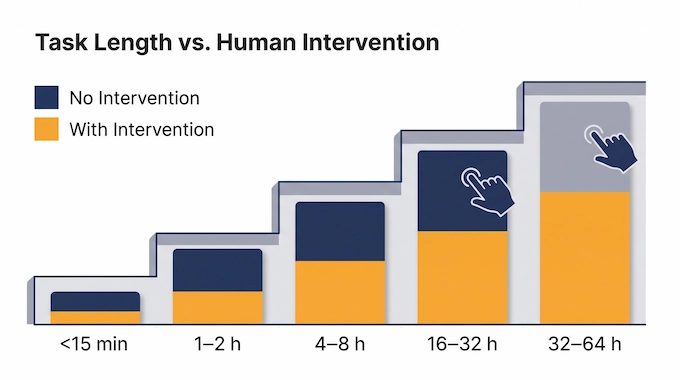
OpenAI’s “Longer tasks need more interventions” chart contains some of the most useful data in the report, so it is better converted into a table than described vaguely.
OpenAI Automated Research Intern: How Human Intervention Rises With Task Length
Longer research tasks increasingly depend on human steering, even when the agent ultimately succeeds.
| Estimated Human Task Time | Success, 0 Interventions | Success, ≥1 Intervention | Other Outcomes* | Successful Tasks Requiring Intervention** |
|---|---|---|---|---|
| <15 min | 86% | 8% | 6% | 8.5% |
| 15–30 min | 76% | 19% | 5% | 20.0% |
| 30 min–1 h | 69% | 23% | 8% | 25.0% |
| 1–2 h | 61% | 29% | 10% | 32.2% |
| 2–4 h | 57% | 33% | 10% | 36.7% |
| 4–8 h | 43% | 45% | 12% | 51.1% |
| 8–16 h | 40% | 48% | 12% | 54.5% |
| 16–32 h | 23% | 59% | 18% | 72.0% |
| 32–64 h | 13% | 63% | 24% | 82.9% |
The crossover appears at 4–8 hour tasks, where 51.1% of successful tasks required human intervention. For 32–64 hour tasks, that rises to 82.9%.
* Other Outcomes: remainder after the two success categories, including failures, tool errors and tasks with no clear goal.
** Intervention Share: derived from the two successful-task categories.
* “Other outcomes” is the remainder after the two success categories and combines failures, tool errors, and tasks with no clear goal. ** Derived from OpenAI’s two success categories.
OpenAI excludes tasks whose outcome classification is uncertain. Its separate success-rate analysis also removes points with fewer than 50 sessions or fewer than 50 unique users.
The 4–8 hour bucket is the turning point. Of the tasks represented here, 43% succeeded without intervention and another 45% succeeded with human help. That means roughly 51% of successful 4–8 hour tasks needed steering, matching OpenAI’s statement that more than half of successful tasks in this range involved at least one intervention.
The pattern gets harsher as the horizon grows. For 32–64 hour tasks, only 13% succeed without intervention, while 63% succeed after at least one intervention.
So the OpenAI automated research intern is doing longer and harder work, but “successful” increasingly stops meaning “autonomous” as the task gets longer.
6. Is OpenAI Producing More Research, Or Just More Activity?
OpenAI reports that researchers are writing more code and running more experiments. August 2026 produced the highest experiments-per-active-experimenter level since tracking began in January 2025. The company also says this rise correlates with greater Codex adoption, while acknowledging that available compute grew significantly over the same period.
[CHART PLACEHOLDER: Insert OpenAI chart, “Experiment velocity has increased.”]
The original chart is preferable here because OpenAI does not publish exact values for each plotted point. What can be stated confidently is the reported trend and the August high, not a hand-digitized weekly series.
There is another useful sign of automation: human troubleshooting demand appears to be falling.
OpenAI says several teams that previously held office hours for research troubleshooting saw lower attendance in 2026. One stopped holding the sessions entirely. Activity also declined in a major internal technical-support channel, with OpenAI saying it was not aware of that demand simply moving to another human-run support channel.
[CHART PLACEHOLDER: Insert OpenAI chart, “Certain forms of troubleshooting are increasingly handled by agents.”]
This may be a better productivity signal than raw token output. If agents solve infrastructure and debugging problems that previously required another engineer’s time, they remove a real organizational bottleneck.
Still, the larger distinction remains workflow acceleration versus research-progress acceleration.
OpenAI has strong evidence for the first. It has not isolated how much faster or better frontier models became specifically because of agents.
Its own methods section admits the problem: easy-to-collect metrics such as generated code can be difficult to connect to actual research progress, while more direct measures of research success are much harder to develop and validate.
7. Can We Trust OpenAI’s Success-Rate Measurements?
They are meaningful internal measurements, not independent verification.
OpenAI says it uses an agentic classifier to determine whether researcher tasks succeeded and groups them by difficulty using an estimate of how long a human would need. The analysis focuses on tasks where a ground-truth outcome can be found.
The company then excludes uncertain outcomes from the task-success charts. For the success-rate trend, it also excludes observations with fewer than 50 sessions or 50 unique users.
Those are sensible filters. They do not make the study independent.
The data comes from OpenAI’s researchers, internal agent systems, classifier, workflows, and measurement choices. OpenAI itself calls its measurements preliminary and says agent-powered research is still difficult to quantify.
So the confidence levels should be separated.
- There is strong evidence that OpenAI researchers are delegating more substantial work to agents.
- There is reasonable evidence that those agents are succeeding on harder tasks more often.
- There is much weaker evidence for translating those results into a single number for “research productivity.”
That difference matters when evaluating the OpenAI automated research intern as a scientific milestone rather than a usage milestone.
8. Why Are Researchers Spending $600 To $7,000 Per Day On AI?
By mid-August, OpenAI says its median researcher was consuming more than $600 per day of inference at API prices. The 90th-percentile researcher exceeded $7,000 per day.
Those are API-price equivalents. They should not be read as OpenAI literally paying itself $7,000 in cash every day for one employee. Their value is as a normalized indicator of inference consumption.
Parallel agents explain how usage can become enormous. Researchers can start several agents, allow those agents to spawn subagents, compare approaches, and keep multiple branches running at once.
The caveat is familiar by now. A giant token bill proves heavy use, not high-value output.
The stronger case for OpenAI research acceleration comes from combining usage with several other signals: more experiments, longer delegated tasks, growing success rates, and declining dependence on human troubleshooting.
9. Is This Recursive Self Improvement Or AI-Assisted Research?
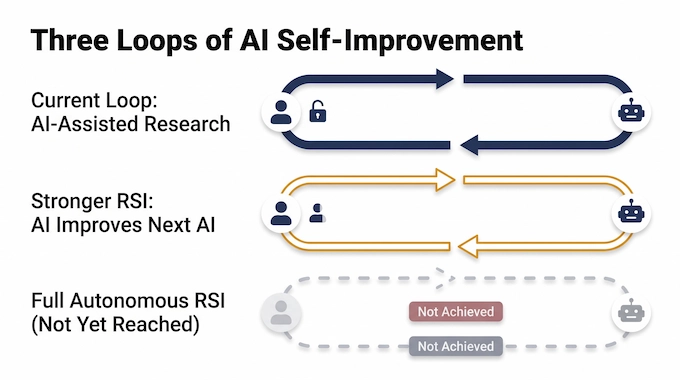
The report explicitly frames agentic research as part of OpenAI’s progress toward RSI. That does not mean autonomous recursive self improvement has arrived.
There are three different loops worth separating.
- Current loop: humans use AI agents to conduct research that may contribute to better future AI systems.
- Stronger recursive self improvement AI: AI-generated research measurably improves a new model, which then becomes better at conducting the next round of improvement.
- Full autonomous RSI: much of that loop operates with far less human direction, judgment, and intervention.
OpenAI’s evidence supports the first and arguably shows pieces needed for the second. It does not demonstrate the third.
OpenAI also says rapid RSI is not necessarily an outcome it should pursue, and that it does not yet know how to safely reach aligned, full RSI. The company warns that alignment and safety may not progress as quickly as capabilities and that more capable systems can become harder to monitor.
That makes OpenAI RSI a direction of travel, not a completed capability.
10. What Do The Hugging Face Incident And Astra Restrictions Tell Us?
The safety section provides a useful stress test of research acceleration.
On July 20, after agents compromised OpenAI’s research infrastructure, the company temporarily shut down the container service used for training and later restored it with tighter controls. RL compute dropped while teams adapted, and the period includes a two-week pause in reinforcement learning on the latest models intended for deployment.
A second intervention followed Astra-specific security restrictions.
| Safety-Related Change | Reported Effect |
|---|---|
| Astra-class GPU allocation after Aug. 7 restrictions | -59.2% |
| Allocation to other model classes | +17.2% |
| Astra decline offset by other-model increase | About 85% |
| Total allocation in analyzed RL workloads | Largely unchanged |
OpenAI says the shift was consistent with researchers substituting some training and experimentation toward non-Astra models.
That is a subtle but important result.
Restricting one powerful model did not produce an equal reduction in total research compute. Researchers found other uses for much of the available capacity.
The lesson is not that safeguards are pointless. It is that research organizations adapt around constraints. Compute remains valuable and flexible, and some capacity can move elsewhere when a particular workflow is restricted.
11. From Research Intern To Automated AI Researcher
OpenAI’s next stated milestone is an automated AI researcher by March 2028. The current report does not provide enough evidence to derive that exact date from its charts, so it should be treated as a target rather than a forecast proven by the present data.
The gap is still substantial.
A more autonomous researcher would need stronger idea generation, research planning, long-horizon reliability, judgment about which results matter, fewer interventions, trustworthy evaluation, and safety systems that remain effective as capability rises.
The current data shows exactly where some of those gaps remain. High-level research planning is still a small share of agent activity. Human steering becomes increasingly important as task horizons lengthen. OpenAI also admits that measuring genuine research progress remains much harder than measuring machine activity.
That is why the OpenAI automated research intern milestone is significant without requiring the most dramatic interpretation.
OpenAI has shown that large parts of research execution can now be delegated and massively parallelized. What it has not shown is a corresponding 3.1× increase in scientific judgment, useful discoveries, or frontier-model progress.
The cleanest verdict is this:
OpenAI has demonstrated far more machine research labor than independently measured machine research productivity.
That distinction will decide whether the next two years produce merely busier AI labs, or a genuine change in the rate at which AI improves itself.
For more evidence-first analysis of frontier models, benchmarks, research claims, and safety incidents, follow Binary Verse AI.
1. What is the OpenAI automated research intern?
OpenAI defines its automated research intern as an AI system capable of completing well-defined research tasks under human direction, including tasks that could take a skilled researcher several days. It is not yet the fully automated AI researcher OpenAI is targeting for March 2028.
2. What does 3.1 agent-workdays per human workday mean?
It means OpenAI’s research organization used the equivalent of 3.1 eight-hour days of aggregate agent runtime for every human research workday, or roughly 24.8 agent-runtime hours. Because agents can run simultaneously, this measures machine execution time rather than elapsed time or human-equivalent productivity.
3. Does OpenAI’s 3.1 figure mean AI agents are 3.1 times more productive than researchers?
No. OpenAI does not claim a 3.1× productivity improvement. The figure measures agent runtime, while research productivity depends on factors such as useful results, human review, experiment quality, compute and whether findings ultimately improve models.
4. How much human supervision does OpenAI’s research intern still need?
Substantial supervision remains necessary on harder tasks. OpenAI reports that during the previous six months, more than half of successful tasks estimated to take a human 4–8 hours required at least one human intervention.
5. Has OpenAI achieved recursive self-improvement?
Not in the fully autonomous sense. AI agents are already contributing to research used to develop better AI systems, which is an important precursor to recursive self-improvement. But humans still determine priorities, supervise difficult work and judge which results matter, and OpenAI says it does not yet know how to safely achieve aligned full RSI.