Hilbert’s 10th problem has acquired a striking AI twist. OpenAI has published a proposed proof concerning its rational-number extension: whether an algorithm can always determine if a polynomial equation has a solution made of fractions. The paper’s answer is no.
That sounds odd for a breakthrough. An AI system helps produce mathematics explaining why algorithms cannot do something. There’s no contradiction. Proving the limits of a universal solver is a different task from building one.
The original problem, over integers, was settled negatively in 1970. The rational version resisted that resolution. OpenAI’s October 6, 2026 manuscript proposes a way through, using finite tests, mathematical logic, elliptic curves, and bounds on arithmetic size.
If validated, it would settle a major question about rational equations and computation. For now, the important story is the proposed argument, its unusual route around a longstanding obstacle, and the scrutiny still required.
Table of Contents
1. What Is Hilbert’s 10th Problem?
Imagine a program that accepts a polynomial equation and returns either “a solution exists” or “no solution exists.” It must finish for every valid input, even when the equation has many variables or enormous coefficients.
Hilbert’s original question concerned Diophantine equations, polynomial equations with integer coefficients, with integer-valued unknowns. The rational version keeps integer coefficients but allows the unknowns to be fractions.
Here are the essential facts behind the new claim:
Hilbert’s 10th Problem Over the Rationals: Key Facts and OpenAI’s Claim
| Question | Answer |
|---|---|
| What is the input? | A polynomial with integer coefficients. |
| What counts as a solution? | A tuple of rational numbers that makes the polynomial zero. |
| Is the number of variables fixed? | No. The number of variables is part of the input. |
| What does OpenAI claim? | No algorithm can always terminate and correctly decide whether a rational solution exists. |
| What was known in 1970? | The integer version is undecidable. |
| What is the current evidence? | A proposed manuscript. No matching entry was found in the published Lean catalogue reviewed on October 8, 2026. |
The task concerns existence. The program need not print a solution or list every solution. Always answering yes or no is already the ambition the proposed theorem rules out.
2. Why the Rational Case Remained Open After 1970
The classical negative result follows from the MRDP theorem, named for Matiyasevich, Robinson, Davis, and Putnam. It connects polynomial equations over integers with conditions that computer programs can recognize by eventually finding a witness.
That connection allows integer equations to encode undecidable computational problems. A universal integer-solvability algorithm would therefore decide problems already known to have no such algorithm.
But integers and rationals are different search spaces. Allowing fractions creates solutions that an integer-only question rejects:
Hilbert’s 10th Problem: How Integer and Rational Solutions Differ
| Equation | Integer Solution? | Rational Solution? | What It Shows |
|---|---|---|---|
| 2x − 1 = 0 | No | Yes, x = 1/2 | Allowing fractions changes the answer. |
| x2 − 2 = 0 | No | No | Decimal approximations to the roots are not exact rational solutions. |
| x2 + y2 = 1 | Yes, for example (1, 0) | Yes, including (3/5, 4/5) | Rational solutions can extend beyond integer solutions. |
| Equation | Integer Solution? | Rational Solution? | What It Shows |
|---|---|---|---|
| (2x-1=0) | No | Yes, (x=1/2) | Allowing fractions changes the answer |
| (x^2-2=0) | No | No | Approximate decimal roots are not rational roots |
| (x^2+y^2=1) | Yes | Yes, including ((3/5,4/5)) | Rational solutions can extend beyond integer solutions |
One established strategy was to express “this rational number is an integer” using existential polynomial conditions over the rationals. That would let researchers translate the integer problem into the rational problem while preserving the restriction they needed.
OpenAI’s paper proposes a different route. It aims to transfer undecidability without providing that existential definition.
Related progress over rings of integers does not automatically settle this question either. A number field’s ring of integers is a different structure from the entire rational field.
The rational field is not finitely generated as an algebra over the integers, so results with that hypothesis do not cover it.
3. What OpenAI’s Proposed Proof Actually Claims
The central claim is precise: no algorithm can take an arbitrary polynomial with integer coefficients, in an arbitrary number of variables, and always decide whether it has a rational zero.
A “zero” means a choice of values satisfying the equation. The proposed result concerns rational Diophantine equations with arbitrarily many unknowns.
This is a statement about the entire input class. It does not identify every individual equation as unsolvable, nor does it say that every rational-solution question requires advanced mathematics.
For example, single-variable rational-root questions are decidable. The rational root theorem restricts possible rational roots of a nonzero integer polynomial to a finite set that can be checked exactly.
The distinction matters when reading claims about Hilbert’s 10th problem. OpenAI proposes to settle the general rational decision problem. It does not claim that existing tools suddenly lose their ability to solve linear equations or check a supplied solution.
4. Why Clearing Denominators and Checking Fractions Are Not Enough
Two obvious approaches deserve attention because they explain why the problem is difficult.
First, replace each rational unknown by a ratio of integers, then clear the denominators. With suitable constraints excluding zero denominators, this turns rational-solvability questions into integer-solvability questions.
The direction is the catch. It shows that rational questions can be handled if one already has an integer decider. It does not show that an integer question can be decided using a rational decider.
Undecidability does not pass automatically from a large problem class to every subclass.
Second, enumerate fractions and try them. A systematic search can eventually visit every rational tuple, checking each candidate with exact arithmetic. When a solution exists, the search will eventually find it.
When none exists, the search continues. After a billion unsuccessful checks, the next tuple might still work. Waiting longer is not a mathematical certificate of absence.
This asymmetry is called semidecidability. The yes cases have witnesses that a search can discover. That alone gives no always-terminating procedure for the no cases.
5. The Key Idea: Finite Rational Tests for Integer Solvability
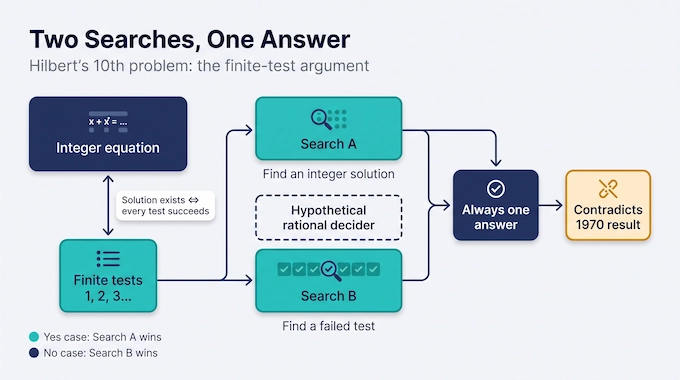
The proposed Hilbert’s tenth problem proof starts with an integer-solvability question and constructs a sequence of finite tests. Each test requires finitely many rational-solvability queries.
The intended relationship is:
[ \text{An integer solution exists} \quad\Longleftrightarrow\quad \text{Every finite test succeeds.} ]
Now suppose, just for the argument, that a universal rational decider exists. Run two searches in parallel:
- Enumerate integer tuples, looking for an integer solution.
- Generate the finite tests, using the hypothetical rational decider to look for a failed test.
If an integer solution exists, the first search finds it. If no integer solution exists, the claimed equivalence guarantees that some test fails, so the second search eventually detects failure.
One search therefore finishes with the correct answer on every input. That would give a universal integer decider, contradicting the classical result.
The appeal is that the argument never asks a computer to complete infinitely many tests. In the no case, a particular finite test must eventually fail. In the yes case, the integer witness supplies the answer.
For Hilbert’s 10th problem, the decisive issue is whether the tests really have this separation property. Writing two searches is easy. Proving that a false integer-solvability claim cannot pass every test is where the arithmetic work begins.
6. How Compactness, Elliptic Curves, and Height Bounds Fit Together
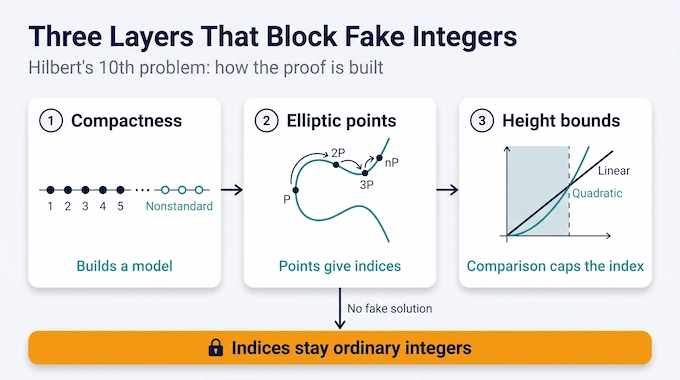
The technical machinery prevents the finite tests from accepting a counterfeit version of integer arithmetic.
6.1. Compactness Builds a Model, Not a Numerical Limit
Suppose every finite test succeeds. The paper uses the compactness theorem from mathematical logic to assemble a model satisfying the full collection of conditions.
This is not the familiar process of taking increasingly accurate decimal approximations. Compactness concerns the consistency of finite sets of logical requirements and the existence of a model satisfying them together.
The model contains a ring with a solution to the input equation, embedded in an elementary extension of the rational field. Such an extension preserves first-order truths but can also contain nonstandard elements, including integer-like values beyond every ordinary integer bound.
A modeled solution is therefore not yet the ordinary integer solution the reduction needs.
6.2. Elliptic Points Attach Integer Indices
The construction associates ring elements with points in a transferred copy of a fixed cyclic subgroup of a rank-one elliptic group. Multiples of a point (P) provide indices, as in (nP).
Those indices encode addition faithfully. But addition alone does not recover the full arithmetic of a polynomial, which also uses multiplication. The paper explicitly addresses this obstacle rather than assuming it away.
Two local comparisons, involving elliptic logarithms and a conjugate curve, relate modeled values to their indices at selected primes. These comparisons supply congruences to prescribed precision.
Conditions on denominators, prime patterns, and representations as sums of fractions coordinate the comparisons. Their purpose is to make the local controls strong enough to support a uniform global bound.
6.3. Heights Force the Indices Back to Ordinary Integers
A height measures arithmetic size. For a reduced fraction (a/b), a standard logarithmic height is (\log\max(|a|,|b|)). It measures the size of the numerator and denominator, not merely the fraction’s numerical value.
The paper combines local information with a height estimate tied to contact with five fixed rational points. Under the assumption that the indexed tuple does not solve the polynomial, it derives a bound growing at most linearly with the largest index size.
On the elliptic side, the relevant coordinate heights grow quadratically with that index. Comparing the bounds forces the indices into an ordinary finite range. The argument then identifies the modeled root coordinates with ordinary integers and obtains a contradiction.
This step is central to the proposed proof: show that passing every test cannot produce a nonstandard substitute for a genuine integer solution.
7. The Halting-Problem Connection and Why Quartic Equations Matter
The paper claims more than a negative answer. It places rational solvability in Turing degree (0′), the degree of the halting problem.
Informally, an idealized oracle answering all rational-solvability questions could answer halting questions, and a halting oracle could answer rational-solvability questions. This is equivalence under Turing reductions, which can involve multiple oracle queries.
Turing equivalence does not compare runtimes. The paper also explicitly stops short of establishing many-one completeness for the rational problem.
Another consequence concerns polynomials of total degree at most four. An arithmetic circuit can replace a complicated polynomial calculation with extra variables and quadratic constraints for its addition and multiplication operations.
Squaring those constraints and adding them produces a single polynomial of degree at most four. Over the rationals, the sum is zero exactly when every squared constraint is zero.
If the main argument holds, undecidability therefore survives this degree restriction. But the number of variables remains unrestricted. This does not claim that an ordinary one-variable quartic is undecidable.
Hilbert’s 10th problem would remain difficult in a precise sense even after high-degree expressions were replaced by lower-degree equations with more variables.
8. Has OpenAI’s Proof Been Verified?
As of October 8, 2026, OpenAI’s published formalization catalogue does not list a matching Lean formalization for this Hilbert-tenth manuscript. The repository also acknowledges that some unformalized results may contain issues.
The responsible description is a proposed proof of Hilbert’s tenth problem over the rationals. The available release materials do not, by themselves, establish independent acceptance.
Verification must also cover the supporting mathematics. The manuscript uses OpenAI results concerning a pointwise 2-converse for elliptic curves and Fontaine–Mazur modularity at the prime 2. These are substantive inputs to parts of the argument.
Both the reduction and its dependencies need scrutiny.
The absence of a published Lean formalization is not evidence that the theorem is false. Traditional mathematical proofs are not required to be formalized. It means readers should not describe this particular claim as computer-verified on the strength of unrelated formalizations elsewhere in the release.
The useful questions concern the actual argument: do the finite tests capture the required conditions, do the bounds apply uniformly, and are the supporting theorems’ hypotheses satisfied wherever they are used?
9. Why Undecidability Still Allows Particular Equations to Be Solved
Undecidability is a limitation on a universal method, not a declaration that every instance is beyond reach.
An equation may have an obvious rational solution. Another may have none for a simple reason, such as a contradiction modulo a prime. Specialized algorithms can decide restricted families.
An AI system can also propose a candidate that a separate program checks exactly. Verifying a supplied rational solution involves evaluating a polynomial, not solving the unrestricted decision problem.
The same distinction answers a common question about Collatz. Even if a particular conjecture is expressed through an appropriate Diophantine condition, general undecidability does not automatically make that specific conjecture unprovable or unsolvable.
Nor does this establish P ≠ NP. That question concerns efficient algorithms for decidable problems. Hilbert’s 10th problem concerns whether an always-correct, always-terminating algorithm exists at all. Slow and impossible are different mathematical categories.
10. What the Proposed Breakthrough Means for Mathematics and AI
If validated, the result would establish a fundamental limit on general rational-equation decision procedures. More compute could improve searches and specialized solvers, but it could not create the algorithm ruled out by the theorem.
This clarifies what useful mathematical AI should promise. A system can search for witnesses, propose arguments, identify special structure, and report unresolved cases. It cannot guarantee a correct terminating decision for every rational polynomial equation in the unrestricted class if the proposed theorem holds.
For builders, the practical distinction is between a verified solution, a verified argument excluding solutions, and a search that has found nothing. Those outputs deserve different labels. A timeout is not a proof.
For researchers, the possible contribution extends to method. The finite-test strategy offers a route around the need for an existential definition of integers inside the rationals. If the construction survives checking, its combination of logic and arithmetic could inform work on related decision problems.
11. What to Watch Next
The next meaningful developments are detailed mathematical checks, clear accounts of the supporting dependencies, and any revisions or formalizations that strengthen the evidence.
Hilbert’s 10th problem makes the stakes unusually clear. A successful proof would explain why no universal rational solver can exist, while giving researchers a new way to reason about that limit. The achievement would be a better understanding of computation, not an escape from its constraints.
Follow Binary Verse AI at binaryverseai.com for research-paper explainers that connect the claim, the proof, and the evidence. Ask what each breakthrough establishes, which assumptions it needs, and what has actually been checked.
1. What is Hilbert’s 10th problem?
Hilbert’s 10th problem asks for an algorithm that can determine whether any polynomial equation with integer coefficients has an integer solution. The algorithm must always finish with a correct yes or no. The rational-number version asks the same question while allowing solutions that are fractions.
2. Wasn’t Hilbert’s tenth problem already solved in 1970?
Yes. Matiyasevich completed the negative solution over the integers in 1970, building on Davis, Putnam, and Robinson. That result does not automatically settle the rational-number version. OpenAI’s proposed proof addresses this separate question: whether a universal algorithm can decide the existence of rational solutions.
3. How does OpenAI’s proposed proof work?
The paper constructs finite rational-solvability tests whose collective success is intended to characterize integer solvability. If a rational-solving algorithm existed, two parallel searches could then decide the integer problem, contradicting its established undecidability. Compactness, elliptic curves, local arithmetic, and height bounds supply the difficult argument connecting the tests to integer solutions.
4. Is OpenAI’s proof of Hilbert’s tenth problem over the rationals verified?
OpenAI has published a proposed proof, but no matching formalization was found in the published Lean catalogue reviewed for this article. The paper also relies on supporting mathematical results that require scrutiny. A released manuscript and an independently accepted theorem are different stages of verification.
5. Does undecidability mean AI cannot solve rational equations?
No. AI and other computational methods can solve many individual equations and useful special classes. Undecidability means that no algorithm can always terminate with the correct answer for every equation in the unrestricted class. Finding a particular solution—or proving that one particular equation has none—remains possible.