

When an algorithm gives you a pretty good answer, the obvious next question is whether a cleverer algorithm could do better. Sometimes the obstacle is engineering. Sometimes it may be a mathematical ceiling.
The Unique Games Conjecture sits at that boundary. OpenAI has published a manuscript claiming to prove it, alongside formalization materials describing the result in Lean. If the proof withstands independent checking, it would settle important questions about how accurately efficient algorithms can solve broad classes of optimization problems.
The headline needs precision. This is a claimed resolution with public supporting artifacts, not a reason to declare P versus NP solved. Its significance comes from a specific construction, one that could turn decades of conditional approximation results into ordinary NP-hardness results.
Table of Contents
1. OpenAI’s Unique Games Conjecture Proof: What Was Released?
OpenAI announced its mathematics collection on October 6, 2026. The relevant manuscript, The Unique Games Theorem, is dated September 23 and attributed to OpenAI. The company says the results were produced by an unreleased internal frontier model.
| Key Fact | What Readers Should Know |
|---|---|
| Main manuscript | The Unique Games Theorem |
| Manuscript date | September 23, 2026 |
| Public announcement | October 6, 2026 |
| Central claim | A deterministic polynomial-time reduction from 3SAT proving full UGC hardness |
| Formal evidence | UGC-specific Lean documentation and associated proof artifacts |
| Practical implication | Established approximation thresholds would no longer require assuming UGC |
| Remaining distinction | Published artifacts, independently reproduced checks, and expert acceptance are separate stages |
The announcement reports average compute equivalent to roughly three hours of ChatGPT Pro thinking per result. That is a collection-wide average, not a disclosed runtime or dollar cost for this particular proof.
The UGC-specific Lean documentation describes the formalized reduction and selected Max-Cut and Vertex Cover consequences. Lean checks a formal statement against its encoded definitions and assumptions. Reviewing that statement’s correspondence to the intended mathematics, its dependencies, and reproducible verification remains important. As of October 7, the documented formalization supports serious scrutiny, while independently reproduced verification requires separate evidence.
2. What Is the Unique Games Conjecture? A Worked Example
A unique game is a labeling puzzle on a graph. Vertices receive labels from a finite alphabet. Each edge carries a permutation, a one-to-one rule specifying which label at one endpoint matches each label at the other.
Imagine three vertices, A, B, and C, with labels 0, 1, and 2. The first two edges demand matching labels. The third demands that C’s label be one step ahead of A’s, wrapping around after 2.
| Constraint | Rule | With A = B = C = 0 |
|---|---|---|
| A to B | B must equal A | Satisfied |
| B to C | C must equal B | Satisfied |
| A to C | C must equal A + 1 modulo 3 | Violated |
All three constraints cannot hold together. Two can, so this game’s optimum value is two-thirds: the largest fraction of edges any labeling satisfies.
“Unique” means that fixing one endpoint’s label determines the permitted label at the other. It doesn’t mean there is one global solution. This example illustrates the definition, not a hard instance from the proof.
For readers seeking the Unique Games Conjecture explained plainly, the essential claim is that distinguishing certain nearly satisfiable games from games with very low optimum value is NP-hard.
3. Why “Almost Satisfiable” Can Be Harder Than “Perfectly Satisfiable”
There’s an apparent paradox here. If edge rules uniquely determine neighboring labels, why not choose a starting label and propagate it through the graph?
For perfect satisfaction, that works. Try each label at a starting vertex, propagate along edges, and check for contradictions. Repeat for separate connected components. With explicitly represented permutations, this takes polynomial time.
Allowing a small fraction of broken constraints changes the task. A contradiction no longer tells you the starting label was wrong. Perhaps an edge on the path should be discarded. Choosing which constraints to sacrifice creates a global optimization problem.
The conjecture concerns a promise problem: inputs belong to either a nearly satisfiable category or a very low-value category. No answer is required for intermediate instances. Even this apparently generous separation is claimed to be hard to recognize.
4. From Khot’s Conjecture to the One-Half Completeness Barrier
Subhash Khot proposed the Unique Games Conjecture in 2002. Researchers used it to establish sharp conditional approximation thresholds.
Those results rest on extensive human mathematics. Probabilistically checkable proofs, or PCPs, connect local verification to computational hardness. Long codes, short codes, Fourier analysis, and expansion results supplied ways to build and analyze the required tests.
Work by Dinur, Khot, Kindler, Minzer, Safra, Barak, Kothari, and Steurer helped establish the 2-to-2 Games breakthrough. Its consequence for Unique Games separated instances with value close to one-half from instances with arbitrarily small value.
Full UGC requires completeness arbitrarily close to one. In this context, completeness describes how well the construction behaves on satisfiable source inputs. Moving from about 50% to almost 100% wasn’t a cosmetic improvement. It was the missing requirement.
The new manuscript retains an established matrix-shortcode structural theorem and changes the noise through a nonlinear construction. The claimed advance builds on those human foundations.
5. What the Unique Games Theorem Actually Claims
Theorem 1.1 starts with 3SAT, the problem of deciding whether a Boolean formula with three literals per clause has a satisfying assignment.
Choose any fixed positive errors ε and δ below one-half. The manuscript claims a deterministic polynomial-time transformation producing a Unique Games instance G such that:
- A satisfiable formula produces a game with optimum value at least 1 − ε.
- An unsatisfiable formula produces a game with optimum value at most δ.
The errors are chosen first. The alphabet is then fixed as a vector space of binary strings, with size depending on those errors. Binary coordinates don’t mean there are only two possible labels.
The output graph is simple, bipartite, and unweighted. Every constraint is a translation within the alphabet. Its size and construction time are polynomial in the source input size, although polynomial degrees and constants may depend on the chosen errors.
This order matters. A huge constant alphabet is permitted. An alphabet that keeps growing with input size would require a different analysis. The Unique Games Conjecture proof must satisfy these quantifiers.
6. The New Idea: Nonlinear Stability Without Losing Detectability
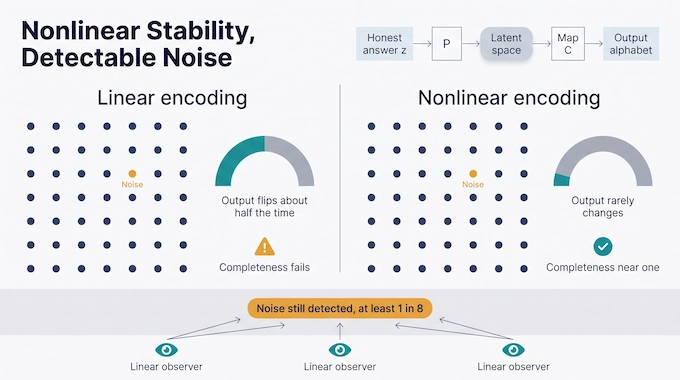
The paper’s starting obstacle appears in a matrix test. Encode an answer z by evaluating a binary matrix M at z. Then perturb M by adding a random rank-one matrix.
For a nonzero answer, the ordinary evaluation remains unchanged with probability close to one-half. An honest encoded answer therefore fails too often to deliver near-perfect completeness.
The proposed solution uses a larger latent space, a nonlinear map C into the output alphabet, and a carefully designed noise distribution. Two properties must coexist.
First, the nonlinear output rarely changes under the chosen noise. Second, sufficiently independent linear observations still detect that noise with probability at least one-eighth. Stability can’t come from making the perturbation invisible to every relevant observer.
The construction uses quadratic blocks over a finite field, combined recursively. Their nonlinear outputs become increasingly stable, while a rank-based argument controls how much linear detectability is lost.
The honest answer now takes the form C(Pz), with P mapping into the latent space. The paper bounds failure of the corresponding equality test by half the chosen stability error. That supplies the route toward completeness near one.
This is the conceptual hinge: change how an honest answer responds to noise while retaining enough detectable structure to expose inconsistent answers. The soundness analysis then has something to work with.
7. How Fourier Decoding and Repetition Establish Soundness
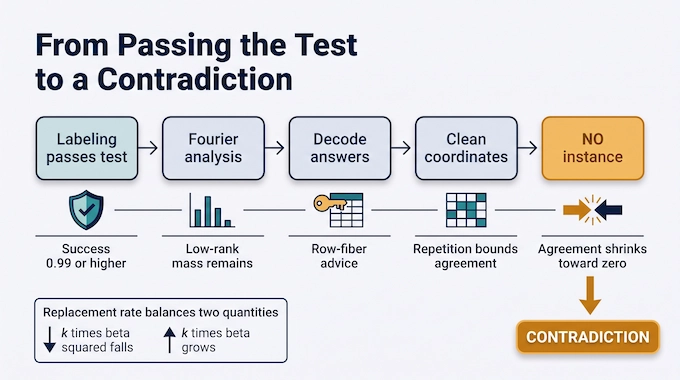
Completeness describes honest answers. Soundness must handle every possible labeling, including arbitrary answers that weren’t generated by the intended encoding.
7.1. From Passing the Test to Recoverable Structure
The reduction begins with a hard system of parity equations. It organizes local answers into affine tables. Shared table keys enforce consistency when different descriptions represent the same relevant table. Folding groups translated versions so their restored answers obey compatible translation rules.
Suppose a labeling passes the latent matrix test with probability at least 0.99. Fourier analysis decomposes its answer behavior into algebraic frequencies. The noise-detection property prevents sufficiently high-rank frequencies from accounting for all that success.
A fixed amount of low-rank Fourier mass must remain. This yields positive acceptance under the ordinary matrix-shortcode test, where the existing structural theorem becomes useful.
That theorem extracts agreement with a structured answer on a slice defined by a bounded number of linear conditions. Row-fiber advice, information fixing selected linear observations of a table, helps turn this local agreement into decodable answer sets.
Recovering structure only on selected slices creates a consistency challenge. The chosen certificates must transfer between the two local views without giving either decoder access to information it isn’t allowed to see.
7.2. Why Those Answers Contradict a NO Instance
The construction sparsely replaces equations with individual variables. It chooses the replacement rate β = k⁻²⁄³ for a tuple of k equations.
Two quantities then move in useful directions: kβ² tends to zero, helping control the comparison between table distributions, while kβ grows, leaving many singleton coordinates available for decoding.
Some coordinates are “clean,” meaning the observed advice carries no slope information about their retained bits. Parallel repetition bounds agreement on these coordinates for an unsatisfiable source instance.
The decoded strategies would agree with a fixed positive probability. The repetition argument makes their agreement at most exp(−ck¹⁄³), which tends to zero for a positive constant c. For sufficiently large k, both statements cannot hold.
Weight rounding, edge subdivision, and further repetition complete the explicit unweighted reduction. These steps preserve the gap in the final output model.
8. Max-Cut: Why the 87.856% Threshold Matters
Max-Cut divides a graph’s vertices into two groups to maximize the number of edges crossing between them. The Goemans–Williamson algorithm provides an approximation guarantee of about 0.87856 relative to the optimum, using semidefinite programming and rounding.
If the optimum cuts 1,000 edges, that ratio corresponds to roughly 879 edges. It doesn’t mean cutting 87.856% of every graph’s total edges. The denominator is the best achievable cut.
The Max Cut approximation ratio becomes significant because the established reduction of Khot, Kindler, Mossel, and O’Donnell makes any fixed improvement beyond this threshold NP-hard under UGC.
If the claimed theorem holds, the UGC premise is supplied. Assuming P ≠ NP, a deterministic polynomial-time algorithm cannot guarantee a fixed better ratio across all instances.
The collection also contains a companion direct Max-Cut hardness proof. That manuscript and the established UGC reduction provide distinct routes to the hardness threshold.
9. Vertex Cover and the Other Approximation Consequences
Vertex Cover asks for the smallest set of vertices touching every edge. Because this is minimization, smaller approximation factors are better.
A factor-two algorithm returns a cover no larger than twice the optimum. If the smallest cover contains 100 vertices, its guarantee allows up to 200. A factor-1.9 guarantee would tighten that to 190.
Khot and Regev’s reduction links UGC to hardness of every fixed factor below two. The proposed theorem would therefore establish this vertex cover approximation threshold without separately assuming UGC. It doesn’t rule out improvements whose advantage vanishes as instances grow.
The paper also treats ordering constraints, with thresholds including one-half for Maximum Acyclic Subgraph and one-third for Betweenness. Its specified weighted Multicut, nonuniform Sparsest Cut, equality-deletion, and general weighted Correlation Clustering formulations have stronger constant-factor hardness consequences.
Those formulations matter. Complete-graph clustering and arbitrary weighted-graph clustering are different settings. The nonuniform Sparsest Cut result concerns producing a cutset under Cook reductions. Its uniform-demand companion is separate. Dropping those qualifications changes the claimed theorem.
10. Why Raghavendra’s Theorem Makes SDP Central
The broader significance comes through Prasad Raghavendra’s characterization of approximation for fixed finite-domain maximum constraint satisfaction problems, or Max-CSPs.
Each variable takes a value from a fixed finite domain. A fixed collection of predicates defines the constraints. The objective is to maximize satisfied weight.
A semidefinite relaxation replaces discrete assignments with a more flexible mathematical representation. Its optimum can exceed anything an actual assignment achieves. Rounding converts that relaxed solution back into a valid discrete answer, with a provable approximation guarantee.
Under UGC, Raghavendra’s framework characterizes the best achievable approximation through the basic SDP, up to arbitrarily small positive error. The new theorem would supply the missing conjectural premise.
An integrality gap alone only shows limitations of a relaxation. The hardness reduction is what connects that gap to limitations on all deterministic polynomial-time algorithms under P ≠ NP.
This does not make every SDP solver optimal for every computational task. Domain, predicate family, objective, and approximation notion remain part of the statement. Vertex Cover uses its own reduction, rather than being casually bundled into the Max-CSP result.
11. What Changes for Builders, and What Remains Open?
For algorithm designers, a valid proof would sharpen decisions about where to invest effort. A universal fixed improvement in a worst-case guarantee may be blocked, while exploiting application-specific structure remains productive.
Heuristics can perform well on real workloads. Restricted graph classes, extra advice, parameterized methods, and longer runtimes require separate analysis. Benchmark success doesn’t contradict a worst-case hardness theorem.
Nor does the Unique Games Conjecture settle P versus NP. NP-hardness identifies what a successful approximation algorithm would imply. Proving that such an algorithm cannot exist still requires a separation assumption.
The paper’s stated exclusions concern deterministic classical polynomial-time algorithms. Randomized and quantum guarantees require appropriate additional analysis and assumptions.
Researchers can inspect the formal statements, reproduce checks, study the nonlinear construction, and assess which applications inherit its consequences. Public manuscripts make that scrutiny possible. Access to the model that generated them is a separate reproducibility question.
12. The Useful Next Step: Understand the Boundary
The Unique Games Conjecture matters because it connects a particular labeling puzzle to the quality of answers computers can guarantee across many optimization problems.
OpenAI’s claimed proof offers a mechanism for crossing the longstanding completeness barrier, supported by a manuscript and documented formalization. Checking and further research will determine its lasting value.
For builders, the immediate lesson is practical: identify your problem’s exact formulation, separate typical performance from universal guarantees, and understand the ceiling before promising to break it.
Read the original paper alongside this explainer, and follow Binary Verse AI for evidence-led coverage of AI-assisted mathematics. Subscribe to our YouTube channel for visual explanations that connect the proofs to the algorithms they constrain.
1. What is the Unique Games Conjecture in simple terms?
The Unique Games Conjecture says that distinguishing certain nearly satisfiable labeling puzzles from puzzles where very few constraints can be satisfied is NP-hard. Each constraint uniquely determines one endpoint’s label once the other endpoint’s label is known.
2. Has OpenAI solved the Unique Games Conjecture?
OpenAI has published a manuscript claiming a proof and accompanying Lean formalization materials. These provide concrete evidence to examine, but publication and formalization should be distinguished from independently reproduced verification and expert acceptance.
3. What is the key idea in OpenAI’s proposed proof?
The construction uses a nonlinear map designed to keep intended answers stable under noise while ensuring sufficiently rich linear observations still detect that noise. Fourier decoding and parallel repetition then supply the soundness argument needed for the claimed hardness reduction.
4. Does proving the Unique Games Conjecture solve P versus NP?
No. The claimed theorem establishes an NP-hardness reduction; it does not prove that P and NP are different. Excluding deterministic polynomial-time algorithms that beat the resulting approximation thresholds still requires P ≠ NP.
5. Why does the Unique Games Conjecture matter for algorithms?
A valid proof would establish widely studied approximation limits without separately assuming UGC, including the Goemans–Williamson threshold for Max-Cut and factor two for Vertex Cover. These concern worst-case guarantees; they do not prevent better performance on particular instances or restricted problem classes.