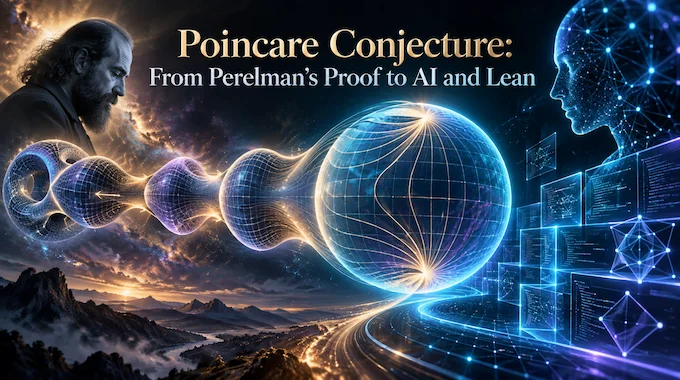
Every closed, simply connected three-dimensional manifold is homeomorphic to the three-sphere. That is the Poincare Conjecture, a statement whose vocabulary takes some unpacking and whose proof took nearly a century.
The question is whether a certain test involving loops can identify the overall shape of a three-dimensional space. Grigori Perelman solved it in 2002–2003, building on Richard Hamilton’s Ricci flow. Now, a team has announced an AI-assisted translation of the Hamilton–Perelman proof into Lean, a language that lets computers check mathematical arguments.
The new story concerns what happens after a great proof exists: making its reasoning explicit enough for a machine to verify. To understand why that matters, start with the space itself.
Table of Contents
1. What Is the Poincare Conjecture?
Imagine living inside a space where every small neighborhood looks like ordinary three-dimensional space. Mathematicians call that a three-manifold. The conjecture asks whether its global shape must be a three-sphere if it satisfies two additional conditions.
First, the manifold is closed, meaning compact and without boundary. Second, it is simply connected: it is connected, and every loop can continuously contract to a point while staying inside the space.
The conclusion, “homeomorphic to the three-sphere,” means there is a continuous, reversible correspondence between the spaces. Distances and curvature can differ. Their topology cannot.
Poincare Conjecture: Key Facts, Proof, and AI Formalization
| Key Fact | What It Means |
|---|---|
| Original question | Can simple connectivity characterize a closed three-manifold as a three-sphere? |
| Mathematical status | Solved by Perelman in work released in 2002–2003 |
| Main method | Hamilton’s Ricci flow, advanced by Perelman |
| New announcement | A team reports formalizing the proof in Lean with AI assistance |
| Reported scale | About 2.7 million new lines, building on roughly 2 million existing lines |
| Central distinction | Discovering a proof and formally checking it are different achievements |
The familiar rubber-band illustration is useful preparation. Every loop on an ordinary sphere’s surface can shrink to a point. Some loops on a doughnut’s surface cannot. Poincaré asked the corresponding question one dimension higher. Clay’s explanation establishes this connection. www.claymath.org
2. Why the Three-Sphere Is Hard to Picture
An ordinary sphere’s surface is two-dimensional. You need two coordinates to locate yourself on it, even though we usually picture that surface sitting in three-dimensional space.
A three-sphere follows the same pattern. It is three-dimensional, and its standard realization sits in four-dimensional Euclidean space. Our imagination tends to resign around here. The mathematics carries on.
Poincare Conjecture: Dimensions, Boundaries, and the Three-Sphere
| Object | Intrinsic Dimension | Boundary? | Why It Matters |
|---|---|---|---|
| Circle | 1 | No | A simple example of a closed space |
| Ordinary sphere’s surface | 2 | No | Supports the rubber-band analogy |
| Solid ball | 3 | Yes | Fails the conjecture’s boundaryless condition |
| Three-sphere | 3 | No | The space identified by the theorem |
This distinction prevents a common misunderstanding: the theorem does not say every solid object without a visible hole is a ball. It concerns entire three-dimensional manifolds and a precise condition on their loops.
That precision also explains the difficulty. Knowing what every small neighborhood looks like tells you surprisingly little about how the whole space fits together. Three-dimensional topology permits complicated arrangements that resist our intuition about surfaces.
3. Who Solved the Poincaré Conjecture, and When?
Henri Poincaré posed the problem in 1904. Richard Hamilton later developed Ricci flow as a way to study geometry and attack the classification of three-manifolds. Perelman supplied decisive advances, releasing his work through arXiv in 2002 and 2003.
His first paper introduced powerful quantities and estimates for studying the flow. His second developed Ricci flow with surgery. A third established finite extinction under conditions sufficient for the Poincaré case. The original submissions are dated November 2002, March 2003 and July 2003. arxiv.org
Publication and acceptance were separate stages. Other mathematicians studied the arguments and produced detailed expositions. Clay awarded Perelman the Millennium Prize in 2010, years after the preprints appeared. www.claymath.org
Those dates matter when asking how long the solution took. The problem stood for nearly a century. The three preprints appeared within a year. Neither interval measures Perelman’s entire research effort, and neither is comparable to the new team’s reported formalization sprint.
4. How Ricci Flow Makes Geometry Reveal Topology
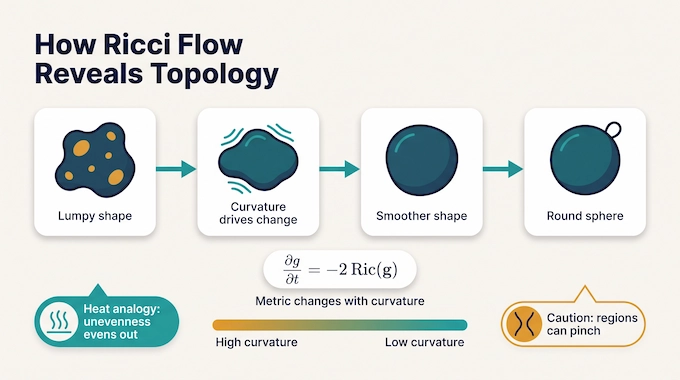
The connection between Ricci flow and the Poincare Conjecture begins with a change of viewpoint. Instead of trying to recognize a space by inspecting it, give it a geometry and study how that geometry evolves.
A Riemannian metric specifies lengths and angles. Ricci flow changes that metric according to curvature:
[ \frac{\partial g}{\partial t}=-2\operatorname{Ric}(g). ]
Here, (g) is the metric and (\operatorname{Ric}(g)) is its Ricci curvature. This is the evolution equation used in the proof. The conjecture itself is a statement about topology.
Heat spreading through an object offers a useful analogy: unevenness can become more orderly as a process evolves. But geometric evolution is less cooperative than warming a cold room. Curvature can concentrate, and narrow regions can pinch.
For a round sphere, the unnormalized flow shrinks the sphere. For a general manifold, understanding what happens requires estimates that control much more complicated behavior. The hope is that the evolving geometry becomes structured enough to reveal the original topology. Singularities are where that program becomes difficult.
5. How Perelman’s Proof Gets Through Singularities
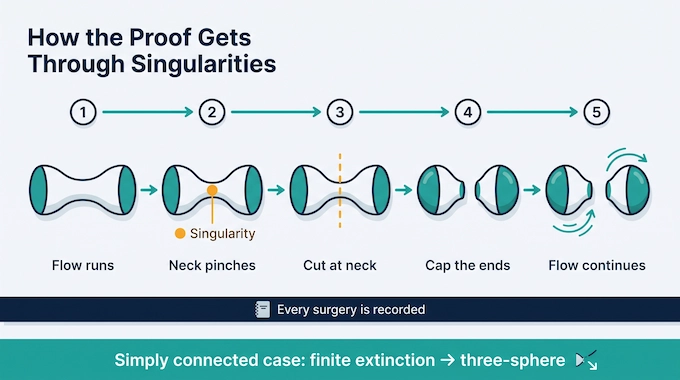
A singularity occurs when the smooth evolution breaks down, for example because curvature becomes unbounded. Stopping there would leave Hamilton’s program unfinished.
Perelman’s work provides control over the geometry approaching such breakdowns. His noncollapsing results constrain how regions can degenerate at appropriate curvature scales. Analysis of high-curvature regions makes it possible to recognize structures suitable for carefully controlled surgery. arxiv.org
Surgery cuts through suitable neck-like regions, caps the resulting ends and continues the evolution. This changes topology, so the proof must record exactly what each operation does. You cannot cut a difficult space into something convenient and declare the original problem solved. The bookkeeping is part of the theorem. arxiv.org
For the simply connected case, finite extinction supplies the decisive endpoint: the evolving manifold disappears after a finite amount of flow time. Combined with the classification of the pieces involved and the recorded surgeries, this restricts the starting manifold’s topology. Simple connectivity eliminates the alternatives, yielding the three-sphere. arxiv.org
That is the architecture of the Poincare Conjecture proof. The real argument lies in proving that every estimate, surgery and topological inference works under precisely stated conditions.
6. What the New Lean Formalization Announces
In his announcement, Ayush Khaitan reports completing a full Lean formalization with Bennett Chow, Yuan Liao and Ziyang Qin. He credits Chow with initiating the project and Liao and Qin with leading the formalization, and acknowledges DARPA’s expMath program.
The public project is qinz1yang/differential-geometry. Its release documentation lists topological and smooth versions of the Poincaré result, alongside substantial supporting geometry and analysis. The topological statement uses Lean and Mathlib concepts to express a homeomorphism with the unit three-sphere. github.com
A reader’s question about geometrization deserves a careful answer. Perelman’s original work addressed the broader geometrization program. The documented formalization includes finite-time extinction for the simply connected case. That scope does not establish a formalization of the entire geometrization theorem.
Formalization also need not mean transcribing a paper sentence by sentence. The earlier Hamilton paper explicitly uses an alternative blow-up route instead of Hamilton’s original normalized-flow argument. A formal development can reorganize mathematics to fit its definitions and reusable components. What matters is that its final theorem has the intended meaning and its dependencies genuinely establish it. Understanding those choices is one reason the detailed mathematical write-up remains valuable even when code is public.
There is another distinction inside the code. Ricci flow works with smooth geometry, while the topological theorem begins with a topological manifold. The final proof obtains a compatible smooth structure before applying the smooth result. That bridge is a mathematical dependency, not administrative decoration. GitHub
7. What AI Contributed to the Work
When asked which models were involved, Khaitan said the team primarily used ChatGPT Astra, with Claude Fable used for some sections. His reply also said an arXiv announcement and a more detailed write-up were forthcoming.
The earlier Hamilton formalization paper describes how language-model agents can contribute: finding declarations, breaking proofs into smaller tasks, attempting Lean proofs, debugging, testing statements and proposing refactors. That is useful evidence about the project’s working methods, although it does not provide a complete accounting of the later sprint.
For developers, a helpful comparison is implementing against a demanding specification. A model proposes code, the checker rejects invalid steps, and the work continues. Mathematical definitions and dependencies make the specification itself a major intellectual task.
Human responsibility remains substantial. Someone must choose the theorem, preserve its intended meaning and judge whether intermediate constructions represent the mathematics correctly. The available announcement does not quantify how much work was autonomous, provide a complete compute bill or establish an exact division of labor between models. Those details should await the promised account.
8. What the Millions of Lines Actually Measure
The headline number is approximately 4.7 million lines of code. Khaitan’s follow-up clarifies the composition: around 2.7 million new lines built on roughly 2 million lines of prior work by Chow, Liao and Qin.
That clarification changes how to read “roughly two weeks.” The sprint relied on an existing mathematical library and earlier formalization. It did not begin with an empty file and recreate all the prerequisite mathematics from scratch.
The tiny final theorem can therefore be misleading. It invokes results whose own proofs depend on many more results, much as a short program can depend on a large software stack.
Line counts convey engineering scale, but they are weak measures of mathematical insight or efficiency. Different styles, automation choices and amounts of repeated code can produce very different totals. The lasting question is whether other researchers can understand, check and reuse the development.
9. How Lean Checks a Proof
Lean’s kernel checks a formal proof against the statement it claims to establish. A plausible paragraph receives no special treatment. The submitted proof must follow the system’s rules and its declared foundations.
The project reports that its headline theorems contain no unfinished sorry placeholders and depend only on three standard axioms: propext, Classical.choice and Quot.sound. An axiom inspection traces dependencies, so an unfinished proof used indirectly should also appear in that accounting. github.com
The public release build also shows a successful GitHub Actions run. Its workflow builds the project from source with lake –no-cache build DifferentialGeometry. That is useful evidence beyond an announcement, although it is a project-run check rather than an independent reproduction. GitHub
9.1 Checking the Logic and Checking the Meaning
A checker can correctly verify a statement that was poorly specified. For example, “assuming the desired object exists, the desired object exists” is valid logic and an unhelpful existence proof.
Section 11.3 of the attached Hamilton paper explicitly discusses this problem. Definitions can be too weak, or inputs can quietly contain the desired conclusion. Human review must check what the formal statements mean.
Lean’s validation documentation likewise directs attention to the statement, definitions and assumptions. Kernel checking provides strong logical assurance within that setting. It does not remove the need to inspect the setting itself. lean-lang.org
10. Why Formalizing a Solved Problem Matters
“We already knew this” is a fair reaction if the only deliverable is another declaration that the theorem is true. The more interesting deliverable is reusable mathematics.
Formalizing a major result forces a project to build many prerequisites. Once those are available through usable interfaces, later proofs may be able to call them rather than reconstruct them. That can reduce repeated work and make dependencies easier to inspect.
For AI systems, a proof assistant also creates a valuable feedback mechanism. Models can generate candidate arguments, while the checker tests their formal validity. The generator’s fluency and the proof’s acceptance become separate questions.
None of this guarantees an immediate application in medicine, engineering or finance. The direct contribution is mathematical infrastructure and verification. Future usefulness depends on maintainability, documentation, integration with other libraries and whether researchers actually adopt the results.
For a builder, the practical question is whether an intermediate theorem can be imported with understandable assumptions and a reproducible environment. A large library becomes useful through those smaller points of access. Raw size alone tells us little about that experience.
The same distinction runs through our Fermat’s Last Theorem coverage: formalizing established mathematics is significant on its own terms. Claims about the next great theorem should be judged by their own evidence, not extrapolated from a successful sprint.
11. Where to Find the Papers and Code
Readers looking for a Poincare Conjecture proof PDF should distinguish the original mathematics from the new formalization materials.
Perelman’s original sequence is available on arXiv: the entropy paper, Ricci flow with surgery, and finite extinction. Each record links to a downloadable PDF.
For the announced Lean work, start with the repository’s release documentation and final theorem file. The release examined here is v0.1.3. Pinning a release matters because the main branch can change.
The related paper, A Lean Formalization of Hamilton’s Three-Manifold Theorem, describes an earlier milestone and identifies release 0.1.0. It explains supporting infrastructure and verification concerns. It is not a paper documenting the full newly announced Poincaré release, and an arXiv listing alone does not establish journal peer review.
12. The Next Test Is What Others Can Build
The Poincare Conjecture connects three kinds of achievement: identifying a deep mathematical problem, discovering its solution and making that solution mechanically checkable. Each asks something different of its authors.
This announcement is worth following because it suggests AI assistance can help tackle the enormous work of formalizing modern geometry. Its strongest future evidence will be independent checking, clear explanations of the workflow and useful results built on the released library.
Read the theorem statement, follow the dependencies and keep the reported sprint in the context of its foundations. That approach leaves plenty of room for excitement while giving the mathematics its due.
For more explanations that connect AI announcements to their papers, code and actual mathematical claims, follow Binary Verse AI and watch our Fermat explainer next.
What is the Poincaré conjecture in simple terms?
It says that a closed three-dimensional manifold in which every loop can continuously shrink to a point must be topologically equivalent to a three-sphere. “Closed” means compact and without boundary. A three-sphere is the higher-dimensional counterpart of an ordinary sphere’s surface, not a solid ball.
Has the Poincaré conjecture been solved?
Yes. Grigori Perelman solved it in preprints published in 2002 and 2003, building on Richard Hamilton’s Ricci flow program. The new Lean announcement concerns formalizing an established proof so a computer can check it.
Did AI solve the Poincaré conjecture?
The announced project formalizes the Hamilton–Perelman proof with AI assistance. According to Ayush Khaitan’s announcement and replies, the team primarily used ChatGPT Astra, with Claude Fable contributing to some sections. Perelman’s original mathematical breakthrough predates this project.
Does a Lean proof guarantee that the mathematics is correct?
Lean checks whether a formal conclusion follows from its definitions and assumptions. Assessing a released proof also requires checking its dependencies and confirming that its statement expresses the intended mathematics. The project reports proofs without unfinished placeholders and using only standard foundational axioms; that report should be distinguished from independent verification.
Why formalize the Poincaré conjecture if it was already proved?
Formalization makes the logical dependencies explicit and enables machine checking. It can also create reusable results in geometry and analysis for later formal proofs. Its value extends beyond checking one theorem, although future discoveries and practical applications remain possibilities rather than demonstrated outcomes.