
For nearly six decades, Grad’s Conjecture hung over one of the strangest questions in plasma physics: can a smooth, fully three-dimensional plasma sit in equilibrium inside nested toroidal surfaces without being forced into a strong symmetry?
The intuition said probably not. Stellarator researchers, meanwhile, work precisely with complicated three-dimensional magnetic fields.
Then September 2026 produced two striking papers. Javier Gómez-Serrano, Lukas Liehr and Mitchell Taylor constructed rigorous families of smooth counterexamples to a precise modern version of the conjecture. Days later, plasma physicist Matt Landreman presented two remarkably explicit families of 3D equilibria, discovered with help from GPT-6 Astra Pro.
The important story isn’t that “AI solved fusion.” It didn’t. The interesting story is that a longstanding mathematical obstruction has lost much of its force, and AI played two very different roles in getting there.
Table of Contents
1. What Is Grad’s Conjecture?
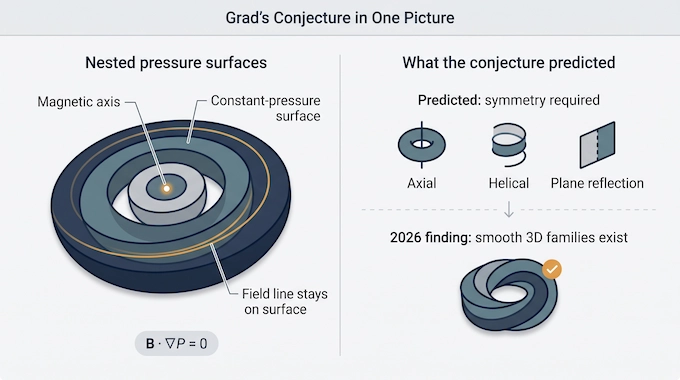
In plain English, Grad’s Conjecture says that sufficiently well-behaved three-dimensional plasma equilibria with smoothly nested pressure surfaces shouldn’t exist in continuous families unless the configuration has substantial symmetry.
The underlying magnetohydrostatic equations can be written as
[ (\nabla\times B)\times B=\nabla P, ][ \nabla\cdot B=0, ]
together with a boundary condition requiring the magnetic field (B) to remain tangent to the plasma boundary.
Here, (B) is the magnetic field and (P) is plasma pressure. The first equation says the magnetic force balances the pressure gradient. Taking its component along (B) gives
[ B\cdot\nabla P=0, ]
which means magnetic field lines stay on surfaces of constant pressure. For magnetic confinement, the useful picture is a set of nested doughnut-shaped surfaces collapsing onto a central magnetic axis.
Grad’s Conjecture: What the 2026 Counterexamples Actually Show
| Question | What the New Work Says |
|---|---|
| What is Grad’s Conjecture? | A claim that smooth, non-isolated 3D plasma equilibria with nested pressure surfaces should require specific symmetries. |
| What equations are involved? | Ideal magnetohydrostatic force balance and ∇·B = 0. |
| What did the 2026 work find? | Smooth nonsymmetric families that evade the predicted symmetry restrictions. |
| Is there one counterexample? | No. The two 2026 papers provide several distinct constructions. |
| Was AI involved? | Yes, but differently in the two projects. |
| Did this solve fusion energy? | No. It concerns equilibrium existence, not reactor performance. |
The modern formulation targeted by Gómez-Serrano, Liehr and Taylor is more precise than the loose phrase “3D equilibria cannot exist.” It concerns smooth, unforced MHS equilibria that aren’t isolated and whose regular pressure surfaces foliate the domain. Under those assumptions, the conjecture predicted plane-reflection, axial or helical symmetry.
That distinction matters when asking whether a proposed Grad’s conjecture counterexample really addresses the conjecture.
2. Why Grad’s Conjecture Was Such A Problem For Stellarator Fusion
A tokamak is close to axisymmetric by design. A stellarator deliberately isn’t.
Stellarators use carefully shaped three-dimensional magnetic geometry to confine plasma without relying on the large toroidal plasma current central to conventional tokamak operation. Their asymmetric shape is not decorative engineering. It’s part of how they work.
That makes 3D MHD equilibrium a foundational question.
Landreman describes three-dimensional equilibria as important to both stellarators and tokamaks, but especially to stellarators because their confinement depends on strongly non-axisymmetric geometry.
Grad’s reasoning therefore created an uncomfortable tension. Numerical stellarator calculations could produce apparently useful nested magnetic surfaces, yet the mathematics suggested that sufficiently smooth, genuinely three-dimensional families might encounter deep obstructions.
That didn’t mean “stellarators are impossible.” It meant that the mathematical foundations of the idealized equilibrium picture remained unsettled.
3. Why The Problem Survived For Nearly Six Decades
The difficult part isn’t drawing a twisted torus. It’s making every mathematical requirement work at once.
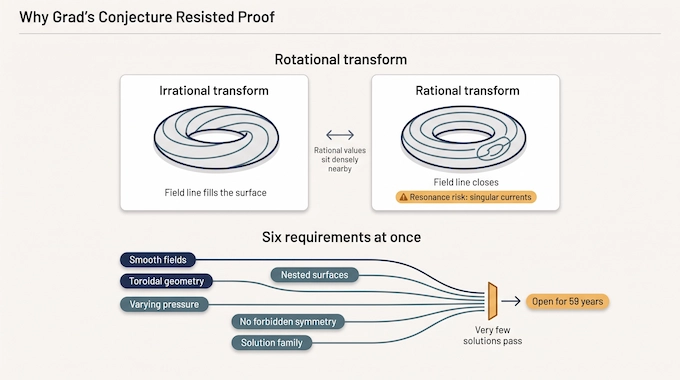
Magnetic field lines must remain trapped on pressure surfaces while force balance holds everywhere. The rotational transform, which measures how field lines wind poloidally as they travel toroidally, introduces another complication.
For irrational rotational transforms, field lines densely explore a surface. Rational values occur densely nearby. Solvability conditions around these surfaces can generate resonances and potentially singular currents. Grad’s argument suggested that demanding a smooth pressure profile through all this could force the system toward symmetry or pressure flattening.
Researchers found ways around pieces of the problem. Some models allowed current sheets. Others used special symmetries, perturbative expansions, cylindrical geometry or approximate near-axis constructions.
Numerical codes also computed 3D equilibria for decades. But a successful numerical solution isn’t automatically an existence theorem. Codes such as VMEC and DESC can assume nested flux surfaces from the start, while other methods allow islands, stochastic regions or stepped pressure profiles. 2609.24739v1
Grad’s Conjecture survived because the target was unusually demanding: smooth fields, genuine toroidal geometry, nested surfaces, nonconstant pressure, no forbidden symmetry, and a meaningful family of solutions.
4. Two Papers, Three Headline Counterexamples
The September 2026 story can sound confusing because people are talking about “three families” and “two papers.”
A useful shorthand is this:
Grad’s Conjecture Counterexamples: Comparing the 2026 Results and AI’s Role
| Work | Construction | Defining Feature | AI Role |
|---|---|---|---|
| Gómez-Serrano, Liehr & Taylor | Smooth families with exact CN cyclic symmetry | Rigorous theorem with no axial, helical, or plane-reflection symmetry required by the modern conjecture. | Several LLMs assisted technical development and Lean formalization under human direction. |
| Landreman, Family 1 | Explicit analytic equilibrium | Uniform rotational transform, ι = 2. | GPT-6 Astra Pro participated directly in discovery. |
| Landreman, Family 2 | Explicit analytic equilibrium | Sheared rotational-transform profile. | GPT-6 Astra Pro participated directly in discovery. |
Calling these “three counterexamples” is convenient rather than mathematically exhaustive. Gómez-Serrano and colleagues actually establish families for every sufficiently large integer (N), while Landreman gives two parameterized classes.
What makes the timing remarkable is that the papers attack the same old obstruction from very different directions.
5. Gómez-Serrano, Liehr And Taylor: The Rigorous Counterexamples
The 147-page Gómez-Serrano, Liehr and Taylor paper is the heavier mathematical result.
For every sufficiently large (N), the authors construct smooth magnetohydrostatic equilibria inside embedded solid tori. Their regular pressure levels form nested tori, and the magnetic field vanishes exactly on a round magnetic axis.
The crucial feature is symmetry.
The complete Euclidean symmetry group of each construction is just the finite cyclic group (C_N), corresponding to rotations by multiples of (2\pi/N). The solutions lack the continuous axial or helical symmetry and the plane-reflection symmetry predicted by the modern formulation of Grad’s Conjecture. They also occur in nontrivial smooth one-parameter families rather than as isolated curiosities. 2609.24739v1
The paper’s Figure 1 makes the geometry much easier to grasp. It shows nested pressure surfaces wrapping around a round magnetic axis while elliptical cross-sections change orientation from cell to cell. 2609.24739v1
The proof uses serious machinery, including a Nash-Moser iteration. Readers don’t need the full functional analysis to understand the punchline: the authors satisfy the conditions that made the modern conjecture difficult and still construct a nonsymmetric family.
6. Landreman’s Explicit 3D MHD Equilibria With GPT-6 Astra
Landreman’s paper lands differently because you can actually write the solutions down.
The magnetic field and pressure are given explicitly in Cartesian coordinates using elementary functions. The configurations are non-axisymmetric, have exact nested toroidal flux surfaces, and don’t rely on an expansion in inverse aspect ratio or small departure from axisymmetry.
The field, current density and pressure remain smooth. One family has
[ \iota=2 ]
throughout the plasma, while the second has rotational shear, meaning (\iota) varies between flux surfaces. 2609.26742v2
For a concrete Grad’s conjecture example, picture a stack of nested distorted doughnuts. A magnetic field line travels around the large toroidal direction while simultaneously circling the local cross-section. In the (\iota=2) construction, it makes two poloidal turns per toroidal transit and closes exactly.
Landreman’s Figure 1 shows how those surfaces deform as the parameter (\epsilon) increases. The configuration is unmistakably three-dimensional, yet the nested structure remains exact.
Explicit solutions are especially useful because numerical equilibrium codes can be asked to reproduce something whose exact answer is already known.
7. How AI Actually Helped, And What The Humans Did
This is where the headline “GPT-6 solved Grad’s Conjecture” becomes misleading.
In the Gómez-Serrano project, the humans first formulated the problem and developed a detailed roadmap. They then used GPT-5.6 Sol, Claude Fable 5 and Claude Opus 5 to work through technical details, calculations and mathematical feedback.
The same models assisted with Lean code under continuous human guidance. Later in the project, GPT-6 Astra and Claude Fable 5.1 were used during Lean verification and proofreading. The authors explicitly state that they checked the mathematical statements and proofs themselves and accept responsibility for their correctness. 2609.24739v1
Landreman describes a more direct discovery role. His paper says the analytic solutions were discovered using GPT-6 Astra Pro, which also helped draft portions of the manuscript. Landreman manually checked the equations.
These are two genuinely different examples of AI-assisted science.
One looks like an expert-led mathematical project in which several models act as technical collaborators. The other shows a frontier model contributing directly to the search for a compact analytic construction.
Neither resembles pressing a “solve plasma physics” button.
8. What Does The Lean 4 Verification Actually Prove?
Formal verification deserves attention here because the Gómez-Serrano result is unusually long and technically intricate.
The authors translated the main theorem into Lean 4, a proof assistant that checks whether each formal proof step follows from specified definitions, assumptions and previously established results.
Their accompanying repository contains a presentation-oriented Showcase.lean and a proved companion, Showcase_WithProofs.lean. The latter replaces the presentation placeholders with verified proofs. GitHub – lukasliehr_Grad-Conjec…
The formal library covers pieces including Nash-Moser iteration, smooth parameter dependence, Fourier analysis, Banach calculus and the magnetohydrostatic application. GitHub – lukasliehr_Grad-Conjec…
That substantially raises confidence against certain kinds of hidden algebraic or logical error.
But Lean doesn’t put plasma in a reactor.
It verifies the formalized mathematics. It doesn’t experimentally prove that these equilibria will be stable, easy to create, resistant to turbulence or useful in an economically viable power plant.
9. Was Grad’s Conjecture Already Disproved In 2024?
This is the historical wrinkle that shouldn’t be buried.
In December 2024, E. A. Sorokina and V. I. Ilgisonis published a peer-reviewed Physical Review E paper titled Existence of true plasma equilibria in asymmetric magnetic fields. Its abstract explicitly describes the work as presenting analytical counterexamples to Grad’s hypothesis and says the resulting smooth solutions describe nonsymmetric magnetic surfaces with continuous pressure and rotational-transform profiles. APS Journals
So “Grad’s Conjecture had never been challenged successfully before September 2026” is too broad.
The better question is: which formulation of Grad’s conjecture is being disproved, under exactly which assumptions?
The 2026 Gómez-Serrano work targets a precise modern formulation involving non-isolated smooth equilibria, embedded toroidal domains and specific symmetry alternatives. It proves a rigorous global theorem and adds Lean certification.
Landreman, meanwhile, produces unusually transparent finite-aspect-ratio analytic solutions. His literature discussion treats the 2024 work in the context of approaches based on perturbing or linearizing around axisymmetry.
The 2024 and 2026 papers therefore shouldn’t be collapsed into one interchangeable result. The later work strengthens the landscape with different constructions and stronger forms of verification.
10. What Does This Actually Change For Fusion Energy?
The immediate payoff is mathematical, not a sudden jump in reactor performance.
First, the papers establish concrete examples showing that smooth three-dimensional equilibrium isn’t automatically forced into the symmetry structure long associated with Grad’s argument.
Second, Landreman’s formulas give researchers exact benchmark cases. A numerical MHD solver can be tested against a known answer instead of only being compared with another numerical method. The paper explicitly identifies code testing and the study of existence and regularity as motivations for the solutions. 2609.26742v2
Third, the result removes one conceptual reason for pessimism about smooth 3D equilibrium theory.
For stellarator fusion, that’s meaningful. The machine’s entire magnetic architecture depends on controlled three-dimensionality.
For the broader story of AI fusion energy, the lesson is narrower but more interesting than hype: modern AI systems can now contribute to highly specialized theoretical work when paired with domain experts who can formulate the problem, challenge intermediate reasoning and verify the result.
11. What It Does Not Solve: Stability, Confinement And A Working Reactor
An equilibrium is a force-balanced state. That’s all.
A useful fusion plasma must satisfy much more:
equilibrium ≠ stability ≠ good confinement ≠ practical reactor
These papers don’t establish that the constructed equilibria remain stable under perturbations. They don’t show that energetic particles stay well confined, turbulence is acceptable, coils can generate the required fields economically, reactor materials survive neutron bombardment, or a machine produces net electricity.
They also aren’t proposed stellarator designs.
That’s why “AI just solved fusion” gets the science almost exactly backwards. Fusion hasn’t been reduced to one mathematical obstruction waiting for a counterexample.
What has happened is subtler. A longstanding claim about the structure of ideal 3D plasma equilibria has been met with increasingly strong counterexamples, and the newest ones provide unusually rigorous and explicit objects for researchers to study.
That’s a real result. It doesn’t need embellishment.
12. What Actually Fell With Grad’s Conjecture
The most important part of the Grad’s Conjecture story isn’t that an old physicist guessed wrong, or that an LLM produced some impressive algebra.
It’s that a difficult existence question has become concrete.
Gómez-Serrano, Liehr and Taylor show that smooth, non-isolated magnetohydrostatic equilibria can evade the symmetry alternatives in the modern formulation of the conjecture. Landreman shows that strikingly simple analytic 3D examples can exist too, including one family with (\iota=2) and another with rotational shear.
And AI was genuinely involved, but in ways that preserve an important distinction. In one project, models helped humans execute and formally verify an expert-designed proof strategy. In the other, GPT-6 Astra Pro participated directly in discovering explicit solutions.
That may ultimately be the larger story. The frontier isn’t “AI replaces physicists.” It’s that expert researchers now have a new kind of mathematical instrument, one that can search, calculate, critique and occasionally uncover something its human collaborator wasn’t expecting.
For more evidence-first coverage of AI-assisted breakthroughs in mathematics, physics and science, follow Binary Verse AI, where we separate the actual result from the headline before deciding which one is more interesting.
1. What is Grad’s conjecture in plasma physics?
Grad’s conjecture concerns whether smooth three-dimensional magnetohydrodynamic equilibria with nested toroidal pressure surfaces and nonconstant pressure can exist without strong symmetry. A later precise formulation predicted that a suitable non-isolated equilibrium must have plane-reflection, axial or helical symmetry; the 2026 Gómez-Serrano–Liehr–Taylor construction provides families outside those alternatives.
2. Has Grad’s conjecture been disproved?
The new 2026 papers provide explicit constructions that contradict important formulations of Grad’s conjecture. However, calling them the first ever counterexamples would be misleading: Sorokina and Ilgisonis published a 2024 peer-reviewed paper that also explicitly claimed analytical counterexamples to Grad’s hypothesis.
3. How did AI help with the Grad’s conjecture results?
The role differed between the projects. Landreman used GPT-6 Astra Pro in discovering his explicit analytic equilibria, while Gómez-Serrano, Liehr and Taylor first developed the mathematical roadmap themselves and then used several LLMs for technical details, calculations, feedback and Lean formalization.
4. Why does Grad’s conjecture matter for stellarator fusion?
Stellarators intentionally use three-dimensional, non-axisymmetric magnetic fields, so the existence of smooth 3D plasma equilibria with nested surfaces is a fundamental theoretical question for them. The new constructions show that such equilibria are mathematically possible under conditions that evade the symmetry restrictions associated with Grad’s conjecture.
5. Does disproving Grad’s conjecture mean AI has solved nuclear fusion?
No. These are results about the mathematical existence and structure of plasma equilibria. They do not by themselves prove that the configurations are stable, efficiently confining, experimentally realizable, or suitable for commercial fusion reactors.