Can a mathematical structure forget how many independent ingredients built it? For free group factors, that question has resisted decades of research. OpenAI’s proposed answer is yes, and the interesting part is how it makes the extra ingredient recoverable from the others.
The free group factor isomorphism problem asks whether operator algebras associated with free groups of different ranks are isomorphic. In An Isomorphism of the Free Group Factors, dated September 23, 2026, OpenAI claims to prove (L(F_2)\cong L(F_3)). Established results would then identify every interpolated free group factor, including the infinite-rank case.
OpenAI also reports Lean formalization of that broader isomorphism statement. That is substantial evidence, but published formalization materials and independently reproduced verification are different things. This explainer examines the manuscript’s argument and reported scope. It does not claim an independent proof audit.
Table of Contents
1. What Is the Free Group Factor Isomorphism Problem?
A free group on (n) generators is written (F_n). Its associated group von Neumann algebra is (L(F_n)). For (n\ge2), this algebra is a free group factor.
The question is whether changing (n) changes the algebra’s isomorphism class. Can (L(F_2)) and (L(F_3)), built from groups with different ranks, nevertheless have identical operator-algebraic structure?
The proposed isomorphism is a bijective complex-linear map preserving multiplication, adjoints, the unit and the trace. It is also normal, meaning it respects the ultraweak topology used for these operator algebras.
Here is the result and its reported verification scope at a glance.
Free Group Factor Isomorphism Problem: Key Findings and Mathematical Implications
| Point | What Is Reported |
|---|---|
| Main Conclusion | L(F2) ≅ L(F3) |
| Constructive Step | L(Fn) ≅ L(Fn+1) for integers n ≥ 3. |
| Core Mechanism | Small automorphisms and a limit that absorbs an extra generator. |
| Broader Consequence | All interpolated free group factors are isomorphic, including L(F∞). |
| Fundamental Group | Every positive amplification scale gives an isomorphic factor. |
| Formalization Scope | OpenAI reports coverage of the broader isomorphism statement. |
The free group factor isomorphism problem concerns the completed operator algebras. Keeping that object in view prevents several tempting misreadings.
2. From Free Groups to Operator Algebras
Think of (F_2) as words built from (a,b) and their inverses. Adjacent inverse pairs cancel. Other relations aren’t imposed, so (ab) and (ba) remain different words.
The group acts on a Hilbert space whose basis vectors are indexed by its elements. Left multiplication shifts those vectors. Taking linear combinations of these operators, then closing in the appropriate operator topology, produces (L(F_2)).
The construction includes a canonical trace, a scalar measurement that extracts the identity coefficient on finite group sums. It supplies the noncommutative counterpart of taking an expectation.
The terminology matters:
Free Group Factor Isomorphism Problem: Understanding the Key Mathematical Objects
| Object | How to Recognize It | What This Result Addresses |
|---|---|---|
| Free Group (Fn) | Reduced words in generators and inverses. | The underlying group is not being identified across ranks. |
| Group Algebra (ℂFn) | Finite linear combinations of group elements. | The algebraic starting point. |
| Reduced Group C*-Algebra | Operator-norm closure. | Its isomorphism is not established here. |
| Group von Neumann Algebra L(Fn) | Closure in a weaker operator topology. | The object of the claimed isomorphism. |
| Quotient Group | A group formed by imposing a normal subgroup relation. | A different meaning of “factor group.” |
A factor has only scalar elements in its center. These are infinite-dimensional algebras with a normalized finite trace, not finite collections of matrices.
Even if their factors are isomorphic, (F_2) and (F_3) remain different groups. Their abelianizations, (\mathbb Z^2) and (\mathbb Z^3), already distinguish them.
3. Why the Expected Obstructions Were Hard to Establish
Rank is visible in the free group. Finding a quantity that reliably remembers it after passing to the von Neumann algebra proved much harder.
Free probability supplied promising tools. For a freely independent semicircular (n)-tuple, free entropy dimension takes the value (n). That looks like a rank detector.
There was a catch: to distinguish the factors, the quantity would need to depend only on the generated von Neumann algebra, regardless of which generating tuple described it. That invariance was a question, not an available theorem.
The free group factor isomorphism problem also motivated comparisons with measured group theory, where rank-sensitive quantities provided reasons to expect distinctions.
In October 8 researcher reactions, Srivatsav Kunnawalkam Elayavalli described expecting nonisomorphism and working toward it for years. Vadim Alekseev likewise described an expectation informed by measured group theory and (L^2)-Betti numbers.
Those comments explain the surprise. They aren’t independent verification reports. Elayavalli explicitly said he had not begun reading the released papers.
4. What OpenAI’s Manuscript Constructs
OpenAI’s free group factors manuscript starts inside (L(F_{n+1})), with (n\ge3), using freely generating Haar unitaries:
[ A_1,\ldots,A_n,C. ]
A unitary has its adjoint as its inverse. “Haar” describes a uniform circular spectral distribution. Freeness means alternating products of centered elements from different component algebras have trace zero. Moments are traces of operator products, which encode their joint distribution.
The task is to construct (n) freely independent Haar unitaries that generate this entire algebra. If successful, their generating distribution identifies the algebra with (L(F_n)).
The extra unitary (C) isn’t discarded. Its information must become accessible through the retained generators.
Earlier work supplies the setting. Voiculescu’s cyclomorphy and Guionnet–Shlyakhtenko free monotone transport developed related ways to change noncommutative variables. The manuscript also discusses Shlyakhtenko’s September Fuchsian-group preprint, while explicitly stating that its proof uses no result from that preprint.
5. How Polynomial Flows Preserve the Structure
The construction first takes a bounded logarithm of (C):
[ S=\arg(C),\qquad e^{iS}=C. ]
Because (C) is unitary, functional calculus defines this self-adjoint operator with norm at most (\pi). Conjugates (A_gSA_g^*), indexed by words (g) in the retained generators, provide directions for moving the tuple.
Finitely supported real coefficient vectors combine those directions into a polynomial differential equation. Small coefficients will eventually mean small operator-norm changes.
But moving operators is easy. Moving them without damaging their relations or distribution is the difficult requirement.
The manuscript proves a formal trace identity, then uses analyticity of the actual solutions’ moments to establish moment preservation for all times. It does not assume that the evolving tuple remains free in order to prove that it remains free.
That preservation also ensures that relations satisfied initially remain satisfied. Trace moments recover operator norms, giving isometric maps. Running the flow backward establishes surjectivity, and the maps extend to normal trace-preserving automorphisms.
These steps are essential to the free group factor isomorphism proof. The perturbations preserve the algebra while changing how its generators sit inside it.
6. The Small Cocycle That Produces a Large Word Effect
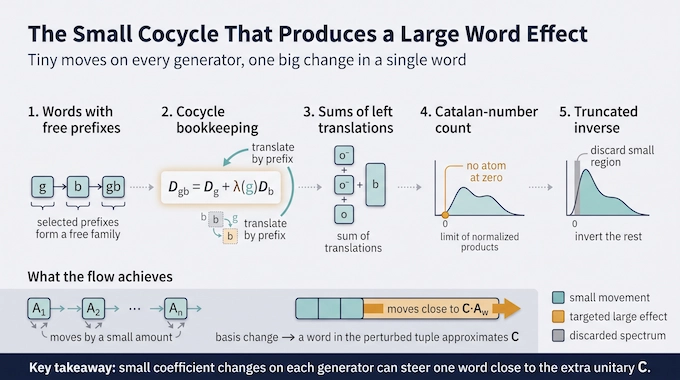
Now comes the apparent mismatch: each generator should barely move, yet one word should change enough to incorporate (C).
A long product can accumulate small changes. The challenge is to organize those changes without losing norm control.
The coefficient bookkeeping uses a cocycle:
[ D_{gb}=D_g+\lambda(g)D_b. ]
Each part of a word contributes coefficients translated by the preceding prefix. This is closely related to Fox’s free differential calculus.
The paper constructs words with selected prefixes forming a free family. Their cocycle values can then be expressed through sums of the corresponding left-translation operators.
A Catalan-number count identifies the limiting spectral distribution of normalized products of these sums. The useful feature is that the limiting distribution has no atom at zero.
That does not mean the spectrum stays uniformly away from zero. Instead, a truncated inverse discards a small spectral region and inverts the rest. The remaining spectral mass lets the construction obtain a small coefficient vector whose image approximates the required target.
The resulting flow keeps each (A_j) close to its starting point while moving a chosen word close to (CA_w). A free-group basis change converts that estimate into a word in the perturbed tuple approximating the original (C).
The extra generator is now nearly recoverable.
7. Why “Nearly Recoverable” Must Survive the Limit
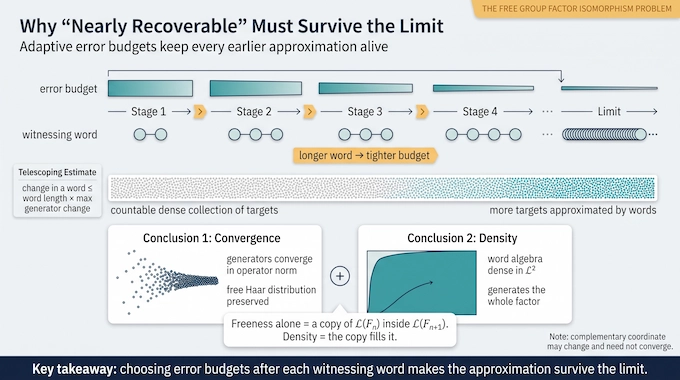
One perturbation doesn’t finish the free group factor isomorphism problem. Its word approximates (C), but later perturbations could ruin that approximation.
This is especially dangerous when the witnessing word is long. Changing each generator by a tiny amount can produce a much larger change in a long product.
The manuscript therefore chooses future error budgets only after the current witnessing word is known. Longer words demand tighter budgets for subsequent steps.
For a fixed word, a telescoping estimate bounds the change in its evaluation by its length times the maximum change in a generator. For a word polynomial, the corresponding bound also includes its coefficients. These explicit continuity bounds turn “be sufficiently careful later” into a numerical requirement.
The iteration also tracks a countable dense collection of targets in the ambient tracial (L^2) space. At each stage, more targets are approximated using words in the retained generators.
Two conclusions must follow separately.
First, the retained generators converge in operator norm. Each fixed word’s trace passes to the limit, preserving the free Haar distribution.
Second, their limiting word algebra is dense in the entire ambient (L^2) space. The trace-preserving conditional expectation then shows that the generated von Neumann subalgebra is the whole factor.
Freeness alone would only identify a copy of (L(F_n)) inside (L(F_{n+1})). Density proves that this copy fills the ambient algebra.
The complementary coordinate may change at every stage and need not converge. The proof needs convergence of the retained tuple and preservation of the target approximations.
8. How the Argument Reaches Two Generators
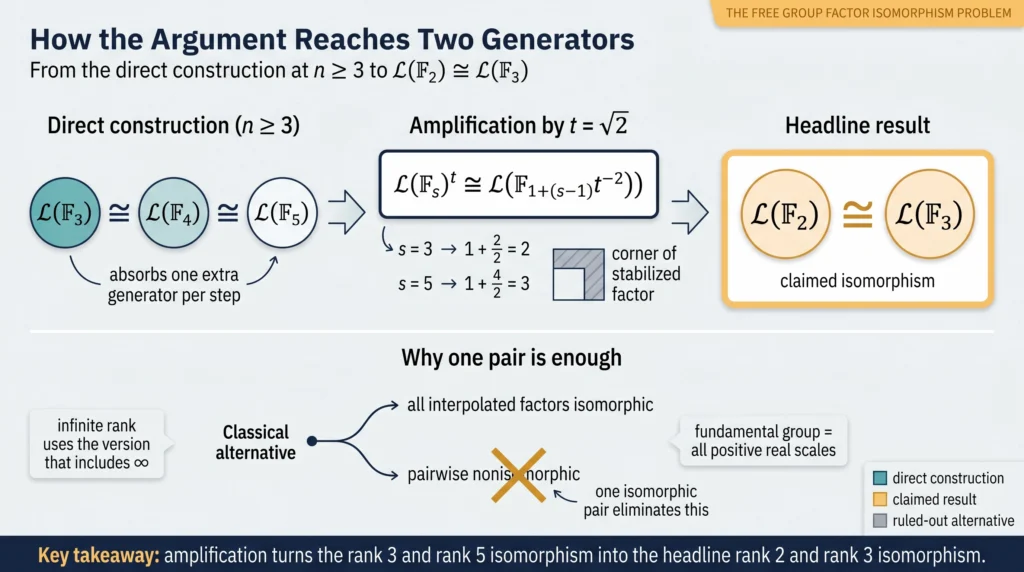
The direct construction applies for (n\ge3). It gives
[ L(F_3)\cong L(F_4)\cong L(F_5). ]
The headline pair requires amplification, an established operation involving normalized corners of a stabilized factor.
For interpolated free group factors, the amplification formula is
[ L(F_s)^t\cong L!\left(F_{1+(s-1)t^{-2}}\right). ]
Apply (t=\sqrt2) to the isomorphism between ranks three and five. The parameters become two and three, respectively. That yields the claimed (L(F_2)\cong L(F_3)).
So, are all free group factors isomorphic? Under the manuscript’s theorem, yes. The classical alternative says the interpolated family is either entirely isomorphic or pairwise nonisomorphic. One distinct pair eliminates the second alternative.
The infinite parameter requires the version of that established alternative that explicitly includes infinity. It is not obtained simply by extending a finite chain indefinitely.
9. What Changes for Free Entropy and Scaling
The free group factor isomorphism problem has consequences beyond relabeling ranks.
A factor’s fundamental group records positive scales (t) for which its amplification remains isomorphic to itself. It is a scaling invariant, unrelated to the fundamental group of a topological space.
Combining the claimed isomorphisms with the amplification formula gives every positive real scale:
[ \mathcal F(L(F_r))=\mathbb R_{>0}. ]
The entropy consequence explains why a proposed rank detector would fail.
The manuscript transports generating tuples from different ranks into the same factor. Their joint tracial distributions survive the isomorphisms, so their entropy-dimension values survive too.
It concludes that each of (\delta,\delta_0,\delta^*,\delta^\star) can take every integer value (n\ge2) on suitable finite self-adjoint generating tuples of (L(F_2)).
These quantities still measure properties of tuples. The claimed failure is invariance under arbitrary changes of von Neumann generators. The microstates and nonmicrostates conclusions use different tuple families, and the argument does not contradict the stated algebraic-generator invariance for the relevant group-algebra calculation.
The number of coordinates used to describe an algebra need not be an intrinsic label on that algebra.
10. What the Lean Formalization Actually Covers
OpenAI provides a Lean scope note for result family 287. It reports normal trace-preserving isomorphisms between interpolated factors at all parameters greater than one, including infinity.
The fundamental-group conclusion is described as a further consequence, rather than a separately selected statement. The note should not be stretched into a claim that every consequence in the manuscript has been separately checked.
Free group factor proof verification involves distinct questions: whether the formal derivation checks, which axioms it uses, and whether its definitions and conclusion express the intended mathematics.
Readers may also encounter sorry in the comparator challenge file. In Lean, that command can stand in for an unfinished proof. Here it appears in the reference statement that the separate solution is supposed to satisfy.
Its presence there does not, by itself, establish a gap in the proof implementation. Nor does the challenge statement establish correctness by itself. The implementation and its comparison against that statement must be checked.
This article has not independently rebuilt the formalization, replayed its proof through the comparator or audited its dependencies. It therefore describes OpenAI’s reported coverage rather than claiming those checks were reproduced.
As checked on October 10, the repository’s published changelog records no correction or withdrawal for this result. That describes the recorded release status, not community acceptance.
11. What Remains Outside the Result
An affirmative answer to the free group factor isomorphism problem would settle this family’s rank question. It would not classify every type (\mathrm{II}_1) factor.
It also would not identify the underlying free groups, turn the construction into a reduced (C^*)-algebra isomorphism or provide an immediate engineering application.
The construction is a limiting mathematical argument. A developer should not read it as a practical algorithm for translating arbitrary operators between representations.
The research questions concern what distinguishes settings where group information survives from those where it disappears, how the absorption method might extend, and which generator-sensitive quantities remain useful.
Those are substantial next steps. A proof can close a conjecture while leaving the mechanism worth years of investigation.
12. The Extra Generator Becomes Recoverable
The striking idea is how the manuscript makes an additional generator accessible through a smaller free tuple without changing the ambient factor.
Small automorphisms create the approximations. Adaptive budgets preserve them. Distribution and density establish two different parts of the conclusion. Amplification supplies the final bridge to ranks two and three.
That chain is the essential story behind the free group factor isomorphism problem. The reported Lean coverage adds another layer of evidence, while independent reproduction and mathematical interpretation remain distinct tasks.
For more research-paper explainers that follow the argument beyond the announcement, visit binaryverseai.com. Binary Verse AI examines what AI-generated mathematics claims, how its proofs work and what their conclusions actually mean.
1. What is the free group factor isomorphism problem?
The problem asks whether free groups with different numbers of generators produce isomorphic von Neumann algebras. A free group factor (L(F_n)) is the operator algebra obtained from the free group (F_n) through its left regular representation and operator closure. The central question is whether this completed algebra remembers the original number of free generators. OpenAI’s manuscript claims that it does not: (L(F_2)\cong L(F_3)).
2. Does this mean the free groups on two and three generators are isomorphic?
No. (F_2) and (F_3) remain nonisomorphic groups; their abelianizations are (\mathbb Z^2) and (\mathbb Z^3). The manuscript concerns their associated von Neumann algebras. Its proposed isomorphism preserves multiplication, adjoints, the unit and the normalized trace, and is normal. It also does not establish an isomorphism between the corresponding reduced group (C^*)-algebras.
3. How does OpenAI’s proof absorb an extra free generator?
The construction repeatedly makes small, structure-preserving changes to a tuple of generators so that words in the changed tuple approximate the extra generator. A small-cocycle estimate supplies the required perturbations. The argument then chooses future error budgets carefully enough to preserve earlier approximations. Two separate conclusions are essential: the limiting tuple retains its free Haar distribution, and its words are dense enough to generate the entire ambient factor.
4. Why would one isomorphism imply that all free group factors are isomorphic?
Established interpolation results give an alternative: the interpolated free group factors are either all isomorphic or pairwise nonisomorphic. An isomorphism between two distinct parameters rules out the second possibility. OpenAI’s manuscript reaches (L(F_2)\cong L(F_3)) through its consecutive-rank construction and amplification. It then invokes the version of the classical alternative that includes the infinite parameter, extending the conclusion to all interpolated parameters greater than one.
5. Has the proof been independently verified, and does Lean’s sorry indicate a gap?
OpenAI reports a Lean formalization covering the isomorphism of all interpolated free group factors, including the infinite case. This article has not independently rebuilt or audited that formal proof. The sorry in the comparator challenge is a placeholder for the target statement; it does not by itself show a gap in the separate proof implementation. Independent verification requires checking that implementation, its dependencies and permitted axioms, and whether the formal definitions faithfully express the intended theorem.