

When two marked points on a curve collide, a comparison made separately on their two formal disks no longer tells you what happens. In OpenAI’s October 4, 2026 preprint, that gap is one of two obstacles to a global quantum geometric Langlands equivalence. Theorem 1.1 relates full derived categories of twisted D-modules for a connected simple complex group and its Langlands dual at negative reciprocal shifted levels, corrected for root lengths. Its argument combines a reconstruction theorem for global Whittaker coefficients with a local comparison that survives collisions. An independent review identified two supporting claims that need repair. The issues concern the machinery used in the construction, and neither supplies a counterexample to Theorem 1.1.
Table of Contents
1. What Does OpenAI’s Quantum Geometric Langlands Proof Establish?
For a smooth, projective, connected complex curve and a connected simple complex algebraic group , Theorem 1.1 of the October 4 manuscript asserts the following equivalence of presentable complex-linear differential graded categories.
The manuscript fixes dual pinnings, which normalize root directions, and a theta characteristic, a square root of the canonical line of the curve. Compatibility with localization from loop-algebra representations characterizes the equivalence, including when marked points move.
2. The Original Problem: Twisted D-Modules, Dual Groups, and Irrational Levels
is the moduli stack of principal -bundles. A stack records families and automorphisms as well as isomorphism classes. D-modules encode the action of differential operators. Their twist changes how local differentiation rules glue when one switches frames of a line bundle. For a bundle , the manuscript uses the line , the determinant of cohomology of its adjoint Lie algebra bundle. The determinant in degree one enters inversely. With the dual Coxeter number of , the exponent defining is . An arbitrary complex exponent specifies a twist without requiring a literal fractional power of the line.
The Langlands dual exchanges characters with cocharacters and roots with coroots. This uses the full root datum, so is dual to . The lacing number is the ratio of squared long and short root lengths, with when all roots have equal length. For , the sample shifted level therefore maps to on the dual side. Here “quantum” refers to deformation by the level in the differential operators and affiliated loop-algebra representations.
3. Why Previous Geometric Langlands Results Could Not Establish the Global Quantum Equivalence
The 2024 proof of ordinary geometric Langlands relates D-modules on the bundle stack to a spectral category on the dual stack of local systems. The quantum geometric Langlands correspondence here compares two bundle-stack categories, both twisted. The ordinary theorem supplies crucial control at determinant exponent zero, where Whittaker reconstruction captures the tempered part. That statement leaves a possible remainder and gives no identity on the full category at an irrational exponent.
Campbell, Dhillon, and Raskin had already established the relevant fundamental local equivalences at irrational levels. A global construction needs coherent comparisons as points move and merge, and Whittaker reconstruction of arbitrary global objects. Bogdanova’s construction of a quantum Langlands functor in the Betti setting supplies another precedent and a model for central compatibility.
4. Proof Roadmap: Six Steps From Local Categories to Global Duality
- Bound the bundle geometry. Show that the irrational twist makes sheaves vanish on sufficiently unstable strata, so a quasi-compact open carries the entire category.
- Build the right pairing. Prove that the diagonal kernel used to turn opposite-sign Whittaker functionals back into bundle objects yields a duality equivalence.
- Recover each side from its coefficients. Test the reconstruction error where the ordinary theorem controls it, then deform the tested error to the irrational range and show that it vanishes.
- Match the local inputs. Use a common W-algebra module category to compare loops and Whittaker tests, then extend the comparison through collisions.
- Integrate the local pairings. Allow auxiliary marked points and use their integration to identify the local reduction pairing with a global unipotent period.
- Descend and invert. Factor through the localization quotient, then apply reconstruction on each side to obtain a left inverse and a right inverse.
OpenAI’s release attributes the work to an internal frontier model. The public repository does not list a reasoning summary for this manuscript. The roadmap follows the written argument.
5. Why Irrational Levels Eliminate Unstable Bundle Strata
The key obstruction comes from inertia, the automorphism groups of objects of a stack. Suppose a central multiplicative group in a stratum’s inertia scales the twisting line with nonzero integral weight . Strong twisted descent identifies constant pullback along this group with pullback carrying a Kummer connection of exponent . In a coordinate on the group, the induced differential sends the Laurent monomial to . For instance, and leave no integer mode in the kernel. Every factor is invertible, so the Kummer de Rham complex is acyclic, whereas the constant complex has nonzero cohomology. The descent identification forces the object itself to vanish.
Harder–Narasimhan types measure how unstable a bundle is. If a simple root evaluates on the type above , vanishing of first cohomology in the relevant unipotent root pieces presents the stratum locally as successive unipotent classifying stacks over a Levi stratum. A central Levi cocharacter gives the nonzero determinant weight that kills the stratum. Restriction to a sufficiently large quasi-compact open becomes an equivalence, making opposite-twist categorical duality available on the full category.
6. Twisted Pseudo-Identity and the Construction of Global Whittaker Categories
Ordinary diagonal pushforward gives the kernel for categorical duality with opposite twists. Reconstruction uses the extraordinary pushforward of the constant object along the diagonal. To show that this second kernel gives an equivalence, the paper compactifies the parabolic correspondences. Irrational inertia eliminates nonzero-defect boundary terms, making ordinary and extraordinary extensions agree at the relevant boundaries. Second adjointness then identifies adjoints using opposite parabolics.
The compactified diagonal has terms factoring through proper Levi groups. Induction on semisimple rank controls their induced Eisenstein objects. On objects with all proper constant terms zero, the pseudo-identity acts by a shift. These pieces generate, extending the equivalence to the whole category.
The global Whittaker coefficient functor pulls a D-module to a stack of generically defined reductions to the maximal unipotent subgroup, allowing poles at moving marked points. It then projects to the sector specified by a nondegenerate additive character. Pairing with the opposite character and twist makes it possible to turn these coefficients back into bundle objects.
7. The Whittaker–Poincaré Identity: Recovering the Entire Category
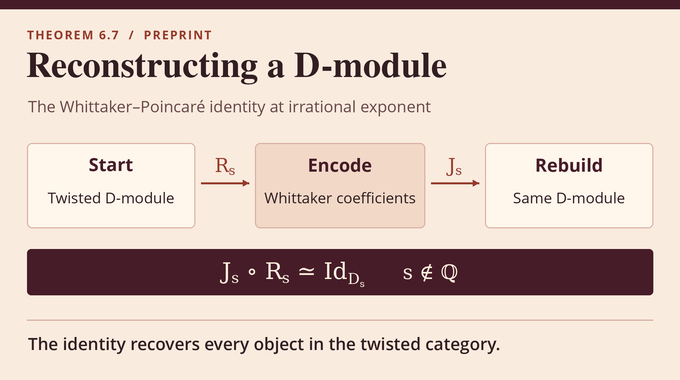
Write for the enhanced global Whittaker coefficient functor and for the Poincaré functor built from the transpose of the opposite coefficient functor, the pseudo-identity, and the manuscript’s normalization shifts. The paper calls this categorical reconstruction the Plancherel identity. Theorem 6.7 identifies their composite with the identity at irrational determinant exponent.
Here denotes for the group under study, indexed by determinant exponent rather than shifted level. At exponent zero, the ordinary comparison has a cone in the anti-tempered category, the part killed by the right adjoint to the tempered inclusion. The manuscript compares kernels, keeping one bundle variable as a parameter and applying a fixed finite Whittaker test to the other. The test kills the ordinary remainder and, by Proposition 6.1, detects vanishing at irrational exponent. That makes the tested cone the target of deformation.
8. How Deformation, Finite Whittaker Tests, and Weight Bounds Establish Reconstruction
The tested cone is a filtered colimit of finite diagrams bounded in pole orders and marked-point operations. A universal Kummer local system records the twist through . Auxiliary affine coordinates record the two character functions by translation. Fourier transform in these coordinates and restriction at the chosen character parameters recover the exponential factors. Keeping track of the diagrams before Fourier transform allows the proof to use mixed Hodge theory.
At the ends of the Kummer axis, the geometric monodromy has eigenvalues that are roots of unity. Tensoring with a rank-one local system of non-torsion monodromy removes the eigenvalue one. The ordinary and compactly supported integrals agree. On perverse pieces their cohomology is concentrated in degree zero, where its dimension is the Euler characteristic. The resulting Mellin calculation controls cohomology dimensions and the ranks of individual transition maps throughout the non-torsion locus.
Zero colimit at only means that classes eventually die. The manuscript needs the same conclusion after changing . Classical geometric Langlands supplies a cohomological bound independent of the Satake label, since on the spectral side the relevant bundles tensor without changing cohomological degrees. Collision codimension and the degree of the finite skeletal approximation lower the maximum degree, leaving a uniform upper weight bound in each fixed degree. In the logarithm completion at , higher powers lower the weight bound by two per power. Killing a generator after sufficiently long truncation therefore kills it in the completion. The corresponding later transition has rank zero generically and thus at every non-torsion . This kills the filtered colimit, leaving the finite test to detect the kernel identity.
9. W-Algebra Duality: Comparing the Local Categories of Dual Groups
Kac–Moody representations describe centrally extended loop currents. Localization sends them to twisted D-modules on the bundle stack. To compare periods, the manuscript pairs a positive-loop-equivariant module with a Whittaker test on the affine Grassmannian, which parametrizes local bundle modifications.
Drinfeld–Sokolov reduction imposes a principal unipotent character by a cohomological construction. Relative Skryabin comparison identifies the resulting category with an appropriate category of principal W-algebra modules, while retaining the parameter operations. Feigin–Frenkel duality identifies the two principal W-algebras at the appropriate inverse shifted forms. At a point, a Weyl module of dominant weight paired with a test of dominant coweight reduces to a simple module in degree zero. The dual reduction exchanges the labels. This gives a common target in which the paper can compare maps as the marks move.
10. The Collision Barrier: Extending Local Equivalences Across Moving Points
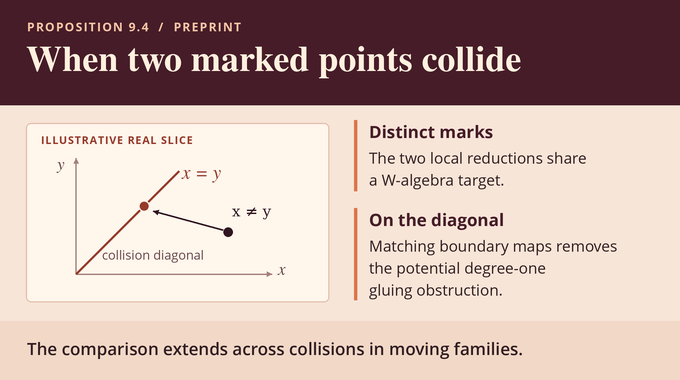
Even identical reductions at every point leave open how objects glue along a collision divisor, where two coordinates become equal. On each configuration stratum, the comparison’s relative right adjoints yield units whose cones start in degree three. The gap comes from the vanishing of degree-one and degree-two de Rham cohomology of a semisimple group. It lets the common target identify maps between objects in the hearts, the degree-zero parts of the relevant derived categories.
Extraordinary restriction of a heart object to a collision divisor has amplitude . The open–closed triangle gives a surjective boundary map onto the degree-one term. Because the common target identifies the boundary maps, surjectivity persists and the potential degree-one gluing obstruction disappears. Induction over the divisors extends the heart equivalence, and realization and the relative adjunctions give the derived equivalence. When both pairing slots have independent inserted marks, translation moves the extra points through the collision. The horizontal vacuum gives the comparison on the diagonal itself, making it compatible with inserting a point carrying no new data.
11. Ran-Space Integration and the Construction of Two Inverse Global Functors
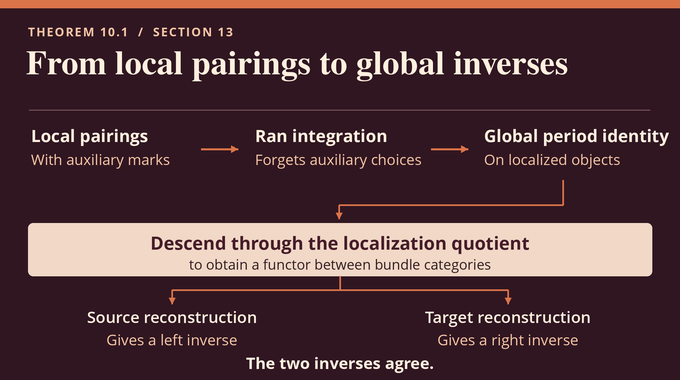
The Ran space organizes finite sets of points on the curve. At fixed finite jet level, the period map compares local semi-infinite cochains with a global unipotent period, the integral over bundles for the unipotent subgroup with the Whittaker character. The construction tracks determinant lines and shifts. To prove the map becomes invertible after integration, consider a principal part supported at an auxiliary point. The finite marked sets containing that point and the original marks are homologically contractible in the relative Ran calculation. Integrating removes the choice of auxiliary sets and leaves the global cohomology complex from forgetting supports.
For vector groups this calculation identifies the generators of the cochains and the functions on the bundle stack by Serre duality. A root-height filtration and bracket deformation extend it to unipotent groups. A filtration by the degree of monomials in loop currents controls passage from reductive inputs. This identifies the integrated pairings. Applying the period comparison again at negated shifted forms, with reversed characters, supplies the opposite-twist identity.
Localization is a categorical quotient, so transposing it gives a fully faithful embedding of the global dual category into the local one. The period identity places the global Whittaker coefficients in the image of that embedding. Factoring through it and applying pseudo-identity gives the global functor. Reconstruction on the source produces a left inverse, and reconstruction on the target produces a right inverse. The two agree by composing the left inverse, the functor, and the right inverse.
The functor sends a source central character and component to target data under the dual root datum identifications. It also exchanges translation by a central torsor with tensoring by a transgression local system or its inverse according to direction, formed from the obstruction to lifting the universal bundle on the other side.
12. The Scope and Verification of OpenAI’s Quantum Geometric Langlands Proof
The OSVerify report on the October 4 manuscript flags two major issues. In Proposition 4.3, absolute de Rham sections over countably many disconnected parameter points give a product of copies of the complex numbers where continuity would require their direct sum. The counterexample is at determinant exponent zero and concerns the broad absolute pairing. The reviewers propose constructing a continuous categorical evaluation and checking its agreement on quasi-compact parameters and with the transposition maps.
In Proposition 6.1, constant fibre cohomology is insufficient to identify the full derived averaging coefficient with a constant one. In the reviewers’ example, a constant coefficient predicts total cohomology dimension four, whereas the actual pushforward has total dimension two. Their proposed repair keeps the actual coefficient and uses local trivializations, where tensoring by a nonzero complex detects zero. Descent then gives the conservativity needed for reconstruction. That repair addresses the conservativity step. Independent verification of the full argument remains open.
The release lists Lean formalizations for other results. It gives no machine-checked proof of Theorem 1.1. The theorem’s scope is unramified de Rham quantum geometric Langlands for connected simple complex groups, at every complex shifted level outside the rationals, including non-real levels. Rational levels, general reductive groups, and ramified problems remain outside the statement. The period identity shows where the two advances in quantum geometric Langlands meet. Collision compatibility lets the local comparison feed into the quotient construction, and reconstruction supplies the two inverses. Follow Binary Verse AI for source-based analysis of AI-generated mathematical research.
Is geometric Langlands proven, and who proved it?
Yes, in the categorical, unramified characteristic-zero setting covered by the five-paper proof announced in 2024. The collaboration comprised Dima Arinkin, Dario Beraldo, Justin Campbell, Lin Chen, Joakim Faergeman, Dennis Gaitsgory, Kevin Lin, Sam Raskin, and Nick Rozenblyum. OpenAI’s 2026 manuscript addresses the separate quantum correspondence at irrational levels. The broader Langlands program contains many other conjectures.
What does “quantum” mean in quantum geometric Langlands?
It refers to deformation by a complex level parameter in categories of twisted D-modules and representations of affine Kac–Moody algebras. The parameter changes how differential operators glue and how loop-algebra representations are centrally extended.
What exactly does OpenAI’s quantum geometric Langlands proof establish?
Theorem 1.1 of the preprint states an unramified de Rham equivalence for a connected simple complex group and its Langlands dual on a smooth, projective, connected complex curve. It relates the full derived categories of twisted D-modules at shifted levels and , where and is the lacing number.
Why are irrational levels essential to the proof?
Irrational twisting eliminates sufficiently unstable bundle strata by making the Kummer exponent along a central inertia group nonintegral. The Kummer monodromy is also outside the roots of unity, where the finite rank calculation used to deform Whittaker reconstruction applies.
What prevented earlier local Langlands equivalences from becoming a global proof?
The local comparisons on formal disks left two tasks. They needed to extend coherently over families of moving points, including collisions, and they needed a global Whittaker reconstruction identity that recovered every object in the irrationally twisted category.
How does the new argument construct an inverse global equivalence?
The manuscript compares the local pairings through W-algebras, then integrates them over the Ran space to obtain a global period identity. That identity allows the functor to descend through localization. The Whittaker–Poincaré identity on each side provides an inverse on the corresponding side, and the two inverses agree.
Has OpenAI’s quantum geometric Langlands proof been independently verified?
Full independent verification remains open. OSVerify reported two major issues and proposed repairs. One counterexample concerns the continuity of an absolute pairing at determinant exponent zero. The other refutes a claimed global scalar identification and gives a way to recover the conservativity required in the reconstruction argument. The main theorem remains a claim of the October 4 preprint.