
Why should a Galois representation have modular Hecke eigenvalues if it has no prescribed algebraic weight? For p-adic Galois representations at the prime two, OpenAI’s October 6, 2026 manuscript answers this through the completed Hecke algebra. Every continuous, odd, absolutely irreducible two-dimensional representation over a finite extension of the 2-adic numbers, unramified outside finitely many primes, occurs there at some odd tame level. The result includes scalar and reducible residual representations. The proof finds a different point in the same deformation family where the classical modularity machinery applies. At that point, a dimension calculation forces the whole family onto Hecke support, including the original representation.
Table of Contents
1. What Does OpenAI’s Unrestricted Pro-Modularity Proof Establish?
1.1. The Frobenius Test for p-Adic Galois Representations
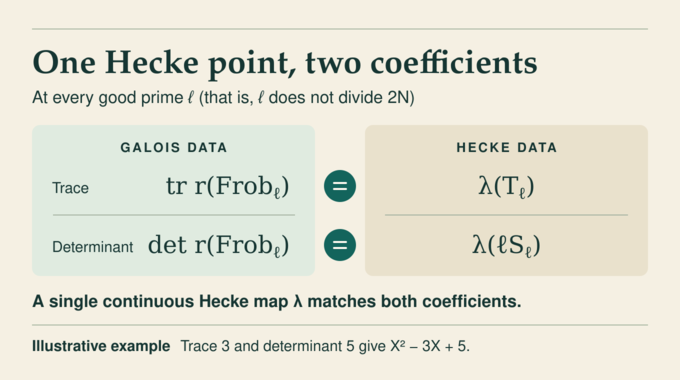
Here is the absolute Galois group of the rationals. The full 2-adic Hecke algebra is the inverse limit of the 2-adically completed Hecke algebras acting on forms at level in weight ranges from up to a growing cutoff. It includes Eisenstein forms and is generated topologically by the good-prime operators and . For every prime outside , the theorem matches the trace and determinant of a Frobenius element . Both values are independent of its representative up to conjugacy.
For example, if a good Frobenius has trace and determinant , its polynomial is . The same Hecke point supplies both coefficients and does so simultaneously at every good prime. The theorem is a statement about a single compatible system of eigenvalues.
2. The Original Problem: From Fontaine–Mazur to Pro-Modularity
The regular two-dimensional Fontaine–Mazur conjecture over links geometric Galois representations to classical cuspidal eigenforms up to Tate twist. At the coefficient prime, regular de Rham means that the representation is de Rham and its two Hodge–Tate weights are distinct. A classical form gives an eigensystem at one weight. Pro-modularity asks for an eigensystem in an algebra that remembers congruences across weights. Such an eigensystem can exist without a classical weight.
Skinner and Wiles worked with ordinary families in the residually reducible case. Emerton’s earlier pro-modularity theorem assumed an odd coefficient prime, an irreducible residual representation and local residual restrictions. Pan moved beyond the ordinary locus for residually reducible representations at odd primes, using ordinary modular points and patching to propagate support. His classical modularity theorems still required regular de Rham hypotheses. The dyadic proof takes up Emerton’s varying-weight question with flexibility at tame primes.
3. Why Prime Two and Scalar Residual Representations Are Difficult
A stable integral lattice in can have a reducible reduction even when is absolutely irreducible. In the scalar case, the semisimplified reduction consists of two copies of one character. If two local residual characters coincide, their labels provide no way to distinguish invariant lines. The proof tracks chosen lines in part of its characteristic-two geometry and uses local block results that cover scalar parameters.
Characteristic two also makes trace-only formulas that divide by unavailable. The identity matrix has trace zero in characteristic two and determinant one. The proof uses two-dimensional determinant laws, which retain both trace and determinant integrally. That lets it move between characteristic-zero coefficient points and characteristic-two families within the same deformation problem.
4. The Proof Roadmap: Six Steps from Galois Representations to Hecke Support
OpenAI’s release announcement credits an internal frontier model with producing the results in the collection and describes Lean formalizations for part of the release. It gives release-wide provenance. The six stages here reconstruct the mathematical dependencies in the written preprint.
5. Building the Fixed-Determinant Galois Deformation Family
The first step in the Galois deformation theory is a continuous twist through the 2-adic cyclotomic character . It writes the new determinant as , with finite order and unramified at . The exponent can be arbitrarily large in one parity class. This supplies a determinant shared by a regular non-CM cuspidal representation. The proof later chooses a separate modular seed to match the original residue.
A framed deformation keeps track of a basis. Lemma 2.2 gives a reduced integral component through the normalized point with dimension at least six, using a real local dimension of two, the global relation estimate, and the passage back to the integral component. Forgetting the frame loses at most three dimensions because scalar changes of basis act trivially. The resulting closed trace image is a domain .
Dimension bounds on reducible, dihedral and exceptional finite-projective loci show that has a point whose algebraic monodromy has nonsolvable identity component. This property survives finite-index restriction and ensures generic absolute irreducibility after base change, even if the original point behaves differently under restriction.
6. Solvable Base Change and Characteristic-Two Curve Connectedness
The seed supplies initial Hecke support, but the family has no known regular de Rham point yet. Proposition 2.3 adapts connectedness arguments from the companion Fontaine–Mazur paper. Over auxiliary totally real fields split at , the proof cuts both the seed’s Hecke component and an unrestricted locus containing the family by equations. Dimension estimates leave room to choose characteristic-two curves whose generic representations have nonsolvable connected algebraic monodromy and finite local images at the allowed non-dyadic places. These are the hypotheses needed to propagate support from a curve to a larger locus.
When the global residue is reducible and the dyadic characters coincide, the proof marks invariant lines at selected dyadic places. It chooses lattices in which each marked line avoids the globally invariant residual lines. Connectedness of this transverse residual fiber and dimension bounds on successive component intersections provide a chain of curves, carrying Hecke support from the seed to the unrestricted locus. A common solvable, totally real Galois extension , completely split at , and a common tame level suffice for the restricted family. The marks are used to construct the connecting chain.
7. Diagonal Local Parameters and the p-Adic Langlands Correspondence
Because splits completely in , the local fields at all places above identify with . Conjugation of decomposition groups gives the same trace and determinant at each place. In the manuscript’s normalization the local Galois parameter is twisted by , so its determinant is and the associated central character is . The actions of the local pseudodeformation rings on the family therefore factor through one common ring .
The p-adic Langlands correspondence relates these local Galois parameters to representations of . The integral Paškūnas–Tung block theory packages a block of such representations using a projective generator and its endomorphism algebra. A Cayley–Hamilton description ties the relevant part of that algebra to the local determinant law, including at scalar residue. Proposition 2.4 places a finite, nonzero, torsion-free module over in this product of blocks. Its compact representation is admissible for the product, and is finite over the common .
8. How One-Factor Admissibility Follows from Product Admissibility
Proposition 3.1 reconstructs a compact object from the first block action. It must be finite over , the completed group algebra of a sufficiently small uniform subgroup of . To prove this, the paper kills the coefficient uniformizer and imposes the relations that make act trivially. If the resulting coinvariants are infinite-dimensional over the residue field, their support contains a nonconstant characteristic-two curve.
At such a curve, a repeated character would have square equal to the constant determinant. Squaring is injective in a field of characteristic two, so the parameter would be constant. An irreducible parameter has one simple block module after splitting. For two distinct characters, the two principal-series orders give the same coinvariant vanishing test. On determinant-one stabilizers, swapping the characters replaces a unit by its inverse. The elements and generate the same ideal. Thus nonzero coinvariants on the curve survive tensoring with every simple of the relevant block. The same argument applies in each remaining factor because the parameters agree. Product coinvariants would then survive on the curve, contradicting their finite dimension. This proves one-factor admissibility.
9. Positive Iwasawa Rank Produces a Regular de Rham Point
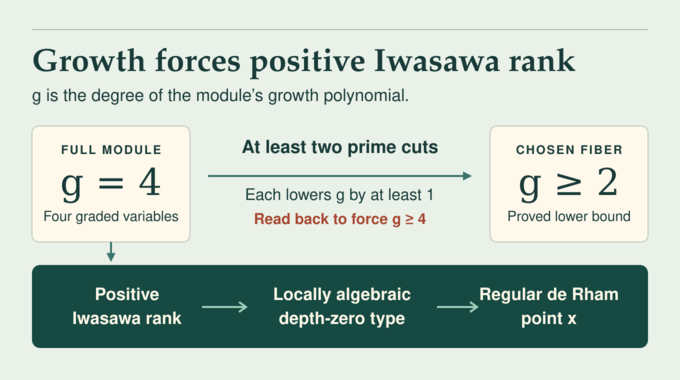
Admissibility gives finite generation, so the proof can count how quickly the lengths of quotients grow under powers of the maximal augmentation ideal of . The associated graded algebra has four polynomial variables, including the uniformizer direction. Proposition 4.2 first chooses a coefficient point away from finitely many exceptional local parameters. There the reduced fiber is infinite-dimensional and its integral lift is uniformizer-torsion-free, giving growth degree at least two.
A saturated chain from the generic point of to has steps. Each step cuts by an injective element before taking a quotient, lowering the growth degree by at least one. Working back from gives growth degree at least , hence exactly four. That maximal degree forces positive rank over .
Positive rank gives a nonzero -linear map from to . On the dual side, polynomial approximation makes matrix coefficients dense in the relevant continuous function space, so some locally algebraic type survives under the dual map. Its smooth factor is the sign character of . The authors choose this sign character because it is nontrivial on the upper unipotent subgroup. A type carrying that sign excludes reducible local parameters and gives a depth-zero supercuspidal smooth factor in the classical eigensystem. A common -eigenvector in the resulting type space yields the coefficient point . Transferring the type to the completed forms over produces a regular cuspidal eigensystem. Proposition 4.5 gives with absolutely irreducible regular de Rham dyadic restriction and Weil–Deligne parameter trivial on wild inertia. The companion regular Fontaine–Mazur theorem makes classical up to Tate twist over .
10. Putting the Classical Point into the Full Hecke Algebra
The classical form behind may have level dividing , while is defined using odd level. Proposition 5.1 evaluates both kinds of classical forms on the same ordinary tower of formal-group trivializations. Tame-level evaluations span a dense subspace there after inverting . Good-prime Hecke operators preserve the integral unit ball, so convergence on this dense subspace extends to the evaluation of the form with dyadic level. Its eigenvalues define a continuous point of the exact algebra in Theorem 1.1.
Proposition 5.2 proves that continuous cyclotomic twists also preserve occurrence at this tame level. It first uses density of classical cuspidal points for finite-order twists. A formal character then extends the result to continuous twists, because a nonzero integral one-variable power series cannot vanish at all the finite-order parameters. This handles the Tate twist at and will undo the normalization of .
11. The Final Argument: Hecke Dimension Four and Adjoint Selmer Vanishing
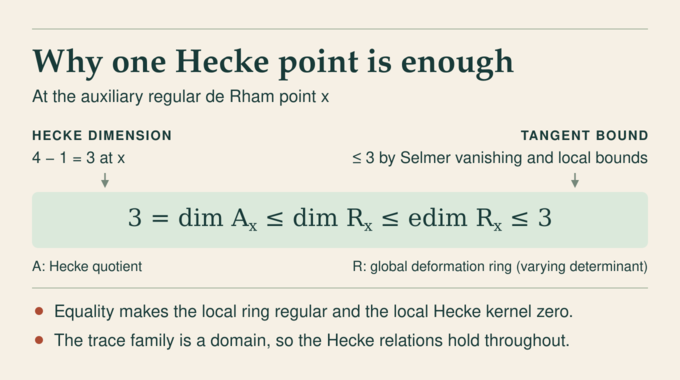
Let be the relevant residue factor of the full Hecke algebra after coefficient extension. Both and are quotients of the global determinant deformation ring , which allows the determinant to vary. The dimension theorem for the full 2-adic Hecke algebra gives integral dimension four for every component through , before localization. The coefficient-point closure has dimension one, giving local Hecke dimension three.
For the upper bound, the proof applies Newton and Thorne’s adjoint Selmer vanishing theorem to . Its Weil–Deligne parameter is trivial on wild inertia, which excludes the wildly ramified quadratic self-twists that could arise from CM fields inside the dyadic cyclotomic tower. The global finite Selmer group vanishes. The local cohomology quotients by the finite condition contribute zero away from and at . Thus the unrestricted adjoint tangent space has dimension at most three.
Here and are the kernels of evaluation at on the corresponding rings, and is embedding dimension, the dimension of the cotangent space. Equality makes the ambient local ring a regular domain. A nonzero kernel would lower the dimension of its Hecke quotient, so the Hecke kernel vanishes after localization. Each kernel element is therefore killed before localization by some element outside . That multiplier has nonzero image in the domain , so the kernel element maps to zero in . Evaluating at the original point and undoing the cyclotomic twist gives the claimed Hecke values. They lie in , which is closed in the enlarged coefficient ring.
12. What the Proof Resolves and Where Its Scope Ends
The theorem removes residual and de Rham restrictions from completed-Hecke occurrence for the specified p-adic Galois representations at . It still requires a two-dimensional representation of that is absolutely irreducible, odd and finitely ramified. The level may include auxiliary odd primes, leaving the sharper prescribed-tame-primes formulation outside the result. Classical modularity still belongs to the regular de Rham setting addressed by the companion theorem.
The decisive distinction is where the weights enter. The auxiliary point supplies the classical input and the tangent bound. The algebraic structure of the family then carries the Hecke identities to , whose weights were unrestricted. Explore the connection with elliptic-curve modularity in Binary Verse AI’s related coverage.
What does unrestricted pro-modularity at prime two prove?
Every continuous, odd, absolutely irreducible two-dimensional representation of over a finite extension of that is unramified outside finitely many primes occurs in the full completed Hecke algebra at some odd tame level. This level contains every odd ramified prime and can include auxiliary primes. There is no de Rham hypothesis and no restriction on the semisimplified residual representation.
How is pro-modularity different from classical modularity?
Classical modularity identifies the Galois representation attached to a classical modular eigenform, with a Tate twist allowed in the Fontaine–Mazur formulation. Pro-modularity gives a point in a completed Hecke algebra that combines data across weights. This point can exist without an eigenform of a single classical weight.
How does OpenAI’s proof work without de Rham conditions?
The proof puts the original representation in a fixed-determinant deformation family and constructs a regular de Rham point elsewhere in that family. The auxiliary point is classical up to Tate twist. Comparing the local Hecke dimension with the global deformation tangent dimension there forces the whole family to satisfy the Hecke relations.
Why are scalar residual representations particularly challenging at the prime two?
Coincident residual characters give no labels to distinguish invariant lines, and integral formulas that divide by two are unavailable. The proof uses determinant laws to retain trace and determinant, tracks marked lines in its characteristic-two connectedness argument, and uses integral local block results that cover scalar residual parameters.
What role does the p-adic Langlands correspondence play?
It relates the dyadic Galois parameters to representations of . Together with integral block theory, it helps the proof pass from an admissible representation of a product of these groups to an admissible representation of one copy. That single-factor object supplies the locally algebraic vectors used to find the regular de Rham point.
Why is the four-dimensional Hecke algebra essential to the proof?
A four-dimensional integral Hecke component has local dimension three at the auxiliary coefficient point. Adjoint Selmer vanishing and the local cohomology bounds give a tangent dimension of at most three for the ambient global deformation ring at that point. Equality makes that local ring regular and forces the Hecke relations to vanish on the entire trace family.
Does the proof establish classical modularity for every 2-adic Galois representation?
The unrestricted conclusion is completed-Hecke occurrence for odd, absolutely irreducible, finitely ramified two-dimensional representations of . The companion dyadic Fontaine–Mazur theorem gives classical modularity up to Tate twist when the restriction at two is de Rham with distinct Hodge–Tate weights.