Edge-Disjoint Cycles: OpenAI’s O(n) Proof Untangles a 60-Year Graph Theory Conjecture
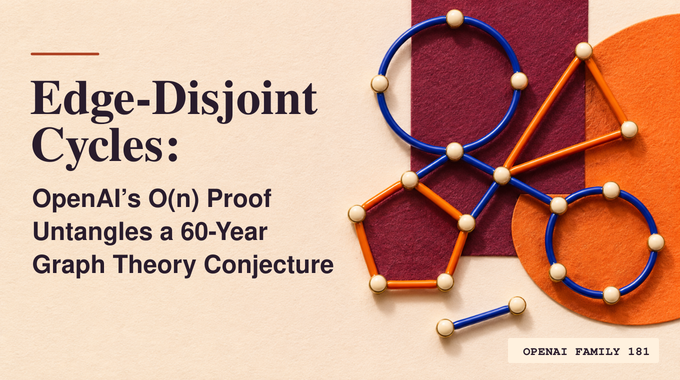
Orange and blue wire paths depict edge disjoint cycles and a single edge.

How many pieces do you need to take a graph apart? A complete graph can have more than half a billion edges on 32,000 vertices, yet OpenAI’s proof shows that a constant times the vertex count always suffices. The pieces are edge disjoint cycles and single edges. The result settles the Erdős–Gallai cycle decomposition conjecture, … Read more

Ramanujan Graph Construction: OpenAI’s Proof of Exact Spectral Expansion in Every Fixed Degreev

Blue Ramanujan graph sculpture between two yellow planes representing the spectral bounds.

Give every vertex exactly three neighbors and ask a random walk to forget where it started. Two densely connected regions joined by a handful of edges can trap the walk for a long time, even when every vertex has the same degree. A Ramanujan graph meets the sharp asymptotic spectral standard for avoiding that kind … Read more

Ramsey Number Bounds: How OpenAI’s Proof Found the Missing Logarithmic Power in r(5,t)

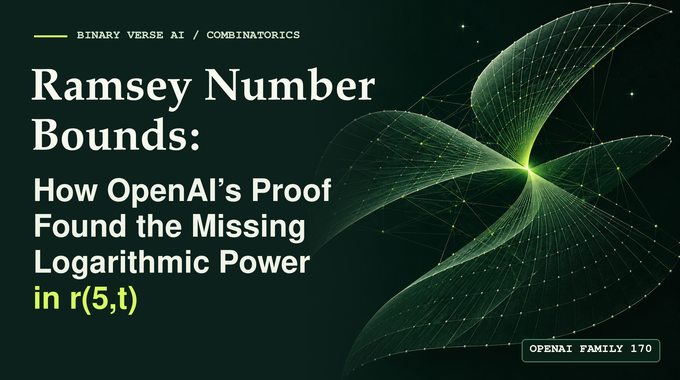
Ramsey number bounds cover with a green wire network converging at a single point.

How long can a network avoid both five mutually connected vertices and a large group with no connections among them? For the Ramsey number r(5,t)r(5,t), the power of tt had been settled, but the best bounds still differed by three powers of a logarithm. OpenAI’s September 24, 2026 preprint pins the logarithmic exponent down to … Read more

Seymour Second Neighborhood Conjecture: The Graph That Cannot Exist

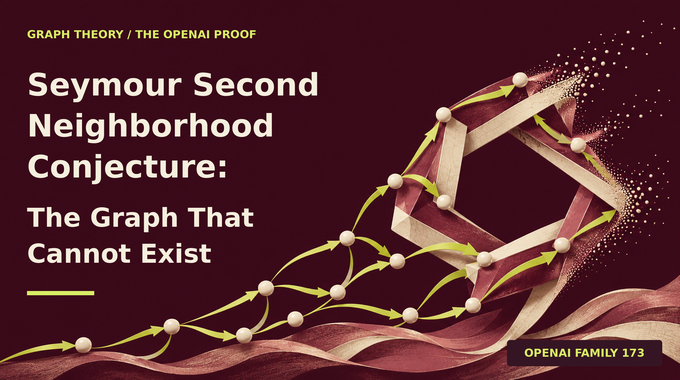
Seymour second neighborhood conjecture artwork showing a directed graph and a dissolving impossible frame.

Take any finite network of one-way arrows, forbid loops and opposing arrows, and look two steps ahead. Must somebody reach at least as many new vertices in two steps as in one? The Seymour second neighborhood conjecture says yes. OpenAI’s September 23, 2026 paper proves this for every nonempty finite oriented graph. Its argument assumes … Read more

Crossing Number of Complete Graphs: How OpenAI Proved Hill’s Drawing Is Optimal

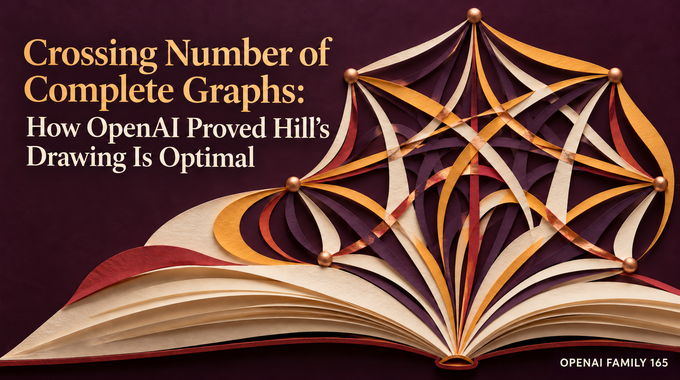
Crossing number of complete graphs shown as interlaced paper ribbons rising from an open book.

Seven dots, twenty-one connections, nine unavoidable crossings. That is the answer for the complete graph K7K_7, even when every connection may bend. The difficult question was whether the same classical formula remained optimal for every graph size, however cleverly its edges were routed. OpenAI’s September 23, 2026 paper presents a proof that the crossing number … Read more