Boltzmann Equation: OpenAI’s Proof for Gases Beyond Hard-Sphere Collisions
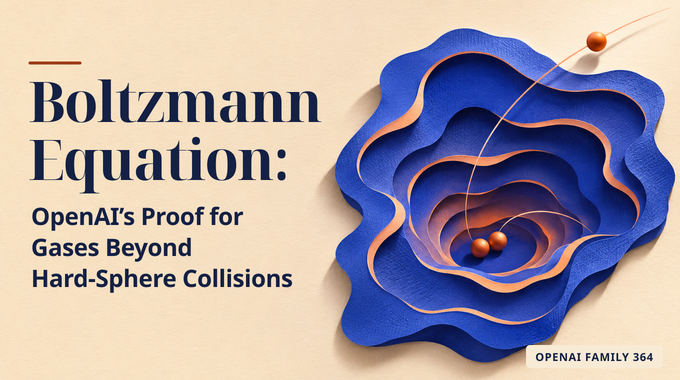
Boltzmann equation cover showing copper particles curving through a blue paper sculpture of an attractive potential well.

A pair of molecules drawn into an attractive well can keep interacting long enough for a third to arrive. The Boltzmann equation still describes the dilute-gas limit of that Newtonian system under the conditions proved in OpenAI’s September 2026 manuscript. The result covers stable, finite-range radial forces in three dimensions, including potentials with attractive wells. … Read more
Mumford Shah Conjecture: How OpenAI’s Proof Rules Out Hidden Crack Islands

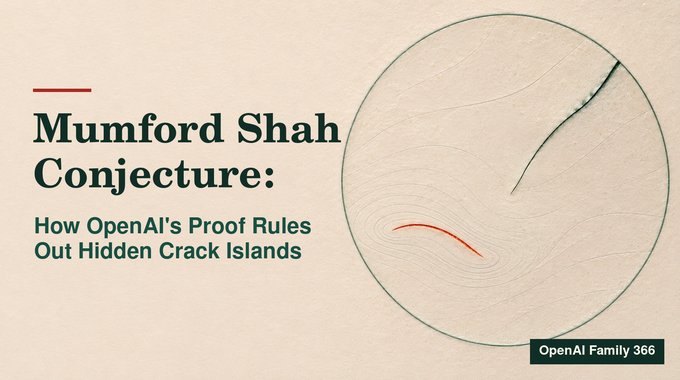
Mumford Shah conjecture cover showing an isolated red crack beside a separate green fissure.

An edge in a segmented image can run through a region, stop inside it, or meet two other edges. Could an energy minimizer hide a disconnected crack among other cracks, even as you zoom in? The planar Mumford Shah conjecture asks whether those three patterns describe every interior point of the discontinuity set. OpenAI’s September … Read more

Isotropic Elasticity: OpenAI’s Proof That the Boundary Determines Hidden Stiffness

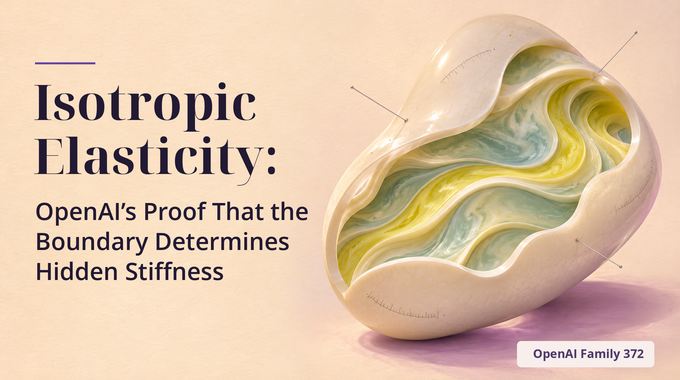
Porcelain cutaway illustrates how boundary data determine hidden stiffness in isotropic elasticity.

Prescribe every displacement pattern you can on the surface of a solid and record the force per unit area needed to hold each one. Could two bodies with the same shape but different interior stiffness give exactly the same responses? OpenAI’s preprint on isotropic elasticity proves they cannot under its smooth, three-dimensional, static model. The … Read more

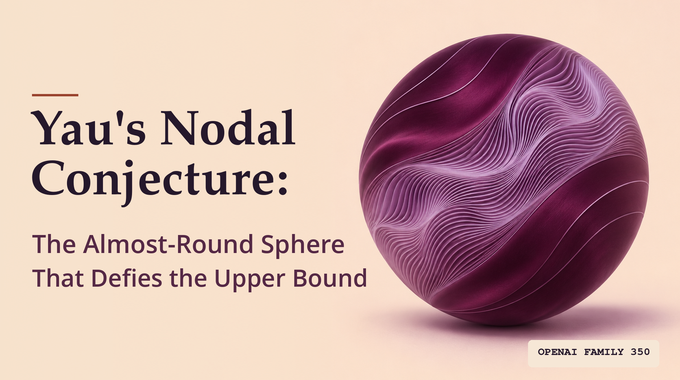
Yau’s Nodal Conjecture: The Almost-Round Sphere That Defies the Upper Bound

Yau nodal conjecture artwork showing a near-round sphere with densely folded contour lines.

A sphere can be changed by an arbitrarily small smooth deformation and yet support Laplace eigenfunctions with far more nodal area than Yau nodal conjecture permits. In a September 2026 manuscript, OpenAI constructs one fixed metric on the three-sphere and another on S2×T2S^2\times T^2 whose exact eigenfunctions have nodal measures growing faster than any constant … Read more

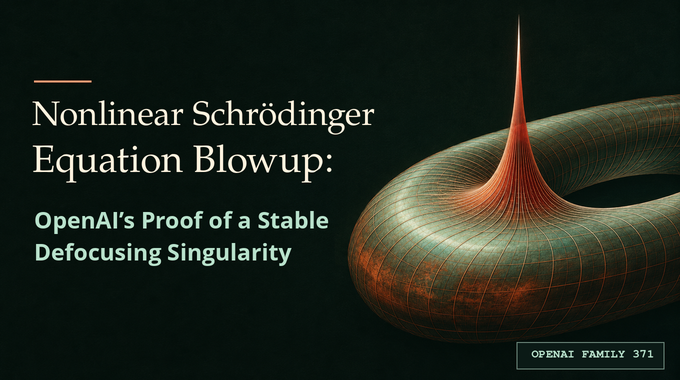
Nonlinear Schrödinger Equation Blowup: OpenAI’s Proof of a Stable Defocusing Singularity

Copper spike rises from a torus in artwork for nonlinear Schrödinger equation blowup.

A wave can conserve positive energy and still grow without bound at one point. OpenAI’s September 2026 preprint proves this kind of nonlinear Schrödinger equation blowup for a scalar defocusing model on the twelve-dimensional torus. For a suitably chosen large odd power, every initial condition in a nonempty open set of a high Sobolev space … Read more

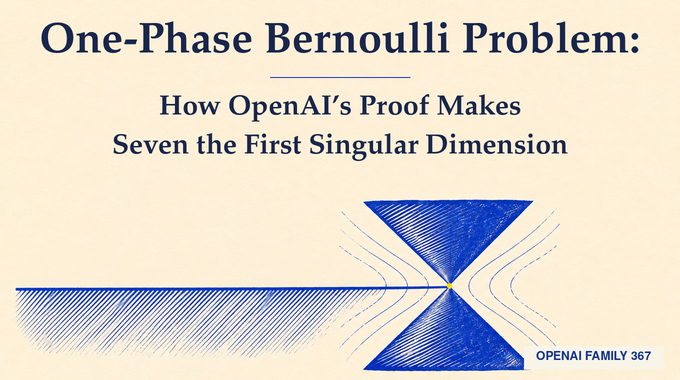
One-Phase Bernoulli Problem: How OpenAI’s Proof Makes Seven the First Singular Dimension

Linocut for the one-phase Bernoulli problem showing a flat interface beside a double cone with a singular tip.

A free boundary can look perfectly smooth in low dimensions yet develop a singular cone when enough coordinates are available. The one phase Bernoulli problem now has an exact threshold: the September 24, 2026 OpenAI mathematical manuscript proves that every nonzero one-homogeneous global minimizer is a half-space solution through dimension six. A nonflat minimizing cone … Read more

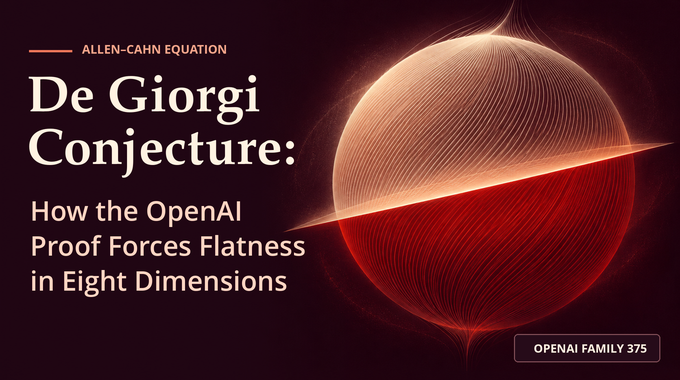
De Giorgi Conjecture: How the OpenAI Proof Forces Flatness in Eight Dimensions

De Giorgi conjecture artwork with a luminous plane dividing a sphere into two phases.

The De Giorgi conjecture asks whether a phase boundary can bend when the field describing it rises in one fixed direction everywhere. In eight dimensions, OpenAI’s September 26, 2026 preprint proves that it cannot for the scalar cubic Allen–Cahn equation. Every entire solution in the open interval between the two wells with an everywhere positive … Read more