Calderon Inverse Problem: The Hidden Geometry That One Boundary Patch Can Determine
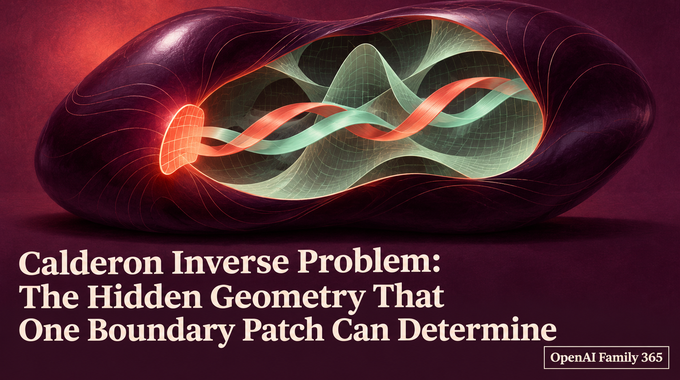
Calderon Inverse Problem artwork reveals hidden geometry and paired transport ribbons through one boundary patch.

Imagine controlling a small accessible patch of an object while its remaining boundary stays out of reach. Can those measurements determine its entire hidden geometry, together with a rule for transporting two-component complex vectors? OpenAI’s October 5, 2026 manuscript answers this version of the Calderon Inverse Problem with a uniqueness theorem. For a smooth metric … Read more
Infinity Laplacian Regularity: How OpenAI’s Proof Turns Flatness into Hölder Gradients

Infinity Laplacian regularity illustrated by copper contours and nested tangent planes.

A function can have a derivative everywhere without that derivative varying continuously. That gap is the central issue in higher-dimensional infinity Laplacian regularity. OpenAI’s October 4, 2026 manuscript proves that bounded infinity-harmonic functions in dimensions d≥3d\ge3 have uniformly Hölder-continuous gradients on interior balls. The exponent is positive and dimension-dependent, but unspecified. The proof converts qualitative … Read more

Hot Spots Conjecture: OpenAI’s Proof That Excludes Every Interior Critical Point

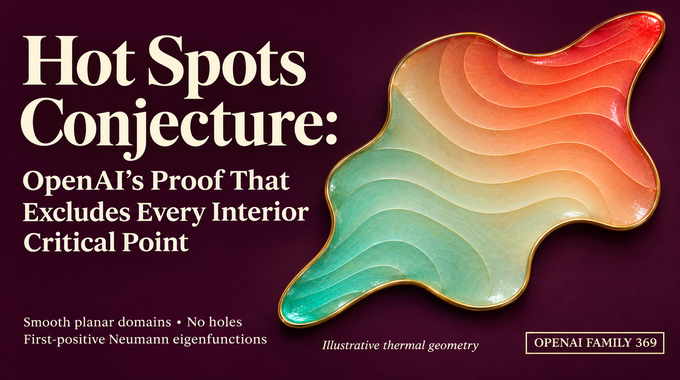
Hot Spots Conjecture artwork shows warm and cold boundary extremes on an irregular enamel plate.

An insulated plate can have an irregular outline, deep indentations and no symmetry. As temperature differences fade, must its slowest nonconstant heat pattern put its hottest and coldest values on the edge? OpenAI’s September 24, 2026 paper on the Hot Spots Conjecture proves a stronger statement for smooth, bounded, simply connected planar domains: every nonzero … Read more

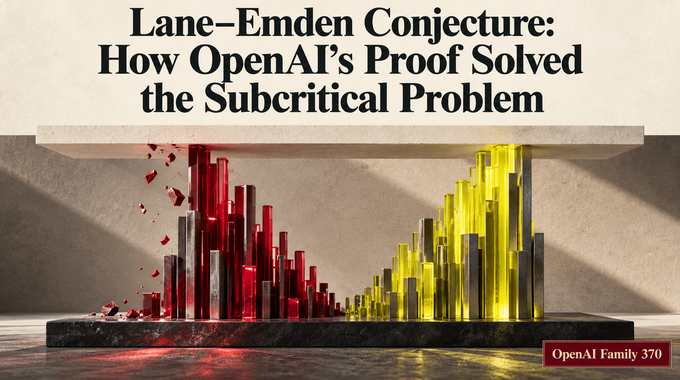
Lane–Emden Conjecture: How OpenAI’s Proof Solved the Subcritical Problem

Lane Emden conjecture artwork shows coupled growth stopped by a fixed energy ceiling.

A positive solution can look harmless near the origin yet become impossible when the same equations are viewed at larger scales. That contradiction drives OpenAI’s Lane Emden conjecture proof. Its manuscript, dated September 24, 2026, proves that the weighted Hénon–Lane–Emden system has no strictly positive entire solution in the subcritical region, without symmetry, boundedness, or … Read more

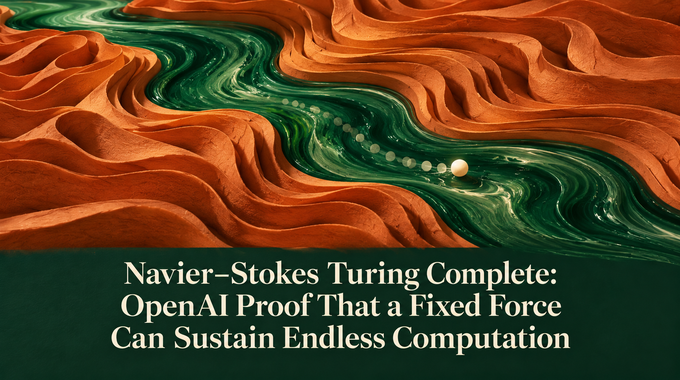
Navier–Stokes Turing Complete: OpenAI Proof That a Fixed Force Can Sustain Endless Computation

Navier Stokes Turing complete artwork showing moving fluid over a fixed sculpted riverbed.

At time one, the force stops changing. The computation does not. OpenAI’s September 27, 2026 preprint constructs a viscous fluid whose particle motion can simulate an arbitrarily long Turing-machine run, even after its external force becomes stationary. For readers searching “Navier Stokes Turing complete,” the precise answer is yes for these specially constructed forced flows. … Read more

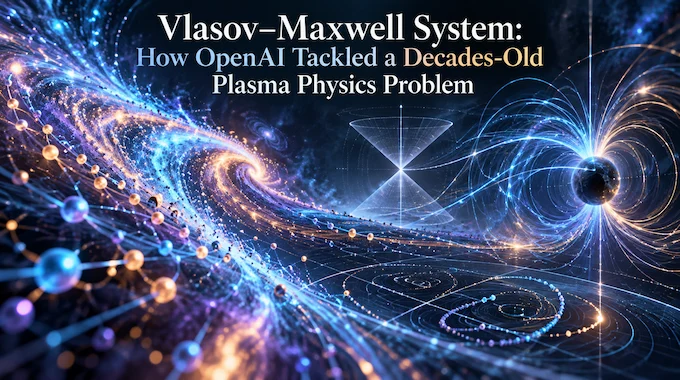
Vlasov Maxwell System: How OpenAI Tackled a Decades-Old Plasma Physics Problem

Vlasov Maxwell system concept art: glowing plasma particles and a light cone with cancelling force arrows

A plasma can behave chaotically without its governing equations becoming mathematically singular. Proving that distinction, however, has defeated researchers working on the Vlasov Maxwell system for decades. In a 49-page manuscript dated September 23, 2026, OpenAI presents a proof of global existence, uniqueness, and smoothness for a three-dimensional relativistic plasma model with arbitrarily large smooth … Read more