A plasma can behave chaotically without its governing equations becoming mathematically singular. Proving that distinction, however, has defeated researchers working on the Vlasov Maxwell system for decades.
In a 49-page manuscript dated September 23, 2026, OpenAI presents a proof of global existence, uniqueness, and smoothness for a three-dimensional relativistic plasma model with arbitrarily large smooth admissible initial data. Its central move is surprisingly specific: track the signed change in particle momentum rather than add up the absolute strength of every electromagnetic force.
The paper, Global Classical Solutions of the Three-Dimensional Relativistic Vlasov–Maxwell System, offers a proposed resolution of a major global-regularity problem. The model has precise assumptions, and the broader mathematical community’s scrutiny matters. Here is what the theorem says and why its argument may work.
Table of Contents
1. What Is the Vlasov Maxwell System?
The Vlasov Maxwell system describes a collisionless collection of charged particles coupled to the electric and magnetic fields the particles themselves create. Instead of tracking individual particles, it follows a distribution $f(t,x,v)$ giving particle density at time $t$, position $x$, and momentum $v$.
In normalized units, relativistic particle velocity is $u(v)=v/\sqrt{1+|v|^2}$. The Vlasov Maxwell equations are
$$\partial_t f+u(v)\cdot\nabla_x f+(E+u(v)\times B)\cdot\nabla_v f=0,$$
$$\partial_t E-\nabla\times B=-j_f,\qquad \partial_t B+\nabla\times E=0,$$
with $\nabla\cdot E=\rho_f$, $\nabla\cdot B=0$, $\rho_f=\int f,dv$, and $j_f=\int u(v)f,dv$. There is no background charge in this paper’s normalization.
Vlasov Maxwell System: Key Facts and What They Mean
| Key Fact | What It Means |
|---|---|
| Model | Three spatial dimensions, three momentum dimensions, one charged species |
| Coupling | Particle motion changes electromagnetic fields, which then redirect particles |
| Relativity | Particle speeds remain below the normalized speed of light |
| Central question | Can smooth initial data develop a finite-time mathematical singularity? |
| OpenAI’s claim | A unique smooth solution exists for every finite time under its stated data assumptions |
The equations are self-consistent. The plasma produces its fields; those fields immediately change the plasma. That feedback is what makes the long-term analysis difficult.
2. The Original Problem: Can a 3D Plasma Stay Smooth Forever?
Vlasov Maxwell global regularity asks whether initially smooth, compatible data always produce a classical solution that can be continued through every finite time. A breakdown would mean the mathematical description loses sufficient smoothness or control, not merely that plasma motion becomes complicated.
The word global refers to time, not to a uniform ceiling on every physical quantity. Large-data theory is harder because it cannot treat the plasma as a small correction to an already manageable solution. The full three-dimensional problem permits particle trajectories and field geometries unavailable in reduced models.
Vlasov Maxwell System: Earlier Mathematical Breakthroughs and Remaining Challenges
| Earlier Result | What It Solved | What It Left Open |
|---|---|---|
| Glassey–Strauss continuation criterion | Bounded momentum support prevents classical breakdown | How to control momentum for arbitrary large data |
| DiPerna–Lions and Rein | Global weak solutions in the relevant relativistic setting | General classical smoothness and uniqueness |
| Dilute-plasma and other small-data results | Global smooth evolution under additional size or decay conditions | Arbitrary admissible large data |
| Lower-dimensional reductions | Global classical solutions in several simplified geometries | Unrestricted three-dimensional dynamics |
| Wang’s July 2026 advance | Large-data existence under cylindrical symmetry | Data without that symmetry |
The history explains the stakes: Vlasov Maxwell global existence wasn’t entirely unknown. What remained elusive was the unrestricted classical result within a natural three-dimensional data class.
3. Why Earlier Mathematicians Could Not Close the Gap
A central achievement of Glassey and Strauss was to isolate a continuation criterion: if the momenta of supported particles stay bounded up to a finite time, a classical solution can continue. Later work refined the criterion. Luk and Strain, for example, reduced the required control to momentum projections onto a two-dimensional plane.
But a criterion isn’t a global bound. It tells mathematicians which door must remain closed without proving it cannot open.
Energy conservation offers only partial help. It bounds total particle and field energy, an integral across space and momentum. A tiny portion of the distribution could still reach exceptionally high momentum without violating that integral bound. Existing small-data, dimensional, and symmetry arguments restricted precisely the configurations where this concentration problem became hardest.
A revealing comparison is Wang’s July 2026 cylindrical-symmetry result. It permits certain noncompact particle data, but requires rotational covariance about a fixed axis and a different Sobolev data class. Neither theorem simply subsumes the other. That distinction prevents the misleading headline that global existence for any relativistic plasma model had never been established.
OpenAI’s manuscript assembles earlier retarded-field representations and particle-trajectory methods around a new estimate designed to close that gap.
4. What Exactly Does OpenAI’s Proof Establish?
Theorem 1.1 addresses the relativistic Vlasov Maxwell system with one charged species. It assumes an initially nonnegative, smooth particle distribution compactly supported in both position and momentum. Initial electric and magnetic fields must have finite $L^2$ energy, bounded derivatives of every order, and satisfy both Maxwell divergence constraints.
Under those conditions, the manuscript asserts a unique global classical solution to the Vlasov Maxwell system, with the particle distribution and fields smooth on every finite interval. Particle support remains compact on each such interval.
Crucially, the theorem imposes no smallness restriction, symmetry assumption, or electrical neutrality condition. It admits nonzero net charge and the associated long-range Coulomb field. It does not cover arbitrary rough initial data or every physically realistic plasma model.
The claim is in a publicly released paper from OpenAI’s October 6 mathematics collection. Calling this a proved theorem describes the manuscript’s mathematical claim, not a substitute for checking its deductions and definitions.
5. The Critical Barrier: Momentum Support and the Continuation Criterion
Follow one particle characteristic, with position $X(t)$ and momentum $V_X(t)$. Its equations of motion are
$$X'(t)=u(V_X(t)),\qquad V_X'(t)=E(t,X(t))+u(V_X(t))\times B(t,X(t)).$$
The right-hand side of the second equation is the Lorentz force. Momentum support means the largest magnitude of momentum among particles present in the distribution. If that quantity cannot escape to infinity before some finite deadline, the Glassey Strauss continuation criterion can extend the classical solution.
The technical challenge is stronger than conservation of average energy. One needs a pointwise statement about every supported trajectory. Even if almost all particles remain well behaved, an uncontrolled extreme trajectory obstructs the standard continuation argument. A relativistic speed limit does not solve this: particle velocity stays below light speed while momentum can increase without bound.
This is why the OpenAI Vlasov Maxwell proof focuses on an individual receiver particle and the integrated force acting on it, rather than trying to bound only bulk plasma statistics.
6. How Retarded Light Cones and Energy Conservation Enter the Argument
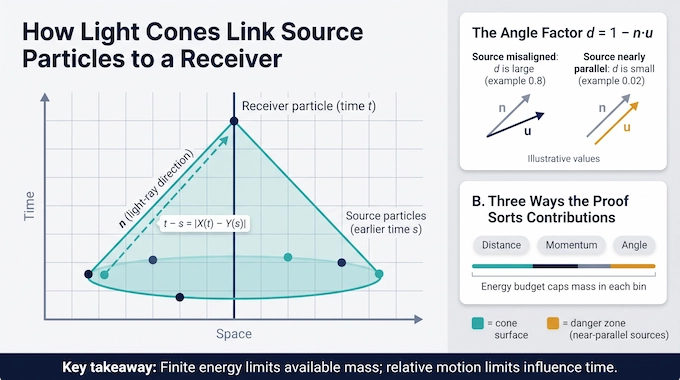
Electromagnetic effects don’t propagate instantly. A field affecting the receiver at time $t$ depends on source particles at earlier times $s$, linked by $t-s=|X(t)-Y(s)|$. Those earlier events sit on the receiver’s backward light cone.
The paper rewrites the force using initial labels for source particles. That converts a difficult moving distribution into integrals over trajectories with a controlled change-of-variables factor. The factor $d=1-n\cdot u$, where $n$ points along the light ray, becomes small when a fast source particle travels almost parallel to the ray.
Conserved energy supplies an overall budget for the particles and the electromagnetic flux crossing these cones. The authors partition contributions into distance, momentum, and angular ranges, then estimate how much source-particle mass can occupy each range.
Two ideas work together: finite energy limits available mass, while relative motion limits how long it can influence a particular receiver. Neither alone settles the problem, but they establish the geometry needed for cancellation.
7. Why Direct Force Estimates Were Too Weak
The natural first attempt is to bound the total force experienced over an interval $J$:
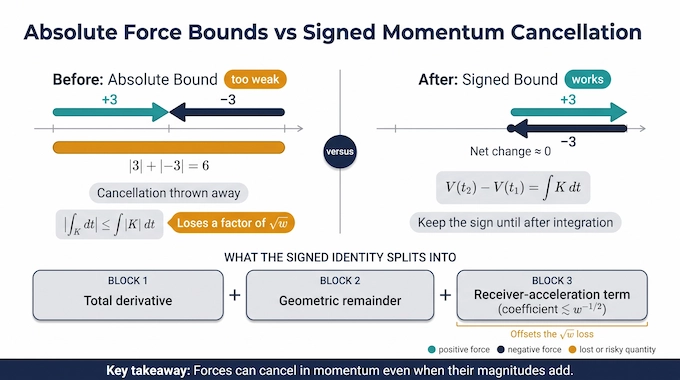
$$\left|\int_J K(t),dt\right|\leq\int_J |K(t)|,dt.$$
That inequality is valid and often useful, but it can waste crucial information. Forces pointing in opposite directions may nearly cancel in the actual momentum change, even while their magnitudes add.
Section 5 shows that direct estimates become too expensive in a narrow angular regime, where a source velocity hugs the light-ray direction much more tightly than the receiver’s velocity does. The resulting absolute-force bound loses an extra factor proportional to $\sqrt w$, where $w$ measures receiver relativistic energy.
At high momentum, that loss prevents the desired argument from closing. More careful bookkeeping of positive quantities cannot simply recover cancellation already discarded by absolute values. The proof needs a different quantity to estimate.
8. OpenAI’s Key Breakthrough: Signed Momentum Cancellation
The manuscript’s central insight is to keep the vector force signed until after integration:
$$V_X(t_2)-V_X(t_1)=\int_{t_1}^{t_2}K(t),dt.$$
Instead of bounding each interaction separately, Section 6 tracks source trajectories through the light cone and integrates by parts. The exact identity combines a term involving source acceleration with the transport part of the retarded electromagnetic kernel. One contribution cancels the dangerous term created by differentiating the cone geometry.
Using the paper’s definitions $r=t-s$, $d=1-n\cdot u$, $D=1-n\cdot a$, $e=1-a\cdot u$, and $k_0=u-(e/D)n$, the signed kernel identity takes the form
$$\mathcal K=-\left(\frac{k_0}{rd}\right)’+\frac{e}{r^2D}\left(\frac{n}{q_X^2D}-a\right)+\frac{n(a_t\cdot k_0)}{rD^2}.$$
Here the prime follows source time, $a$ is receiver velocity, and $a_t$ is its acceleration. This isn’t a miraculous disappearance of force. The equation exchanges a singular-looking contribution for a total derivative, a geometric remainder, and a receiver-acceleration term.
The remainder still needs estimates. Boundary contributions and cutoffs still need control. Most importantly, the coefficient multiplying receiver acceleration must be small enough to absorb. Those obligations make the identity a proof tool rather than a complete proof by itself.
9. Controlling Particle Direction and Improving Occupation Estimates
Signed cancellation serves two purposes, not one. First, Section 7 projects momentum changes perpendicular to a particle’s motion. This controls how often a high-energy particle can turn through a specified angle.
Why care about turning? Imagine two fast-moving particles passing through a narrow configuration that contributes strongly to the retarded field. If their directions were free to change repeatedly, they might revisit that dangerous configuration many times. Limited turning means relative motion crosses the relevant region in a substantially more orderly way.
The paper makes this precise through near-monotone crossings and sharper occupation estimates, bounds on the time source particles spend in sensitive angular and distance bins. The improvement is only needed for particular intermediate relative angles, not across every possible encounter.
That specificity matters. The proof extracts additional control exactly where the next step requires it, rather than claiming a universal geometric simplification.
10. Selecting Dangerous Contributions and Closing the Bootstrap
Sections 8 and 9 separate force contributions into two categories. Unselected bins are already small enough under direct estimates. Selected bins exceed a carefully chosen, summable threshold and receive the signed-cancellation treatment.
For the selected contributions, an improved occupation estimate makes the coefficient of receiver acceleration at most a constant times $w^{-1/2}$ after summation. That offsets the $\sqrt w$ loss from the available absolute-force estimate. The angular partition isn’t cosmetic. It identifies which encounters truly threaten the bound.
The argument then uses a bootstrap: assume a candidate bound on signed momentum increments, derive a strictly better version of the same bound, and extend it across the solution interval by continuity. A time weight suppresses troublesome endpoint terms during integration by parts. The authors restore those endpoint intervals using the assumed signed estimate instead of reverting to absolute force.
This is the delicate logical step. The assumed bound isn’t taken on faith indefinitely. Its improvement and continuity are what turn it into Proposition 2.1.
11. Why the New Estimate Rules Out Finite-Time Momentum Blow-Up
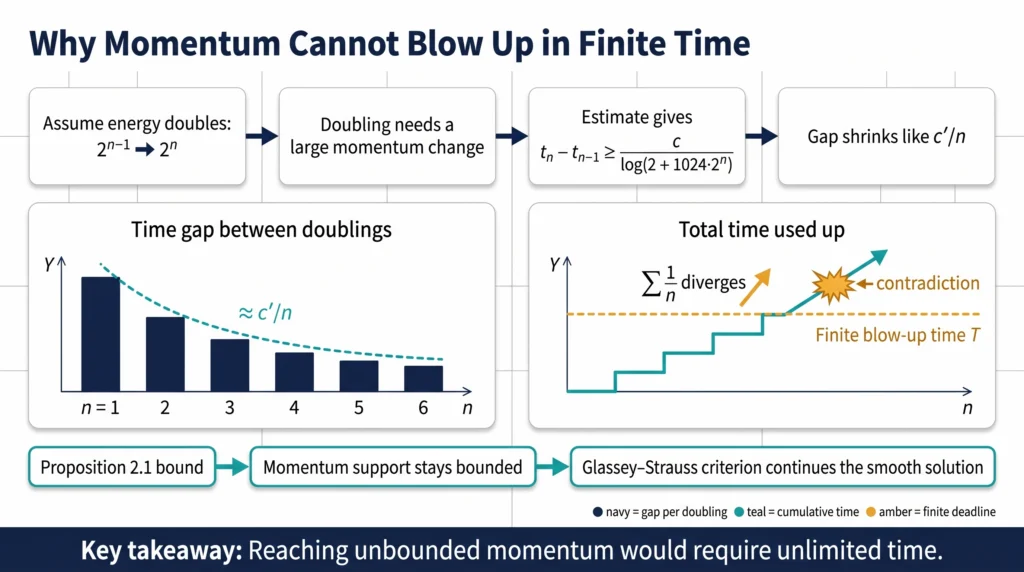
Here is the decisive quantitative result. For a momentum scale $P$ above a fixed multiple of all supported particle energies, $L=\log(2+P)$, and a receiver-energy scale $w$, Proposition 2.1 gives
$$|V_X(t_2)-V_X(t_1)|\leq MP\sqrt{t_2-t_1}+A(t_2-t_1)\frac{P^2L}{w}.$$
The constants $M$ and $A$ depend on the initial data and a fixed finite horizon, not on the chosen solution subinterval or $P$. The bound applies while receiver energy stays comparable to $w$.
Suppose, for contradiction, maximum particle energy doubles successively through $2^{n-1}$ and $2^n$ before a finite blow-up time. Choose $P=1024\cdot2^n$ and $w=2^n$. Since $q(v)=\sqrt{1+|v|^2}$ is Lipschitz in $v$, doubling energy requires a substantial momentum change. The estimate forces the time between successive doubling thresholds to obey
$$t_n-t_{n-1}\geq\frac{c}{\log(2+1024\cdot2^n)}\asymp\frac{c’}{n}.$$
But $\sum_n 1/n$ diverges. Infinitely many doublings therefore cannot fit into finite time. Momentum support stays bounded on every finite horizon; Proposition 2.2 and the Glassey–Strauss criterion then continue the smooth solution.
This is the mathematical payoff: not a universal maximum particle momentum, but a proof that reaching unbounded momentum requires unlimited time.
12. What the Proof Means for Plasma Physics, and What It Doesn’t
For mathematical plasma theory, the claimed result closes the large-data classical-regularity question for a specific Vlasov Maxwell system. It allows complex, nonsymmetric initial conditions and demonstrates how precise geometric cancellations may overcome a barrier that energy inequalities alone could not.
It doesn’t establish that every plasma is stable, that turbulence disappears, or that a fusion reactor can avoid disruptions. Collision effects, multiple charged species, boundaries, and other physical ingredients fall outside the stated theorem. Smooth solutions can still develop elaborate structures, and a bound on each finite interval isn’t a uniform-in-time bound.
What about verification? OpenAI lists a Lean formalization of the main statement. Independent project MathVet’s October 10 review provisionally rates the formal statement as matching the headline and reports a sandboxed comparator check. Its assessment remains pre-referee, not a completed independent mathematical review. Formal machine checking and broad scientific acceptance answer different questions.
The best way to assess the research is to read the original manuscript, particularly Sections 2 and 6 through 10. The essential test is whether signed cancellation, occupation bounds, and the bootstrap genuinely justify the momentum-doubling estimate under the stated assumptions.
At Binary Verse AI, we follow research like this beyond the headline: the theorem, the argument, and the caveats. Explore our AI mathematics coverage, and judge the breakthrough by the equations rather than the excitement around them.
1. What is the Vlasov–Maxwell system?
The Vlasov–Maxwell system is a set of coupled equations describing how charged particles move through electromagnetic fields while simultaneously generating those fields. The Vlasov equation governs the evolution of the particle distribution, and Maxwell’s equations govern the electric and magnetic fields. OpenAI’s proof addresses the relativistic, three-dimensional, one-species version.
2. Did OpenAI prove that the Vlasov–Maxwell system has global smooth solutions?
OpenAI’s September 2026 paper presents a proof of global existence and uniqueness for arbitrary smooth admissible initial data in the three-dimensional, one-species relativistic Vlasov–Maxwell system. The result requires compactly supported initial particle density and finite-energy electromagnetic fields with bounded derivatives of every order. It removes smallness and symmetry restrictions within this class.
3. Why was global regularity for the Vlasov–Maxwell equations so difficult to prove?
The central obstacle was controlling particle momentum under self-consistent electromagnetic forces. Earlier theory established that bounded momentum support permits classical solutions to continue, but available estimates did not establish the necessary bounds for arbitrary large three-dimensional data. OpenAI’s argument addresses this gap through signed momentum estimates and cancellation.
4. How does OpenAI’s proof prevent finite-time momentum blow-up?
The proof estimates the net change in particle momentum, preserving cancellations that are lost when absolute force is estimated directly. It then shows that doubling the maximum momentum requires a minimum amount of time. Summing those time intervals produces a divergent series, ruling out unbounded momentum growth in finite time and enabling the continuation argument.
5. Does OpenAI’s Vlasov–Maxwell proof directly solve problems in nuclear fusion?
No. The theorem strengthens the mathematical foundations of a collisionless plasma model, but it does not directly solve fusion confinement, turbulence or reactor stability. It concerns one charged species in unrestricted space under specified initial-data assumptions, whereas practical fusion plasmas involve multiple species, boundaries and additional physical processes. Its direct result is a global regularity theorem, not a guarantee of reactor performance.