

When smooth curves vary over a base, both the curves and the base can carry holomorphic differential forms. The Iitaka conjecture asks whether the total space retains the growth of both systems through twisting and degeneration. In its September 2026 preprint, Orbifold and Logarithmic Iitaka Subadditivity, OpenAI proves Campana’s stronger lower bound for smooth compact manifolds in Fujiki class C with rational simple normal crossing boundaries. The proof extracts a Hodge line from fibers of Kodaira dimension zero and matches entire spaces of sections across the reduction. Ordinary and logarithmic subadditivity follow from the same theorem.
Table of Contents
1. Iitaka Conjecture: The Original Problem in Algebraic Geometry
Let be a surjective morphism of smooth projective complex varieties with connected fibers, and let be a general smooth fiber. The canonical line bundle consists locally of holomorphic top-degree forms. A section of is an -fold tensor differential, called a pluricanonical form. The Kodaira dimension measures their growth, equivalently the largest dimension of their images in divisible degrees. It is if every positive-degree space vanishes. The classical inequality is
Two smooth projective curves of genus at least two each contribute one dimension. Tensoring their forms gives Kodaira dimension two on the product. In a nontrivial family, the forms on an individual fiber may have no global counterparts.
2. Why the Iitaka Subadditivity Problem Resisted Earlier Proofs
Relative pluricanonical direct images organize fiberwise forms into sheaves on the base. Viehweg’s weak positivity makes suitable symmetric powers generically generated after a small positive ample twist. Over a base of general type, its big canonical divisor can absorb that twist. Without that positivity, generation after twisting leaves the untwisted section spaces undetermined.
Kawamata treated curve bases and fibers with good minimal models. Kollár treated general-type fibers. Birkar proved the ordinary inequality in total dimension at most six, and Cao and Păun treated abelian bases. For logarithmic pairs, Kovács and Patakfalvi proved the projective log-general-type-fiber case. The new argument invokes general-type addition only after changing the fibration.
3. Campana’s Orbifold Iitaka Conjecture and the Stronger Theorem
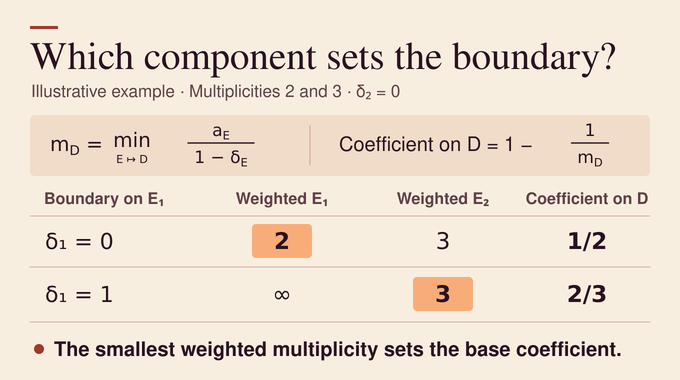
A rational boundary assigns each component a coefficient between zero and one, with zero off the boundary. Simple normal crossing (SNC) means the components locally look like coordinate hyperplanes. In a divisible degree , permits poles of order at most along . Campana’s orbifold construction assigns a coefficient to each prime divisor on a smooth base. Put for each source prime dominating . The inf-multiplicity rule takes the least weighted multiplicity.
If two components over have multiplicities two and three and both have boundary coefficient zero, the minimum is two, so receives coefficient one-half. Giving the first component coefficient one makes its weighted multiplicity infinite. The second then sets the coefficient at two-thirds. The minimum enforces every component’s pole bound. Campana’s birational invariant takes the infimum of the resulting base adjoint dimensions across equivalent orbifold models. A neat model computes it.
Theorem 1.1 takes smooth, compact and connected in Fujiki class C, meaning bimeromorphic to a compact Kähler space. The map is proper and surjective with connected fibers onto a normal compact irreducible complex space. On a very general smooth fiber , chosen outside a countable union of proper analytic subsets, put . The orbifold Kodaira dimension bound is
4. The Complete Proof Roadmap: Five Mathematical Transitions
- Factor through the relative Iitaka image. The fiber’s pluricanonical ratios determine the image. The remaining fibers have Kodaira dimension zero.
- Take roots and compare orders. Take the root of a single generator on a cyclic cover. Its Hodge line and a boundary correction transfer the original sections to the intermediate space.
- Find positivity on a projective quotient. Descend the Hodge line using the covers’ variation. Curvature and monodromy give bigness after adding a multiple of that line to the canonical divisor.
- Apply log-general-type addition. An ample perturbation realizes part of the Hodge contribution as a boundary. The perturbed system has enough ratios both along the new general-type fibers and along the original base.
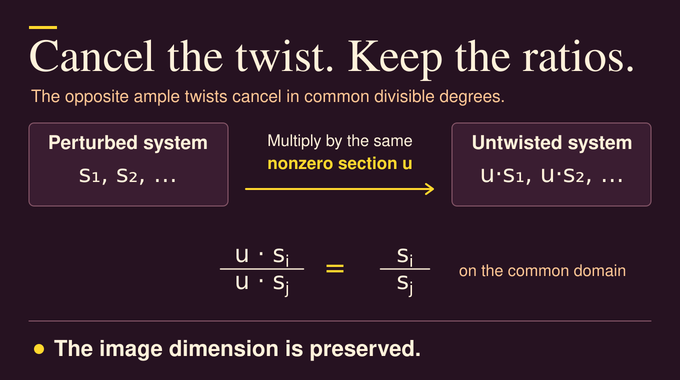
- Cancel the perturbation and lift. Multiply by powers of a fixed section carrying the opposite twist. The ratios survive, and the exact section comparison transports them back to the original total space.
OpenAI attributes the release to an unnamed internal frontier model. The roadmap follows the written Iitaka conjecture proof. The repository’s Lean note for Family 033 covers the negative-fiber branch of the reverse-inequality companion.
5. Relative Iitaka Reduction: Turning Fibers Into Kodaira-Zero Geometry
Set and retain the image of its own stabilized log pluricanonical system. If either summand in Theorem 1.1 is , the lower bound is automatic. Otherwise, relative direct images and generic base change supply one sufficiently divisible degree with image dimension on very general fibers. Resolve the relative map and use Stein factorization to obtain connected fibers. Write and let be a very general fiber of .
The last equality follows from maximality of the Iitaka image. A nonzero section restricts to a very general residual fiber. Positive Iitaka dimension there would let a higher-degree system enlarge the Iitaka image. This uses no finite generation of the relative ring.
On each source resolution, take the strict transform of the boundary and add the exceptional divisors with coefficient one. Log discrepancies bound the pulled-back poles. In reverse, sections extend over the exceptional centers of codimension at least two. This preserves divisible section spaces on the total space and very general original fibers. The proof fixes a smooth model of to retain its orbifold boundary as changes.
6. Cyclic Root Covers and the Exact Hodge-Line Comparison
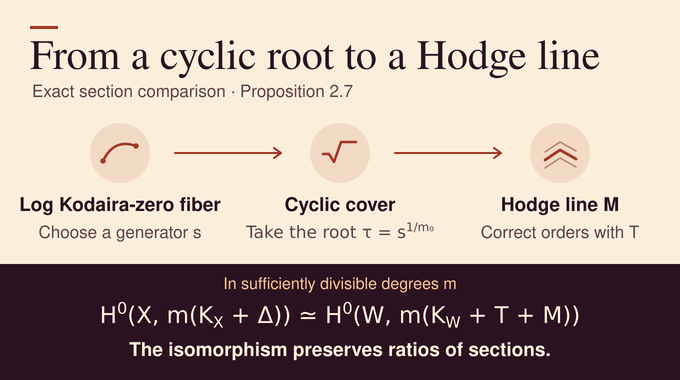
On a general -fiber, choose a nonzero generator in a divisible degree . Its powers span their spaces: two independent sections would give a nonconstant ratio and positive Iitaka dimension. Locally over , take the normalized cyclic cover carrying the root form . Where the order of divided by is , a covering prime of ramification index gives order . In particular, gives the logarithmic pole order on the cover.
The root spans the highest Hodge line in its deck-character summand. The ratio of two forms with that character descends to the fiber. Its possible poles lie on the zero divisor of the generator viewed as a log pluricanonical section. A power of the generator absorbs those poles, so Kodaira dimension zero forces the ratio to be constant. With logarithmic poles present, the line lies in one pure weight grade of mixed cohomology. Tensor descent and parabolic extension, which records rational orders after local power base changes, give a rational line bundle on .
For a prime of , work on a prepared model. Write and let be the order of the generator, divided by , after inserting an ordinary base volume form to make a total pluriform. Each minimum below runs over source primes dominating . The first tests the allowed source poles. The second tests the Hodge extension by using a logarithmic base volume and allowing a simple pole.
The differences between the terms inside the two minima range from the Campana coefficient to at most one. Hence . The Hodge frame and correction together contribute order . The upstairs and downstairs regularity tests are identical. Horizontal orders already satisfy the fiber pole bounds, and descent to the smooth reference source handles the exceptional centers. Proposition 2.7 gives, for sufficiently divisible ,
The isomorphism also holds relatively over and preserves ratios in a common divisible grading. The systems that defined the relative Iitaka image therefore have full image dimension on . In other words, is big.
7. Adjoint Positivity: How Hodge Theory Supplies the Missing Geometry
Semipositive curvature alone supplies no big adjoint divisor. The proof seeks one on a projective quotient. The line map follows only the distinguished one-dimensional subspace in a flat trivialization. A full period map records the whole Hodge filtration. The proof keeps rational adjoint factors of the ambient integral variation, selected so that their full periods recover a power of the chosen line. On the Kähler compactification of the connected period quotient, the Griffiths line is big. This yields a smooth projective model and, after modification, a fibration .
Curvature identifies the rank of the line map with the numerical dimension of the descended nef line . This is the largest for which has positive intersection with a complementary power of an ample divisor. The retained full period map is generically immersive and yields a big logarithmic canonical divisor , with marking the divisors of nonidentity local monodromy. Monodromy normality and Ax–Schanuel control the line-map fibers. The manuscript uses that control to prove on every marked component , including those with finite nonidentity monodromy.
Lemma 4.7 fixes a rational coefficient before counting sections in high divisible degrees. As a function of , the leading section supply from an ample part of grows with degree . The loss from removing the marked boundary is bounded by a polynomial of smaller degree. Taking large yields Theorem 3.1 on the modified model.
8. Log-General-Type Addition and Its Role in the Proof
Proposition 3.2 treats a fibration whose fiber log canonical divisor is already big. It lowers the horizontal coefficients slightly, preserving fiberwise bigness and the vertical pole allowances. The resulting general fibers have Kawamata log terminal singularities on their log canonical models, meaning positive log discrepancies. After a generically finite cover, classifying data compare the family with a stable one over a projective base.
Kovács and Patakfalvi’s stable-family positivity supplies relative pluriforms with full image dimension on the general fiber. A finite Galois invariant section algebra descends these forms to the original class C setting while preserving image dimension. Vertical order calculations on disk models identify which poles survive ramification. At a prime over a divisor on the base, the inf-multiplicity inequality ensures the product with a base section has the permitted pole order. A prime over higher codimension can be exposed over a base divisor on a modified model. Its coefficient one provides the necessary logarithmic allowance.
Ratios of the resulting products retain both the fiber coordinates and the base Iitaka map, giving the sum of their dimensions as a lower bound. The complementary direct-image input is Fujino’s weak positivity. Applied over the projective period base, it will provide the single section needed to remove the ample twist.
9. The Adjoint-Addition Principle: Deriving the Final Iitaka Inequality
Write and on the fixed base model. Multiplicities multiply in the composition . Since , this gives and preserves coefficient one over base centers of codimension at least two. Choose rational close enough to one that remains big on general -fibers. For an ample divisor on and rational , the class is ample. A general divisible multiple supplies a small-coefficient boundary representing the pullback. Log-general-type addition then gives image dimension at least in divisible degrees.
A section of a divisible multiple of restricts nontrivially to a general -fiber, where both pullback twists vanish. This gives a positive-rank relative direct image. Take sufficiently large and sufficiently small so that is big. Weak positivity and this big base twist yield one nonzero section of a divisible multiple of . Set and . Then
Take common divisible degrees and multiply the sections by the same power of the fixed section. Wherever that section is nonzero, the common factor cancels in every ratio. Thus the untwisted system keeps image dimension at least . The section isomorphism carries it back to , and the definition of bounds the invariant base term by the one on the fixed model. This proves Theorem 1.1. If is a point, is rationally trivial and log-general-type addition applies directly.
10. What the Proof Establishes: Ordinary, Logarithmic, and Orbifold Subadditivity
Empty boundaries recover the ordinary inequality because the orbifold base term bounds the ordinary base term from below. For reduced SNC boundaries , require that every component of belong to . The orbifold coefficients then include the prescribed full base boundary on the appropriate model. On a smooth compactification, the logarithmic Kodaira dimension is the Iitaka dimension of the canonical divisor plus the reduced divisor at infinity. Compatible compactifications yield subadditivity for dominant morphisms of smooth complex quasi-projective varieties with geometrically connected general fiber. The projective ordinary and logarithmic results also extend over algebraically closed fields of characteristic zero.
Section 7 adds a projective Kodaira-zero refinement. For a reduced boundary, taking the first positive degree with a log pluricanonical section gives a minimal root cover whose entire logarithmic top-form space is one-dimensional. For an arbitrary rational boundary the general argument singles out a character line. Along Campana’s core, the base is already of orbifold general type, so the lower bound meets the elementary upper bound given by the dimension of the base plus the fiber’s Kodaira dimension. The general theorem is a lower bound. The reverse-inequality companion imposes additional smoothness conditions on boundary strata.
The Iitaka conjecture asks for global growth from local geometry. Here, the relative section comparison tracks exactly which poles are allowed, and the final multiplication retains the ratios that measure growth. Explore more algebraic and complex geometry in Binary Verse AI’s mathematics series.
What does the Iitaka conjecture state?
For a fibration of smooth projective complex varieties with connected fibers, the Kodaira dimension of the total space is at least the sum of those of its general fiber and base: .
How does Campana’s orbifold Iitaka conjecture strengthen the original?
It incorporates multiple fibers and rational boundary coefficients into an orbifold base invariant. The resulting inequality controls the Kodaira dimension of the total pair using the fiber pair and this refined base term.
What is the key mathematical breakthrough in the proof?
The relative Iitaka map reduces the section comparison to Kodaira-zero fibers. Cyclic covers give a Hodge line, and adjoint positivity and log-general-type addition supply sections whose ratios give the lower bound.
Why is Hodge theory necessary for the Iitaka conjecture proof?
In this proof, Hodge theory records variation in the cyclic covers and provides a nef line on a projective period quotient. A positive multiple of that line makes the canonical adjoint big, which supplies the section used to cancel the ample twist.
Does the proof establish logarithmic Iitaka subadditivity?
Yes. The orbifold theorem gives the logarithmic inequality for compatible reduced simple normal crossing boundaries. Compatible compactifications give the result for dominant morphisms of smooth complex quasi-projective varieties with geometrically connected general fiber.
Does the proof establish equality of Kodaira dimensions?
The main theorem gives a lower bound. Equality follows along Campana’s core, where a separate upper bound matches it. The reverse logarithmic inequality in the companion paper has additional hypotheses on the smoothness of the family and its boundary strata.