BFSS Matrix Model: OpenAI’s Proof of Unexpected Quantum Bound States
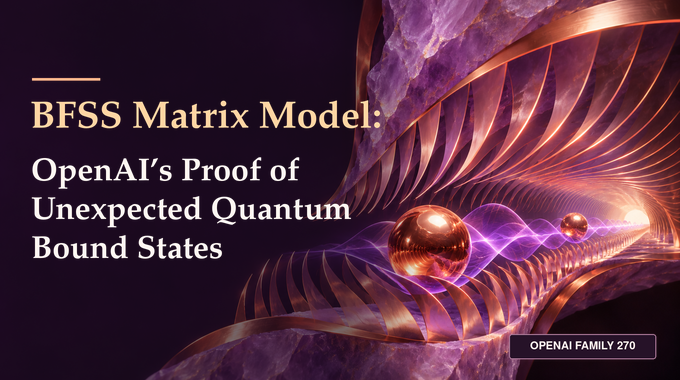
A BFSS matrix model illustration of two D0-branes and a localized wave in an open channel.

Two D0-branes in the BFSS matrix model have a route to unlimited separation along configurations where the classical potential vanishes. Yet OpenAI’s October 2026 preprint proves that the relative SU(2)\mathrm{SU}(2) Hamiltonian has infinitely many normalizable states at strictly positive energies, including a sequence of energies that tends to infinity. The escape directions remain open. In … Read more
Bound Entanglement’s Secret-Key Paradox: Inside OpenAI’s 10×10 Proof

Two woven panels meet around a keyhole, illustrating bound entanglement with zero distillable secret key.

Can two quantum systems be entangled yet supply no usable secret key? OpenAI’s September 27, 2026 paper answers yes within its specified local-instrument protocol model. It constructs a state on two ten-dimensional systems for which unlimited copies and permitted two-way public discussion cannot produce even one arbitrarily accurate secret bit. Bound entanglement alone never established … Read more

Chiral Gauge Theory: How Nathaniel Craig Tackled a 50-Year-Old Lattice Problem with Astra

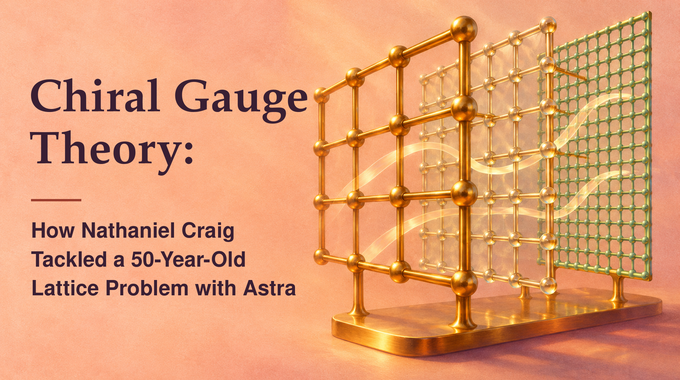
Brass and jade grids illustrate Nathaniel Craig’s lattice refinement in chiral gauge theory.

The Standard Model’s weak interactions distinguish left-handed particles from right-handed ones. Put those fermions on a spacetime grid, and that distinction becomes a problem for the path integral. In his preprint, physicist Nathaniel Craig constructs a gauge-invariant fermion measure for four-dimensional chiral gauge theory at finite lattice spacing, in a class that includes the Standard … Read more

Yang–Mills Existence Proof: How OpenAI Built a Four-Dimensional Quantum Field Theory

Jade lattice becoming continuous glass, illustrating the Yang–Mills existence proof.

OpenAI’s Yang–Mills existence proof starts with matrices on the edges of a four-dimensional grid and ends with local quantum fields on continuous spacetime. The Yang–Mills Working Group’s November 10 assessment concludes that the Lean submission constructs relativistic pure Yang–Mills theories satisfying the specified Wightman axioms for compact matrix gauge groups with a nonabelian simple Lie … Read more

Kohn–Sham Representability: The Three-Electron Density That Defies Standard DFT Ensembles

Conceptual density artwork illustrating the Kohn–Sham representability counterexample.

A density can come from a real interacting Coulomb ground state yet have no exact Kohn–Sham stand-in within a familiar class of local potentials. OpenAI’s manuscript constructs precisely that situation with three electrons and two nuclei. Its Kohn–Sham representability result survives arbitrary mixtures of noninteracting ground states. The obstruction lies in a tiny density tail … Read more

Generalized Amplitude Damping Channel: Two States, One Exact Capacity, OpenAI’s Proof

Generalized amplitude damping channel shown as two copper signal ribbons passing through thermal noise.

A noisy qubit can lose an excitation, gain one from its surroundings, and still carry a precisely calculable amount of classical information. OpenAI’s September 24, 2026 paper proves that the generalized amplitude damping channel has classical capacity equal to its one-shot Holevo capacity for every allowed damping strength and thermal occupation. Two equally probable pure … Read more

Spherical Perceptron: OpenAI’s Proof of a Long-Predicted Free Energy Formula

Cutaway spherical perceptron artwork with the article title and OpenAI Family 222 label.

A neuron can be simple while the landscape of its possible weights is anything but. Give it thousands of random inputs, constrain its weight vector to a sphere, and even calculating its equilibrium statistical weight becomes a research problem. OpenAI’s spherical perceptron proof identifies an exact variational formula for that model’s limiting pressure, often discussed … Read more