Entropy Photon Number Inequality: OpenAI’s Proof of a 19-Year Quantum Light Puzzle
Entropy photon number inequality artwork showing two colored light waves mixing through smoked glass.

A beam splitter is simple enough to draw on a napkin. Proving the sharp entropy bound for everything that can enter its two ports took considerably more machinery. OpenAI’s September 24, 2026 manuscript presents an entropy photon number inequality proof for independent finite-energy bosonic inputs, allowing arbitrary entanglement among modes within either input. The result … Read more
Ionization Conjecture: How Many Extra Electrons Can an Atom Hold? The OpenAI Proof

Ionization Conjecture artwork showing excess electrons escaping a copper potential well.

An atom can attract an extra electron. Explaining why it cannot keep collecting them indefinitely is much harder. The Ionization Conjecture asks whether every atom has a universal ceiling on its excess electrons, however large its nuclear charge becomes. OpenAI’s September 24, 2026 manuscript presents a proof that a nucleus of charge ZZ strictly binds … Read more

Strong Cosmic Censorship: Inside OpenAI’s Proof of Generic Inextendibility Near Kerr

Strong cosmic censorship art showing continuous Kerr-like geometry with disrupted vector transport.

A black hole can have a boundary across which distances remain continuous while the mathematical machinery for transporting vectors becomes too singular. That gap is the target of OpenAI’s strong cosmic censorship proof near Kerr. Its September 23, 2026 manuscript presents a precise result: near each fixed rotating, subextremal Kerr bridge, data allowing a future … Read more

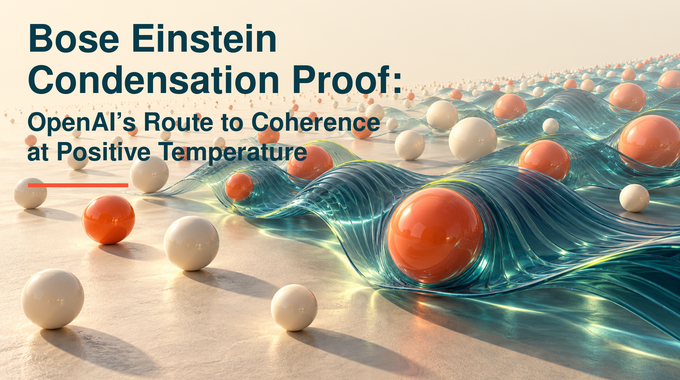
Bose Einstein Condensation Proof: OpenAI’s Route to Coherence at Positive Temperature

Bose Einstein condensation proof illustrated by separate spheres and a shared wave across a growing gas.

An interacting quantum gas can look well behaved in every small region while still withholding the one thing a condensation proof needs: coherence across the whole sample. The difficulty grows with the box. A bound that works for a thousand particles may disappear when their number becomes unlimited. The Bose Einstein condensation proof in OpenAI’s … Read more

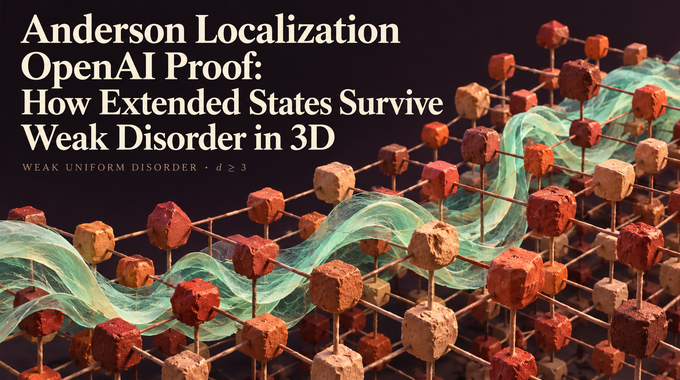
Anderson Localization OpenAI Proof: How Extended States Survive Weak Disorder in 3D

Anderson localization OpenAI proof illustrated by a mint wave spanning a disordered three-dimensional lattice.

Randomness can trap a quantum particle. The harder question is whether weak randomness must trap it. The Anderson localization OpenAI proof addresses that second question: its September 23, 2026 manuscript establishes a nonempty energy interval with purely absolutely continuous spectrum for the nearest-neighbor Anderson model with independent uniform disorder, in every fixed dimension d≥3d\geq3. The … Read more

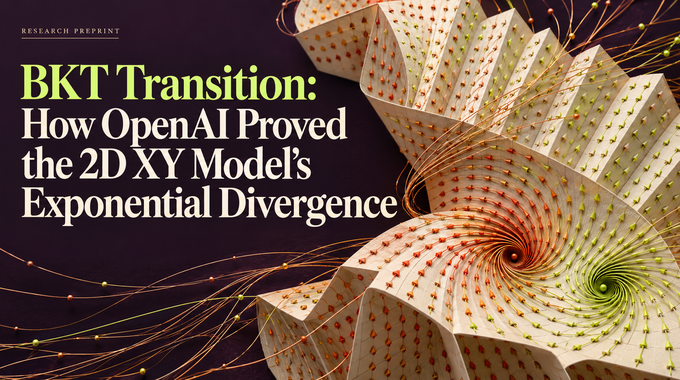
BKT Transition: How OpenAI Proved the 2D XY Model’s Exponential Divergence

BKT transition artwork shows paired spin vortices and expanding correlations, with the full article title.

A phase transition can be known to exist while its most distinctive prediction remains unproved. That was the gap facing the BKT transition in the original square-lattice XY model: exactly how fast does the distance over which spins remain correlated grow near criticality? OpenAI’s October 5, 2026 preprint proves that the logarithm of this correlation … Read more

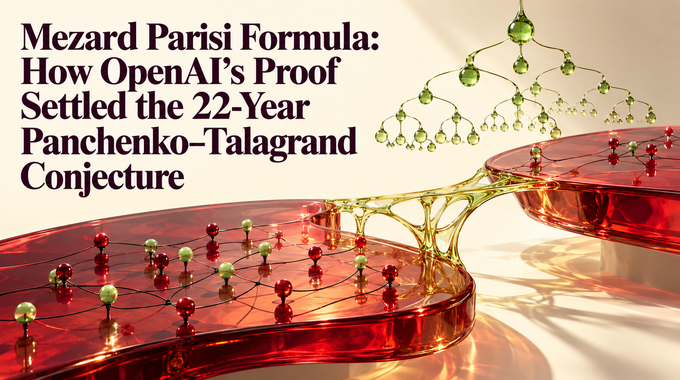
Mezard Parisi Formula: How OpenAI’s Proof Settled the 22-Year Panchenko–Talagrand Conjecture

Mezard Parisi formula: glass surfaces joined by a branching bridge symbolize the missing lower bound.

A formula can give the right answer for twenty-two years without anyone knowing how to prove it. The Mezard Parisi formula faced precisely that problem: a hierarchy of cavity-field distributions supplied rigorous upper bounds for sparse spin systems, but the matching lower bound remained missing. OpenAI’s September 23, 2026 paper proves that equality for the … Read more