Ricci Flow: When Geometry Breaks but Scalar Curvature Stays Bounded
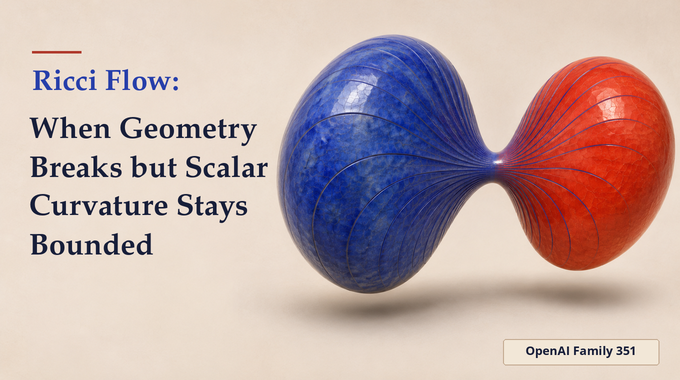
Ceramic lobes pinch at a narrow waist, illustrating Ricci flow blowup with bounded scalar curvature.

Ricci flow can reach a finite time when some sectional curvatures become arbitrarily large, even though scalar curvature stays uniformly bounded in space and time. OpenAI’s manuscript makes that split precise on a closed, sufficiently high-dimensional product of spheres. The key is a shrinking cap that sits inside a much larger region resembling a Ricci-flat … Read more
Geodesic on a Sphere: Why Infinite Closed Paths Survive Every Smooth Distortion

Geodesic on a Sphere article title beside a distorted glass sphere traced by luminous closed paths.

Every great circle on a round sphere closes. Stretch the sphere unevenly, and the same starting direction can send you along a path that never closes. Yet infinitely many periodic routes still exist. OpenAI’s September 2026 preprint proves that every smooth Riemannian metric on the standard sphere of dimension two or higher admits infinitely many … Read more

Cartan–Hadamard Conjecture: How OpenAI Proved Sharp Euclidean Fillings in CAT(0) Spaces

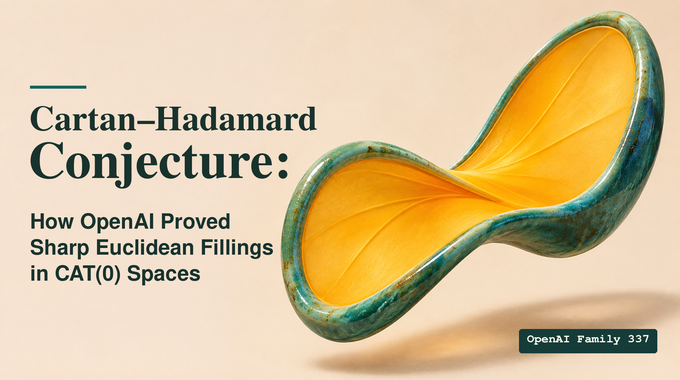
A gold membrane spans a warped ceramic rim in the feature art for the Cartan Hadamard conjecture.

How much volume can a boundary of fixed area enclose when the surrounding space has nonpositive curvature? The Cartan Hadamard conjecture says the Euclidean ball sets the limit. In Sharp integral fillings in CAT(0) spaces, OpenAI proves the corresponding domain inequality in manifold dimensions three and higher by establishing a broader result. Every compactly supported … Read more

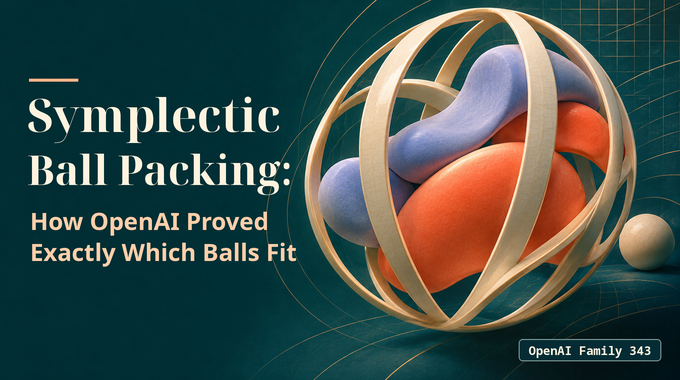
Symplectic Ball Packing: How OpenAI Proved Exactly Which Balls Fit

Ceramic shell and curved forms illustrate symplectic ball packing in higher dimensions.

Two balls in six dimensions can use just 43.2% of a target ball’s volume and still be impossible to pack inside it. Take two balls of capacity 0.6 and a target of capacity 1. Their capacities add to 1.2, which violates Gromov’s two-ball bound. OpenAI’s September 23, 2026 preprint proves that for symplectic ball packing … Read more

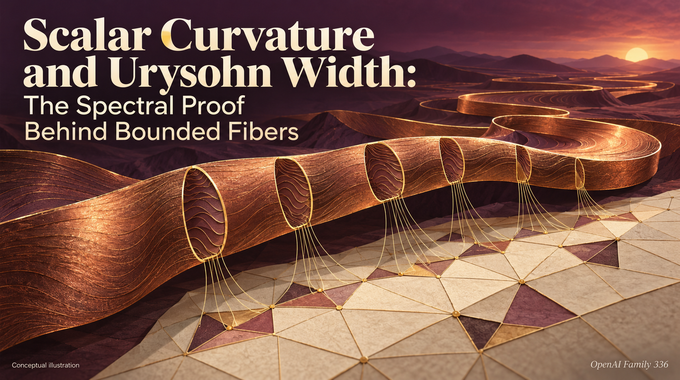
Scalar Curvature and Urysohn Width: The Spectral Proof Behind Bounded Fibers

Scalar curvature and Urysohn width visualized as copper fibers projecting onto a triangulated map.

A manifold can extend forever while its geometry remains uniformly narrow in two directions. The new connection between scalar curvature and Urysohn width makes that intuition precise under a spectral condition that even permits negative scalar curvature locally. OpenAI’s October 5 paper proves that every complete, connected, smooth, boundaryless manifold of dimension n≥4n\ge4 satisfying −4Δ+Scal≥1-4\Delta+\mathrm{Scal}\ge1 … Read more

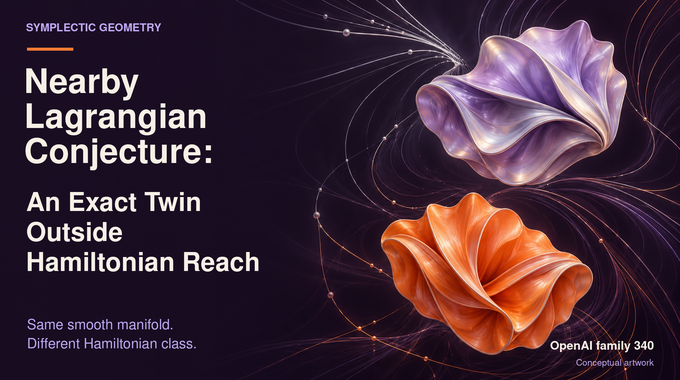
Nearby Lagrangian Conjecture: An Exact Twin Outside Hamiltonian Reach

Nearby Lagrangian conjecture artwork showing smooth twins in different Hamiltonian isotopy classes.

Two manifolds can be exact smooth twins yet occupy different Hamiltonian isotopy classes. OpenAI’s September 23, 2026 manuscript gives a nearby Lagrangian conjecture counterexample: a closed exact smoothly embedded Lagrangian, diffeomorphic to the base of its cotangent bundle, that cannot be carried to the zero section by Hamiltonian isotopy. The base is a product of … Read more

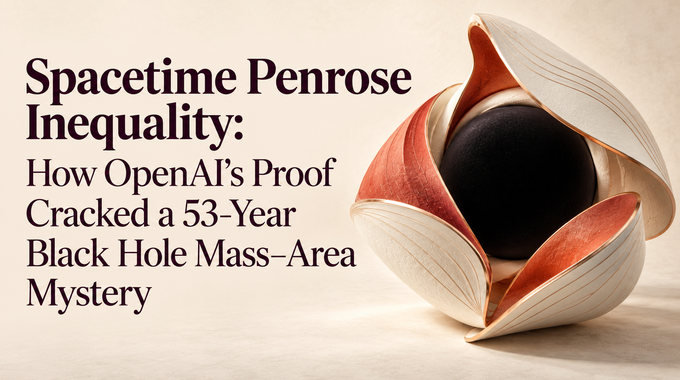
Spacetime Penrose Inequality: How OpenAI’s Proof Cracked a 53-Year Black Hole Mass–Area Mystery

Spacetime Penrose Inequality artwork showing sculpted enclosing surfaces around a black hole.

A black hole cannot be arbitrarily large while the universe around it carries arbitrarily little mass. Turning that intuition into a theorem has occupied relativists since 1973. OpenAI’s September 27, 2026 manuscript presents a proof of the spacetime Penrose inequality for a broad, precisely defined class of initial data, including moving configurations and disconnected trapped … Read more