Heilbronn Triangle Problem: A Tiny Exponent Overturns Decades of Geometric Belief
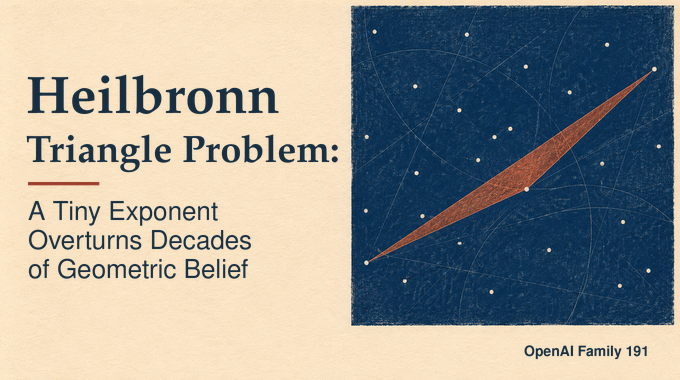
A thin copper triangle joins three points in an indigo square on the Heilbronn triangle problem cover.

Put four dots at the corners of a unit square. Whichever three you join, the triangle covers half the square. With a million dots, how much area can you guarantee for the skinniest triangle? The Heilbronn triangle problem asks how well the best arrangement can do as the number of dots grows. OpenAI’s September 2026 … Read more
Translative Covering Density: How OpenAI Proved Some Convex Bodies Need n log n

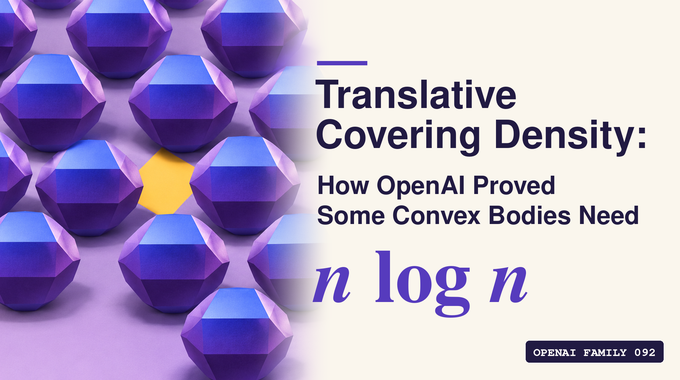
Violet convex bodies leave a yellow gap beside the translative covering density article title.

A floor tiled with squares uses one square’s worth of material per square’s worth of space. In high dimensions, some convex shapes make that economy impossible even when you can place each copy wherever you like. OpenAI’s September 2026 preprint proves that, in every sufficiently large dimension, some centrally symmetric convex body has translative covering … Read more

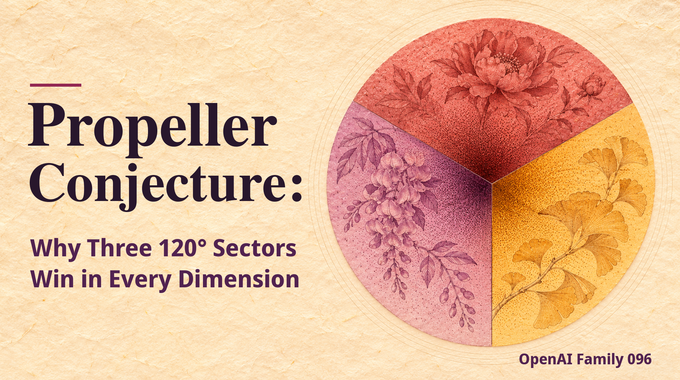
Propeller Conjecture: Why Three 120° Sectors Win in Every Dimension

Botanical print of three 120° sectors illustrating the propeller conjecture.

Give a standard Gaussian cloud as many labels as you like. For each label, add up the vectors assigned to it, weighted by Gaussian probability, and square the length of that sum. Can a fourth label, or a hundredth coordinate, improve the best total? OpenAI’s proof of the propeller conjecture gives a sharp answer. Every … Read more

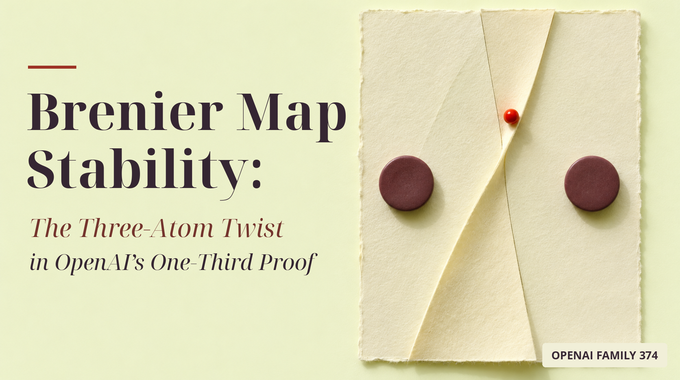
Brenier Map Stability: The Three-Atom Twist in OpenAI’s One-Third Proof

Brenier map stability cover with a small red bead pulling a folded paper strip between two fixed disks.

How can moving a tiny amount of probability mass cause a much larger change in the optimal transport map? OpenAI’s Brenier map paper answers with three target atoms. Keep two atoms fixed and move the lightest one sideways. The target distribution barely changes, yet a thin region of the source gets reassigned to destinations roughly … Read more

Logarithmic Brunn–Minkowski Conjecture: How OpenAI Proved the Symmetric Inequality in Every Dimension

Logarithmic Brunn Minkowski conjecture artwork showing symmetric shapes and geometric interpolation.

A convex body can become smaller when you replace arithmetic averages with geometric ones. The logarithmic Brunn Minkowski conjecture asks whether its volume nevertheless stays above a precise lower bound. OpenAI’s paper proves that it does for any two origin-symmetric convex bodies, in every dimension. The result rests on a sharp variance inequality, a transport … Read more

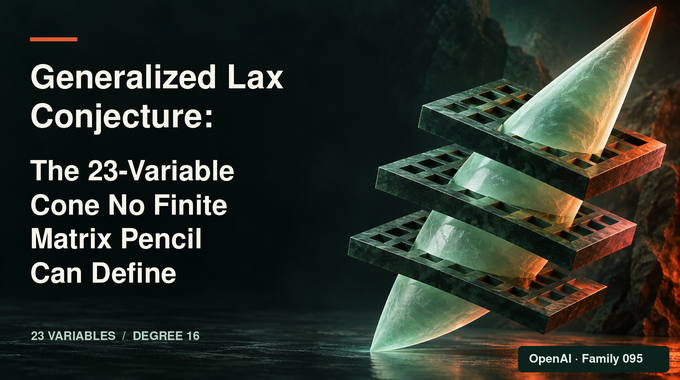
Generalized Lax Conjecture: The 23-Variable Cone No Finite Matrix Pencil Can Define

Generalized Lax Conjecture: A 23-Variable Counterexample shown as a glass cone escaping rigid matrix frames.

A convex cone can pass every real-root test in its definition and still resist every finite matrix description in its original coordinates. OpenAI’s September 24, 2026 manuscript gives an explicit example: a hyperbolicity cone in 23 real variables, ultimately defined by a degree-16 polynomial, that is not spectrahedral. This disproves the geometric generalized Lax conjecture. … Read more

Triangular Lattice Universal Optimality: OpenAI Proof Breaks the Nonperiodic Barrier with an Atomic Certificate

Triangular lattice universal optimality shown as a red lattice facing irregular points beneath a certificate.

A perfect triangular grid has a formidable opponent: every disordered arrangement of points in the plane. The opponent can abandon repetition, squeeze distinct points arbitrarily close together, and concentrate enormous crowds in scattered regions. OpenAI’s September 26, 2026 preprint presents a proof that none can beat the grid’s lower energy per particle for an entire … Read more