Saxl Conjecture: One Staircase, Squared, Contains Every Symmetry Type
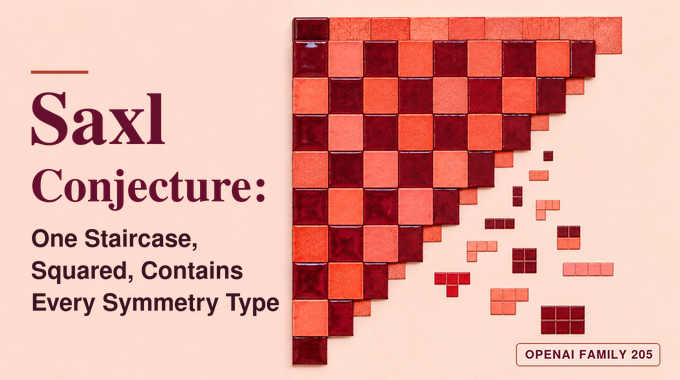
Saxl conjecture artwork with two overlapping red tile staircases and a fan of smaller shapes.

One staircase, squared, contains every symmetry type of its symmetric group. The staircase is a Young diagram, and the object being squared is the irreducible complex representation it labels. OpenAI’s September 2026 paper, publicly shared in October, proves the Saxl conjecture for staircases of every size: g(ρm,ρm,λ)>0g(\rho_m,\rho_m,\lambda)>0 for every partition λ\lambda of the staircase’s number … Read more

Hyperbolic Groups: OpenAI’s Proof of an Element No Finite Quotient Can Detect

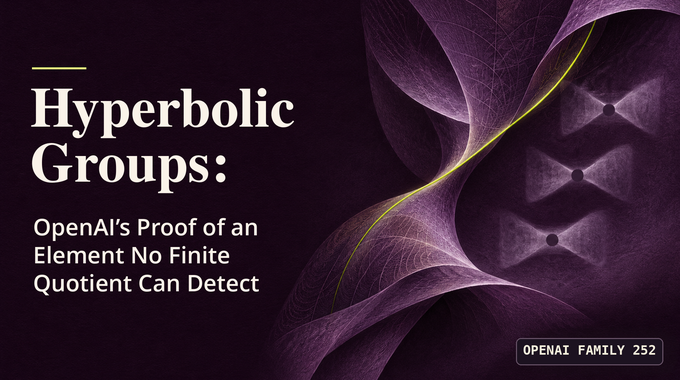
Hyperbolic groups illustration with a green filament and three projections that miss it.

A group element can be nontrivial and still look exactly like the identity in every finite quotient. The longstanding question was whether the coarse negative curvature of hyperbolic groups prevented that from happening. In its September 23, 2026 preprint, OpenAI constructs a torsion-free word-hyperbolic group in which it does happen. Geometry certifies that finitely many … Read more

Finitely Presented Burnside Problem: OpenAI’s Proof of an Infinite Torsion Group

Receding glass loops illustrate the infinite torsion group in the Finitely Presented Burnside Problem.

Every element of OpenAI’s group has a positive power equal to the identity. Yet the group contains infinitely many elements, and a finite list of generators and relations defines it. That combination gives a negative answer to the Finitely Presented Burnside Problem. In An infinite finitely presented periodic group, dated September 23, 2026, OpenAI proves … Read more

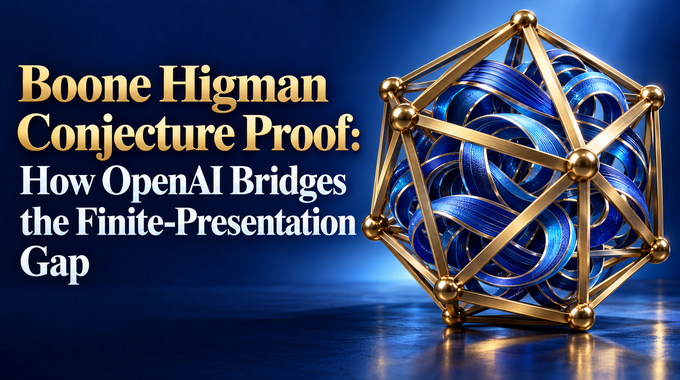
Boone Higman Conjecture Proof: How OpenAI Bridges the Finite-Presentation Gap

Boone Higman conjecture artwork showing intricate blue ribbons preserved inside a finite golden frame.

A finite list of rules can describe an infinite group. The hard question is whether that group can also be simple while containing every operation of another group faithfully. OpenAI’s September 23, 2026 manuscript presents a positive proof of the Boone Higman conjecture: a finitely generated group has a decidable word problem exactly when it … Read more

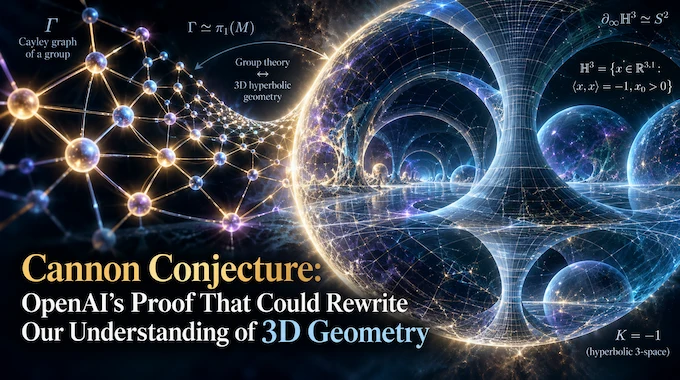
Cannon Conjecture: OpenAI’s Proof That Could Rewrite Our Understanding of 3D Geometry

Cannon Conjecture feature image: glowing sphere boundary revealing a hyperbolic 3D tiling

Can the shape of an abstract group’s boundary reveal the three-dimensional geometry hidden inside it? That question has driven research into Cannon Conjecture, one of geometric group theory’s most important longstanding problems. It asks whether every word-hyperbolic group whose boundary at infinity resembles a two-dimensional sphere must admit a geometric action on hyperbolic three-space. On … Read more

Thompson’s Group F: How OpenAI Tackles the Decades-Old Amenability Mystery

Thompson’s group F visualized through binary trees, dyadic interval transformations, and a broken invariant balance.

A mathematical object can be easy to describe and remarkably difficult to understand. Thompson’s group F fits that description almost too well. Its elements stretch and compress an interval according to a short list of rules. Yet a basic question about averaging over those transformations resisted resolution for decades. OpenAI’s manuscript, dated September 23, 2026, … Read more