
Every element of OpenAI’s group has a positive power equal to the identity. Yet the group contains infinitely many elements, and a finite list of generators and relations defines it. That combination gives a negative answer to the Finitely Presented Burnside Problem. In An infinite finitely presented periodic group, dated September 23, 2026, OpenAI proves the result using a rank-twelve Steinberg group over an algebra of characteristic two. The proof works at two levels. It first shows that the group’s elementary matrices have finite order. It then proves that the elements invisible to those matrices also have finite order.
Table of Contents
1. What Is the Finitely Presented Burnside Problem?
| Topic | What the Paper Shows |
|---|---|
| Question | Must a group be finite if it has finitely many generators and defining relations and every element has finite order? |
| Answer | No. Theorem 1.1 constructs an infinite finitely presented periodic group. |
| Witness | A rank-twelve Steinberg group over a graded algebra of characteristic two. |
| Matrix image | Every element has finite order by reduction to a finite field and nilpotence of matrices over the positive-degree ideal. |
| Kernel | Theorem 6.9 proves torsion in the kernel at rank twelve and above. |
| Order guarantee | The theorem gives a finite order for each element individually. |
An ordinary finite presentation starts with the free group on finitely many generators and imposes finitely many relator words, declaring each equal to the identity. The resulting group is periodic, or torsion, if every element has finite order. The order of an element is the smallest positive power that gives the identity. Infinitude refers to how many distinct elements the group contains.
Consider the following presentation.
On the integers, let act by and by . Both actions square to the identity, so they give a representation of the presented group. Applying and then translates each integer one step to the left. Every positive power of that translation still moves every integer. Thus has infinite order even though each generator has order two. Periodicity has to hold for arbitrary products.
2. Why Earlier Solutions to Burnside’s Problem Were Not Enough
Golod used the Golod–Shafarevich inequality to construct nil algebras and obtain infinite finitely generated periodic groups. Novikov and Adian constructed infinite finitely generated groups of bounded exponent, meaning one positive power kills every element. Neither result by itself provides an ordinary finite list of group relators. Even an identity quantified over all group elements represents a family of constraints when translated into relators on words in the generators.
Ol’shanskii and Sapir gave finitely presented groups with a torsion normal subgroup and an infinite cyclic quotient. An element mapping to a generator of that quotient necessarily has infinite order. Their construction isolates the difficulty of making the entire group periodic while keeping the finite presentation.
3. OpenAI’s Main Theorem and the Rank-Twelve Steinberg Group
Theorem 1.1 identifies the counterexample as the Steinberg group below. Here is the paper’s graded associative algebra with identity, and twelve is the number of matrix coordinates used to index the group’s generators.
The group maps onto the elementary matrix group . Fix one off-diagonal position and vary its entry over . Each choice gives a different elementary matrix, so the infinitude of forces both groups to be infinite. The proof must also turn the algebra’s finite rule table into a finite group presentation, prove periodicity of the matrix image, and establish torsion in the kernel. The last step controls what the matrix representation cannot see.
4. How Finite Local Rules Construct the Algebra
The field has two elements. The degree- component comes from words of length . The empty word supplies the identity, and the positive-degree words span a two-sided ideal .
The presentation uses a finite alphabet and two kinds of rules. Replacements identify equal-length strings wherever they occur. Zero declarations kill any word containing a designated substring. Multiplication concatenates words and then passes to their algebra classes. All the defining relations are homogeneous, so terms in different degrees remain separate.
The rule table is self-simulating. At each level, one letter from the next level is encoded by a fixed-length block. Local control tracks check color data and certificates for simulated rules. A completed check allows the encoded rule to take effect. Since replacements can run in either direction, the construction tracks what happens during incomplete checks. It also handles syntactically admissible words that begin in forged or unfinished control states, which can occur in the free algebra independently of any clean encoding. The hierarchy describes the behavior of the level-zero rules, which are the entire defining table. Related reading on local computation and resource bounds appears in the Turing machine time–space tradeoff explainer.
5. Why the Algebra Remains Infinite Despite Its Finite Relations
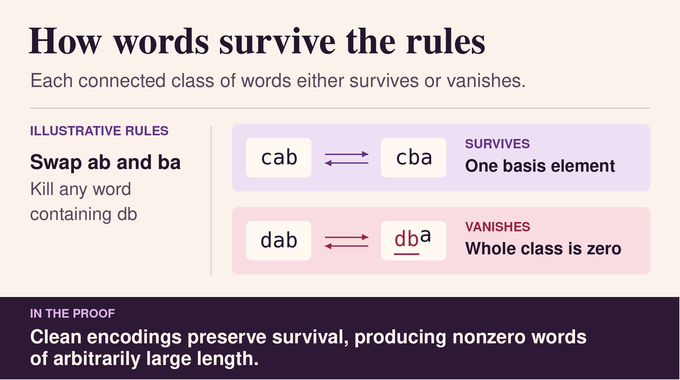
Imagine a graph whose vertices are words and whose edges are legal replacements in context. By Lemma 2.1, each connected component gives one basis element unless it contains a word with a zero-declared substring. In that case the whole component vanishes.
A clean encoding preserves the nonzero status of an upper-level word. The paper proves this by tracking legal replacements from a concatenation of clean blocks and showing that a reachable zero declaration would correspond to an upper-level obstruction. Choose a surviving letter arbitrarily high in the hierarchy, then encode it down to level zero. Each encoding multiplies its length by a block length greater than one. This produces surviving words in arbitrarily high degrees. Distinct degrees are linearly independent, so has infinite dimension over .
6. Why Every Matrix over the Positive-Degree Ideal Is Nilpotent
Sufficiently long surviving words have bounded end pieces and an interior divided into tokens. A cut is a position immediately before a designated kind of letter. Each token runs from one cut to the next and can be normalized without changing its neighbors. Long words also contain runs of palette letters with distinct, freely permutable colors and identical non-color fields.
Assign numerical matrix weights to chunks of letters. In a long palette run, permuting complete chunks keeps their common word class and changes the order of their matrix weights. When chunks are available, the varying part of the coefficient is the sum over the permutation group .
This sum is multilinear and vanishes when two weights agree. Swapping their labels pairs equal products, and each pair sums to zero in characteristic two. The space of numerical by matrices has dimension , so expansion in a basis gives zero whenever . At higher levels the palettes grow fast enough to reach that threshold for any fixed test. To move up one level, normalize each token to the encoding of a bounded-length upper-level word. Carry the token’s matrix weight with that word. A finite weighted automaton then records alternative segmentations into those chunks. Its transitions sum the weights of all valid segmentations in their original order, converting the chunk test into a test on letters in a larger matrix dimension.
A power of a matrix groups terms by the number of factors, while the cancellation argument groups them by total word length. To connect the two, the paper attaches a central indeterminate to each factor. A product of factors contributes to the coefficient of . Every factor has positive word length, so all terms in a sufficiently high power lie in lengths where the weighted sums vanish. Extracting that coefficient proves Theorem 3.7. Every matrix over of any fixed finite size has a power equal to zero.
7. Turning the Algebra into an Ordinary Finite Group Presentation
An elementary matrix is the identity matrix with the off-diagonal entry in row , column . The corresponding abstract Steinberg generator is . Write for the group commutator. At one position, parameters add. Roots at positions whose indices satisfy the disjointness condition commute. With three distinct indices, a commutator multiplies the two parameters in their stated order.
Theorem 4.1 starts with root generators for words of length at most two, including the empty word. A longer word splits into its first letter and a shorter tail. The multiplication relation builds its root as a commutator using an intermediate index. Spare coordinates make the induction work for rank at least five and give independence from the choice of split and index. Addition then handles sums of word images. For each algebra relator, the presentation imposes a finite product of the corresponding root words at each position. These relators and the short-root relations imply the full Steinberg relations over .
8. Why Every Elementary Matrix Group Element Has Finite Order
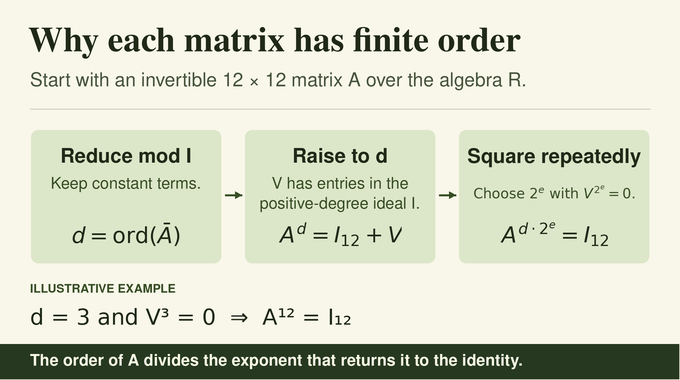
Let be an invertible twelve-by-twelve matrix over . Reduction modulo takes the constant term of each entry and lands in the finite group . Let be the order of the reduced matrix. Then , where is the identity matrix and every entry of belongs to . Theorem 3.7 makes nilpotent. Choose a nonnegative integer such that is at least its nilpotence index. Repeated squaring gives
For example, if the reduction has order three and , then and . The order of therefore divides twelve. Lemma 4.4 applies to all invertible matrices and hence to the elementary subgroup.
9. The Remaining Obstacle of Torsion in the Steinberg Kernel
Write for the map sending every Steinberg generator to its elementary matrix. The kernel consists of Steinberg elements whose matrix image is the identity.
A root strip is a subgroup generated by roots with row indices in one set and column indices in a disjoint set. Its roots commute, and the matrix entries record their parameters faithfully. The paper uses a presentation of the full matrix group with relations on at most five coordinates. A spare coordinate lets the proof test how those relations act on strips. This gives centrality of the kernel in ranks six and above, so each such kernel is abelian.
The frame complex organizes collections of columns that are linearly independent after reduction modulo . Its rational homology and the homology of the elementary group’s simplex stabilizers give stability in degree two. The resulting comparison of central extensions shows that every homomorphism from the rank- kernel to the additive group extends along the standard inclusion to rank for . Rank twelve is the threshold used by the proof to bring torsion back from higher rank. Related reading includes the free group factor isomorphism problem, Wall’s D(2) problem, and the four-dimensional Borel conjecture.
10. How Shift Substitutions and Rational Stability Prove Kernel Torsion
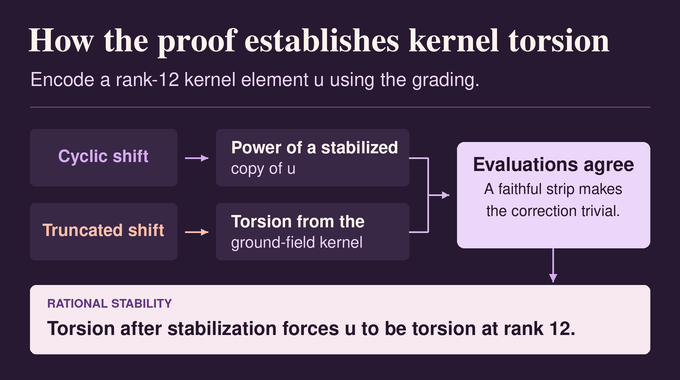
The grading gives a homomorphism sending each homogeneous term to , with central. Apply it to a finite root word representing a kernel element . Its matrix product stays the identity over the polynomial ring. Evaluating at recovers , and evaluating at retains the constant coefficients and gives a ground-field kernel element.
The proof substitutes two numerical shift matrices of the same power-of-two size . If the root word has factors and its entries have degree at most , Lemma 6.7 takes . The cyclic shift wraps at the boundary. In characteristic two it becomes upper triangular with diagonal entries one after a change of basis. The truncated shift has diagonal entries zero. The wrap creates correction roots from the last inner coordinates to the first. Moving all corrections to the end of the word broadens those endpoint bands by a controlled amount. The bands stay disjoint by the choice of , so the corrections lie in a faithful strip. Both words have identity matrix image, and the strip’s injectivity makes the correction trivial in the Steinberg group.
The cyclic evaluation represents the th power of a stabilized copy of . The truncated evaluation is a product of commuting copies of a torsion element from the ground-field kernel. Their equality makes the stabilized copy torsion. Every rational homomorphism on the original kernel extends to the larger rank and kills that copy. For an abelian group, an element killed by every homomorphism to is torsion: a nontorsion element would survive tensoring with and be detected by a linear functional. This proves Theorem 6.9 in rank twelve and above without needing injective stabilization maps.
11. Completing OpenAI’s Proof and Checking the Lean Scope
For any , a positive power lies in because its elementary matrix image has finite order. Kernel torsion supplies a positive integer with .
This completes Theorem 1.1, which asserts finite order element by element. Corollary 1.2 gives the same group Kazhdan’s property (T), which forces a unitary representation with almost invariant unit vectors to have a nonzero invariant vector. An infinite amenable group would have almost invariant vectors in its left regular representation, where any invariant vector must be constant. On an infinite group the only square-summable constant is zero. This makes the constructed group nonamenable. See also the separate nonamenability question for Thompson’s group F.
Corollary 3.8 gives an infinite-dimensional, finitely presented nonunital algebra that is nil and Jacobson radical but has no vanishing ideal power. Adjoining the scalar identity gives the infinite-dimensional algebraic algebra . Each element is a scalar plus a nilpotent term, so it satisfies a polynomial over . The surviving words of arbitrarily large length are products of arbitrarily many degree-one elements. They explain how the ideal can be nil element by element while every ideal power remains nonzero.
OpenAI shared the preprint and formalization as part of its October 2026 mathematics research release. The Lean scope note identifies the existence of an infinite finitely presented periodic group and a Steinberg-group witness in characteristic two as selected formalized statements. The Lean entry point also names the rank-twelve kernel-torsion and periodicity theorems. The selected statements leave the separate nil- and radical-algebra conclusions outside their scope. For another example of machine-checked mathematics, read the Fermat’s Last Theorem formalization coverage.
The Finitely Presented Burnside Problem turns on whether finite defining data can coexist with infinitely many elements of finite order. The preprint achieves that combination by preserving arbitrarily long algebra words and controlling the elements that disappear in the matrix image. Follow Binary Verse AI for more paper-first coverage of AI-assisted mathematical proofs.
How can a group be infinite if every element has finite order?
The order of an element and the number of elements in a group are different quantities. Every element may return to the identity after finitely many repetitions while the group contains infinitely many distinct elements. OpenAI’s construction has both properties.
Does having finitely many finite-order generators make a group periodic?
No. Take the group defined by two generators with the sole relations that their squares are the identity. Each generator has order two, but their product has infinite order. Periodicity requires every group element, including arbitrary products of generators, to have finite order.
Wasn’t the Burnside problem already solved decades ago?
Yes, earlier constructions gave a negative answer to the classical finitely generated Burnside problem. The finitely presented version also requires finitely many defining relations. The September 2026 preprint constructs an infinite periodic group that meets this stronger requirement.
Does OpenAI’s proof establish a fixed exponent for every element?
No. The main theorem gives a finite order for each element individually. It does not assert that one positive integer makes the corresponding power of every element equal to the identity.
Why is proving the elementary matrix group periodic insufficient?
The map from the Steinberg group onto the elementary matrix group sends all kernel elements to the identity. Periodicity of the image puts some power of each Steinberg element in that kernel. The separate kernel-torsion theorem supplies a further power that equals the identity in the Steinberg group.
What exactly does the Lean proof verify?
The released Lean formalization covers the existence of an infinite finitely presented periodic group, including a Steinberg-group witness over an algebra of characteristic two. The selected statements leave the paper’s separate nil-algebra and radical-algebra conclusions outside their scope.