
One staircase, squared, contains every symmetry type of its symmetric group. The staircase is a Young diagram, and the object being squared is the irreducible complex representation it labels. OpenAI’s September 2026 paper, publicly shared in October, proves the Saxl conjecture for staircases of every size: for every partition of the staircase’s number of boxes. The proof starts with one tensor made from two polytabloids. Permuting the boxes of both factors together makes that tensor generate a module containing every irreducible. Tracking the same construction as the staircase shrinks is what makes the proof work.
Table of Contents
1. What Is the Saxl Conjecture, and What Did OpenAI Prove?
Jan Saxl proposed the conjecture at a UCLA combinatorics seminar on March 20, 2012, as recorded by Igor Pak, Greta Panova, and Ernesto Vallejo. It asks whether one irreducible in each triangular degree can produce every irreducible of the same group when tensored with itself. Saxl specified which input should work: the staircase representation.
Theorem 1.1 of A Cyclic Polytabloid Proof of Saxl’s Conjecture answers yes. With and , the quantifiers run over every positive staircase size and every partition of its degree.
The notation means that the parts of sum to . A Kronecker coefficient counts how many copies of the target representation occur in the tensor product. A positive coefficient establishes that at least one copy is present.
| Object | Statement |
|---|---|
| Staircase | |
| Group degree | boxes, giving the symmetric group |
| Theorem 1.1 | Every irreducible complex representation of that group occurs in the staircase tensor square. |
| Theorem 3.1 | Every irreducible already occurs in the orbit span of one explicit tensor. |
| Range | Every integer and every partition |
2. Staircase Partitions, Young Diagrams, and Specht Modules
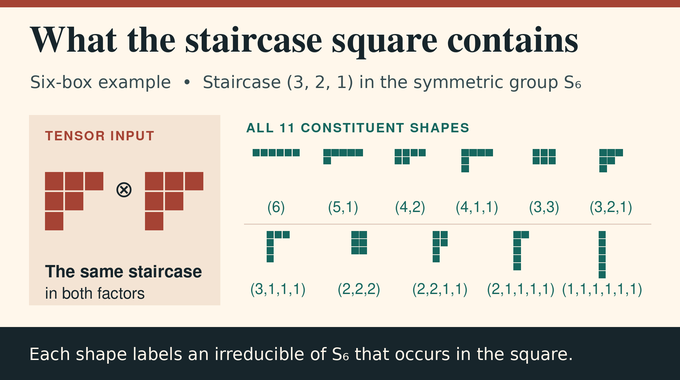
A partition lists positive integers in weakly decreasing order. Its Young diagram puts that many left-aligned boxes in successive rows. Swapping rows and columns gives the conjugate partition . For a staircase, both the row lengths and column lengths are , making the shape self-conjugate.
In the representation theory of symmetric groups, the Specht modules , indexed by partitions of , give all irreducible complex representations of up to isomorphism. An irreducible has no proper nonzero invariant subspace. The symmetric group permutes objects. On a tensor square, it acts diagonally: the same permutation acts on each factor. The multiplicity is the dimension of the space of equivariant linear maps from the target Specht module into the product. Here denotes that space of maps.
Take . The staircase has boxes, with columns of heights three, two, and one. Its square is a representation of . The theorem guarantees constituents as different as the trivial module , the sign module , and the two-row module . In this example the first row of exceeds the staircase’s first row, so the proof needs a step beyond the initial dominance criterion.
3. Why Earlier Approaches Could Not Establish Full Tensor-Square Coverage
Ikenmeyer proved positivity for partitions comparable to the staircase in dominance order and also obtained all hook constituents. Other approaches detected specific families. Character values on principal-hook cycle types gave a criterion for finding constituents. Modular methods supplied results that included every constituent of odd dimension. These criteria placed substantial families inside the square while leaving the general case open.
Luo and Sellke showed that a random partition appears in the staircase square with probability tending to one under both the uniform measure and the Plancherel measure, which weights shapes by squared representation dimension. This still allows some shapes to escape in a given degree. Harman and Ryba obtained full coverage for the staircase tensor cube. Adding the third factor can create a constituent from a different irreducible already present in the square. Its appearance in the cube therefore leaves the exponent-two question open.
The width-two step in the new proof also has a close predecessor. Brown, van Willigenburg, and Zabrocki determined the full tensor square of the two-row Specht module . The induction requires a statement about a particular vector in that square. Knowing an irreducible occurs in the ambient space leaves open whether the chosen vector has a component of that type.
4. The Stronger Cyclic Polytabloid Theorem Behind the Proof
The paper puts the positions in a triangle . The group consists of all permutations of these positions. Let and be the row and column blocks. For a block of length , assign letters and sum all permutations of those assignments, each weighted by its sign. A two-position block, for instance, contributes .
One layer alternates independently in each row to produce . The other alternates in each column to produce . The paper’s polytabloid construction identifies both orbit spans with because the block lengths, interpreted as column lengths of the Specht shape, give the self-conjugate staircase. The paired generator and its span are
Here is the complex linear span of all translates of . Theorem 3.1 finds every inside this prescribed cyclic module. Fixing the vector lets the induction recover its smaller counterpart after a band cut.
5. Dominance Order: The First Family of Kronecker Coefficients
Write when every initial sum of the parts of is at most the corresponding staircase sum, padding both lists with zeros. Proposition 3.2 directly handles this range. A signed average over the row subgroup leaves the row tensor in the first factor and a nonzero row-invariant vector in the second. Nonvanishing comes from the word that assigns letter throughout row : every row permutation contributes its same coefficient.
Twisting by the sign representation and using self-conjugacy turns that second vector into a scalar multiple of the first. The crucial quotient now comes from applying the local letter rule at every position and keeping words with exactly occurrences of each letter from one through . On a row of length , the output letters average . The chosen global content forces equality in the sum-of-squares bound for every row, so the only retained word is constant on each row, with value equal to its length. Compatible assignments on a row are reversals of one another and have the same product of signs, so the coefficient survives.
The orbit of that word spans the row permutation module. Young’s rule supplies every Specht module whose shape dominates in this quotient. Conjugation reverses dominance, and twisting back conjugates the constituent labels, giving every shape dominated by the staircase in .
6. Cutting the Staircase: How the Induced Band Quotient Works
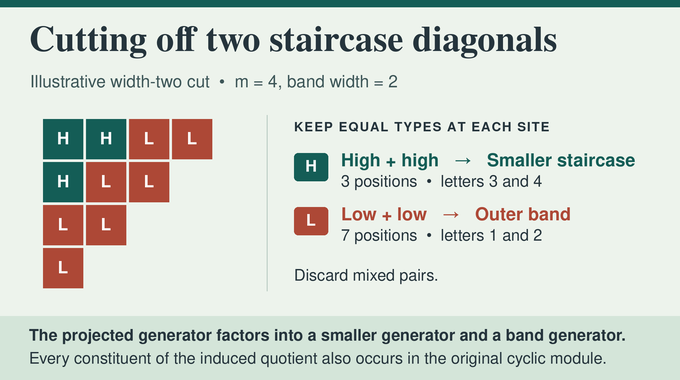
For a band of width , put , let , and let . Call letters numbered at most low and the others high. The projection retains a pair of letters if both are low or both are high. Using the same test at every position makes the projection commute with every permutation.
Row and column alternation fix how many high pairs lie in each row and column. In the first rows, a column with high pairs contributes at most . The row counts attain the sum of these bounds, forcing every column to fill from the top. The high pairs of the projected generator therefore occupy exactly . The retained tensor factors as the smaller generator, with relabelled high letters, times the band generator . Write for the latter’s cyclic span.
The stabilizer of is . Translates for distinct high-position sets have disjoint word bases, giving separate coordinate sectors. Lemma 4.1 identifies their direct sum with the full induced module. Proposition 4.2 gives the resulting surjection
The symbol denotes an outer tensor product on which the two groups act separately. Over the complex numbers, finite-group representations are completely reducible. Every irreducible in the quotient therefore also occurs in .
7. The Width-Two Band Becomes a Path of Matrices
A width-one band has only singleton blocks. Its generator is a constant word, so is the trivial representation of . A width-two band for has positions on two adjacent diagonals. Along the path, a column pair connects positions one and two, a row pair connects two and three, and the two kinds alternate. The first position has a fixed row-layer letter , and the last has a fixed column-layer letter .
At each site, the possible letter pairs form a four-dimensional space. A linear functional on that space is a matrix, with entry giving its value on the pair . For the path-ordered band vector , Lemma 5.1 contracts the alternating pair indices into one matrix product:
Odd positions contribute their matrices directly. At even positions the contracted indices are read in reverse order, and the antisymmetric pair factors convert the transpose to minus the adjugate. The fixed endpoint letters select the entry, and the even positions supply the overall sign. For a two-by-two matrix , , so this operation is linear.
8. Why Alternating Matrices Detect Every Four-Row Partition
For a target partition with at most four rows, pack its tableau columns into consecutive path segments. Each segment’s length is its column height, at most four. Alternating test matrices within each segment gives a dual polytabloid. The paper uses the ordered basis : the identity, the diagonal matrix with entries , the matrix swapping the two coordinates, and .
Lemma 5.2 computes each segment’s alternating sum , where is its length and its starting position. The last three basis matrices anticommute in pairs. At even positions adjugation fixes and negates the other three. Combined with the permutation sign, these effects make all terms agree. Each result is invertible.
| Segment Length | Odd Start | Even Start |
|---|---|---|
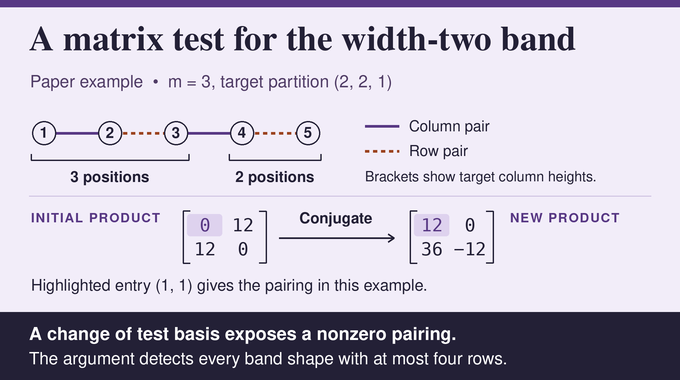
Invertibility alone allows the selected entry to vanish. In Example 5.4, and give segments of lengths three and two, starting at positions one and four. Their product is , whose upper-left entry is zero. Conjugating all four test matrices by conjugates the whole product. The paper chooses
The resulting pairing is . In general, a change of test basis puts an eigenvector of the invertible product in the first coordinate, so that entry becomes its nonzero eigenvalue. The resulting evaluation map onto the dual Specht module is equivariant and nonzero on the band generator. Irreducibility and self-duality give Proposition 5.3: every shape of size with at most four rows occurs in .
9. Horizontal Strips and the Pieri Rule: Completing the Reduction
A horizontal strip has at most one box per column. Lemma 6.1 starts with a shape outside the staircase’s dominance range. If its first row has at least boxes, remove the bottom cell in each of the rightmost columns. The column heights still decrease weakly, and the remainder is a partition of .
For the earlier example at , the rightmost three columns have heights two, one, and one. Removing their bottom boxes leaves column heights two and one, so the smaller shape is . Reversing that cut is a single Pieri addition from size three to size six.
If the first row has at most boxes, a failed dominance comparison must occur at some prefix length : prefixes of length one through three satisfy the bound automatically. The mean of the first four parts is at least the mean of the first . The failed comparison then forces the first four parts to sum to more than . Sweeping the bottom cell of every column removes exactly as many boxes as the current first row holds. At most four sweeps, with a rightmost partial sweep if needed, remove exactly boxes and leave a partition of .
The paper gives a case that really needs four strips. At , eleven rows of length eight and a last row of length three give boxes. Three strips can remove at most boxes from eight columns. The width-two cut needs , and the sweeps remove .
The Pieri rule says that inducing from a Specht module and a trivial factor adds a horizontal strip of the factor’s size. Reverse the deletions and apply Pieri repeatedly. The trivial factors on the band can be induced together first. Starting from the empty diagram, each strip can introduce at most one new row. Thus some band constituent with at most four rows combines with by induction to produce .
10. How the Induction Proves Saxl’s Conjecture for Every Staircase
At the cyclic module is the one-dimensional representation of the trivial group. For larger , Proposition 3.2 takes care of dominated shapes. For an outside shape admitting the single-strip cut, induction gives the smaller constituent in , and the trivial width-one band supplies the Pieri factor. For the other case, induction puts the remainder in , and Proposition 5.3 supplies the band constituent required by repeated Pieri.
In either band case, the induced quotient carries the target constituent back into by complete reducibility. This proves Theorem 3.1. Since the two generating layers have Specht type , lies inside the staircase square and Theorem 1.1 follows.
11. What the Proof Establishes and What Questions Remain
The Saxl conjecture proof establishes positive multiplicity for every target at every staircase size. The argument detects whether each constituent occurs. Its maps give no general formula for how many copies occur. The cyclic theorem strengthens support by specifying one orbit span in which all targets occur. The manuscript also points to a companion paper that uses this stronger statement and further arguments to construct universal tensor squares in every positive degree except , , and .
The Lean scope note describes the main positivity theorem, which is also the result stated by the comparator. The note lists the stronger orbit-span statement as outside its scope. The linked Lean source explicitly proves both: saxl_kronecker_pos gives positivity, and cyclic_saxl_conjecture follows from full_cyclic_support for the prescribed staircase construction.
The proof of the Saxl conjecture turns a question about an entire tensor square into a question about what survives in the orbit of one tensor. Follow Binary Verse AI for more source-led explanations of AI-assisted mathematics, from the proof on Thompson’s group F to the Lean formalization of Fermat’s Last Theorem.
Has Saxl’s conjecture been proved?
Yes. OpenAI’s September 2026 paper proves that the tensor square of every staircase Specht module contains every irreducible complex representation of the corresponding symmetric group. The positivity theorem is also formalized in Lean.
What does the Saxl conjecture formula mean?
For the staircase partition with rows of lengths m, m − 1, and so on down to 1, the inequality g(ρₘ, ρₘ, λ) > 0 means the irreducible Specht module indexed by λ occurs at least once in the staircase tensor square. The statement applies to every partition λ with the same number of boxes.
Why are staircase partitions important in this proof?
Their row lengths and column lengths agree. This self-conjugacy supports the sign-twist argument, while the triangular arrangement makes the two alternating tensors factor after a band is removed.
What is a cyclic polytabloid, and why is it central to the proof?
The generator is a single tensor of two polytabloids, one alternating along rows and the other along columns. The linear span of all its simultaneous permutations is the cyclic module Wₘ. Theorem 3.1 finds every irreducible in that particular module inside the tensor square.
How does the proof use 2×2 matrices and four-row partitions?
The width-two band is an alternating path of pairs. Its contraction is a product of matrices and adjugates. Alternating along consecutive segments and choosing a suitable test basis gives a nonzero pairing for every partition with at most four rows.
Why was proving tensor-cube coverage not enough?
Tensoring with a third copy can introduce new constituents. The cube theorem gives universal coverage after that step, while Saxl’s conjecture requires coverage with two copies.
Does the Lean formalization verify the entire cyclic-polytabloid argument?
The current Lean source proves the main positivity theorem and the stronger support theorem for the prescribed cyclic construction. The comparator states the positivity theorem, and the separate scope note still describes the cyclic theorem as outside its scope.