

A group element can be nontrivial and still look exactly like the identity in every finite quotient. The longstanding question was whether the coarse negative curvature of hyperbolic groups prevented that from happening. In its September 23, 2026 preprint, OpenAI constructs a torsion-free word-hyperbolic group in which it does happen. Geometry certifies that finitely many four-edge loops represent nonidentity elements. Preserving all of them in one finite quotient would force incompatible rank bounds. It follows that one fixed element escapes detection in every finite quotient.
Table of Contents
1. What OpenAI Proved About Hyperbolic Groups
Theorem 1.1 answers the residual-finiteness question from Gromov’s program in the negative. The example is the fundamental group of a finite Euclidean triangle complex , based at a vertex . Its elements are based loops up to deformation, with contractible loops representing the identity. The group is torsion-free, meaning every nonidentity element has infinite order, and word-hyperbolic, meaning its Cayley graph satisfies a uniform thin-triangle condition. Yet the group has a nontrivial finite residual.
| Result | What the paper establishes |
|---|---|
| Existence theorem | A torsion-free word-hyperbolic group fails residual finiteness. |
| Construction | The fundamental group of a finite Euclidean triangle complex with three vertices. |
| Finite-quotient obstruction | At least one fixed nonidentity rectangular word maps to the identity in every finite quotient. |
| Linearity | The same word vanishes under every finite-dimensional representation over a commutative field. |
| Lean scope | The main existence theorem is formalized. |
The geometry must certify the same words that the algebra tests. Otherwise a word erased by every quotient might already equal the identity in the group itself.
2. Residual Finiteness: Can Finite Quotients Detect Every Element?
A finite quotient is the image of a surjective homomorphism from onto a finite group. Its kernel consists of all elements sent to the identity. Two elements have the same image precisely when their quotient lies in that kernel. Residually finite groups allow the quotient to vary with the element being tested. The finite residual intersects the kernels of all homomorphisms from into finite groups , since replacing the target by the image makes the map surjective without changing its kernel.
Take the additive group of integers. Reduction modulo three sends both six and zero to zero, so this test misses six. Reduction modulo five sends six to one, detecting it. For any nonzero integer, a modulus larger than its absolute value works, making the integers residually finite. OpenAI’s counterexample has an element that lies in every kernel, regardless of how the finite quotient is chosen.
3. Why the Hyperbolic-Group Problem Resisted Earlier Methods
In a Cayley graph, vertices are group elements and an edge records multiplication by a generator. Word-hyperbolicity requires a constant such that each point on one geodesic side of any triangle is within distance of the union of the other two sides. A tree gives the limiting picture: its geodesic triangles have the shape of a possibly degenerate tripod, and every point on a side belongs to another side. Thinness constrains the word metric at large scales and gives no direct construction of finite quotients.
Additional geometry does give such results. Agol showed that a word-hyperbolic group acting properly and cocompactly on a CAT(0) cube complex is virtually special. Together with Haglund and Wise’s work, this yields residual finiteness in that setting. In the opposite direction, Wise’s non-residually finite complete square complexes have universal covers that are products of trees containing Euclidean planes. These examples have nonpositive curvature without word-hyperbolicity. The Cannon conjecture poses a different geometric question about word-hyperbolic groups with a two-sphere boundary.
4. Building the Counterexample from a Finite Triangle Complex
The complex has three vertices, , and many parallel edges. Each line label gets an array of edges directed from to , where . At a regular point, the incident labels are split into two blocks. A block has labels, indexed by pairs of residues modulo and respectively. The other edge families, and , go from to and from to .
For each label in the block and each pair of array indices, equation (2.4) attaches a triangle along , , and . Its angles at are . The based element follows a chosen path from to the edge’s start, traverses the edge, and reverses the chosen path from to its endpoint. With products read in path order and , the oriented triangle boundary gives (2.5).
The shifts use the opposite array index, with each addition taken modulo its coordinate size. For fixed , translating both residue coordinates permutes the full Cartesian grid. That permits the matrix factorization later. Since each modulus is at least , a shift also determines at most one opposite index, which is what the link projection needs.
5. Punctured Affine Lines, Large Girth, and the Exceptional Set
Fix a sufficiently large integer and work in , where is a large prime and counts the points. The potential marks are the points of for a subset of size . Choose a random line direction independently at each mark. A label is incident to points on its line other than its own mark . The punctured incidence graph has point vertices and line-label vertices, with edges for these incidences.
Lemma 2.2 deletes the labels lying on cycles of length at most 12. The exceptional set includes points that originally had low degree and points on discarded lines. A successful sample has at most short cycles. Each cycle contains at most six line labels, and each discarded line contains points. Thus the discarded lines cover at most points. The initially low-degree points number at most . Both bounds are small compared with , so as grows with fixed. Outside , each point still has at least incident labels, enough to partition them into two blocks with both coordinate sizes at least . If is the number of retained labels, the data are fixed with and . These choices precede every finite-quotient test.
6. Why Angular Links Make the Group Torsion-Free and Hyperbolic
An angular link records the directions of edges leaving a vertex, regardless of how the edges were oriented in the construction. A triangle corner joins two directions by a link edge whose length is that corner’s angle. At , each block gives a complete bipartite link, so a nonempty cyclically reduced closed walk uses at least four edges, of total length at least . At and , the links map locally injectively to the punctured incidence graph. Its bipartiteness and absence of cycles of length at most 12 force such walks to use at least 14 edges, hence have length at least . The common excess above is at least .
Theorem 2.1 turns that excess into a statement about the fundamental group. In a reduced planar filling, interior link walks contribute nonpositive angular curvature. A boundary whose cyclic turns are all at least supplies no positive contribution either, even with repeated boundary visits. Angular Gauss–Bonnet requires total curvature , ruling out such a filling. A shortest loop in a nontrivial free homotopy class is locally geodesic, with turns at least after subdivision. Every positive repetition still has those turns. If the element had finite order, some repetition would contract. The finitely presented Burnside problem asks whether every element of an infinite finitely presented group can have finite order.
For hyperbolicity, cut out a simple geodesic polygon inside a filling. Gauss–Bonnet allows at most interior vertices mapping to original vertices when the polygon has at most three sides, where is the minimum angle excess. Each small triangle of the fixed barycentric subdivision touches an original vertex. The fixed mesh then converts the count into an inradius bound. A level-arc argument then proves thinness of diagram triangles, and stability of paths with controlled subarc lengths transfers thinness to the Cayley graph.
7. Rectangular Words: The Nonidentity Elements Geometry Protects
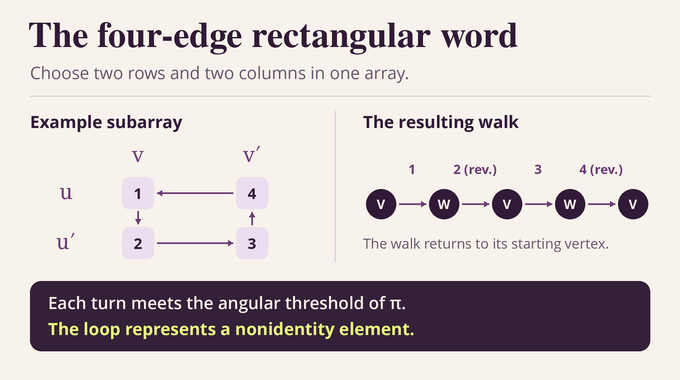
Choose two distinct rows and two distinct columns in a single array. The loop alternates between and : it follows the edge in entry , reverses the one in , follows , and reverses . Cancelling the paths used to base the edges at leaves a conjugate of this loop. Equation (2.6) states that its element is nontrivial.
At each turn, the two edge directions are distinct but carry the same line label. A shortest link path joining them, if one exists, projects to a closed incidence walk with no immediate reversal at its internal vertices. Such a walk contains a cycle, giving link distance at least . All four turns therefore meet Theorem 2.1’s threshold. The resulting finite set contains only nonidentity elements.
8. Suppose Every Rectangular Word Survives a Finite Quotient
If each member of survived in some finite quotient, the product of those finitely many maps would preserve them all in its finite image . Let . Left multiplication on gives a permutation matrix for each element’s image. Only the identity fixes any point, so its trace is , while every other trace is zero. Each array becomes the block matrix of size .
Set . The first trace counts the blocks, each paired with its transpose. The second expands into traces of rectangular products. These products give the identity when the row indices coincide or when the column indices coincide. Each coincidence accounts for terms, with counted twice. All other terms have zero trace by the simultaneous survival assumption. In a two-by-two array, twelve of the sixteen index choices repeat a row or column, giving a second trace of twelve times the quotient order.
Cauchy–Schwarz on the positive eigenvalues bounds the rank below by the square of the first trace divided by the second. Over the reals this gives .
9. The Fixed-Field Rank Estimate That Works for Every Quotient
Each row of has one unit entry per block column, so its Euclidean norm is . Lemma 2.4 takes a nonzero minor of an integer matrix of positive real rank whose rows satisfy that norm bound. Hadamard’s inequality gives . If the minor has rank modulo , choose rows spanning its row space modulo . Subtract integer lifts of the necessary linear combinations from the other rows. The remaining rows are divisible by , so .
Since , at least half the real rank survives reduction. This gives . The row norm is independent of quotient order, so the fixed field works even when divides .
10. Lagrange Interpolation and the Contradictory Rank Bounds
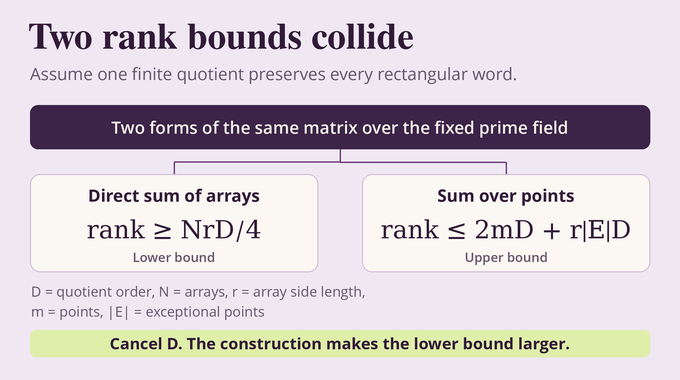
Work over and sum the arrays at each point as , where is the set of incident labels. At a regular point, the translated coordinates range over every residue pair in each block. Using the triangle relation, the sum for that block factors as a block column of sums of inverse left-edge matrices times a block row of sums of right-edge matrices. The inner dimension is , so two blocks give rank at most . At an exceptional point, the ambient size gives the bound .
Product Lagrange interpolation gives polynomials that equal one at their own mark and zero at the other marks. Collect their values in the column and write for its outer product. It has rank at most one, and at mark it is the diagonal matrix unit . On an affine line every entry has degree at most . The sum over the full line is zero by the finite-field power-sum identity. Omitting that line’s own mark leaves . Exchanging the sums gives (2.14), with denoting the matrix tensor product.
The direct sum adds the ranks of arrays, each contributing at least . On the right, the rank-one weights cannot increase the rank of a local term. Adding the local bounds, with points in total and exceptional ones, gives the decisive comparison.
Cancel the positive integer . The resulting inequality contradicts the strict numerical gap fixed before constructing the group. It applies to every quotient size.
11. What the Proof Establishes: Nonlinearity, Lean, and Limits
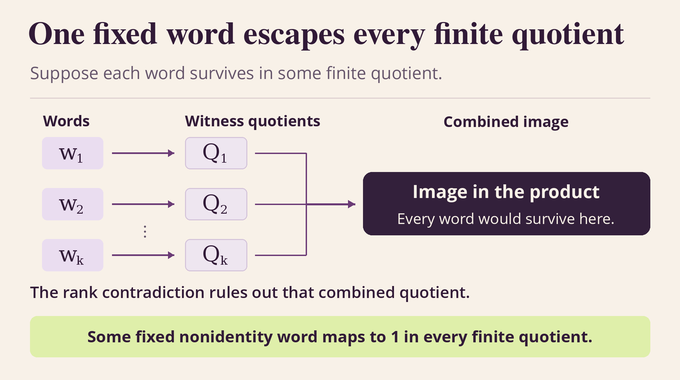
Since separate witnesses for all members of could be combined, one fixed member belongs to the finite residual. The argument leaves its identity within undetermined. The theorem leaves room for finite quotients that detect other elements. Kapovich and Wise’s class-wide equivalences do imply the existence of a nontrivial hyperbolic group with no nontrivial finite quotient and of a hyperbolic group with no torsion-free subgroup of finite index. Those existential consequences do not identify either group with this construction.
Corollary 1.2 uses Malcev’s theorem: a finitely generated linear group over any commutative field is residually finite. The image of any finite-dimensional representation of is finitely generated. If the image detected the fixed rectangular word, a finite quotient of that image could detect it too. Thus the same word lies in every such representation’s kernel. This rules out faithful finite-dimensional representations over commutative fields. The corollary is silent on skew fields and infinite-dimensional representations.
The October release announcement describes the wider publication effort. The Family 252 Lean scope statement covers the main existence theorem, and the Lean implementation concludes torsion-freeness, word-hyperbolicity, and failure of residual finiteness together. The nonlinearity corollary is established separately in the paper. For hyperbolic groups, the construction shows exactly where local curvature and finite separation diverge: curvature keeps the four-edge loops nontrivial, while the quotient-independent rank estimate forces one of them to vanish in every finite image. Follow Binary Verse AI for more research explainers on geometric group theory, including the Boone–Higman conjecture and Thompson’s group F.
Are all hyperbolic groups residually finite?
No. OpenAI’s September 2026 paper constructs a torsion-free word-hyperbolic group that is not residually finite. This answers the longstanding question negatively, even in the torsion-free case.
What does it mean for a hyperbolic group to be residually finite?
Every nonidentity element must have a nonidentity image in some finite quotient. Equivalently, the intersection of the kernels of all homomorphisms into finite groups contains only the identity.
Why is the torsion-free condition important in this proof?
It strengthens the counterexample by ruling out nonidentity elements of finite order. The paper proves torsion-freeness by showing that a shortest closed loop in a nontrivial free homotopy class, and every positive repetition of it, satisfies an angular criterion that prevents contraction.
How does OpenAI prove that the constructed group is hyperbolic?
The proof establishes angular-length bounds in vertex links and derives uniform thinness of geodesic triangles using reduced planar diagrams and Gauss–Bonnet. It then transfers thinness to a Cayley graph of the group.
How can a nonidentity group element disappear in every finite quotient?
The paper proves that every word in a finite family of rectangular words is nontrivial and that no finite quotient preserves them all. If each word survived somewhere, the product of those finitely many maps would preserve them all. So at least one fixed word maps to the identity in every finite quotient.
Does the construction have no nontrivial finite quotients?
The paper establishes that at least one nonidentity element maps to the identity in every finite quotient. It leaves the identity of that rectangular word undetermined. The conclusion allows for finite quotients that detect other elements.
Is OpenAI’s hyperbolic-group proof formally verified in Lean?
The released Lean development formalizes the existence of a torsion-free word-hyperbolic group that is not residually finite. The paper separately proves nonlinearity over every commutative field, which is outside the scope of the linked Lean theorem.