

The Zariski cancellation problem asks whether one extra dimension can hide the difference between an affine variety and ordinary affine space. OpenAI’s September 2026 preprint gives an explicit example over the complex numbers. Its hypersurface has dimension four and cannot be described by four freely generating polynomial coordinates. Attach an affine line, however, and the resulting cylinder has five such coordinates and is isomorphic to affine five-space. The paper builds those five coordinates explicitly, then shows that four coordinates on the original hypersurface would create an additive symmetry that a polynomial degree argument rules out.
Table of Contents
1. What Is the Zariski Cancellation Problem?
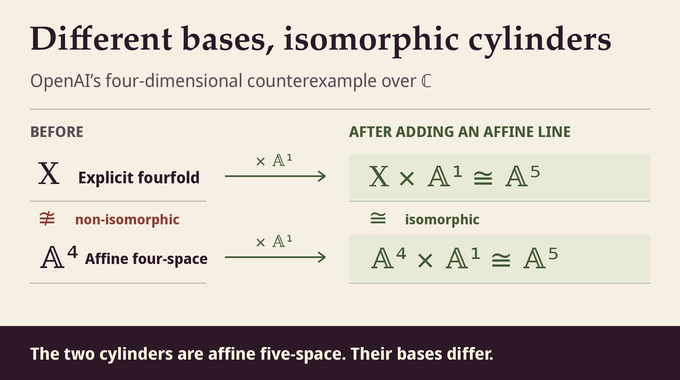
Write for the polynomial ring in independent variables over the complex numbers. Its geometric counterpart is affine -space, . If is the coordinate ring of an affine variety , adjoining a free variable gives the coordinate ring of . The Zariski cancellation conjecture asks whether the following implication always holds for finitely generated complex algebras, with isomorphisms fixing the complex scalars.
An isomorphism of cylinders can mix with functions from . If it carried to a standard coordinate, setting that coordinate to zero would recover ordinary affine -space. Affine space cancellation asks what that freedom can do. Even on an ordinary plane, the polynomial change from to carries the slice to a parabola in the new coordinates. That slice is still an affine line. The theorem shows that the slice singled out by the extra variable in the fourfold’s cylinder can have a genuinely different coordinate ring.
| Question | Answer |
|---|---|
| Ground field | The complex numbers, of characteristic zero |
| Variety | An integral affine hypersurface of dimension four |
| Before stabilization | Its coordinate ring has no four-variable polynomial presentation |
| After adjoining one variable | The cylinder is isomorphic to affine five-space |
| Scope | The construction leaves complex dimension three unresolved |
2. Why Was Cancellation Over the Complex Numbers So Difficult?
Cancellation in dimension one follows from work by Abhyankar, Heinzer, and Eakin. Fujita and Miyanishi–Sugie established the complex surface case using the geometry of affine surfaces. In positive characteristic, Asanuma built threefolds with polynomial cylinders, and Neena Gupta proved that suitable examples were genuinely nonpolynomial. Her subsequent construction gave counterexamples in every dimension at least three over every field of positive characteristic.
For the Zariski cancellation problem in characteristic zero, the July 2026 Gaifullin–Petrov preprint cited by OpenAI still listed dimensions three and higher as open. There is a simple reason a counterexample does not automatically propagate up the dimensions. Once the first cylinder is polynomial, taking further products with affine space keeps it polynomial. A counterexample in a higher dimension therefore requires a new argument.
3. The Explicit Fourfold: The Polynomial Behind OpenAI’s Proof
The five independent ambient variables are . Write . The first equation defines an abbreviation in those variables. The second gives the defining polynomial of the hypersurface in Theorem 1.1.
Introduce and . Expanding gives . After inverting , the substitutions are reversible. Recover from , then and . The defining equation is linear in the remaining variable with invertible coefficient. The localized quotient is a Laurent polynomial ring in with three further coordinates . Since does not divide , primality after localization descends in the ambient polynomial ring. The resulting domain has fraction field and therefore dimension four.
4. How Adding One Variable Turns the Fourfold Into Affine Five-Space
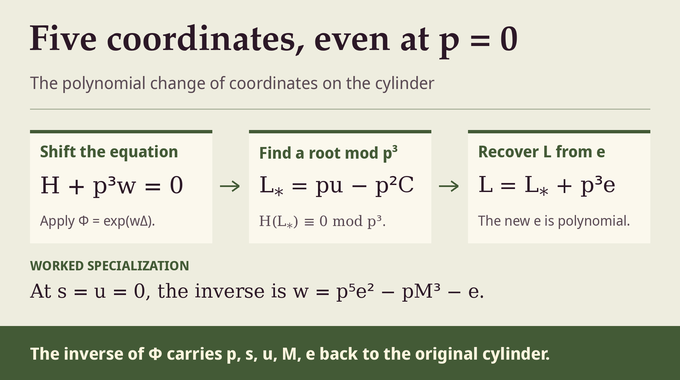
With fixed in the localized ambient ring, apply . Its values on the original generators are polynomials, so it restricts to the original ambient polynomial ring. For example, differentiating gives . In the formula for , the resulting factors of in the numerator cancel the denominator, giving . Repeated differentiation eventually kills each polynomial, the defining property of a locally nilpotent derivation. Extend it by fixing the new variable. Because and , the finite exponential sends to . Its inverse is .
Put . The following change of variables in has determinant one and works even at .
The inverse is and . Over , express the defining polynomial in terms of the new variable. Let , and . Then . This makes a root modulo . The term involving the square of the parameter corrects the first approximation, and the remaining error is divisible by the cube.
In the shifted quotient, put . Its relation is . The polynomial satisfies . For a worked specialization, at one gets , and . The shifted equation becomes . Thus and , an inverse that still makes sense when .
In general, recover and . The formula for the new variable is polynomial because the approximate root makes the constant term divisible by the cube of the first coordinate, and the correction changes the polynomial by a multiple of that cube. The shifted ring is a domain by the exponential automorphism, so the defining relation lets us cancel that common power in the inverse identities. After inverting , is affine linear in the free variable , so it is independent over . The shifted ring is therefore . Applying the inverse exponential transports its five coordinates back to .
5. Why the Original Fourfold Cannot Be Affine Four-Space
Showing that the cylinder is polynomial leaves open whether a completely different choice of four coordinates could generate . The Zariski cancellation proof addresses that possibility through a symmetry every polynomial ring has. Translating one coordinate gives an algebraic additive-group action and keeps the other coordinates fixed.
The paper tracks such a hypothetical action in a graded algebra that records leading terms near . Its goal is to exclude a specific kind of action, one with a fixed function of positive valuation degree. The argument can therefore succeed even when other additive actions exist.
6. The Valuation and Associated Graded Algebra
The coordinate ring contains the subalgebra generated by . The earlier identity gives its defining relation. Setting the first generator to zero in that subalgebra gives a smooth quadric times an affine line.
The two rings agree after inverting the first generator. Measure order along the prime in and take its negative as valuation degree. For example, has degree two because its numerator has nonzero residue in . This can be seen by setting in . The quadric relation still holds, and the numerator reduces to , a nonzero polynomial. The other generator with a denominator has the same degree. Put , , and in . The paper identifies the associated graded ring exactly.
Here is the leading form of and has degree minus one. The coefficient ring has degree zero. In this presentation the degree tracks a pole along the chosen divisor. The extra generators have positive degree even though they are regular functions on the original fourfold. That distinction comes from measuring the order in the auxiliary subalgebra, where the same functions have a denominator. A polynomial representative in the original five generators has weights . If its highest-weight part cancels in , that part is a multiple of , the highest-weight part of . Subtracting the corresponding multiple of lowers the weight without changing the represented element. This reduction yields representatives whose weights match their valuation degrees. It controls the action of derivations on all elements from their action on the generators.
7. Locally Nilpotent Derivations: Turning Polynomiality Into a Contradiction
Assume the fourfold has four polynomial coordinates. Elements of nonpositive valuation degree form a subalgebra, and lies outside it. At least one coordinate must therefore have positive degree. Differentiate with respect to any other coordinate. The resulting nonzero locally nilpotent derivation fixes the chosen positive-degree coordinate.
Take the largest degree shift of the derivation on the five original generators. The exact representatives from Section 3 of the paper make this a bound on every element. Keeping the part that attains that shift gives a nonzero homogeneous derivation on . Its iterates are graded components of the original iterates, so it remains locally nilpotent. The initial form of the fixed coordinate survives as a nonzero homogeneous invariant of positive degree.
8. The Line-Bundle Lift That Makes the Obstruction Visible
Pull back from the quadric to the determinant-one matrix variety , keeping unchanged. The ring maps the quadric coordinates to , and . Scaling the first matrix column by a nonzero scalar and the second by its inverse fixes these three functions. Over the nonzero fiber parameter is , and over it is . On their overlap the transition is , so the fiber parameters differ by a unit on the base. The transition also explains why and carry the same fiber weight.
Upstairs the two generators of generate a principal ideal, with as generator. Indeed, and , and the two multipliers generate the unit ideal. Pulling back gives the single relation
| Element | Valuation Degree | Fiber Weight |
|---|---|---|
| 0 | +1 | |
| 0 | −1 | |
| 0 | 0 | |
| −1 | 0 | |
| +2 | +2 |
The additive action lifts directly from the smooth affine variety of the graded ring. Pullbacks of its line bundle by the action and by the projection agree along the identity section and are isomorphic by invariance of the Picard group under a polynomial extension. Normalizing at the identity makes the lift unique because polynomial units over a domain are constant in the action parameter. The lift preserves fiber weights and retains the original valuation degree shift. Fiber weight measures how a function transforms when the nonzero vector in the line is rescaled. Valuation degree instead records how the function scales under the grading inherited from . Both are needed because extracting a derivation can preserve one grading while shifting the other.
9. The Final Rigidity Argument: Polynomial abc and an Impossible Weight
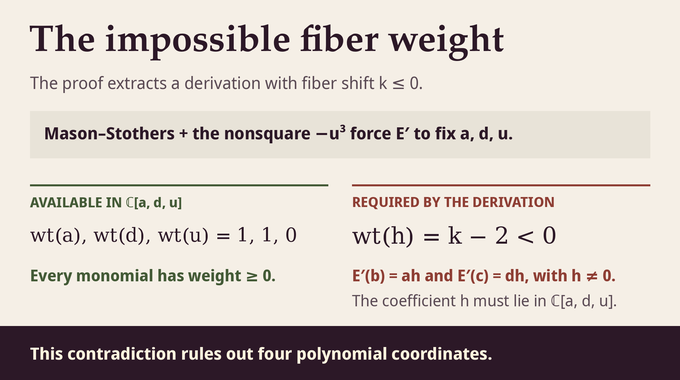
Every positive-degree homogeneous element in the pullback ring is divisible by . For a locally nilpotent derivation in characteristic zero, the last nonzero iterate order adds under multiplication. A fixed product thus has fixed factors. The positive-degree invariant forces to be fixed. If is fixed too, the lifted derivation gives one on with fiber shift zero and fixes . If moves, factoring out the common homogeneous multiplier instead gives a negative fiber shift. Each application lowers the last nonzero iterate order by one plus the order of . Since , two applications must kill . In both cases one obtains a nonzero derivation with and nonpositive fiber shift.
A third grading assigns degrees . Taking the highest component separates , of degree six, from , of degree minus three. Consequently . Along the polynomial orbit of , with parameter , this gives
A common root of the summands would be a multiple root of the nonzero sum, so the three terms are pairwise coprime. If either summand varies, both have the same degree, , where the subscripts indicate orbit degrees. Mason–Stothers bounds that common degree by the number of distinct roots of the product of the three terms minus one. The root count gives , forcing . Then cancellation of the leading terms would make a square in . Its order at is three, whereas a square has even order. The orbit polynomials of must all be constant.
Differentiating the determinant relation now gives and for one coefficient . Localizing over leaves a one-variable polynomial ring, where a locally nilpotent derivation sends the variable to a field element. Comparing the charts that invert and then puts in . If the fiber shift is , that coefficient must have weight , strictly negative. All monomials in that ring have nonnegative weight. The contradiction rules out the four polynomial coordinates.
10. Two More Consequences: Stable Coordinates and Affine Fibrations
The Stable Coordinate Conjecture asks whether an ambient polynomial that becomes a coordinate after adjoining a variable was a coordinate already. Here becomes a coordinate in by the residual-coordinate theorem of Dutta–Lahiri. Its hypothesis holds because the defining polynomial is a coordinate after inverting , and at its reduction is the coordinate from the determinant-one change. In other words, the polynomial is a coordinate over each residue field of the parameter ring. If were a coordinate in , quotienting by it would give a polynomial ring in four variables. This disproves the conjecture in ambient dimension five.
The maps and are smooth surjections with affine three-space fibers over every residue field. In each fiber, fixing the value of the residual coordinate leaves three free variables. Differentiation in that coordinate shows that the four partial derivatives along the original variables generate the unit ideal fiber by fiber. This supplies the relative Jacobian condition for smoothness. Zariski local triviality would make each coordinate algebra the symmetric algebra of a projective module by Bass–Connell–Wright. Quillen–Suslin makes that module free over either base. The first map would then make the fourfold’s ring polynomial, and the second would make the defining polynomial an ambient coordinate. Both outcomes contradict the paper, giving two counterexamples to the Dolgachev–Weisfeiler affine-fibration conjecture.
11. What Does Lean Verify in OpenAI’s Proof?
OpenAI’s Lean documentation lists this result as family 047. OpenAI’s October release announcement describes the wider project that published the preprints and Lean files. Binary Verse AI covers OpenAI’s AI mathematics program in more detail. The proof entry point assembles five facts about the explicit quotient. The quotient is a finite-type complex algebra and a domain, has Krull dimension four, becomes polynomial in five variables after adjoining one variable, and admits no complex-algebra isomorphism to a polynomial ring in four variables. This is the formal version of the main cancellation counterexample. The stable-coordinate corollary, the two affine-fibration consequences, and the general line-bundle lifting statement sit outside that main theorem’s formalized scope.
12. What the Four-Dimensional Counterexample Leaves Unresolved
The Zariski cancellation problem over the complex numbers has a negative answer in dimension four. Dimension three remains unresolved by this construction. In particular, the affine three-space fibers from Section 7 of the paper are themselves polynomial over their residue fields. The obstruction concerns fitting those fibers together over a base, so they supply no threefold with the required cancellation failure.
The fourfold shows exactly what stabilization can erase. Five polynomial coordinates describe its cylinder globally, including the fiber where the localization formulas would divide by zero. Four polynomial coordinates downstairs would force an additive symmetry with an impossible fiber weight. Follow Binary Verse AI for more proof-level coverage, including Nagata’s conjecture, the CM case of the Hodge conjecture, and the Lean formalization of Fermat’s Last Theorem.
What is the Zariski cancellation problem?
It asks whether an affine variety must be affine n-space if its product with the affine line is affine (n + 1)-space. Algebraically, the question is whether adjoining one polynomial variable can conceal a genuine difference between coordinate rings.
Has the Zariski cancellation problem been solved over the complex numbers?
OpenAI’s September 2026 preprint gives a counterexample in complex dimension four, disproving the general cancellation assertion over the complex numbers. The construction leaves dimension three unresolved.
How can adding one dimension erase an algebraic difference?
An extra independent variable can be mixed with functions on the original variety in a polynomial change of coordinates. The paper explicitly constructs five polynomial coordinates on the cylinder and proves that the original fourfold admits no system of four polynomial coordinates.
What is OpenAI’s explicit counterexample to Zariski cancellation?
It is an integral complex affine fourfold defined by a single polynomial equation in five variables. Its coordinate ring becomes a polynomial ring in five variables after adjoining one variable. The original ring admits no complex-algebra isomorphism to a polynomial ring in four variables.
How does the proof establish that the fourfold is not affine space?
Four polynomial coordinates would yield a locally nilpotent derivation with a positive-degree invariant after passage to the associated graded ring. The proof lifts the action to a line bundle and rules it out using the Mason–Stothers polynomial abc inequality and a contradiction in fiber weights.
What parts of the Zariski cancellation proof were formalized in Lean?
OpenAI’s scope note covers the explicit finite-type complex domain, its Krull dimension four, its polynomial cylinder, and the proof that the original ring is nonpolynomial. The stable-coordinate corollary and the general line-bundle lifting statement lie outside that scope.
What other mathematical conjectures does the construction disprove?
It disproves the Stable Coordinate Conjecture in ambient dimension five. It also disproves the Dolgachev–Weisfeiler affine-fibration conjecture in relative dimension three over the complex affine line and plane, through smooth fibrations that fail Zariski local triviality.