Hindman Finite Sums and Products Conjecture: OpenAI Proof Finds Order Where Addition Meets Multiplication
Hindman Finite Sums and Products Conjecture illustrated by jade addition and multiplication woven through colored threads.

Choose three positive integers. Add any selection of them, or multiply it. Can every result carry the same color, however someone has colored the number line? The Hindman Finite Sums and Products Conjecture asks for this cooperation between addition and multiplication for every prescribed finite set size. OpenAI’s September 23, 2026 manuscript presents a proof … Read more
Barker Sequence Conjecture: How the OpenAI Proof Rules Out Lengths Beyond 13

Barker sequence conjecture artwork showing cyclic sign tiles dissolving beyond a mathematical boundary.

Thirteen signs can meet a strict cancellation rule. According to OpenAI’s September 23, 2026 manuscript, fourteen signs, fourteen trillion signs, and every other length above thirteen cannot. Its proof of the Barker sequence conjecture closes the outstanding even-length case through a theorem about cyclically shifted matrices. The answer is precise: Barker sequences longer than one … Read more

Hadwiger Conjecture: How OpenAI’s Counterexample Proof Breaks an 83-Year-Old Coloring Rule

Hadwiger Conjecture artwork with colorful embroidered graph knots and missing connections.

A graph can demand many colors while refusing to collapse into an equally large complete graph. OpenAI’s September 23, 2026 manuscript constructs precisely that separation, presenting a disproof of the Hadwiger Conjecture, proposed in 1943. Its counterexamples have no independent set larger than two vertices, yet their largest clique minors fall well below the resulting … Read more

Snaky in 21 Maker Moves: How OpenAI’s Proof Ended a 47-Year Tic-Tac-Toe Mystery

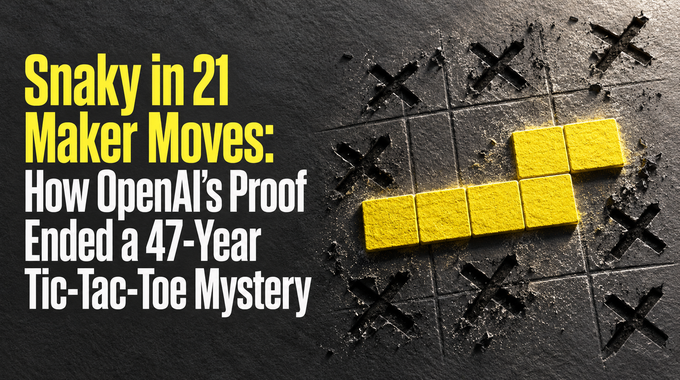
Snaky in 21 Maker Moves: a yellow six-cell target beside graphite blocking marks and the full article title.

Six squares were enough to leave a gap in a decades-old classification of tic-tac-toe variants. The shape was Snaky: a straight four-cell body with a two-cell kink. OpenAI’s September 25, 2026 paper, Snaky in 21 Maker Moves, supplies a guaranteed winning strategy from an empty board against every legal defensive response. Maker can finish within … Read more

Periodic Tiling Conjecture: How OpenAI Built a 3D Tile That Cannot Fully Repeat

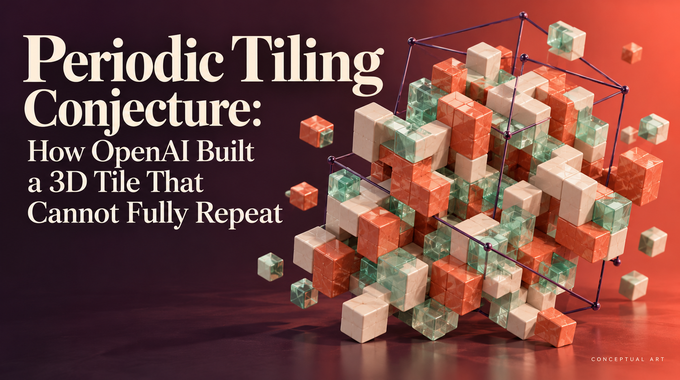
Periodic tiling concept art with coral and mint cubes escaping a repeating cell, alongside the full article title.

A finite shape can fill three-dimensional space perfectly and still refuse every arrangement with three independent repeating directions. OpenAI’s September 23, 2026 manuscript presents exactly that counterexample to the periodic tiling conjecture: one finite lattice tile that tiles, yet admits no fully periodic tiling. Its unit-cube version has the same property in ordinary space, even … Read more

Counting Common Bases of Two Matroids: How OpenAI’s Proof Breaks the Approximation Barrier

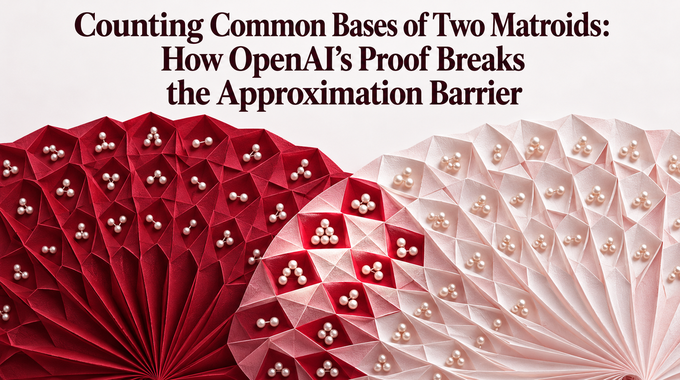
Counting Common Bases of Two Matroids depicted as overlapping paper collections revealing shared configurations.

Finding one valid assignment can be easy while estimating how many assignments exist remains stubbornly hard. A four-edge bipartite square captures the difference: selecting one perfect matching answers feasibility, but the graph has two. Scale up the constraints, and enumeration quickly becomes the wrong tool. Counting Common Bases of Two Matroids asks for the number … Read more

Sidorenko Conjecture: How OpenAI’s 35-Vertex Graph Challenges the Random-Graph Bound

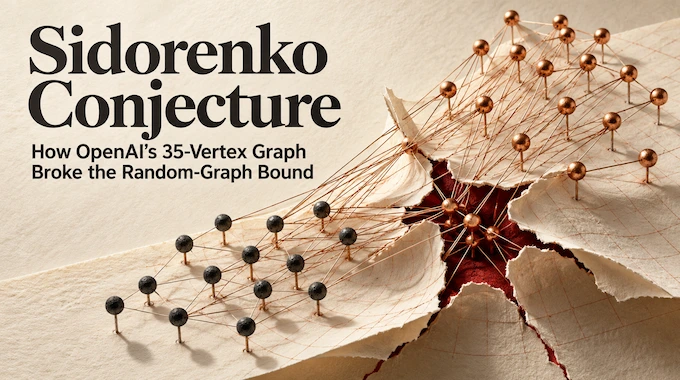
Glowing 35-vertex graph breaking through a glass floor, illustrating the Sidorenko conjecture counterexample

Randomness was supposed to set the floor. For every bipartite pattern, the Sidorenko conjecture predicts that a graph with a given edge density contains at least the pattern density supplied by a uniformly random model. OpenAI’s manuscript claims that a carefully arranged graph can slip beneath that floor. The proposed Sidorenko conjecture counterexample has 35 … Read more